Additional Accompaniments to Bach's and Händel's Scores
Durch. KÜnstlerische Gestaltung.”
HEINRICH HEINE : SchÖpfungslieder.
IT is both fortunate and unfortunate that people in general have got into the habit of regarding Bach and Händel with a rather careless admiration. Those great names are too often treated with mere after-dinner-speech complacency. This is fortunate in so far as the admiration, if careless and of somewhat second-hand quality, is after all of a respectful character, and offers no opposition to whatever serious attempts may be made towards doing real honor to the great composers’ works; but unfortunate as it tends to induce a too lukewarm interest in the painstaking study of what is most to be cherished in the rich legacy of music bequeathed to the world by Bach and Händel, without which study our appreciation of its full worth is unintelligent and undiscriminating. Although the astounding development which purely instrumental composition has undergone at the hands of Haydn, Mozart, Beethoven, and others may seem to throw the instrumental works of Bach and Händel into the shade, it must be recognized that in the department of vocal composition the world has produced very little that can bear comparison with their monumental oratorios and cantatas. It seems strange, at first sight, that, while we can bring about an excellent performance of so huge a score as that of Berlioz’s Requiem, with its four supplementary orchestras of brass instruments, eight pairs of kettle-drums, and all its imposing vocal and orchestral panoply, we stand utterly impotent before so apparently simple a work as Händel’s Theodora. In the former case it is a mere question of good-will, orchestral resources, and money; in the latter, a question of something far more difficult to procure. In looking over the pages of a Bach or Händel score, we are surprised at the apparent meagreness of the instrumental portion. While the voices are treated with all the elaborate care that was characteristic of the composers’ day, the instrumental accompaniment seems to have been unaccountably neglected. In some places the orchestral accompaniment is worked out with the same elaborateness as the vocal parts; in others we find little or nothing more than an instrumental bass to support the voices. But upon closer inspection we find that this bass is in most cases accompanied by a curious series of Arabic numerals, which were evidently not put there for nothing. In fact, both Bach and Händel were in the habit of writing a great part of their music in that species of short-hand known to the initiated as a figured bass. Wherever there seems to be a lack of instrumental accompaniment in their scores, we may feel sure that the bass contains the germ from which this is to be developed. This bass is called the continuo or basso continuo, and until it is developed into full harmony, unt il the frequent gaps in the score are filled out, anything like an adequate performance of the work is out of the question. In the composers’ time, this filling out was in all probability done by themselves, or under their direction, on the organ or harpsichord. The organist played either directly from the continuo itself, or from an organ part prepared from it. All passages which the composer did not intend to be played in full harmony were marked tasto solo ; the other portions were usually elaborately figured, that is, the harmony was indicated by figures written under the continuo. In some instances the figuring was omitted, the choice of harmony being then far more problematical. It is generally supposed that in such cases the composer intended to play the organ himself, or else that, although the figuring is not to be found in the score, it was written down by the composer in the separate part the organist was to play from, and has been since lost. It will be easily seen that the manner in which Bach’s and Händel’s continuos are worked out is by no means a matter of indifference, inasmuch as a very vital and essential element in the music depends thereon. The subject has given rise to much discussion, which has to-day assumed the proportions of an actual pen-and-ink war. Musician after musician has tried his hand at working out the continuo in many scores of the old masters, with very varying success. To distinguish those parts which were actually written out by the composers themselves from the indispensable additions to the score made by other hands, the former are called “original parts;” the latter are generally known by the name of “ additional accompaniments.” The violence of the discussion on the subject of additional accompaniments now going on in Germany, and its direct bearing upon the all-important problem of how to insure a correct and adequate performance of Bach’s and Händel’s vocal works, makes it interesting to see how the two present contending parties arose.
It must be borne in mind that, as far as the familiarity of the public with Bach’s works is concerned, Sebastian Bach is practically a more modern composer even than Beethoven. By this is meant that the public recognition of his works is of much more recent date. For a long period, during which the works of Haydn and Mozart had become familiar as household words, and Beethoven— yes, even Weber, Mendelssohn, and Schumann — was very generally known and admired, Sebastian Bach was known only by name except to a very few choice spirits. Organists knew his organ works, and his Well-Tempered Clavichord had been more or less studied by musicians; but his oratorios and cantatas were almost unheard of. How hard Mendelssohn and one or two other men worked to bring the public at large into direct relation with some of Bach’s more important compositions is well known to every one. The task was a severe one, as almost all of Bach’s vocal works existed only in MS. Mendelssohn succeeded, however, in having the St. Matthew-Passion brought out in the Thomas-Kirche, in Leipzig, — the very church in which Bach had held the position of organist, — and in bringing one or two of his orchestral suites to a performance at the Gewandhaus. The annual performance of the Passion Music on Good Friday soon grew to be a fixed institution. A large portion of the public all over North Germany got to regard this work with peculiar veneration. The St. John-Passion was also given annually at another church, the PaulinerKirche, but it was not so generally admired as its mighty companion. The Gewandhaus orchestra continued playing the D-minor suite, more as a matter of routine than anything else, for their audiences were hugely bored by it. The fruits of Mendelssohn’s strenuous endeavors in the cause of Bach were practically limited to this. Few persons knew, and still fewer cared, about the existence of some three hundred church cantatas from the pen of the great master. Surely, very few indeed suspected the fact that these cantatas were one of the most precious mines of musical riches that the world ever possessed. It was not until some time after Mendelssohn’s death that the world at large began to learn anything about them. With Händel the case was somewhat different. Although his works have never, to this day, won anything like general popularity in Germany, the few musicians and musical savants who were interested in Händel took more active measures to have his oratorios publicly performed than the Bach lovers did, on their side; witness the great preponderance of Händel’s vocal works, which had been supplied with additional accompaniments, over works by Bach, for which similar things had been done, in Mendelssohn’s time. Many completed scores of Händel (made by Mozart, Mosel, and others) were ready for use by choral societies, while almost nothing of Bach existed in a performable shape. The violent discussions between “ Bachianer ” and “ Händelianer,” about which the world has since heard a good deal, interested only the parties actively engaged in them; the outside world cared nothing about the whole question. It was indeed impossible that any general enthusiasm should have been felt on the subject at a time when new works by Mendelssohn and Schumann were continually making appeals to public interest; when Weber was exciting every one’s attention, and Richard Wagner was beginning to stir up all the musical elements in Germany into astonished, chaotic strife by his music-dramas and theoretical pamphlets. Yet the true Bach and Händel lovers were not idle. Three years after Mendelssohn’s death several musicians and men interested in the cause came together in Leipzig, to debate upon the practicability of publishing a complete edition of the works of Johann Sebastian Bach. They decided that this undertaking could be carried out only by subscription, as the demand for such music in the market was virtually null. Accordingly the now well-known Bach Society 1 was formed, the chief founders of which were C. F. Becker, the firm of Breitkopf und Härtel, Moritz Hauptmann, Otto Jahn, and Robert Schumann. The edition was to be published by Breitkopf und Härtel. The matter must have been taken up with a good deal of energy, for on the 18th of July, 1850, — the centennial anniversary of Bach’s death, — an official circular soliciting subscriptions was sent out over Germany. Subscriptions came in quite rapidly, and among a host of names on the list we find especially prominent those of Franz Liszt, I. Moscheles, Louis Spohr, and A. B. Marx. The first volume, containing ten church cantatas in score, appeared in December, 1851. A list of the then existing subscribers was printed with the volume, classified according to their places of residence. It is interesting to note in this list, under the head “ Boston,” the single American name of “ Herr Parker, J. C. D, Tonkünstler.” The society has since that time continued publishing volume after volume, and the edition has at the present date attained its twenty-fourth volume. But in spite of these labors of the Bach Society, which were, after all, prompted by an archæologicohistorical rather than a purely musical interest in Bach’s works, the general love for Bach kept pretty much in statu quo. Some years after the appearance of the Bach circular, another organization was formed, namely, the Händel Society, for the purpose of publishing a complete edition of Händel’s works. It was conducted on precisely the same principles as the other body, and the edition was published by the same firm. The first volume, comprising the dra-
matic oratorio of Susannah, appeared in October, 1858. That far more vital musical interest in its task was felt by this organization than by its fellow society is evident from the fact that, in its edition, all the orchestral scores of Händel’s vocal works are accompanied by a carefully written-out part for organ or piano-forte, in which the bare places in the score are filled out according to the figured basso continuo. In the Bach edition there is nothing of the sort, but only the incomplete score, just as the composer left it. Thus, while the Bach Society gave to the world an edition of that master’s works which was historically valuable, and only that in so far as the vocal scores were concerned, the Händel Society took active measures to make the vocal scores in their edition available for actual performance by choral bodies. The champion of the latter society was Friedrich Chrysander, a man who had always assumed the attitude of an almost exclusive admirer of Händel, and who, in his writings, rarely let a chance slip of saying something invidious about Bach. Chrysander had much more prestige as a musical authority than any man on the Bach side. Another man was G. G. Gervinus, who, although not a musician in any way, had somehow got bitten with the Händel mania, and allowed his admiration for Händel to expand into all the implacable bigotry of an amateur. As most of Händel’s vocal works were originally written to English words, Gervinus was of great service to the Händel Society in furnishing them with German translations for their edition. That a man like Gervinus should have been willing to wade through the unspeakable balderdash of many of the texts of Händel’s oratorios, and diligently turn it into rhymed German, is a good proof of the strength of his enthusiasm. The most actively prominent Bachite was Philipp Spitta, a school-master in Eisenach. As Chrysander had the peculiar failing of not being able to keep from defaming Bach, Spitta could never be dissuaded from indulging in similar flings at Händel; so the two men were continually at swords’ (or pens’) points. Their animosity reached its climax when Spitta came to Leipzig, a few years ago, to deliver a course of lectures on Bach. How long this state of affairs might have lasted, if a third element had not been introduced into the discussion, no one can tell. But a third element was very soon introduced in the person of Robert Franz. Franz had, for some time past, been attracting considerable attention by his additional accompaniments to several scores of Bach, Händel, Durante, and Astorga. Now Chrysander felt rather as if he himself, the noted biographer of Händel, and one of the most influential members of the Händel Society, had, or ought to have, something like a monopoly of knowledge on the subject of filling out Händel’s continuos; in like manner, Spitta felt that he, the biographer of Bach, and the well-known Back student, knew all that was to be known about writing additional accompaniments to Bach’s scores. About the manner in which this was to be done both men essentially agreed, if in nothing else. Franz believed that he, although neither an archæological pedant, necrologist, nor school-master, but merely a hard Bach and Händel student, and a highly cultured musician with a decided spark of genius, knew rather more about the æsthetic side of his favorite masters than either Chrysander or Spitta, who, with all their labor, may be said to have sounded those mighty heads only wigdeep at best. He also showed in his work that he differed widely in opinion from Chrysander and Spitta on some very vital and essential points. So he came in for a sound rating (through the medium of printing-ink) from both those literary lights. But Franz, although the most modest and naturally inoffensive mortal alive, was not the man to shirk an encounter in which the honor of Bach and Händel was at stake; being also a man of no mean literary ability, he answered back, calmly but firmly, and with such effect that his opponents’ wrath fairly reached the boiling-over point. There was evidently nothing to be done but to make common cause against the common enemy. Accordingly Chrysander and Spitta shook hands, swearing eternal alliance; Bachianer and Händelianer fused, as the politicians say. The Leipziger Bach-Verein (Bach Union) was formed on the most violent anti-Franz principles. This association had for its object not only the editing of many of Bach’s choral works in pianoforte and vocal score, with a complete organ accompaniment, worked out from Bach’s figured continuo, to be used whenever the works in question were performed, but also the public performance of those works by the best choral and orchestral means that Leipzig afforded. So the pen-and-ink war was no longer between Bachianer and Händelianer, about which of the two was the greater man, —a rather foolish bone of contention, at best, —but between Robert Franz and the Leipzig Bach Union, as to the manner in which the necessary additional accompaniments to Bach’s and Händel’s (but more especially the former’s) vocal scores should be written. The contest, as has been said, has by this time got to be a particularly fierce one, both parties indulging in personalities and mutual recriminations to a lamentable extent. Be it said, however, that, as far as Franz is personally concerned, he has expressed himself with a noble moderation in all he has written. The most notable sympathizers with either party are, on the Franz side, Julius Schaeffer (who may be regarded as Franz’s official mouthpiece), Joseph Rheinberger, and Franz Liszt; on the side of the Bach Union, Johannes Brahms, Joseph Joachim, and several others. The Bach Union represents the conservative, archæologicohistorical element, and Franz the progressive, artistic one. There seems to exist considerable divergence of opinion on many points among some of the influential members of the Bach Union itself; one of them, Franz Wülluer, may be regarded as to all intents and purposes a sympathizer with Robert Franz. In his additional accompaniments to the cantata “ Jesu, der du meine Seele,” he has followed Franz’s method in all essential points. How it happens that the Bach Union can have permitted this arrangement to be embodied in their edition is not wholly clear. There are also many prominent musicians who sympathize wholly with Franz, but who take no active part in the controversy. The first publication of the Bach Union appeared in 1876. It contained the cantatas, “ Sie werden alle aus Saba kommen,” arranged by A. Volkland; “ Wer Dank oppert, der preisset mich,” arranged by H. von Herzogenberg, and “Jesu, der du meine Seele,” arranged by Franz Wüllner.
Having thus seen how the famous Bach and Händel controversy arose, it is now time for us to examine into its merits.
The question of how additional accompaniments are to be written to Bach and Händel scores is really a double one. The first and more important is in what style the filling out of the figured continuo is to be done; the second is upon what instrument, or instruments, the added parts are to be played. This second question seems of easy solution at first sight; the almost universally accepted tradition being that the composers themselves used the organ, and in some cases the harpsichord or spinet. But there is, notwithstanding, a great difficulty in the matter. The majority of Händel’s vocal works are either concert compositions or else dramatic works, which the great change in the art of dramatic musical writing since his time has driven from the stage, and which our modern taste can find acceptable only in the concert room. Bach wrote mainly for the church; but the altered fashions of our day make the availableness of his church cantatas for purposes of divine worship very questionable; at all events, they could be used only in the German Lutheran church service. Bach’s oratorios and cantatas come to-day as much within the domain of the concert room as Händel’s works. Now the number of concert halls in the world which possess an organ is exceedingly limited, so that the enforced use of an organ in these scores would shut the doors of many choral societies upon them at once. But more of this farther on; let us consider the more important and vital question first. How is the figured continuo to be worked out? There are many opinions on the subject. That something needs to be done, even in those scores in which there is no figuring to the continuo, is agreed by every one. Bach and Händel never showed the slightest symptoms of being of the opinion that a melody and bass are all that is necessary in music. Jean Jacques Rousseau advocated this strange theory, saying that a truly æsthetic ear takes more pleasure in divining the harmony of a composition than in actually hearing it; but Bach and Händel had minds of a different stamp. As for the working out of these masters’ figured (or unfigured) basses, some persons have thought that “the greatest possible neutrality in the filling out ” is, above all things, desirable; in other words, that the additions should be as inconspicuous as possible. These are the archæological extremists. Others have felt less scruples, saying that one need only have a clear insight into the A B C of the matter (that is, of writing harmony to a figured bass, or, as it was called in Händel’s time, — mark the expression,— the art of accompanying) to be able to do all that is needful in any case; that every skillful musician, even every musical amateur who has some knowledge of the theory of the art, cannot fail to find the right path and walk securely in it. What the “greatest possible neutrality in the filling out” means is not hard to guess. It evidently means that the figured continuo should be filled out in plain harmony,—what the French call accords plaqués. Now one thing is clear: if this added harmony is to be “neutral,” it must be neither actively consonant nor discrepant with the spirit of the instrumental and vocal parts which the composer actually wrote; it must neither help nor hinder them; it must have no individuality of its own; in short, it must be a sort of musical tertium quid, not to be very easily defined. It is a little strange, however, that we may look through all Händel’s and Bach’s vocal works without finding an instance of their having treated a single item in their compositions as “ neutral.” On the contrary, every voice, every orchestral part, is instinct with life, every instrument has something of vital importance to say. It may be retorted, with Some show of speciousness, that, admitting this musical vitality to be found in everything that Bach and Händel actually wrote out, there is no direct evidence that they intended their mere figured basses to indicate anything of the sort; and that if they had intended the gaps in their scores to be filled out in a purely polyphonic style — that is, a style in which every part is vitally important — they would not have left those gaps there at all, but would have filled them out themselves. Of circumstantial evidence in this particular there is naturally none, or the question could never have come up. But the internal evidence is very strong. In the first place, the style of writing in which certain instrumental parts are used merely to fill up gaps in the harmony, or simply for the sake of enriching the quality of tone, without adding anything to the essential musical structure of the composition, was entirely foreign to the spirit of Bach’s time. This style cannot be traced back farther than Mozart, Haydn, and Gluck. Bach and Handel may be said to have lived in a purely polyphonic age; in a time when everything that was not absolutely essential in music was looked upon as superfluous, and hence inadmissible. To understand why they should have been content merely to indicate certain things in their scores, and that, too, in a way which was open to great latitude of interpretation, we must understand something of the musical habits of their day. At that period the “art of accompanying ” did not mean the art of playing or conducting an already elaborated instrumental accompaniment to one or more singers or solo players. It meant the art of deciphering — either at sight, or after some practice — a figured bass on the organ or harpsichord. This art was very generally cultivated, and no one was considtered a competent organist or clavecinist who had not attained to a high degree of proficiency in it. More than this, an organist was expected to be able not only to decipher a figured bass correctly and freely at sight, but to extemporize contrapuntally upon a given theme. A significant fact in this matter is that we find that certain famous singers in London stipulated especially, in their contracts with managers, “that Mr. Händel should play the accompaniments; ” that is, that he should preside at the harpsichord or organ, and decipher the figured continuo. Now it is hardly likely that, at a time when there were so many instrumental virtuosi in London, such stress should have been laid upon Händel’s accompanying if it had been only a question of technical executive talent. No; it was because Händel filled out a figured bass better than other artists. If this filling out were to be done merely in correct plain harmony, there would have been small chance for Händel’s shining perceptibly superior to other artists, at a time when the next best organist was perfectly competent to do as much. But if the continuo was to be worked out in pure polyphonic style, in imitative counterpoint, we see at once how Händel could easily distance less gifted virtuosi than himself. Indeed, it is reported that to hear Händel or Bach play from a figured bass was like listening to a brilliant organ concerto. In the second place, we find by experiment that, in by far the majority of cases, the effect of mere plain harmony (accords plaqués) in conjunction with the parts actually written out by Bach and Händel is unsatisfactory if not downright bad. The contrast between Bach’s and Händel’s freely moving parts, so full of glorious life and vigor, and the heavy, sluggish chords is too marked; the " accompaniment ” hangs like a millstone round the neck of the brilliant counterpoint, or else it so muffles and chokes it that it loses half of its charm. It is like filling out the space between the beautiful head and limbs of some incomplete antique statue with mere shapeless ashlar. The head and limbs do better without it. There are even passages which absolutely defy simple harmonic treatment. Take, for example, the following measure from the bass air in Bach’s cantata, “ Sie werden aus Saba alle kommen.”
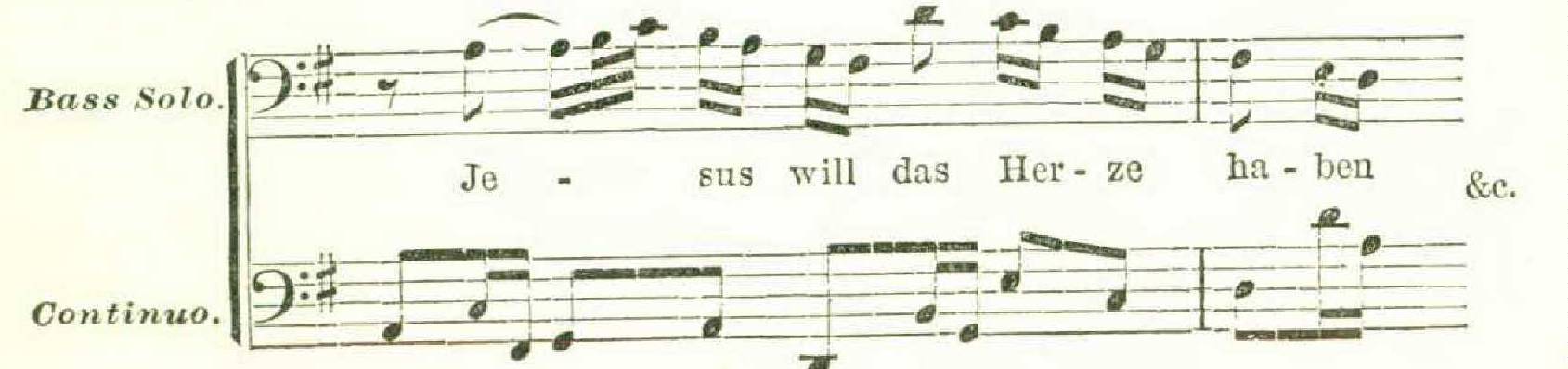
Try to fill out the accompaniment in plain chords, and see what the effect will be. Franz evidently felt this difficulty when he wrote it out thus:
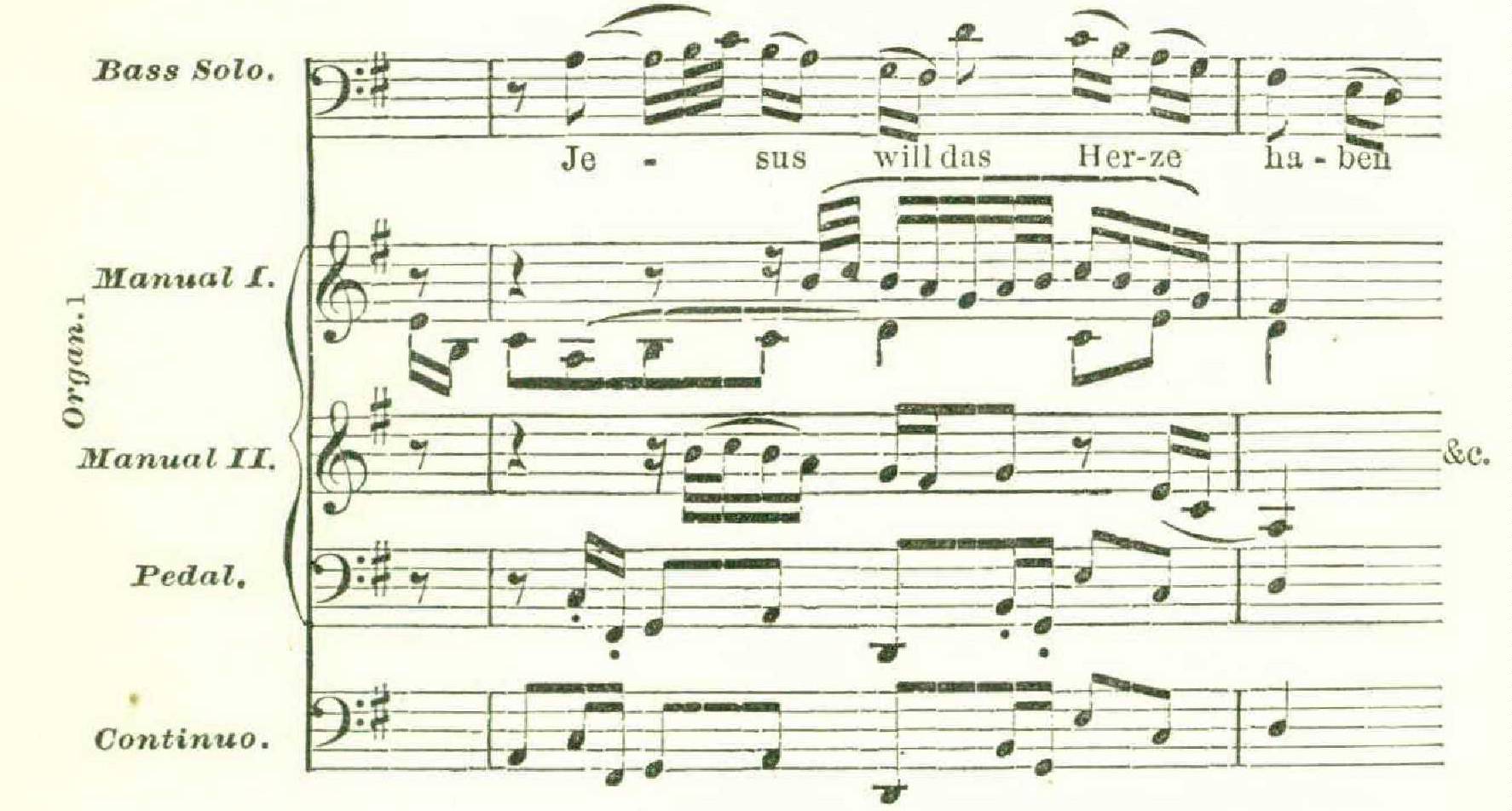
Were it worthwhile, I might also quote the Bach Union version of this measure, which Schaeffer has very justly characterized as sheer harmonic nonsense.
No, Franz is clearly right when he says that the greatest possible neutrality in the filling out must necessarily lead to a want of character. A mere harmonic accompaniment will be irksomely conspicuous by its very neutrality. Even the Bach Union have found it impossible to adhere exclusively to this principle, and the co-workers of the Händel Society have found its unstinted application equally out of the question. A vital polyphonic style is requisite, and through it alone can the gaps in Bach’s and Handel’s scores be so filled out that the contrast between the original parts and the additional accompaniments shall not strike the ear as ungraceful and unmusical. The truth of this was most clearly perceived by the greatest, and to all practical purposes the first, musician who tried his hand at filling out an incomplete score, — a man whose name carries such weight with it that the present archæologicohistorical party have always carefully omitted it in their discussions. I mean Wolfgang Amadeus Mozart. In his time the mighty question of additional accompaniments had not set so many wise and foolish heads wagging as it has since. In working out the scores of Händel’s Messiah and Alexander’s Feast he had only the dictates of his own fine musical instinct to follow. The style in which he completed the accompaniments to the airs, “ O thou, that tellest good tidings to Zion,” and “ The people that walked in darkness,” is to be looked upon as the model for all such work. It is curious to notice how differently the Leipzig historical party face, on the one hand, a discussion that deals with pure abstractions, and, on the other hand, a definite musical fact, especially when the latter is backed up by the prestige of a great name. In the former case they are as bold as lions; in the latter — Mum ’s the word! What explanation can be given of the very singular fact that, among the thirty-eight volumes of Händel’s works already published by the German Händel Society, the Messiah is not to be found? Does it not seem as though Messrs. Chrysander & Co. felt that an accompaniment to the Messiah, written out on their principle, could not stand for a moment in face of Mozart’s score; and that to embody a piano-forte or organ transcription of Mozart’s score into their edition would be virtually to deny the soundness of their principles? The fact that there is much that is unsatisfactory in Mozart’s score is not worth a jot, seeing that in just those passages where Mozart has been most successful in making his additional accompaniments blend harmoniously with both the spirit and the letter of the original parts, so that both Händel’s work and his own seem to have sprung from the same source, and no ear can detect which is Händel and which Mozart, in the two airs just referred to, he has worked out the continuo in the very freest and most elaborate contrapuntal style.
In so far as clear insight into the A B C of the matter is concerned, it is not hard to see that this is quite too flippant a way of settling a very grave question. Franz holds, with perfect truth, and it cannot be said too often nor too emphatically, that additional accompaniments are quite as capable of weakening and distorting the original as they are of ennobling and adorning it. Verily, the task of filling out adequately Bach’s and Händel’s vocal scores is not one to which the musical tyro, nor even the merely learned contrapuntist, can safely feel himself equal. To the modern musician, brought up in the midst of music of a post-Händelian period, and strongly imbued with the art tendencies of our day, it is the most difficult task in the whole range of music. I say this circumspectly, and with full conviction. Let me repeat here that unless Bach’s and Händel’s figured or unfigured continuos are adequately filled out, their vocal works are in no fit condition to be performed. Let it be understood most distinctly that to perform such compositions with only the “ original parts,” and without additional accompaniments of some sort, is to commit the greatest conceivable act of unfaithfulness; it is presenting the works of those masters in a totally wrong light, and should not be tolerated for a moment.
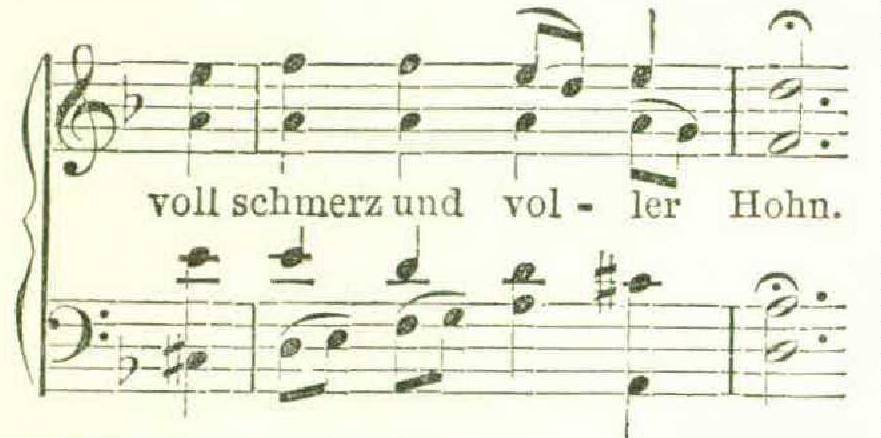
But to proceed with our subject. The fact that the perfectly free, melodious, and expressive movement of each part in the harmony was one of the prime characteristics of Bach’s style, even when nothing like fugued writing was in question, seems to have escaped many of his arrangers. Yet this is not only an evidence of Bach’s supreme skill in polyphonic writing, but is one of the means by which he gave expression to some of his finest and most beautiful poetic conceptions. Speaking technically, the bass with him contained the germ from which a composition was to be evolved, rather than that part which we, in modern parlance, call the melody. Of all the parts lying above the bass, the “ melody ” was, at most, primus inter pares. In his vocal works, where the music naturally seeks to give expression to the sentiment of the text, we often find that what we now call the poetic essence of the music lies in the middle parts (alto and tenor), or in the accompaniment. This is peculiarly noticeable in his chorals, where the middle parts move with the most absolute freedom, and nothing of that timidly restricted leading of the voices which is advocated in elementary manuals of harmony is to be found. Take, for instance, the following phrase in the choral “ O Haupt voll Blut und Wunden:—
and further on in the same:—
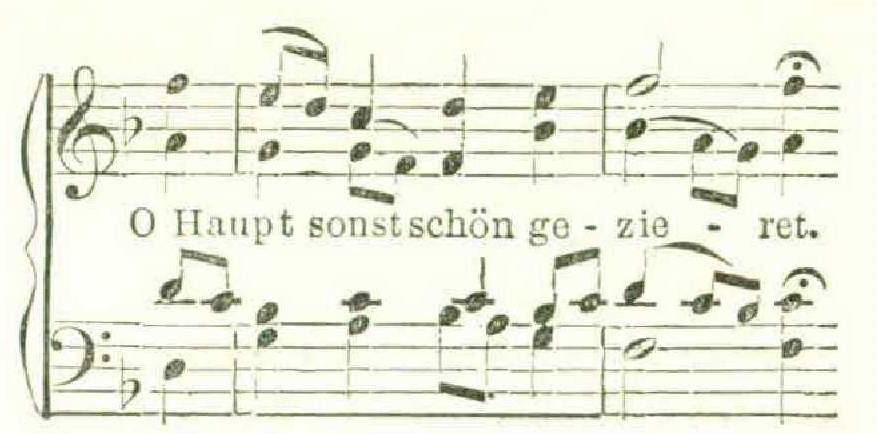
What a plenitude of grief the tenor brings into the harmony at the word Schmerz (grief)! What can be more expressive of mental anguish than the suspended E in the tenor, making, as it does, the grating dissonance of a minor ninth with the upper voice? In the following passage, “ O Head, once beautifully adorned,” the wondrous glow of light, shining like a halo around the divine head, at the word gezieret, is due wholly to the leading of the alto and tenor voices; again, in the choral ‘‘Ich bin’s, ich sollte büssen ” (the melody of which is commonly known as ‘‘Nun ruhen alle Wälder ”), where the last two verses are, “ The scourging and the bonds that thou hast undergone, them has my soul deserved,” with what loving, sorrowful penitence is the tenor voice instinct in the last line! —
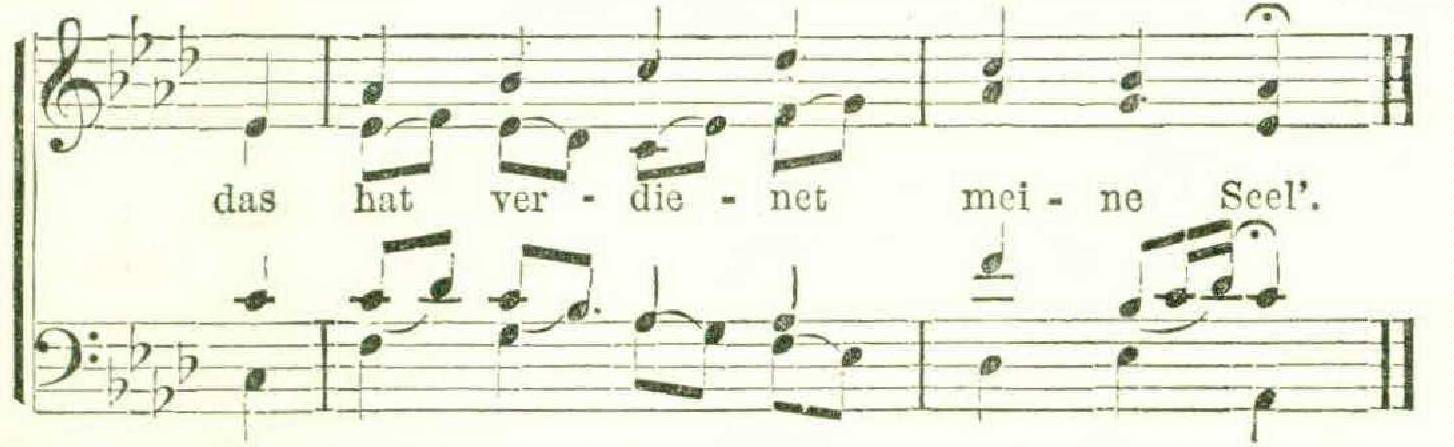
Franz has given abundant proof of his thorough appreciation of this characteristic of Bach’s style. Of his skill in reproducing such effects — effects is an unpleasant word, but let it pass — the following passage from his arrangement of the Saba cantata is a fine example. The words are, “ So accept it ” (that is, my heart) “ graciously, since I can bring nothing nobler.”
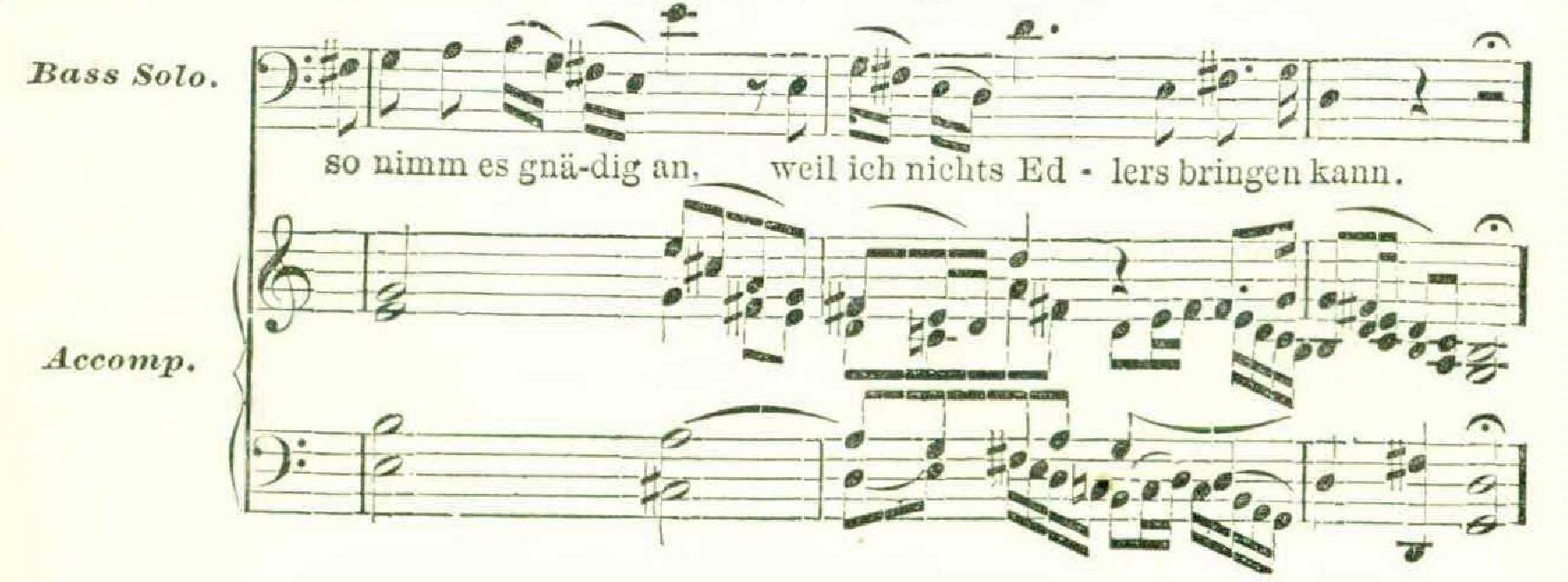
Here Franz had only the voice part and the bass (this time unfigured) to work from; but what an admirable piece of work he has made of it! It sounds as if Bach himself had done it. How joyfully the accompaniment soars up at “accept it graciously” (in this place the Bach Union edition has a diminished seventh chord, which sounds as if the supplicant were performing some painful surgical operation upon his heart, or else were invoking the powers of darkness), and how humbly it bows down to prepare for the words “since I can bring nothing nobler ”! How full of reposeful trust in the acceptance of the offering is the descending closing cadence! I have hinted that the Bach Union arrangers, and some others too, had sounded Bach’s head only wig-deep; as for diving down to the great, bounteously loving heart of him, so full of tender piety and child - like trust, that seems to have lain as far as possible from their thoughts. Concerning the mere grammatical errors (Schulfehler), such as rank fifths and octaves, hideous harmonic progressions, and what not, made by men of no mean repute as musicians, in filling out his and Händel’s continuos, things that would expose any scholar in a harmony class to summary correction, I can only refer the reader curious in such matters to the thirtysecond volume of the Händel Society, containing the famous Italian Chamber Duets and Trios, with accompaniments worked out by Johannes Brahms and Joseph Joachim, and the Bach Union edition of the cantata “ Wer Dank opfert, der preisset mich,” 2 with the accompaniment arranged by H. von Herzogenberg. Both of these publications will give ample food for serious meditation on the condition of the art of music at the present day.
Having discussed the manner in which the additional accompaniments to Bach’s and Händel’s scores are to be written, the next question is, Upon what instrument, or instruments, are they to be played? Difficult of solution as the first question was, this one is still more so. Indeed, it has not yet been solved to the reasonable satisfaction of any one. If we look at the matter from a purely historical point of view, the fact stares us in the face that, in all probability, Bach and Händel used the organ and harpsichord. So far as the latter instrument is concerned the sound of a piano-forte (which is the modern equivalent of the harpsichord) in combination with the orchestra, the contrast between its short, sharp notes and the sustained tones of the voices and other instruments, is peculiarly ungrateful to the modern ear; so much so that anything more than a very sparing resort to it is to be deprecated. For let us not lose sight of the fact that, in filling out old scores, the main desideratum is to preserve the spirit of the original works, which is in general far more dependent upon purity of musical outline than upon mere effects of quality of tone. In this particular Bach’s and Händel’s works differ diametrically from the greater part of the music of the present day, which is to an overweening extent dependent upon the sheer physical (what Hanslick calls the pathological) effect of strongly contrasted, harsh, mellow, powerful, or sensuous qualities of sound. If archæological accuracy were the only object in view, the piano-forte, or even the old harpsichord or spinet, could certainly be largely employed for purposes of accompaniment; but this would result, in most cases, in a mere quaintness of sonority (to our ears), utterly at variance with the purposes of the music. What we should have most at heart is to enable the music to produce, as far as practicable, the same effect upon our organization that it did upon the listener of the day in which it was composed. Who would wish the broad stripes of bright paint, which antiquaries tell us once adorned the Ægina marbles, restored? What æsthetic end would be gained by it? The use of the piano-forte in Bach and Händel scores would be a piece of historical accuracy of very much the same artistic value. As for the organ, I have already hinted at one objection to its use; but as that objection is based merely upon the ground of the scarcity of organs in concert rooms, and has no direct bearing upon the musical side of the question, it cannot be considered as final. In fact, the whole question is at present in such an undecided condition that it is not worth while to go into it here at great length. I will only give some significant facts. The historical party are naturally in favor of the organ, and the organ only; their claim to the title of historical party rests mainly upon this preference. That Bach and Händel used the organ is not to be questioned; but where, how, and how much they used it is by no means so certain. In Bach’s case it is not even certain why he used it; that is, whether he used it entirely from preference, or partly from necessity. Bach wrote his church cantatas at very short intervals, and copied out many of the parts himself. It is easily conceivable that he was often much pressed for time, and seized upon the make-shift of a figured bass, to be played upon the organ, either by himself or under his own supervision, simply to save time. The lack of proper orchestral means may have been another reason. The following quotation from the preface to the first volume of the Bach Society throws some light on this matter: “While Händel brought out his sacred compositions by means of elaborate concert performances, with large masses of the best-drilled executants, in a metropolis where a numerous public were interested to pass judgment upon them, S. Bach3 wrote solely for the church service, and had at his disposal but very limited means of performing his music for Sundays and holidays. Judging from what we know of the demands made by Bach upon his executants, the performance cannot have always been a euphonious one, much less such a one as could reveal all the intrinsic wealth of the composition. Even if the choir, well trained to sing with precision, was fully equal to its task, it is hard to believe that the solo singers could have been equally competent to grapple with S. Bach’s airs, —.those airs of which the peculiar and not always convenient vocal style is to be mastered and rendered with musical freedom only by finished artists. . . . Among his MS. parts for strings and chorus we never find more than a single copy for each voice or instrument; the chorus parts also contain the solo passages for their respective voices. From this fact alone it might be concluded that both stringed instruments and chorus singers at these performances were very few in number; and a MS. letter of Bach, still preserved in the archives of the Leipzig common council, containing complaints of the insufficient means offered him for performing his church music, together with an enumeration and description of the same, leaves no room for further doubt on this head.” Another fact to the point is that in Bach’s and Händel’s day such a thing as a conductor, marking time with a bâton, was unknown. The organist led the performance. In Philip Emanuel Bach’s treatise on the art of accompanying, we find: “ The organ is indispensable in church matters, on account of the fugues, the loud choruses, and in general for the sake of establishing a firm connection [that is, between the various voices and instruments]. It increases the splendor and preserves order.“ Now it is one thing to use the organ as a reinforcing agent, to strengthen certain vocal or instrumental parts, and thus add power to the volume of sound; but it is quite another thing to use it as an independent element in a composition. It has been found that the organ loses much of its noble individuality in a rectangular hall; the irregular surface of walls and roof, the pillars and vaulted arches of Gothic church architecture, have much to do with the tone of this mighty instrument. On the use of the organ in connection with the orchestra, the following opinion of Berlioz (who may he considered a high authority in all matters connected with the effect of combinations of different qualities of sound) is of great value. He says, “ We must recognize the fact that its [the organ’s] even, equal, uniform sonority never blends perfectly with the variously characterized voices of the orchestra, and that there seems to exist a secret antipathy between these two musical powers. The organ and the orchestra are both kings, — or rather the one is emperor, and the other pope; their interests are too vast and too divergent to be confounded. Thus, on nearly all occasions when this singular combination has been tried, either the organ proudly domineered over the orchestra, or else the orchestra, forced to an immoderate pitch of energy, wellnigh extinguished its adversary.” The intrinsic incompatibility of the organ with the orchestra is peculiarly felt in the accompaniment of airs, and concerted music for solo voices, where there can certainly be no question of reinforcing weak parts. Of course, in such cases, only the softer stops can come into play; and just these stops so greatly lack decision of utterance and accent that their contrast with the orchestral instruments is especially unfavorable to the full effect of polyphonic writing. In the concert room, moreover, both organist and organ-pipes are at such a distance from the singer and the accompanying instruments in the orchestra that anything like a sympathetic performance is rendered well-nigh impracticable. There is good historical evidence for the belief, entertained by many persons, that both Bach and Händel accompanied many of the airs in their works on a Rückpositiv,4 or a Regal5 placed directly by the singer’s side. Franz has suggested supplying the place of an organ, in cases where that instrument is not used as a reinforcing agent, by a quartet, composed of two clarinets and two bassoons; in some cases, by the strings in the orchestra. The quartet of reed instruments has much the quality of tone of an organ, and has the advantage of a far greater power of accent and dynamic variety. These instruments are to be placed, together with a double-bass and ’cello, close beside the singer, and consequently directly under the conductor’s eye. This arrangement has proved eminently successful in many instances; in others, it is not so satisfying. The union of the second bassoon with the double-bass and ’cello, especially when the part runs low, often sounds thick and muddy. This difficulty might perhaps be obviated by substituting a bass clarinet for the bassoon in some passages, but I believe this has not yet been tried. At all events, it is well known that both Bach and Händel were not at all averse to a very solid bass to their works. But even if Franz has been unsuccessful in some passages,— for his surpassing skill in counterpoint and his fine musical instinct have nothing to do with his possible lack of knowledge in orchestration, —he and notably Mozart have been so thoroughly successful in many of their arrangements of Bach and Händel scores for orchestra without organ that the possibility of its being well and satisfactorily done has been convincingly demonstrated. But, upon the whole, this subject has not yet been made clear by sufficiently exhaustive experiments, and no one can have come to a rational final conclusion about it. It must also not be forgotten that this question is, after all, one of secondary importance. Whether a musical phrase is played on the organ or on a clarinet, it still remains one and the same phrase. Whatever opinion one may hold of the condition of the art of instrumentation in Bach’s and Händel’s day, it must be very evident to any one who takes the trouble to examine those masters’ scores that instrumentation per se was a far less integral element in the art of musical composition then than it is now. The prime question in this matter is, What shall be played? not, By what instruments shall it be played ?
William F. Apthorp.
- This Deutsche Bach-Gesellschaft (German Bach Society), which to-day counts among its members distinguished musicians and music-lovers all over Europe and in many parts of America, must not be confounded with the Leipziger Bach-Verein (Bach Union), a totally distinct society, which was organized much later.↩
- The two manuals are to be registered with contrasted stops.↩
- Published by Rieter-Biedermann: Leipzig und Winterthur. 1876.↩
- Bach is commonly known in Germany by his middle name, Sebastian.↩
- Rückpositiv (Ger.) a back choir organ ; that is, a choir organ which is behind the player, the connecting mechanism of which passes under his feet. (Stainer and Barrett’s Dictionary of Musical Terms.)↩
- The Regal was a small, portable organ↩