Pope's Virginia Campaign, and Porter's Part in It
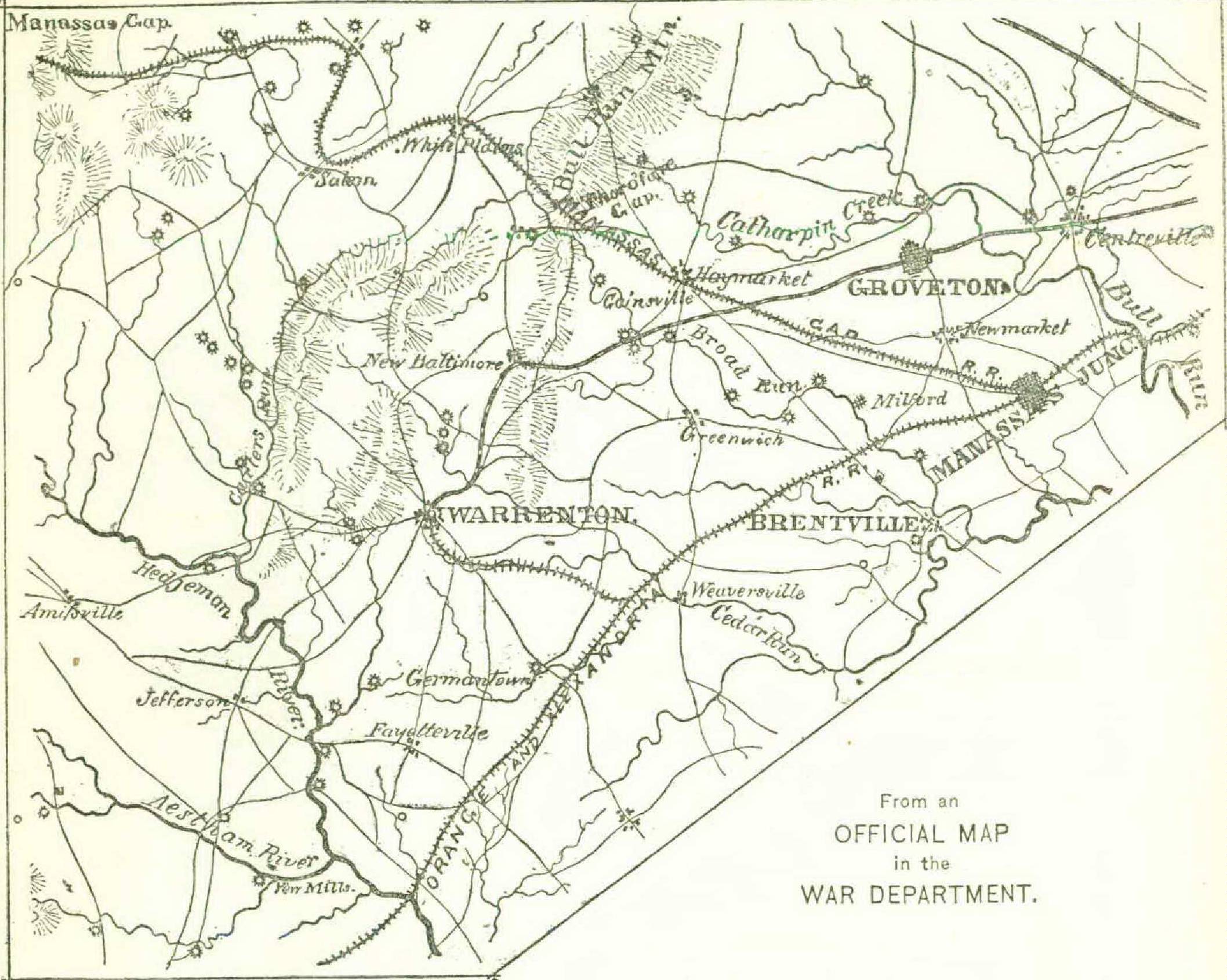
BY July, 1862, our efforts in the Peninsula had resulted only in disaster. After the failure of the attempt upon Richmond, a “change of base” had placed the nation’s principal army where it could not fire a shot to protect Washington from capture or the loyal States from invasion. As Richmond was no longer seriously threatened, there was nothing to prevent the march northward of a Confederate army of 90,000 men but a few scattered divisions in Northern Virginia, which could have made but a short and feeble resistance.
This dangerous situation was the result of the last of McClellan’s blunders in the Peninsula. When, after Fair Oaks, satisfied, right or wrong, that he was not strong enough either to march upon Richmond or to maintain his position, common sense, as well as military principles, required him to retire towards Hanover Court House, near the Richmond and Fredericksburg Railroad, for this would have been marching towards his reinforcements instead of away from them, and would have been interposing his army between Washington and the enemy, whose capital he would still threaten, while retaining his base at White House.
It took General Halleck the whole month of July to discover that no time should be lost in recalling the army for the protection of Washington, the first order for its return not being sent till August 3d, which would have been already too late but for the extreme caution of the Confederate commander.
Obviously, the first movement of our troops homeward from the Peninsula, Richmond being no longer threatened, would be the signal for the rush forward of the mass of the Confederate army; and our only chance of safety consisted in keeping this formidable force at bay till our Peninsular army should be transferred to its new field. This was the difficult task imposed upon General Pope, with a scattered force, to begin with, of 28,000 at the end of July, increased to 33,000 by August 12th, and to only 41,000 by August 14th. On the 15th Jackson began his march from Gordonsville. His command, including seventeen field batteries, was not far from 30,000 strong, and was the advance of an army of 80,000 men on its way to overwhelm Pope before McClellan’s forces could join. Longstreet, with 50,000, constituting the main body of Lee’s army, had left Richmond August 13th, and by the 16th had passed Gordonsville, only two short marches from the Rappahannock. The situation recalls Sir John Moore’s daring attempt to relieve his Spanish allies by throwing himself with his small column into the heart of Spain, within reach of a large French army under Napoleon himself, ready to crush him by superior numbers. There has seldom been a more trying position. Defeat and disgrace seemed certain, as three days would suffice for Lee’s concentrated army to rout our forces and possess itself of Manassas Junction, the key to Washington.
August 16th. Pope, having learned by the capture of a dispatch Lee’s intention to overwhelm him before McClellan’s arrival, retired behind the Rappahannock: his right three miles above Rappahannock Station, where the Orange and Alexandria Railroad crosses the river; his left at Kelly’s Ford, three miles below it, —thus covering the railroad, which was his line of communication and supply.
On the 18th he received a dispatch from General Halleck directing him to “stand firm on the line of the Rappahannock. " General Halleck, with more self-confidence than was ever displayed by Napoleon himself, had undertaken to direct the movements of our forces in the field from his cabinet in Washington; in a dangerous crisis, too, when the situation was changing every hour.
August 19th. Heavy columns were seen marching to our right. The enemy’s turning movement had begun.
August 20th. The pickets upon our extreme right were driven in, and the whole Confederate army was in our front, overlapping our right. Halleck, informed of this, merely instructed Pope to hold on to his communications with Fredericksburg; Pope suggesting in vain that his right might be turned, in which case he ought to throw himself on the enemy’s flank and rear.
August 21st. Pope reports a decided movement of the enemy to his right, and that he can no longer hold on to Fredericksburg. But Halleck persists in directing him to hold on, saving, “ In forty-eight hours more we can make you strong enough.”
August 22d. Pope telegraphs to Halleck: " Clear, enemy turning our right. No forces east of Stevensburg. All tending up river. Lee’s captured letter of 15th indicates this movement.”
At five P. M. “ Movement to our right all day. Will mass all at Fayetteville to attack his flank.” At 6.30 P. M. “ Everything indicates enemy marching to Warrenton by Sulphur Springs.” At nine P. M. “ Heavy forces moving up Hedgman’s River towards Warrenton.” At 9.15 P. M. “Enemy crossing Sulphur Springs, and on road from Sperryville to Warrenton.”
But Pope, in obedience to Halleck’s instructions, still waited for reinforcements to arrive from Fredericksburg before falling on Jackson’s flank.
The next day, Halleck telegraphed Pope “ not to expose his railroad communications with Alexandria.” Early that morning Sigel had reported that the enemy had positively outflanked us. Hampered by his instructions, Pope simply ordered Sigel to “ stand firm, and let the enemy develop towards Warrenton,” and threw forward McDowell a few miles towards Warrenton, which place his advance occupied that night.
August 24th. Sigel reported the enemy’s main body (under Longstreet) atJeffersonville, and his advance (Jackson’s corps) at Amissville: the advance “ consisting of thirty-six regiments, with the usual proportion of batteries, and considerable cavalry, seen marching in the direction of Rectortown, White Plains, Salem, and Thoroughfare Gap; the main body moving to our right.”
August 25th. Jackson’s corps, consisting of Jackson’s, Ewell’s, and A. P. Hill’s divisions, marched, covered by the Bull Run Mountain range, to Salem, where it arrived at midnight. Pope, having heard through McDowell that the enemy was at White Plains, moving to Thoroughfare Gap, gave orders for massing his troops, including those expected from Alexandria, at Warrenton, Warrenton Junction, and Manassas Junction; the cavalry (a mere handful effective) then at Manassas Junction to push forward to “watch” Thoroughfare Gap. He had then been reinforced by Reynolds’s 2500 Pennsylvania Reserves, and by Kearney’s division of Heintzleman’s corps; making his total effective strength about 45,000.
August 26th. Longstreet, with the enemy’s main body, marched from Jeffersonville to join Jackson. Meanwhile Jackson marched from White Plains, through Thoroughfare Gap, by Haymarket and Gainesville. He was joined at Gainesville by the Confederate cavalry under Stuart, who accompanied him to Bristoe Station, seven miles southwest of Manassas Junction, where he arrived at sunset. At eight P. M. Pope was still of the opinion that the fight should be made at Warrenton; but that same night he heard of the enemy’s passage of Thoroughfare Gap. Meantime he had been reinforced by Porter’s corps and Heintzleman’s corps (Kearney’s division of which had previously joined), the two corps amounting together to 18,000 men.
August 27th. The next day Pope’s force, exclusive of Banks’s corps of 5000 left to bring up the trains, numbered about 49,000 effective, with only 500 cavalry fit for service. It was posted at Gainesville, Warrenton, Warrenton Junction, and on the railroad below Bristoe Station. McDowell’s and Sigel’s corps and Reynolds’s division were ordered to Gainesville, by which place Lee’s main body would have to pass to unite with Jackson; to be supported by Reno’s corps and Kearney’s division, directed on Greenwich. Porter, on being relieved by Banks, was also to march to Gainesville; McDowell’s column to reach Gainesville that night. At the same time Pope, with Hooker’s division, moved up the railroad after Jackson. That afternoon, after a sharp fight, Hooker drove Ewell from Bristoe Station, who then joined Jackson at Manassas Junction.
The same night, however, this programme was changed, Jackson, then at the Junction, becoming the sole objective point. McDowell, Sigel, and Reynolds were ordered to push forward from Gainesville, right on Manassas Gap Railroad, towards Manassas Junction, and Reno from Greenwich to the same point, as also Porter, Kearney and Hooker; McDowell’s column to attack Jackson before Lee’s main body should arrive.
August 28th. But Jackson did not wait to be attacked. Early the next morning he moved northward, by the Sudley Springs road, to the Warrenton turnpike, crossed the pike, and took up a strong position on some timbered land northwest of Groveton, his right on the pike, where he awaited Longstreet’s coming. Jackson had commenced his march from Manassas Junction in the direction of Centreville. So Pope pushed on to that place in pursuit of him, with Reno’s corps, which had arrived from Greenwich, and Hooker’s and Kearney’s divisions of Heintzleman’s corps.
If every part of Pope’s present programme had been carried out according to orders, Jackson would that day have been overwhelmed by twice his number. But it was just as well for us that Jackson did not await our attack; for half of our force would have been absent. McDowell’s column, of about 25,000 men, had been ordered to march from Gainesville by the railroad to the Junction early that morning; but Sigel, who was to lead, did not leave that place till the day was well advanced. At two P. M., Pope, having learned that Jackson was on the Warrenton road, ordered McDowell to march by that road towards Centreville, in order to intercept him. At six P. M., King’s division (under Hatch) of McDowell’s corps, which was the advance of his column, marching by this road, was attacked in flank by the whole of Jackson’s force, near Groveton. After a fierce combat, in which the division nobly held its ground against greatly superior numbers, it retired under cover of the darkness to Manassas Junction. Jackson prudently remained in the position he had chosen, not wishing to risk an engagement with forces whose numbers were unknown, of which this division was apparently the advance.
Again, though McDowell had been ordered to “ move with his whole force ” to the Junction, he had that forenoon taken the responsibility of detaching Ricketts’s division of his corps, without Pope’s knowledge, to seize and hold Thoroughfare Gap, which the enemy’s main body, under Longstreet, was now approaching in its march to unite with Jackson. Ricketts pushed rapidly forward, but arrived just too late. The enemy had taken up strong positions in the pass, and was already crowning the heights. Ricketts nevertheless commenced an attack which lasted till dark; when, the enemy marching through Hopewell Gap, three miles to his right, in large numbers, and his left being at the same time threatened, he was compelled to retire, with considerable loss. He rejoined the main body near Sudley Church by the evening of the 29th.
The result of all this was that both Thorough fare Gap and the road from it to Jackson’s position were left open to the enemy, who were pouring throught the Gap that night and the next morning.
August 29th. Early in the morning Jackson was still holding his position on the high ground northwest of Groveton, commanding the Warrenton turnpike, by which he was expecting Longstreet to join him. His right rested on the turnpike, his left was near the Sudley Mills, and his masses were sheltered in thick woods. Our own forces were still scattered. Sigel and Reynolds were near Groveton, to the east of Jackson; Reno’s corps and Hooker’s and Kearney’s divisions on the turnpike, between that place and Centreville; and McDowell and Porter at Manassas Junction. Hooker and Kearney, followed by Reno’s corps, were ordered to push forward to Groveton, join Sigel, and attack. McDowell and Porter were ordered to march to Gainesville. Sigel, with Hooker and Kearney, attacked Jackson’s left with such vigor as to drive it back several hundred yards to an unfinished railroad, crossing the turnpike obliquely northeast and southwest; behind the embankment of which, a ready-made parapet, Jackson’s line maintained its ground, substantially, during the whole day.
Meantime, the enemy’s main body had been rapidly advancing from Thoroughfare Gap, had entered the turnpike near Gainesville, and by noon, with the exception of Anderson’s division, was all in line on Jackson’s right. Its own right extended either to the Manassas Railroad, or to the south of it; its three right brigades, somewhat refused, and in echelon; the whole flanked by Stuart’s cavalry, thus barring our approach by the Manassas Railroad to Gainesville.
Towards noon Pope arrived on the ground from Centreville, and stationed himself at a point about half a mile north of the crossing of the Warrenton and Sudley Springs roads. Longstreet’s line was entirely concealed by wooded heights, and Pope did not dream, what was literally the fact, that he had in his front not Jackson’s corps alone, but (less Anderson’s division, not yet up) the whole Confederate army. Pursuant to orders, McDowell and Porter had begun their march from Manassas Junction to Gainesville. They halted at noon near Bethlehem Church, a little to the west of the Sudley Spring’s road, where, about one P. M., notwithstanding his orders, McDowell marched his own corps towards Groveton, but did not arrive there till towards sunset. Left to himself, Porter did not take the responsibility of a movement with his single corps which had been directed to be made by two corps; especially as he discovered a strong force of the enemy to be in front of him, which force could be no other than Lee’s main body under Longstreet, since Jackson’s corps was then in front of Pope, some five miles off. He therefore remained in position the rest of the day, with one division deployed, the other troops massed.
Porter’s judgment had not deceived him; for, as before stated, the road to Gainesville was covered by the right of Longstreet’s force, which was the main body of the Confederate army. The Confederate commander, seeing his right flank seriously threatened by what was evidently an army corps at least, reinforced it at once with three brigades drawn from his left, and with some guns. These brigades returned to their position in line about sunset. Though Lee had intended to bring on the general battle on the 29th, Longstreet was deterred from doing so by this deployment of force in his front, which apparently left him no available point of attack. Accordingly, Longstreet’s entire command remained in position the whole day, taking no part in the battle with Pope, except that, late in the evening, Hood’s and Evans’s brigades were engaged in repulsing an attack by King’s division of McDowell’s corps.
Our attack in the morning on Jackson’s left was followed by desultory artillery firing, attended with no effect; and afterwards by skirmishing at various points, more or less severe.
At 4.30 P. M., Pope still supposed that only Jackson’s corps was on the field, not knowing that Lee’s main body was at that moment in position on Jackson’s right, and held in check by Porter’s single corps. He therefore, very naturally, sent an order to Porter to move upon the enemy’s right and rear, keeping his right in communication with Reynolds (who was on the left of our line at Groveton), and using his batteries. This order did not reach Porter till 6.30 P. M.; that is, about sunset. He immediately made his dispositions to obey it. The ground did not admit of the use of batteries; but, what was still more important, it was impossible to keep his right, as directed, in communication with the left of our line at Groveton. He had already attempted to communicate with McDowell, then on his march to that place; but his messengers had run into the enemy. It was but doing justice to Pope to assume that he would not have issued such an order had he been aware that it required the march of an isolated corps, not upon Jackson’s flank, but upon the front of what was apparently Longstreet’s whole force, outnumbering ours, probably, three to one. Under these circumstances Porter judged it to be his duty not to attempt to carry the order into execution.
About 5.30 P. M., Pope, expecting Porter to arrive on Jackson’s flank, ordered an attack on the enemy’s left, which was so vigorously made by Reno, Heintzleman, and Sigel as nearly to double back the enemy’s left on his centre; but who, with the aid of heavy reserves, succeeded in reëstablishing his line, and by about eight P. M. the fighting was over.
I have been unable to find authentic data fixing the exact number of the Confederate forces in this battle; but a careful examination of the materials for forming a judgment in the matter gives the following result, which cannot differ materially from the truth. At the commencement of the battle Jackson’s effective force, including seventeen field batteries, numbered about 25,000 men; and Longstreet had actually in line some 30,000 infantry and artillery, with Stuart’s cavalry, 2500 strong.
Exclusive of Banks’s corps, left behind in charge of the trains, Pope’s aggregate force was about 49,000 men; but as Porter’s corps of 11,000 was not on the field, and McDowell’s of 13,000 did not arrive till the battle was virtually over, the total of Pope’s forces in line did not exceed 25,000. Thus, though Pope was not aware of it, from twelve o’clock at noon, with 25,000, he was facing at least 55,000 of the enemy.
August 30th. In view of the great disparity of numbers (for the enemy was reinforced the same night by Anderson’s division of 10,000 men) Pope’s campaign was already virtually lost. The next day, however, though he knew that Longstreet had joined, and that he was now greatly outnumbered, despairing of receiving the promised reinforcements, but not despairing of his country’s cause, Pope determined upon one struggle more, and ordered an attack on the enemy’s left. Our troops in advancing found that flank refused, and discovered other apparent indications that the Confederates were withdrawing from that part of the field. Indulging in the too sanguine belief that the enemy had commenced a retreat, Pope acted accordingly. Jackson’s left and centre were vigorously assailed by our right wing, under Heintzleman; while McDowell, who commanded on our left, was directed to send forward Porter’s corps (arrived that morning on the field), supported by King’s and Reynolds’s divisions, “ in pursuit.” The battle on our right was fierce and bloody, Ricketts’s and Kearney’s divisions, especially, losing very heavily. At four P. M. Porter’s corps, reduced to 7000 by the departure of two of his brigades to Centreville, through some misconception of orders, moved forward in two lines fifty yards apart, with King’s division (under Hatch) on its right, and drove back the enemy’s advanced line. But this only developed his real line behind the railroad embankment, from which there poured forth an incessant and murderous fire. Our troops pressed on. A portion of them gained the embankment, when there ensued a desperate struggle for its possession, — one of the most bloody of the whole war. Meanwhile, Jackson had sent an urgent request to Longstreet on his right for assistance, and Longstreet had planted a battery on an eminence that gave him an enfilading fire upon Porter’s lines. By five P. M., swept in front by musketry and in flank by artillery, our troops were forced to retire, leaving near one third of their number on the ground.
Reynolds’s division, on Porter’s left, having been withdrawn by McDowell, to check a threatened movement of the enemy to seize the Warrenton road, our line of retreat, Colonel (afterwards General) Warren, with his small brigade of 1000 (the fifth and tenth New York Volunteers), rushed without orders to fill the gap thus left, and gallantly held his position till the rest of Porters corp’s had retired.
The following extracts from the official reports of Stonewall Jackson and General Longstreet, and from a letter from the latter to the writer, will make the cause and manner of this repulse perfectly plain.
From Jackson’s report: “ After some desultory skirmishing and heavy cannonading during the day, the Federal infantry, about four o’clock in the evening, moved from under cover of the wood and advanced in several lines, first engaging the right, but soon extended its attack to the centre and left. In a few moments our entire line was engaged in a fierce and sanguinary struggle with the enemy. As one line was repulsed another took its place, and pressed forward as if determined, by force of numbers and fury of assault, to drive us from our positions. So impetuous and well sustained were these onsets as to induce me to send to the commanding general for reinforcements; but the timely and gallant advance of General Longstreet on the right relieved my troops from the pressure of overwhelming numbers, and gave to those brave men the chances of a more equal conflict. As Longstreet pressed upon the right the Federal advance was checked, and soon a general advance of my whole line was ordered. Eagerly and fiercely did each brigade press forward, exhibiting in parts of the field scenes of close encounter and murderous strife not witnessed often in the turmoil of battle. The Federals gave way before our troops, fell back in disorder, and fled precipitately, leaving their dead and wounded on the field. During their retreat the artillery opened with destructive power upon the fugitive masses. The infantry followed until darkness put an end to the pursuit.”
From General Longstreet’s report: “ Just after reaching my front line [this was towards four o’clock] I received a message for reinforcements for General Jackson, who was said to be severely pressed. From an eminence near by, one portion of the enemy’s masses attacking General Jackson were immediately within my view, and in easy range of batteries in that position. It gave me an advantage that I had not expected to have, and I made haste to use it. Two batteries were ordered for the purpose, and one placed in position immediately and opened. Just as this fire began, I received a message from the commanding general informing me of General Jackson’s position and his wants. As it was evident that the attack against General Jackson could not be continued ten minutes under the fire of these batteries, I made no movement with my troops. Before the second battery could be placed in position the enemy began to retire, and in less than ten minutes the ranks were broken, and that portion of his army put to flight. ”
Extract from a letter from General Longstreet :—
“ On the afternoon of the 30th, just before my advance and attack, I received a message from General Jackson asking me to reinforce him; that the attack of the enemy was getting to be too severe for him. And soon after the receipt of that message an order came from General Lee to the same effect. It was then I rode to the advance of my line and discovered that I could relieve General Jackson sooner and more effectually by the movement of my batteries to my front and opening them upon the flank of the Federal masses.”
As soon as Porter’s troops were driven back, the whole Confederate army advanced in pursuit. Bald Hill was carried by them, but the Henry House Hill, to the east of this, was still ours. Its possession by us was of the utmost importance, as covering our retreat to Centreville. It was firmly held to the last by what remained of Porter’s corps, aided by two of Reynolds’s brigades and Munroe’s Rhode Island Battery; which enabled our troops to make an orderly retreat over Bull Run, followed, long after dark, by the covering forces.
Pope retired to Centreville behind intrenchments. Sumner, with 11,000 men, and Franklin, with 8000, had arrived there just too late to do any good. There was no further pursuit.
According to the Confederate reports, the enemy captured from us, on this bloody field, 9000 men, 30 guns, and 20,000 stand of arms.
August 31st, Sunday, was a day of rest. Banks had come in with his trains intact.
September 1st. A. P. Hill’s and Ewell’s divisions advanced towards Fairfax Court House. Pope posted the ninth corps (under Reno) in advance, covering the main road at Chantilly, with McDowell, Hooker, and Kearney in support. Reno was vigorously attacked at six P. M., in the midst of a terrific thunder-storm. The enemy retired soon after dark, but Generals Kearney and Stevens were killed during the combat.
September 3d. Three thousand of our wounded were found left on the field of battle without food.
Pope’s entire loss during the campaign is said to have been 30,000 men; that of the enemy, 15,000.
September 5th. The Confederates crossed the Potomac, and the Antietam campaign began.
OBSERVATIONS.
(1.) Pope has been blamed for not following Jackson with his whole force after the battle of Cedar Mountain, and possessing himself of Gordonsville. But this would have been rash in the extreme. He had then but 28,000 men Supposing he could have driven Jack son, whose force was equal to his own he could have held Gordonsville but a short time in the face of 90,000 men that Lee could have concentrated upon him, and his escape from such a force would have been very difficult. His mere presence behind the Rapidan sufficed to draw off Jackson’s corps — that is, one third of the Confederate army — from Richmond, and thus to make a diversion in favor of McClellan, which was the object in view. Nothing more could have been accomplished with the force then at his command.
(2.) On August 16th Lee’s dispatch of the 15th was captured, announcing his intention to unite with Jackson and overwhelm Pope before McClellan could join. Pope thereupon retired behind the Rappahannock. He had then 40,000 men; but this was a mere handful to guard a line extending some fifty miles, from Fredericksburg to the Blue Ridge, against a concentrated force, daily expected, of more than double his numbers. Our subsequent disasters are traceable primarily to the stolid obstinacy of General Halleck, who undertook to conduct the operations in the field at his office desk in Washington. Though kept informed almost hourly of everything that transpired, he insisted on Pope’s holding on to the line of the Rappahannock, and to his communications with Fredericksburg, thirty miles off. Were that river both deep and wide through its whole length, no degree of skill or activity on our part, as Halleck must be supposed to have known, could have prevented Lee’s crossing it somewhere, and turning our position. But the Rappahannock has numerous fords, and above the Forks is fordable every mile or two for all the three arms. Halleck continued by telegrams to restrain Pope from profiting by the enemy’s rashness till further telegrams were no longer possible, from our communications being cut by Jackson. The cause of this obstinate persistency of Halleck was his daily expectation of reinforcements from McClellan’s army via Fredericksburg. By August 25th, 7000 men had arrived, but the campaign was already virtually lost by the delay. It was plain enough that Lee would not be guilty of the folly of crossing the river to attack us in front, and these expected reinforcements would not have the slightest effect in preventing his turning movement, where it would be so easy, on the Upper Rappahannock. We were not then threatening Richmond, but trying to cover Washington. Our position was a purely defensive one. If, after the reinforcements arrived, we were strong enough to take the offensive, we could then have moved forward without taking up any position at all.
Again, when Jackson had actually turned our right, and Pope would have massed his force to crush him in his flank march, within easy striking distance from us, Halleck would not consent to his uncovering the Orange and Alexandria Railroad at Rappahannock Station. What though this was the front gate to Washington? Why continue to guard it while the enemy was actually on his way thither through one of several back gates left open in our rear? But this point would have been sufficiently secured, the railroad bridge being first destroyed, by a single corps properly posted, which could have defended the crossing till Pope should have had time to destroy or capture Jackson’s corps.
This is by no means the first instance of a campaign being lost through the blunder of directing the concentration of forces at a point too near the enemy.
(3.) The safe and proper position for covering Washington till our whole force should be concentrated would have been Manassas Junction. If Rappahannock Station was the front gate to Washington, Manassas Junction was its front door. There were six possible routes by which the enemy could reach Washington. First, by Maryland. But this was impracticable, for we held the Potomac River by forts and by war vessels. Secondly, by the river road, through. Acquia and Dumfries. But supposing the enemy to have been able to push their way through in this direction, before reaching Alexandria they would have had us massed on their flank. Thirdly, by the Shenandoah Valley and down the Potomac, on either the Virginia or the Maryland side. But Washington would have had nothing to fear from an enemy coming by so circuitous a route as this; for a few hours would have sufficed to concentrate our whole force there. Moreover, Washington was then garrisoned by 12,000 men; and though these were principally undisciplined volunteers, Bunker Hill, New Orleans, and Fort Sandusky are proof enough that such troops, behind earth-works, may be a match for more than their number of veterans.
The other possible routes would have been the Orange and Alexandria Railroad, the Warrenton turnpike, and the Manassas Gap Railroad through Thoroughfare. Now Manassas Junction commands the approach by the Orange and Alexandria Railroad, and Gainesville the approach by both the other two routes. And Gainesville is but fifteen miles from the Junction by the railroad. Pope’s main body should therefore have been posted at Manassas Junction. A single corps, with a few earth-works at Gainesville, keeping out patrols to Thoroughfare Gap and on the Warrenton road, could have held its ground against any odds till the arrival of its main body from Manassas. Of course the troops coming from the Peninsula should have been ordered to Alexandria instead of Acquia.
The position at Manassas would have been, it is true, en l'air; but this constitutes no serious objection to a strategic position otherwise good, however it may be as to a merely tactical one.
(4.) When, on August 10th, Lee’s whole army fronted us, overlapping us on the right, our right was already potentially turned; and when, on August 24th, Pope knew the enemy’s advance corps to be at Amissville, his intention to march west of the Bull Run Mountain range to Thoroughfare, and not to Warrenton, was evident. Lee’s main body was then at Jeffersonville, and would undoubtedly follow by the same route. A flank march so near us was itself a rash and dangerous proceeding; but such a march in two columns, separated by a mountain range, would have been an act of mere folly. Pope’s inaction at this time was opposed to sound military principle. If it was too late to throw himself on Jackson’s flank, he should have made a forced march to Gainesville, now obviously become the decisive point. If this had been done even on the 25th, at daylight, when Jackson was known to be at Salem, the mass of his troops could have arrived at Gainesville that evening. Instead of this, learning on the 25th that the enemy was at White Plains, heading for Thoroughfare, he gave orders for massing his troops, including those expected from Alexandria, at Warrenton, Warrenton Junction, and Manassas Junction; the cavalry, of which there was only 500 effective, to push forward “to watch” the Gap, through which Jackson debouched the next morning. Through some singular hallucination, Pope remained of opinion that the fight should be made at Warrenton until the night of the 26th, when he learned that the enemy had actually passed the Gap. Then he awoke to the true situation of affairs, and instantly ordered a massing of his troops at and about Gainesville, which was successfully accomplished. And if this disposition had remained unchanged the campaign might still have been won.
(5.) In the afternoon of August 27th, Pope had moved up the railroad with Hooker’s division, and after a sharp fight with Ewell at Bristoe Station had driven him back on his main body, then at Manassas. From that moment Pope’s sole thought was to crush Jackson by superior numbers before Longstreet could arrive. In his zeal to accomplish this praiseworthy object he apparently forgot two things: first, that Jackson might not wait to be crushed, but, thus threatened, would probably march to meet his reinforcements; and, secondly, that it is unsafe to attempt to crush one of two corps of the enemy unless the approach of the other corps is in the mean while delayed. Accordingly, he that night ordered McDowell, Sigel, and Reynolds at Gainesville, and Reno at Greenwich, to march early the next morning by the Manassas Gap Railroad upon Manassas Junction, and Kearney, Hooker, and Porter, from Bristoe Station to the same point. But, as might have been expected, by daylight that morning Jackson had marched to the Warrenton turnpike, where he awaited, in a strong position, the coming of Longstreet with the main body. When, on arriving at Manassas Junction, it was found that the bird had flown, Pope too readily believed that the flight was to Centreville. But nothing was more unlikely. Jackson would thus have been marching straight into the centre of our camp, and away from his reinforcements, upon whose speedy junction his salvation depended. It may be here observed that it is unadvisable to pursue an undefeated enemy in order to bring him to battle; because in such case he can choose his own battle-ground, as did Napoleon at Austerlitz, which gives always a great advantage.
Pope’s pursuit of Jackson to Centreville with Reno, Hooker, and Kearney, leaving Porter at Manassas Junction, while McDowell’s column was at or onlyleaving Gainesville, scattered his forces, and thus led to disaster. Had he not changed his plan, but gone himself to Gainesville with Porter’s and Heintzleman’s corps, simply sending a cavalry detachment to ascertain and report Jackson’s whereabouts, occupying Thoroughfare Gap with a division or two, Longstreet’s force would have been delayed long enough to enable us to defeat Jackson, and then, countermarching, to attack Longstreet while debouching from the Gap, an attack in which we should have had all the chances of success. And if Longstreet were forced to retire, defeated or not, we should have had the shorter line to Richmond.
(6.) At Centreville, early upon the morning of August 28th, Pope knew that Jackson was marching west to meet Longstreet. This required a second change of plan. He immediately sent orders to McDowell, whose column numbered about 24,000, to advance with his whole force eastward on the Warrenton turnpike instead of the Manassas Gap Railroad; intending to march, himself, westward on the same road, and fall upon Jackson with Reno’s, Porter’s and Heintzleman’s corps, numbering about 25,000, on the east, while McDowell should attack him on the west. Considering the strength of both the attacking columns, the plan itself was an excellent one, and must have resulted in the destruction or capture of Jackson’s entire force, if Pope’s orders had been faithfully executed. But there was one serious objection to it: it left the road open to Longstreet, who might arrive at any moment in McDowell’s rear, and thus place him between two fires.
(7.) The chief cause of the failure of this last combination was McDowell’s disobedience of orders. He had been directed to march from Gainesville “ with his whole force.” But knowing that Thoroughfare Gap was undefended, and that Lee’s main body was rapidly approaching it, he took the responsibility of detaching Ricketts’s division to occupy and defend that defile. By so doing he obviously made himself amenable to a courtmartial. But considering that it was of the last importance that Longstreet’s debouching should be delayed, this appears to be one of those rare and extreme cases in which a subordinate commander, unable to communicate with a distant superior, may be justified in departing from his orders, even where this very departure afterwards leads to disaster.
(8.) The battle of August 29th suggests no special remark, except that, theoretically speaking, on the hypothesis that Jackson alone was present, our attack should have been on his right instead of on his left; because the flank by which the enemy is expecting to be reinforced is, for that reason, the decisive point for attack. Had Longstreet not been there, our attack on Jackson’s right would have placed us on his line of retreat, and, giving hand to McDowell and Porter, would have thrown Jackson back from his reinforcements. This is what, to cite no other instance, Napoleon did at Ligny, thus separating Blucher from Wellington at Quatre Bras.
FITZ JOHN PORTER.
(9.) Pope’s action in regard to General Porter was based upon three important mistakes: First, that Longstreet’s troops did not begin to come upon the field until about sunset of Friday, August 29th. Second, as a necessary consequence of this, that Jackson’s right flank was exposed to Porter’s attack. Third, that when Porter received the order of 4.30 P. M. he could have attacked Jackson in flank in time to enable Pope to rout Jackson before Longstreet arrived.
First, as to the time of Longstreet’s arrival. The Confederate official reports put it beyond question that their main body under Longstreet was arriving on the ground during the whole forenoon of August 29th, and that it was all in line on Jackson’s right by about noon. This also appears from General Longstreet’s letter, to be given presently.
Secondly, as to the exposure of Jackson’s flank. That Jackson’s flank was not exposed, but that on the contrary, from noon of the 29th, Longstreet’s troops formed a continuous line extending from Jackson’s flank southerly to the Manassas Gap Railroad is also conclusively shown by the Confederate official reports, and is as certain as any fact in history. General Jones, for instance, who commanded Longstreet’s rear division, reports that he arrived on the field and took up his position on the extreme right; the other divisions on his left connecting with Jackson’s right.
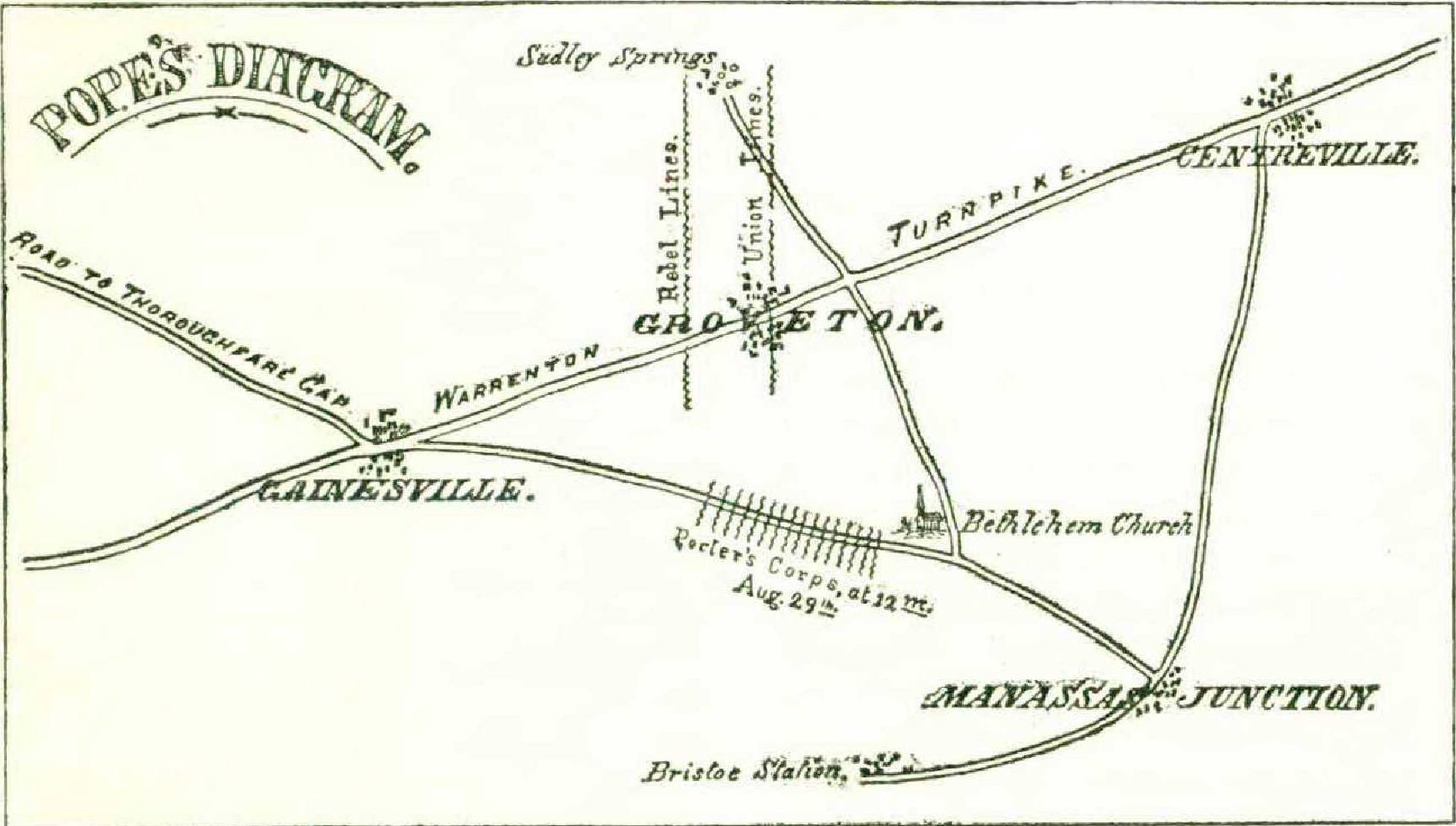
The two diagrams presented herewith show, roughly, the positions of the respective forces on August 29th. “ Pope’s Diagram ” is printed from one given in General Pope’s pamphlet, entitled Brief Statement of the Case of Fitz John Porter. This diagram must be assumed to show correctly the general position of our own troops; for, as to this, General Pope is, of course, the best authority. But in respect to the position of the enemy, of which Pope had no personal knowledge, and which was concealed from him by wooded heights, General Longstreet must be deemed much better authority than Pope. The real position and direction of the Confederate line is roughly shown by General Longstreet’s hasty sketch contained in the following letter:—
NEW ORLEANS, LA., July 30, 1870.
GEN. F. J. LIPPITT, Boston, Mass.: —
GENERAL,—Your favor of the 23d instant is received. I am not able to answer your questions as definitely as I would like, because of many lost papers. The head of my column reached the field of the second Manassas about eleven o’clock, A. M., on the 29th of August. The forces were advanced and deployed as rapidly as possible, and I think that I was fully prepared for battle by one o’clock, P. M. The strength of the force I cannot give for reasons already assigned, but there were twelve brigades, Anderson’s division of three brigades coming up after dark on the 29 th.
Neither of your diagrams agrees with my recollection of the lines occupied by the Southern forces. I shall attempt one that accords more nearly with my recollections.
I am a poor draughtsman at best, having but my left hand now with which to aid you. I hope that you may be able to excuse this effort.
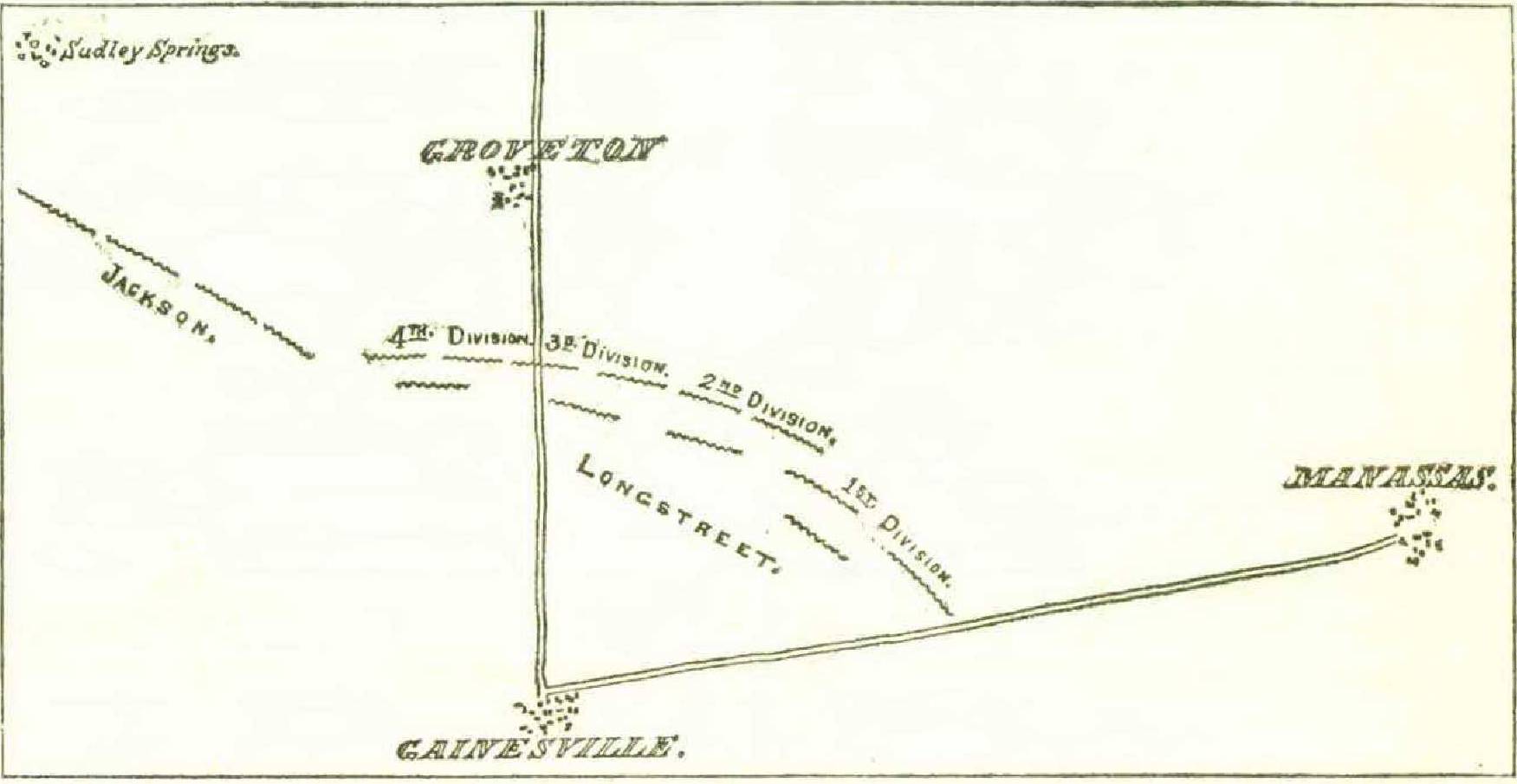
As your inquiry and my information only extend to our own forces, the sketch is only intended to meet this view.
My recollection is that the ground on my right was broken, which broke that part of my line to the rear. My right brigade was, I think, on the right of the Manassas Gap Railroad; but I am not sure of that, and have placed the right upon that railroad. The divisions were arranged as represented in the diagram, — two brigades in line of battle and one in reserve. On the night of the 29th Anderson’s division arrived, and in my attack on the 30th was added to the third division as the assaulting column, making the assaulting column one of six brigades, in column of brigades, except the head of the column which was two brigades.
So many inquiries have been made since the war upon all of these matters that the few papers and records that I saved from the wreck have been sent to friends in various parts of the country who are writing, leaving me without data from which to write. I may say, however, that General Lee was anxious to bring on the battle on the 29th, but finding no assailable point I failed to do so, and made a forced reconnaissance at dark in order to assure myself that there was, or that there was not, a point in my front that would justify an attack. Finding the Federal position too strong to warrant such effort, I withdrew my forces about twelve or one at night to my original line, as represented in this diagram. It appears that the Federal commander mistook this move of mine for a retreat, which induced him to attack Jackson the next afternoon. His forces massed against Jackson, you will readily perceive that a slight advance of my batteries gave me an enfilade fire upon his masses that no troops could live under, and this with but little exposure to me. Of course I seized the opportunity. My batteries broke the masses in about five minutes, that appeared, but a moment before, as formidable and resistless as an avalanche. My command, being fully prepared for the emergency, was sprung to the charge as the Federal masses melted away.
I don’t know but I should apologize for this long reply to your brief interrogations. It seems to be almost impossible to give an intelligible answer to a single question without some detail of connected incidents.
I am, sir, very respectfully, your obedient servant, JAMES LONGSTREET.
A comparison of the two diagrams plainly shows how widely Pope’s theory differs from the truth, and how grossly he was mistaken in supposing that Jackson’s right was accessible in the afternoon of August 29th.
Thirdly, as to Porter’s failure to obey the order of 4.30 P. M. being the cause of Pope’s own failure to rout the enemy on that day. That order was not received by Porter till 6.30 P. M.; that is, about sunset. The impossibility of an attack on Jackson’s flank which the order suggested has already been shown. But further, the only possible result of an attempt to execute the order would have been the sacrifice of Porter’s corps, without any aid being given by it to our troops at Groveton.
In the first place, Porter’s advance would have brought him squarely upon Longstreet’s front. General Lee reports that his line extended to the Manassas Gap Railroad, with Stuart’s cavalry to the south of the railroad. General Longstreet (ut supra) thinks that one of his infantry brigades was also to the south of the railroad. However this may have been, Longstreet’s three flank brigades being in echelon, a few minutes would have been sufficient to extend his line so as to present a continuous front to Porter, and effectually to bar his further advance. Porter had three miles of ground to march over, and would have been enveloped, upon arriving, by cross fires sufficient to sweep him from the field.
Again, the force he would have been attacking outnumbered him three to one. His own corps was about 11,000 strong. Now Longstreet left Richmond with 50,000 infantry and artillery. Deducting 9000 for probable losses, and Anderson’s division of 10,000 not yet up, would leave him 31,000. Add to this Stuart’s cavalry, 2500, and Longstreet must then have had in line at least 33,000 men; which entire force, as shown by the Confederate official reports, was held in readiness to receive Porter.
But even if Porter had rashly attacked Longstreet, the destruction of his corps would have been no help to Pope. It being sunset when he received the order, he could not have actually attacked till about dark, when Pope’s battle with Jackson, which began at 5.30 P. M., was substantially over.
(10.) Not only this, but the course adopted by Porter, in all probability, saved Pope from being utterly routed on that day by superior numbers. The Confederate reports clearly show that the whole of Longstreet’s force was actually held in check by Porter’s corps. It is a significant fact that, hard pressed as Jackson reports himself to have been by our grand attack in the afternoon, Longstreet’s entire force remained quietly in position, no part of it being engaged that day, except Hood’s and Evans’s brigades for three quarters of an hour late in the evening, after the battle of the day was over; when they received an attack from King’s division under Hatch, which they claim to have repulsed. And this would naturally confirm Pope in his belief that Longstreet was not yet on the field. Longstreet reports that he was informed of the approach of the enemy in heavy columns against his extreme right, and that thereupon he withdrew Wilcox’s three brigades from his left to support Jones in case of attack; and Wilcox reports that he was not ordered back to his position till sundown. Again, Longstreet states that the enemy’s entire force appearing to be massed directly in front of him, he deemed it not advisable to move against his immediate front, and therefore quietly withdrew his force at one o’clock A. M. And again, in his letter (ut supra) he states that he was deterred from attacking on the 29th by the strength of our position. A glance at the two diagrams will show that the force which thus held him in check could have been no other than Porter’s corps; since, as shown by Pope’s diagram, our forces at Groveton extended but a short distance south of the Warrenton turnpike.
If this fact needed further proof, it would be found in the statement to Lewis Este Mills (see his pamphlet) of the chief engineer on Lee’s staff to the effect that what induced Lee to remain on the defensive during the afternoon of “ Saturday ” was the absence of Anderson’s division, and “ a feeling of uncertainty as to Porter’s force and intention.” To this was added that Porter’s attack was “feebly urged.”
It is very plain that this statement referred not to Saturday the 30th, but to Friday the 29th. In the first place, it was on Friday the 29th that Anderson was absent. He arrived that same night (Longstreet’s letter, supra), and on Saturday the 30th he was present; taking his place in line, as the Confederate reports show, about noon. In the next place, in characterizing Porter’s attack as “feebly” made, Mills’s informant again showed that he was not referring to Saturday the 30th, butconsequently, to Friday the 29th. Porter’s attack on the 30th was one of the most vigorous and determined in the war, costing him the loss of about one third of his men. It was this attack that compelled Jackson to ask Longstreet for assistance; which Longstreet effectively gave by so plowing through Porter’s lines with round shot as to compel them finally to retire.
(11.) There remains for observation one other point, important and interesting to military men. Did Porter really disobey any order of Pope’s; and if he did, was he justified, from a military point of view, in doing so?
As to the first order, sent from Centreville early that morning, directing McDowell’s and Porter’s corps to march to Gainesville, no serious question can be made. It may be observed, in passing, that this order was a rash one, not justified on military principles. Lee’s main body, which must have been known or supposed to outnumber, two to one, both these corps combined, was hourly expected at Gainesville. The danger was great, therefore, that they would arrive there only to be defeated. But when at one P. M. McDowell, the senior in command, chose to take the responsibility of marching to Groveton with his 13,000 men, leaving Porter on the railroad with his 11,000, and Porter advanced no further, this was no disobedience of orders. The order directed the march of two corps to Gainesville, not of one corps alone, and that the smaller of the two. Not only this, but the order expressly left it to the discretion of the commander how far it should be executed; and after McDowell’s departure Porter exercised a wise discretion in declining to carry it out; which, by the way, would have been now impracticable, as we have already seen. The other order was sent to Porter from the field. It read thus: —
HEADQUARTERS IN THE FIELD,} August 29, 1862, 4.30 P. M.
MAJOR-GENERAL PORTER, - Your line of march brings you in on the enemy’s right flank. I desire you to push forward into action on the enemy’s flank, and, if possible, on his rear, keeping your right in communication with General Reynolds. The enemy is massed in the woods in front of us, but can be shelled out as soon as you engage his flank. Keep heavy reserves and use your batteries, keeping well closed to your right all the time. In case you are obliged to fall back, do so to your right and rear, so as to keep you in close communication with the right wing.
[Signed] JOHN POPE,
MajorGeneral Commanding.
This order supposed four things: (1.) That by pushing forward, Porter would be brought upon the enemy’s flank. As already seen, this supposition was erroneous. (2.) That Porter’s right could be kept in communication with General Reynolds. This also was a mistaken supposition. General Reynolds was some four or five miles off, and Porter had found that the cross roads from his position to Groveton were in possession of the enemy, who had thus isolated him from the main body. (3.) That Porter could support his attack with his batteries. The ground appears to have been such as to preclude the use of batteries. But, aside from that, the order supposed: (4.) That, if compelled to fall back, Porter could do so in such a manner as to keep him in close communication with the right wing at Groveton. Here again was obviously a mistaken supposition.
The order itself, under the circumstances assumed to exist, was an eminently proper one, and the framing of it indicated a Skillful and prudent commander; the attack it directed not being that of an isolated corps of a few thousand men, unsupported, upon a distant front of the enemy, where it would be vastly outnumbered. The only objection to its execution was that it was drawn up in ignorance of material facts. Can it be seriously contended that an order to a distant subordinate commander must be obeyed at all risks, though showing on its face that it contemplated an entirely different state of facts from that actually existing; or that, in such case, the execution of it, if it would apparently lead to unforeseen and disastrous consequences, would be even justifiable ? Had Porter, on receiving this order, thrown his corps upon the force in front, and the result had been its destruction, no court of inquiry could have helped finding that he had rashly exceeded his orders; and he would have been deemed thenceforth unfit, as lacking in judgment, to hold an important command. If he had pleaded the terms of the order, the obvious reply would have been that it directed an attack on the enemy’s flank, not on his front, and that, as he well knew, not one of the other conditions existed in reference to which the order was framed.
The settled principle in military ethics in such cases is this, that an order to a subordinate from a distant superior is not to be disobeyed simply because it would apparently lead to disastrous consequences; but that when, in addition to this, the order itself, by its very terms, assumes facts which do not exist, and the subordinate is clearly satisfied, in the exercise of a sound judgment, that the superior would not have made the order if he had known the real circumstances of the case, obedience to it would be in the highest degree blameworthy, —nay, criminal. And no friend of General Pope would venture to assert that, under the circumstances of the case as now known, and as Porter believed them to exist at the time, the latter would have been ordered “to push forward into action at once on the enemy’s flank.”
As for Porter’s marching to Groveton, he had no order to do so. The idea that, hearing the sound of battle, he ought to have gone there at once is a very natural one, but it leaves important facts out of view. He was too far away to hear any sound of musketry, and the firing heard indicated an artillery duel at long range, not an actual conflict of troops. If he had marched at 5.30 P. M., when the grand attack was made, it was very doubtful, the enemy being apparently in possession of the roads, when he could have arrived at Groveton, or if he could have arrived there at all. In point of fact, McDowell’s Corps, which began its march at one P. M., did not arrive till about six o’clock; certainly not earlier than five o’clock.
But there was a conclusive reason why he should remain where he was. He was then holding in check a much larger force than his own. If he had marched for Groveton, that force, having the shorter line, would have been there before him. By remaining in his position he was rendering the greatest possible service to General Pope and to his country.
There remains to be noticed one other charge against General Porter. In the night of August 27th, being then at Warrenton Junction, he was ordered to march with his corps at one A. M. the same night, and arrive at Bristoe Station by daylight the next morning; instead of which he did not march till three A. M. (or, as some accounts say, till daylight), nor arrive at Bristoe till tea o'clock in the forenoon. This sort of disobedience, as all military men know, necessarily occurs more or less often in every campaign. In directing the movements of a detached column at a distance, the superior commander can seldom, if ever, know the circumstances which sometimes necessarily delay, for a few hours, the putting of the column in route, or its arrival at the point designated. Undoubtedly, in failing to arrive at the hour required a commander is technically guilty of a disobedience of orders. But the real question always is whether the delay was blameworthy, for which he would be properly amenable to punishment. On this point it may not be material that Porter’s failure to arrive at daylight led to no prejudicial consequences; but it is material that, as shown by the weight of evidence, he exercised a sound judgment under the circumstances in not marching till three A. M., and especially that he actually arrived at Bristoe full as soon as if he had marched at one instead of three A. M., or at daylight.
MCCLELLAN.
(12.) The principal responsibility for the disasters of Pope’s campaign must rest upon General McClellan. This will sufficiently appear from reading the dispatches sent and received by him, of which, and of his action in connection with them, I subjoin the following brief notes. It must be remembered that, in spite of his losses in the Peninsula, McClellan had still with him at Harrison’s Landing 85,000 or 90,000 men.
August 3d. McClellan ordered to Acquia Creek. He remonstrates. Order repeated.
August 4th. The order again repeated.
August 9th. Halleck urges instant reinforcements to Acquia Creek. “ Enemy massing to crush Pope and Burnside.”
August 10th. Halleck telegraphs, “ Enemy crossing Rapidan in large force. Fighting Pope to-day.”
August 15th. McClellan puts two corps in motion towards Fortress Monroe.
August 21st. Halleck telegraphs,
“ Pope and Burnside hard pushed.”
August 23d. Franklin’s corps (8000 men) sails.
August 25th. The only reinforcements from McClellan arrived so far are Reynolds’s and Kearney’s commands, 7000 in all.
August 27th. Halleck to McClellan (then apparently at Alexandria): “ General battle imminent. Franklin’s corps should move out by forced marches.” McClellan reports 13,000 men ready to march at a moment’s notice.
August 28th. Pope telegraphs for supplies: “ Troops but little to eat; for two days marching and fighting. Troops and animals perfectly exhausted. For two days no forage for cavalry and artillery horses; for ten days saddled and harnessed.” 4.10 P. M. McClellan telegraphs to Halleck: “ General Franklin is with me here. Not yet in condition to move. May be by to-morrow A. M.” 4.45 P. M. " Neither Franklin or Sumner in condition to move and fight battle.”
Halleck sends a direct order to Franklin to move towards Manassas Junction.
McClellan answers, “Thinks enemy not in such force near Manassas as to need to move in force.”
Halleck telegraphs, “Not a moment to be lost, to push as large a force as possible to Manassas, to unite with Pope before enemy reinforced. Franklin must go to-morrow morning, ready or not ready.”
August 29th. 10.30 A. M. Franklin’s corps in motion. McClellan halts it at one P. M., and telegraphs, “ Not safe to go beyond Annandale.”
Two days before, McClellan’s troops had been ordered to march to Manassas Junction by forced marches, but they had now only reached Annandale, six miles out.
August 30th. In reply to Pope’s urgent telegram of the day before, McClellan instructs Franklin to inform him that he will have the wagons and cars loaded with rations as soon as Pope should “ send in a cavalry escort to Alexandria, as a guard to the train.” (A cavalry escort for a railroad train!)
On the 29th McClellan had telegraphed to the president “ to leave Pope to get out of his scrape, and at once to use all our means to make the capital safe.” (As if saving Pope from defeat was not the surest means of making the capital safe.)
These dispatches need no comment. In connection with his action, they clearly show a determination on McClellan’s part that, so far as he could help it, Pope should receive no assistance from him, whatever might be the consequences to Pope’s army, or to his country; and, to carry out that determination, a continued and criminal disobedience of orders to the very last.
On the 3d of August McClellan had a well-equipped army of some 85,000 men lying inactive at Harrison’s Landing. On that day he was ordered to transfer it to Acquia Creek. In spite of repeated and peremptory orders, owing to his indisposition to obey them and inexcusable delays, by August 30th only 20,500 of this large force had reached the field.
On the 27th of August, 1854, during the Crimean war, the allied armies commenced their embarkation at Varna. It was made under no urgent pressure. Nevertheless, by the night of September 4th, that is, in eight days, 62,000 men had been embarked, with all their stores and guns. Again: McClellan himself had, not long before, embarked his whole force, of over 100,000 men, for the Peninsula, in twelve days. In view of these facts it is incredible that McClellan, if so disposed, could not easily, in twenty-seven days, have had 60,000 men to reinforce Pope. In that case, on August 30th the entire Confederate army would have been overwhelmed, and Richmond, in a few days, would have been in our hands.
LEE.
(13.) Lee erred in not promptly marching to crush Pope with superior numbers before his reinforcements could arrive. If he had done so, there would have been nothing to prevent him from marching to Washington; and that city would have fallen soon after he had possessed himself of Upton’s Hill, which commands both Arlington Heights and Washington. His inaction was caused, of course, by his uncertainty as to McClellan’s intentions and the fear of losing Richmond. But a few brigades, well intrenched, could have defended Richmond till Lee should be able to send reinforcements; and even at the worst, Washington gained would have been far more than compensation for Richmond lost. But by August 6th, Lee knew that McClellan’s army was being recalled. Then not a moment should have been lost in marching to destroy Pope before the junction of the two armies. Yet his force was not concentrated on the Rappahannock till August 20th.
(14.) Lee’s grand turning movement must have had something more for its object than merely to get between Pope and his base, and to destroy his communications. For it is not enough to get on the enemy’s line of communication and retreat. This is only a means to an end, that end being the defeat of the enemy, and such a defeat as may be decisive of the war or of the campaign. It did not suffice Napoleon to cross the Alps and swoop down, as from the clouds, upon Milan, thus cutting off Melas at Turin from his base. By this he really accomplished nothing until he had induced Melas to come out against him on the plains of Marengo and be beaten. Then the campaign was won. Again, in 1806, it was not enough suddenly to move his principal mass upon the Prussian army’s line of communication, until, by the victory of Jena, he had virtually ended the campaign, and thus achieved the conquest of Prussia.
When a commander has resolved upon a turning movement that shall place his army on the enemy’s line of communication, in order that this manœuvre shall be decisive of the campaign, two conditions are essential: one is that his columns should be so near each other as to insure his fighting the intended battle with his whole force. And here was the great defect in the execution of Lee’s plan. Jackson’s corps, constituting a third of his force, was three days in advance of his main body. It was at Manassas Junction on the 26th, while Longstreet did not arrive till the 29th. During these three days Jackson was in imminent danger of being beaten by superior numbers. It was Lee’s good luck that Thoroughfare Gap had not been secured. Had he arrived there two hours later on the 28th, Ricketts would have been in possession of the defile, and Longstreet could not have been in line by the 29th nor by the 30th, on which day Jackson’s corps would have been destroyed or captured ; for we then greatly outnumbered him on the field. Longstreet should therefore have followed close upon Jackson, instead of being three days behind him. A few brigades left in Pope’s front on the Rappahannock, with the expedients usually resorted to in such cases to deceive the enemy, might have sufficed to mask the movement long enough for the object in view.
The other essential condition is that when the decisive battle is fought, it be fought with our back to the enemy’s base; for then a defeat, cutting him off from all possibility" of reinforcement or supply, insures his surrender or destruction. In the contrary case, the defeated enemy has only to fall back upon his base, as Pope did after his battle of the 30th. If in that battle the positions of the contending armies had been reversed, Lee being between Pope and Centreville, after thoroughly defeating Pope there would have been nothing to prevent Lee’s marching to Washington. Now if Lee had debouched from Thoroughfare with both Jackson and Longstreet, his superiority of numbers would have enabled him to choose his own battle-ground, and by giving battle facing to the west to make it decisive of the campaign.
On the 30th of August Pope must have known at last that the whole Confederate army was fronting him, and that he was therefore largely outnumbered. It was a brave and chivalrous act to fight with the chances decidedly against him, an act of which McClellan would never have been capable. The contrast between these two commanders must have been strongly felt in Washington; and it is no wonder that on Pope’s arrival there Halleck warmly exclaimed to him, “You have done nobly!” — a greeting in which his countrymen, in spite of his mistakes, might have sincerely joined.
According to statements now made, Longstreet’s and Jackson’s commands numbered somewhat less than is supposed in the foregoing article; but the discrepancies are not important enough to require any modification in the conclusions arrived at.
Francis J. Lippitt.