The Meaning of Music
SOME time ago — it is full fifteen years since — I broached a theory in regard to music which none of my fellow-devotees of the art — none at least that I heard of—received with favor. It was that music is entirely without rational significance or moral power; that the creations of this divine art, while they have an exquisite fitness to certain conditions of feeling (in those who have a certain physical constitution), have rarely any definable meaning; and above all that a fine appreciation of even the noblest music is not an indication of mental elevation, or of moral purity, or of delicacy of feeling, or even (except in music) of refinement of taste. That in this the witness of all literature is against me, I know well; and even better do I know that my own feeling is against me while I say that what has been from my earliest memory, and is now, the greatest, keenest pleasure of my life is one that may be shared equally with me by a dunce, a vulgarian, or a villain. But that this is true, I have not the beginning of a doubt. So thoroughly am I convinced of it that not even that subtlest and strongest of all allurements to man’s soul, the temptation to believe that some peculiar endowment of his sets him at least in one respect above his fellows, — that intellectual phariseeism which makes us thank God that we are not mentally constituted as other men are, — can win me to believe that the finest musical organization ever sent upon the earth was either a sign or a necessary accompaniment of any mental or moral superiority, or the cause or the occasion of any excellence, except in music itself.
Of this theory, upon which at the time when I first set it forth incidentally and very briefly I insisted as strongly as I do now, I received not long ago a reminder, to speak logically, e converso, musically, al rovescio. For John Ruskin, in a Fors Clavigera (No. 82), following Plato, asserted just the contrary. To differ from Ruskin on a subject that he understands is almost as perilous as to do the like with Plato; and the Oxford Graduate understands so many more things than what is good painting and good architecture, and the tendency of whatever he writes is so directly toward the elevation of man’s whole nature, and so notably toward purity, truth, and justice in all things, that even when he seems to be impracticable in his notions, or even wholly wrong, to maintain the right against him is an ungrateful task. The theory of political economy, if so it must be called, which he promulgates is as impossible of practical application in this workaday world as the reversal of the revolution of the earth upon its axis; but I do not envy the man whose heart does not warm to the visionary prophet as he proclaims that the law of just living is the doing good work, and not the getting of as much money as may be gotten by doing work of any degree of badness that will sell, or, better, by doing no work at all. And as to his hatred of railways (and all manner of steam contrivances for doing the work of man’s hands), and of electric telegraphs, the question at least remains to be decided whether without them we might not live a more comfortable and a happier life, as well as a nobler. But, however this may be, as to music it is not strange that he should be wrong; for it is plain that his knowledge of it is very limited, and that even his feeling for it stops short of its higher and finer manifestations. In this he is not at all peculiar among men of letters of the higher class,—of the highest; for among them Plato stands. All literature is full of evidence that mental power, æsthetic intuition, the gift of utterance, fancy, imagination, and, strangest of all, even the gift of rhythm do not necessarily accompany such an enjoyment or even such a comprehension and apprehension of music as may be almost intuitive in a man who could not write a line, and could hardly think two logically connected thoughts.
The examination of a few passages from the writings of authors of high rank who were men of rare personal accomplishment will not only make manifest in them this incapacity, but show them revealing an elementary ignorance of music in the very words which they use for the purpose of illustrating it or of using it as an illustration.
To begin with Ruskin himself. In his eighty-third Fors he says, “ I think this passage [from Plato] alone may show that the Greeks knew more of music than modern orchestral fiddlers fancy. For the essential work of Stradivarius in substituting the violin for the lyre and the harp was twofold. Thenceforward instrumental music became the captain instead of the servant of the voice, and skill of instrumental music became impossible in the ordinary education of a gentleman. So that since his time Old King Cole has called for his fiddlers three, and Squire Western sent Sophia to the harpsichord when he was drunk; but of souls won by Orpheus or cities built by Amphion we hear no more.” It is true that in these days neither do cities rise to the sound of the lyre nor their walls, when they have them, fall flat at the sound of rams’ horns; but as to the winning of souls of women by music, let the tenors on the stage and in society testify, upon their honor. Apart, however, from its last clause, this paragraph contains in its every assertion and implication an error shot off point blank into the eye of truth. So far was Stradivarius from substituting the violin for the lyre and the harp that when he lived and worked the lyre was to all intents and purposes unknown in music, and that since his day the harp has been much more used in both the public and the private performance of the higher music than it was before. So untrue is the assertion that thenceforward instrumental music dominated the voice, that on the contrary all the great vocal music, both solo and choral, has been written since the day of Stradivarius, and that before his time violins were much less used in accompanying the voice than they have been since. And again, for every gentleman who attained skill of instrumental music as a part of his ordinary education before the time of the great Cremonese there have been a hundred or a thousand since, and the number is yearly increasing.
And finally, the admirable old fiddle maker had no influence, direct or indirect, upon King Cole or Squire Western, or their contemporaries of whom they may be accepted as the type. For King Cole lived nearly a century before Stradivarius,1 and Squire Western’s creator, Fielding, was his contemporary. Nor did Stradivarius exercise any influence whatever upon music in his own day or thereafter. Many intelligent persons, including some poets, seem to have a notion that the Stradivarius of whom they hear so much in connection with the violin was an inventor of something, or an introducer of something in music. But he did not even invent anything in the violin, and neither exercised nor sought to exercise any influence upon the instrumental music of his day. He was merely an artisan; a highly intelligent, very skillful, and very conscientious workman with saw and plane and chisel and varnish. His workmanship is excellent, admirable; and he deserves the honor which belongs to all skillful and conscientious handicraftsmen. But even in violin making he did not do anything new. A great array of skillful and now Celebrated violin makers had preceded him; and he, so far from being an inventive genius even in his own craft, was an eclectic maker. Sound judgment, good taste, and thorough workmanship as an artisan are his claims to distinction. He united the good qualities of the good makers who had preceded him; he patiently perfected their plans; and in his greatest distinction, his flat sounding board, he merely returned to the model of that great violin maker, Gaspard da Salo, who lived and worked a hundred years before him. To attribute to such a man any influence upon music is much like attributing to Joseph Gillott, the great Birmingham steel-pen maker (one of Stradivarius’s greatest admirers), an influence upon literature.
Passing by, for the moment, the reference to the Greeks’ knowledge of music, let us consider some other examples of ignorance of music on the part of authors of repute, ignorance which is not so technical in its character as it may seem. Arthur Helps writes of a nervous man, “ And when for the sixth time he hears C flat instead of C sharp played in an adjacent house, he is very apt to be distracted from his work, and very much inclined to utter unbecoming language. ” (Social Pressure, chap. iii.) If Mr. Helps had been content with referring in a general way to the annoyance felt by a nervous person at unskillful performance or practice of music, he would have done well; but in attempting to talk music he merely showed that he knew nothing about it, in a way that raises a smile upon the lips of those who do. It is true, of course, that there is such a note as C flat; but it may be said to be the one which, under that designation, is least often heard. It is also not the note that would be misplaced for C sharp, the mistake for which, as every musical tyro knows, is C natural. But Mr. Helps had heard talk of flat and sharp, and probably, too, of natural, which however had not character enough to attract his attention or to serve his purpose; he had also been annoyed by musical practice; and of this musically nebulous condition of mind we here have the result.
Bulwer has in The Caxtons this comparison, upon which if he did not pride himself he had the misfortune of seeming to do so: “ As when, some notable performer not having arrived behind the scenes, or having to change his dress, or not, having yet quite recovered [from] an unlucky extra tumbler of exciting fluids — and the green curtain has, therefore, unduly delayed its ascent — you perceive that the thorough bass in the orchestra charitably devotes himself to a prelude of astonishing prolixity, calling in Lodoislca or Der Freyschütz to beguile the time,” etc. (Part XI., chap. v.) Already my musical readers have laughed at the “ thorough bass in the orchestra devoting himself to a prelude.” Readers non-musical may need to be told that thorough bass is not a big fiddle or a big fiddler, but a way of writing harmony, the name of which is sometimes used for the art itself of writing harmony. But Bulwer, having heard musical people speak of thorough bass, thought that the thoroughest bass as was must be the contra basso “in the orchestra.” More subtle, but to a truly musical person perhaps even more convincing evidence of ignorance, and ignorance of a more radical and essential nature, is his saying of a voting girl, “ She has an ear for music, winch my mother, who is no bad judge, declares to be exquisite.” The application here of “ no bad judge” and “ exquisite ” to an ear for music shows that Bulwer, when he heard people talking about music, did not even know what they meant.
So Lord Beaconsfield, K. G., which being interpreted is Benjamin Disraeli, recently talked about “ the diapason of England’s diplomacy,” which showed that he did not know the difference between the diapason and the key note. The diapason of a diplomacy is nonsense. And in one of the many vulgar scenes in that vulgar book, Lothair (in his pictures of society Mr. Disraeli is very apt to be vulgar), the same distinguished person shows us a family party at a ducal house, where two of the young ladies present “ from time to time burst into song.” I quote from memory, not having seen the book since the time of its publication, but the absurdity music wise of the expression impressed me so strongly that I am sure I must be essentially right. People who can sing do not burst into song in a promiscuous and headlong way.
On the other hand, when Sterne makes uncle Toby sympathize with Mr. Shandy about a horse, and repeat his brother’s words, he illustrates the sympathy by this comparison: “Poor creature! said my uncle Toby, vibrating the note back again like a string in unison! ” This is the real thing; it is written from knowledge, — knowledge which has become so much a part of the writer’s mental furniture that, he can use it familiarly and with a steady hand. True, the illusion is strictly rather acoustical than musical, but it has the air of coming from an observant violin player; and I believe that Sterne did play the violin. If he did, I do not doubt that he showed in his playing no less sentiment than in his writing, sentiment doubtless somewhat false and morbid, but still sentiment; just like many another foul and shallow-souled creature that had played and written before him, or has played and written since, or will play and write — secula seculorum. But violinist or not, and showing here some acquaintance with music, Sterne elsewhere shows that he could not soar to the heights or fathom the depths of music; as we shall see.
To return to Plato and Ruskin. In the Fors preceding the one before referred to (No. 82), the latter, after some consideration of certain æsthetic and ethical theories — it would not do to call them notions — of the former, says, “And understanding thus much, we can now more clearly understand, whether we receive it or not, Plato’s distinct assertion that as gymnastic exercise is necessary to keep the body healthy, musical exercise is necessary to keep the soul healthy; and that the proper nourishment of the intellect and passions can no more take place without music, than the proper functions of the stomach and blood can go on without exercise. We may be little disposed, at first, to believe this, because we are unaware, in the first place, how much music, from the nurse’s song to the military band ami the lover’s ballad, does really modify existing civilized life.” (Page 317.) Mr. Ruskin afterwards (page 329) refers approvingly to the notion that music is “throughout life to be the safeguard of morality.”
One of the great difficulties in the way of intelligent and fruitful discussion, a difficulty so great that by it many of those who are most fitted for this mode of inquiry are entirely deterred from it, is the uncertainty as to the meaning of the terms which must be used. From this cause arises much of the confusion, the prolixity, and the acrimony which attend religious discussion. By religion, one man means one thing, possibly a creed or an external form, and another possibly piety, which has nothing to do with creeds and forms. Two men may both have faith in a God; but one’s idea of God is very different from the other’s. We encounter this difficulty at once in the consideration of what Plato says, and Mr. Ruskin endeavors to enforce, in regard to music. If music meant the same thing to Plato that it does to us nowadays, and has meant for the last three centuries, the Academic philosopher was on one subject at least clean daft.2 The very persons whose love and enjoyment of music is deepest, strongest, subtlest, most fervid, most enduring, — whom it enwraps, soul and body, in a delight, an elevated joy that lifts them for the moment out of the material world and at. once awakens and expresses emotions for which there is no other voice, no other sign or symbol,—would not, unless their perceptions were limited to this art, accept these dicta of Plato in regard to its functions and its influence. If they observe, if they reflect, they must know — none so well as they — that although in them music may soothe, or stimulate, or even tone that human thing, or condition of human action, which we now call the soul, it has no point of contact with their moral nature; and that although it may awaken passion, good or bad, holy or unholy, as the case may be, it has no nourishment for the intellect, and less than all other arts demands intellect either in its loving devotees or in its executive ministers. Pomfret, who passed his life in writing pompous platitudes in Pindaric verse for the world of William and Mary’s reign, has yet one keen couplet which shows that he had observed and thought upon this subject:—
And yet Melania like an angel sings.”
This epigram is the more valuable because it is not in a satire nor even meant satirically. It occurs in Strephon’s Love for Delia, and Melania is merely one of a row of “ fairs ” whom the lover passes in review in search of one superior or equal to his mistress; and the couplet, so far from being “ wrote sarcastical.” is intended to set forth Melania’s attractions in the best light.
It is remarkable that a writer like Pomfret, in all of whose longsome, wearisome works I have not discovered two other lines worth the printing, should have observed and recorded the frequent coexistence of skill in music and silliness in all other things. For poets, with writers of sentiment and æsthetic generally, have taken another view of the question, even when the gods had not made them musical. And indeed very few of them have left evidence that they were capable of the enjoyment of the higher music. Shakespeare was. He showed that he had the soul of music in him. Not in the passage which will occur to most of his readers, but in various others, chiefly in two; first, this beautiful one in the last act of the Merchant. of Venice : —
Here will we sit, and let the sounds of music
Creep in our ears : soft stillness and the night
Become the touches of sweet harmony.
Sit, Jessica. Look how the floor of heaven
Is thick inlaid with patines of bright gold.
There’s not the smallest orb which thou behold’st
But in his motion like an angel sings,
Still quiring to the young-eyed cherubins.
Such harmony is in immortal souls ;
But whilst this muddy vesture of decay
Doth grossly close us in, we cannot hear it.
Come, ho ! and wake Diana with a hymn :
With sweetest touches pierce your mistress' ear
And draw her home with music.
No man could have written so far who had not in his nature the capacity of the greatest enjoyment that music can afford. The passage is pervaded with evidence of the finest musical sensibility; and the thought of sweet touches piercing the ear cuts down to the very quick of feeling. After this comes Jessica’s reply in that one immortal line, —
which to the lover of true music shadows forth the unutterable, the incomprehensible. For Lorenzo’s after-attempt to account for this condition of the music-lover’s soul is only a brilliant and ingenious attempt to explain the unexplainable. But of a yet higher value as evidence of Shakespeare’s finely receptive musical organization are two passages in Twelfth Night. The first of these is the first speech in the comedy. The love-sick duke says, —
Give me excess of it, that surfeiting
My appetite may sicken and so die.
That strain again : — it had a dying fall:
Oh, it came o'er my ear like the sweet South
That breathes upon a bank of violets,
Stealing and giving odor. Enough — no more !
'T Is not so sweet now as it was before.”
The other is in a subsequent scene, in which there is music. The duke asks Viola how she likes the “tune;” and the poor girl answers with her heart,—
Where Love is thron'd.”
Music is inexplicable, and defies all analysis of how and why and wherefore; and thus in like manner it is impossible to explain to those who are not musically organized how it is that these passages show beyond all possibility of doubt or question that Shakespeare was exquisitely sensitive to the finest touches of music; which those who are themselves so organized know without the telling. But the former may perhaps apprehend that the phrase “ a dying fall ” expresses the cadence or falling close of a tender strain in a way which shows that it had sunk into the. very soul of him who uses it, and that the subsequent lines about the wind have, apart from their poetic beauty, and setting aside their charm of rhythm, a descriptive fitness which could have been given by no man who had not felt what he told. And so as to Viola’s speech, we know from it that Shakespeare had loved with sentiment, and had found in music an expression of the sweet, tender sadness that sometimes fills a lover’s soul.
These, however, are not the passages that commonly come up as indicative of Shakespeare’s feeling for music. That function is performed to the general apprehension by the last few lines of Lorenzo’s clever and pretty, but altogether unsatisfactory, attempt to philosophize upon music: —
Nor is not moved by concord of sweet sounds,
Is fit for treasons, stratagems, and spoils ;
The motions of his spirit are dull as night
And his affections dark as Erebus :
Let no such man be trusted.'”
Now this, like very many passages in Shakespeare’s plays which have been perverted from their proper function of individual utterances appropriate to time and place and personage, to abstract moral maxims, is dramatically good and ethically bad. It is quite in character for Lorenzo to say it to Jessica as they listen to music together in the light of their honeymoon; but if Shakespeare himself could come before us for a few minutes, only long enough for him to glance his mind’s eye along the records of his memory, be would say that as a general truth, a gnomic sentence, it is absolutely untrue. But because of the magic of Shakespeare’s name and chiefly because it is not understood, — for nothing more captivates the general man or is more eagerly received than that which has the form of wisdom without the substance, the semblance of truth without the reality, particularly when it seems to declare what men wish to believe, — it has had large acceptance as a law of ethics and æsthetics, and is quoted with unction by lovers of music who wish to believe that there is virtue in pleasure. A good man, one of refined tastes, and a very pleasant writer, the Rev. John Wood Warter, Southey’s sonin-law, gives us in The Seaboard and the Down (vol. ii., p. 352) this dilution of Lorenzo’s declaration: “ He that has no love for soft, sweet sounds is very frequently devoid of tenderness and mercy.” This dose of Shakespeare and water may be very safely taken. The assertion is indisputably true; but it is equally true that he that has no love for soft, sweet sounds is frequently six feet high, or has frequently a snub nose, and that he frequently is devoid not only of tenderness and mercy, but of cash and of house and land. But there is no more connection between the two facts that he lacks a love for sweet sounds and also lacks tenderness and mercy, than there is between the former and his stature, or the shape of his nose, or the condition of his pocket. To establish for ourselves any claim to superior consideration on moral grounds, we music-lovers must show that benevolence and justice are always accompanied by a fondness for our beloved art, that brutes and scoundrels are not to be found among singers and fiddlers, that the Neros of the world do not ply the bow while Rome is burning, —in a word, we must show, not that many of us are good, which is undoubtedly true, but that none or very few of us are bad, which is as surely untrue. How impossible these conditions are, no one knows better than an observant musician; and by musicians I mean not only, or chiefly, those whose profession is music, but all real lovers of music, whether per formers or not, who love it with understanding as well as with heart. To such persons, if they are observant and thoughtful, the union of all the baser passions, in strong activity, with a fine sensibility to the most exalted beauties of the higher kind of music must have presented itself as one of the strange, inexplicable problems of humanity.
And otherwise than in its moral aspect this subject has been sadly muddled, not only by poets but by fine writers of a metaphysical, or fancied metaphysical, turn of mind. The saying that “ architecture is frozen music,” which is attributed to Madame de Staël, has done much to continue the contusion which has so generally prevailed upon this subject, and to confirm the exaltation of exalted musicians as to their favorite art. It is only one of those fanciful figures of speech which, not founded upon truth, are in fact mere silly sayings, absolutely without meaning, and which yet, because of their sententious air and gnomic form, impose upon a world always ready to have its thinking done for it, and to accept what seems to be a general truth embodied in an adage. Because of this readiness and of the demand which it has created, there has been a continuous supply of oracular utterances for centuries, a few of which do put ethical truth in a striking and compact form, but the greater number of which are mere painted word-bladders filled with gas, which, if people would only puncture them with a point of criticism, would collapse suddenly with an evil odor. The demand for this sort of thing has created the saver of sayings; and really clever people will not be content to tell us what they have to tell simply and directly, but will put it into some fantastic shape, that it may seem Delphic. Among these was that really gifted woman to whom this medley of music and masonry seems to belong.
The truth is that between no other two arts is there such absolute, radical unlikeness as there is between music and architecture. And the unlikeness is of such a nature that, although a comparison of them as to æsthetic purpose might find unstable rest upon vague analogy, a comparison of them in form is absurd; it is a comparison in form that is made by likening architecture to frozen music. Now the condition of architectural beauty is stability; it is a fixed conception, and one which even implies no reference to any action or thought that has gone before or that will come after. It is thus even more fixed and single in its purpose than painting, which, though it fixes its subjects at a certain moment of action, implies action that has gone before, and suggests other that must or may follow. I speak, of course, only of the higher order of painting, not of landscape. But in music the only means to the æsthetic end is movement; movement is the very being of its beauty. At any given moment there is actually no aesthetic difference between any one musical composition and any other. Brief reflection will make this clear to any music-lover as to melody. The single note of one melody may be the single note of any other. But it is no less true as to harmony. A single pleasant sound is not music, nor is a combination of single and stationary sounds uttered together — that is, a chord—music. Thus, if we strike the following chord upon the piano-forte,—
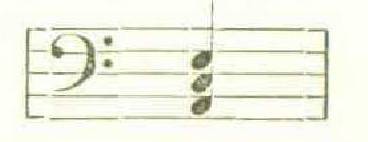
it is not music, nor is this chord
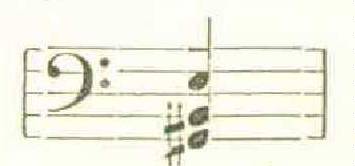
by itself music. But strike those very chords in a certain succession, only pass from one to the other thus,
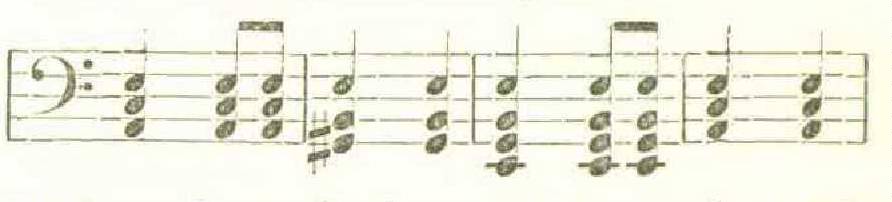
and you have the impressive opening and the germinal thought of one of the most beautiful, marvelous, and mysterious conceptions that ever was born in the brain of Beethoven, fertile in such enchanting fancies.3 In music it is this movement, whether in melody or in harmony, this passage from one sound, or from one combination of sounds, to another, which gives to a strain whatever beauty it may have. It is this only which gives form to music, that form without which in no art is there beauty. This motion in sound is the very essence of the composer’s conception, the very soul of his purpose. Let the movement of Ids music be arrested, even at a stage of its development when it is most complicated, and its beauty vanishes. Not only so, its very existence is at an end. When a stream is frozen its movement (external) is arrested, yet its course is still continuous and its form remains. But you cannot so, even metaphorically, stop and stiffen a strain of music, every note of which, ceases, passes away, and is not, before another can be begun.4 And even in northern caves and snow-topped mountains, where icy stalagmite and stalactite meet in huge fantastic forms which seem the work of gnomes playing at architecture, there is still the same unlikeness to the ever present, ever vanishing beauty of form in music. Madame Corinne had probably icicles in her mind when she said her saying; and the result was, instead of a strong and living thought, only a cold, brittle conceit, that melts away before the glow of real feeling and shivers at the touch of reason.
Byron seems to have been somewhat impressed by this saying of De Staël’s, but with that union of fine poetic instinct and strong common sense characteristic of his mind he shrunk from it as an affected mysticism. He says in his journal (November 17, 1813), “ Last night . . . I was trying to recollect a quotation (as I think) from some Teutonic sophist about architecture. Architecture, says this Macoronico Tedeschy, reminds me of frozen music. It is somewhere, but where? The demon of perplexity must know and won’t tell. I asked Mackintosh, and he said it was not in her [De Staël]; but Puységur said it must be hers, it was so like.” But Byron himself had, I suspect, no love for real music, the higher productions of the art, what the lovers of Händel, Mozart, and Beethoven mean when they say music. His enjoyment was probably confined to music of the very lightest and shallowest sort, — feeble songs and pretty dance tunes; and even in these was largely dependent upon association. In his diary, under the date February 2, 1821, he writes, “ Oh, there is an organ playing in the street — a waltz, too! I must leave off to listen. They are playing a waltz which I have heard ten thousand times at the balls in London between 1812 and 1815. Music is a strange thing.” This is unmistakably the record of a man who does not know the enjoyment of real music. The cumulative delight expressed in the exclamation, “ a waltz, too!” tells that plainly. Byron, like many people not poets, had just enough perception of music to enjoy society ballad singing— Tom Moore’s, for example — and the band music which accompanied and stimulated his social enjoyments. His pleasure on this occasion, as theirs in music is so frequently, was merely that of association.
It is quite in keeping with such a very low apprehension and such a limited comprehension of it that the poet should have fine fancies about music. In the Bride of Abydos he says of Zuleika, somewhat incoherently, —
The mind, the music breathing from her face.”
His biographer, Moore, tells us that the second line was “one of the most popular ” in the passage in which it occurs. Quite likely; for it is one of that kind which seems to mean something and means nothing. Poetry is not to be censured for extravagance; many of the finest passages that were ever written are merely splendid extravagance. But extravagance must have something substantial to start from; your very comet must have a nucleus. Now by extremity of metaphor mind might be said to breathe from the face of a beautiful and intelligent woman, although that is not exactly the way in which a woman’s beauty strikes a man. But “ the music breathing from her face,” what does that mean? Nothing at all. And T do not hesitate to say that Byron himself—brightest of the Georgian constellation—did not know what he meant when he wrote it. I may without presumption say this when he himself has said, —
My own meaning when I would be very fine.”
(Don Juan, iv. 5.)
And there is the story of his reply when asked the meaning of a certain passage, “ I suppose I knew what I meant when I wrote it, but I ’ll be dashed if I do now.” Byron had largely I the virtue of candor. And it so happens that we know the struggles through which he passed when he produced this line. The preserved manuscript reveals them. The couplet first stood, —
Mind on her lip, and music in her face.”
But that did not satisfy the poet; “ music in her face ” was too much even for him. He therefore re-wrote the second line thus, and made it much worse: —
I doubt whether he saw the real absurdity of “ the mind of music,” and am inclined to think that “breathing in her face ” displeased him from its ambiguity. However this may have been, he made a third attempt and produced the “ popular ” line which stands in the poem. But all this fumbling merely showed — not simply because of the re-writing, but because of the manner of it — that Byron’s notion of music was the shallow sentimental one. His fancy of music in flesh and blood is of the same kind as Madame De Staël’s of music in marble or in bricks and mortar. Milton, who did know what music was, makes his infernal palace “ rise like an exhalation,” but it is “ with the sound of dulcet symphonies.” True, just in the place of which he was writing (as his conception of it was not like Dante’s) music could not very well be frozen ; but he was tempted into no extravagance of that sort.
Music is indeed “ a strange thing ; ” but its strangeness is not that which Byron had in mind when he wrote his diary. He thought that it was strange that music should so disturb him, and give him such great enjoyment. But he was not truly enjoying music. If he had been greatly capable of that musical enjoyment, the Organ would have provoked one of those strong expletives with which his splendid letters are so profusely garnished. All his excitement and all his pleasure came from mere association, to which is due much the greater part of the enjoyment generally attributed to music. But in its power of calling up the absent and past events, and renewing long faded memories, music is far inferior to odors, good or ill. In this respect, smell, the lowest of all the senses, is superior to hearing; and the odor of a rose or the stench of patchouli surpasses the melody of a song or the march of a symphony.
But my subject has so grown upon my hands, or rather I laid out for myself so much more work than can be got into the number of pages for which I can ask with any semblance of decency, that I must postpone its conclusion until hereafter.
Richard Grant White
- Sec King Cole and his Band, Galaxy, August, 1876.↩
- A piddling critic might “ remark " upon this expression because it “ savors of the north of the Tweed ; " but, as Byron said about “ anent,”which he uses freely, “ it has been made English by the Scotch novels.” A fitting answer to such an objector. “ Couvercle digne du chaudron,'’↩
- By the way, this movement is one of several that ought to settle a dispute which has unaccountably come up of late years as to the musical meaning of andantino, which some musicians of the present day take to mean a little slower than an. dante. Now we know that Beethoven intended first to mark this movement andantino, but finally decided on allegretto, — unmistakable evidence that he regarded the times of the two as living next each other, and the former as a little slower than the latter. So in Mozart’s Ninth Trio (D-minor) the time of the second movement is indicated by andantino; but the composer, to prevent its being taken too slow, added “ tempo di minuetto,” which we all know is (with him and Haydn at least) allegretto. We find also in compositions of the same period andantino quasi allegretto, but, according to my observation, never andante molto qualified with quasi andantino ; a slow andante being indicated lay quasi larghetto. This shows that andantino lay between allegretto and. andante, and andante between andantino and larghetto. The etymological meaning of the word in question —a little andante — is such that it might be used to indicate a move ment either a little slower or a little faster than andante. Therefore usage is our only guide ; and surely the usage of all the great masters down at least as far as Weber (and I believe Schubert and Mendelssohn) is an authoritative decision which is beyond dispute.↩
- I may as well say that I have counterpoint in my mind as I write this. It does not affect the question.↩