The Nature of Music
AMONG the mistaken notions that have hug prevailed in regard to music is the one that a taste for it may be planted and cultivated in almost any young person, and that some skill in musical execution may be attained by almost any one who will begin early enough and practice long enough. I say almost, because there are some young people of either sex who, joining to their natural incapacity of music a certain stolidity, a certain stubbornness, or shall we say a certain combination of self-knowledge and self-respect, prove so thoroughly impracticable iu this respect that it has to be confessed that they have absolutely no talent for music. Such as these, however, are regarded by the holders of the notion aforesaid as the very rare exceptions, — exceptions which, they say, with admirable logic quite worthy of the notion it is intended to support, prove the rule.1 It is gravely proposed by these people that music should be made a part of the routine of early education in all schools, and that all, or praeticall)' all, children and adolescent persons should be taught to sing or to play at sight. It is admitted that they will attain to various degrees of proficiency in skill of music; but it is assumed that all or nearly all of them will acquire some executive ability, — enough to take part in concerted music; at least enough to have made the training a valuable part of education. It would be as reasonable to expect all the girls to have black i yes, arid all the boys to grow to he six feet high. The great number of people who are wholly without musical perceptions, and who are born without even the germs of musical development, seems to he little suspected; as little as, until a few years ago, it was known that a very considerable proportion of the men and women around us had not only no eye for color, but could not distinguish the real difference between the very primary colors themselves. Still less does it seem to have been suspected that of those who have the musical faculty in a certain rather low degree, that is, the apprehension of rhythm and pilch, or time and tune, and the ability of receiving a certain kind of pleasure from certain forms of melody, there are many in whom all the experience and all the cultivation to which they could he subjected would not develop the capacity to appreciate the higher music.
ft would seem that the fact that men and women are born with or without the musical faculty, or with it only in a certain degree, should be one of universal and undisputed acceptance,—one that should be assumed and acted upon in all inquiries or experiments in regard to the condition of the intellect or the phenomena of emotion. But it is not so. It has been a matter of general belief for a long period that music exercised a more or less soothing influence over the mentally insane. “Music cures madness ” is another one of those silly sayings that are generally received and repeated and believed, partly because of their embodying what seems to be a general truth in a terse form, partly because of their alliteration, and partly because no one knows any reason why they should bo true. Not long since, some of the patients in one of our public insane asylums were subjected to the influences of music by way of testing its effect upon persons in their condition. Upon most of them it seemed to have no effect at all, whether their insanity was melancholia or mania in any of its forms. Of those affected with mania, some were brought in with the paroxysm on, others in intervals of quiet; but all were alike unmoved by the music. They took little* or no notice of it, and remained in their stolid or their raving state, as the case might be; and this equally whether the music was lively and spirited, or sad and tender.
This result was merely what might., or rather what should, have been expected. Indeed, the experiment decided nothing, and could have decided nothing; for as to the adage about music and madness, that is too absurd for the demonstration of its fallacy to be taken into consideration. The experiment could have decided nothing, because nothing was known of the conditions under which it was made. To test the effect of music upon the insane, the subjects of the experiment must be persons known to have been susceptible of musical impressions in a state of mental health. If these persons had been stone deaf from birth, the most visionary believer in the powers of music to “ soothe the savage breast” would not have thought of experimenting upon their insanity by the performance of music in their presence. Need it be said, that it would be as reasonable to subject the born deaf to the influence of music, with the expectation of consequent psychological phenomena, as to do the same with those who are born without the perception of melody and harmony V No case is insupposable; and it is supposable that insanity might develop musical susceptibility in a person who in a normal state was entirely without musical perceptions. But as this involves the absurdity of assuming that a defect ot organization is remedied and supplied by disease, it may be dismissed without further consideration. Disease sometimes increases natoral sensibility, even to a painful degree; insanity sometimes appears to bestow knowledge, always, however, by merely uniting a broken chain of memory; but there is, I believe, no case on record, nor is it consistent with reason that there should be a case, in which disease, which is disorganizing, enfeebling, and destructive, bestowed faculties not before possessed. Therefore, as I remarked before, the only way to test the effect of music upon the insane is to choose subjects known to have been musically sensitive in their sane condition. Whether this lias been done, 1 do not know; but I will venture the prediction that when it is done the result of the experiment will be that music will be found to have just the same effect upon these persons, other things being equal, in their insane condition that it had upon them before the period of their intellectual disturbance. By other things being equal, I refer to their emotional condition. Lovers of music, however sensitive or however sane, are more easily moved by it at some times than at others, and in certain moods than in others; and if the insane subject of a musical experiment is by nature musically sensitive, and at the time of the experiment is in a condition of unusual emotional excitability, that excitability will cause an unusually quick and strong response to the influence oE music, as it will to that of any other stimulus or irritant. The point is that intellectual derangement in a musically organized person will not blunt musical sensitiveness, or disturb musical perceptions.
How common musical incapacity is, how great its varieties are, and how frequently persons of rare intellectual and moral qualities are, afflicted with this defect of organization, and suffer the loss of this incomparable pleasure, I believe to be not generally known with a knowledge which leads to any intelligent apprehension. It is admitted in regard 10 Certain persons that they know nothing about music. Of these a conspicuous example is Dr. Johnson, of whom Macaulay says that he just knew the bell of St. Paul’s from the organ; and like stories arc told of a few other celebrated people. But these persons am regarded in literature (which is generally made by music-lovers, or by those who, like Bulwer and Helps, affect to be so) as intellectual monsters, fu.su,s' natural?, — as much so as the Duke of Marlborough in his inability to tell red from green. As to this, by the. way, the question naturally arises, When the beaut if u Duchess of Cleveland blushed with love when Sarah Jennings, less beautiful but more alluring, flamed with anger, did their cheeks turn deep green in the eyes of their admirer? — that is, the tint that to him was deep green? If so. what was the beauty that captivated him? If not, were the trees and the turf red, or the tint that to him was red? In either ease, wliat a strange aspect would the world present to us of its color-seeing inhabitants if we were obliged to look through such eyes for awhile at the face of man and of woman, and that of nature! From some difference of this kind I am sure the musically sensitive would suffer if they were compelled to listen with the ears of those who are music-deaf. Life would lose to them one of its greatest charms; and not. only so, but it, would seem that there was a “great gap in nature,” — that a part of the cosmos had suddenly been extinguished. And so indeed for them it would truly he; for as far as the individual, at least, is con cerned, phenomena exist only subject ively, from our consciousness of their nature.
The numbers of the wholly music-deaf are, I believe, generally very much underrated. Literature, at least that important part of it known as belles-l-etties, having been made by music-lovers, and poetry — the poet having at, first been a singer as well as a maker oi verses — being filled with lauds of music and cxtollings of music lovers, and condemnation, implicit if not explicit, of those who have no music in their souls, a confession of a lack of interest in this art is one that demands no inconsiderable candor and courage. A man may own to an incapacity to appreciate pictures, or statues, or the beauty of architecture, as he may say that he does not relax his mind over chess, or amuse his leisure hours with logarithms; and the admission will he regarded as not at all damaging,— as having nothing to do with his character. But let him say plainly that he does not care anything at all for music,—let him, in earnest, call ballad singing squalling, dramatic singing screaming, and violin playing scraping, — and he is set down by a very large {moportion of his hearers as a coarse, hardhearted, embruted person; not because of his lack of consideration for others, shown in the epithets which he applies to that which is so dear to them, but simply because he “don’t like music.” I have a great respect for the man who, in candid and not uncourteous terms, confesses that music has no charm or interest for him. He must have some manliness and independence of character; and he is quite likely to have as clear an intellect and as kind a heart as if music formed as great a part of the highest pleasure of his life as it does of mine, or that of any other of my sort. For, to tell the truth, many of us are miserable creatures. Nor is the quality of the music that we most enjoy the least indication of our mental traits or moral characters. Ihe Heroic symphony, the C-minor, the ninth, the allegretto of the seventh, the Hallelujah chorus, the great largo in D-major, the andante of the Jupiter symphony, Stradclla’s aria di chiesa, —all these, and all that is of their kind, we may understand and enjoy with a delight that has in it something mysterious, something almost awful, so deep does it descend into unfathomable depth, so high does it mount into the soul’s empyrean, so profoundly does it thrill us with a joy indescribable, incomprehensible; and yet we shall be mentally and, more likely, morally miserable creatures; no better than that one of our number who, having been a bad son and a hard-hearted husband, not long ago, in New York, habitually starved and beat and tortured his young daughters, to prepare his soul for the pleasure that he enjoyed, also habitual'y, at public and private performances of the best music. T think that the basest, most sordid, most selfish souls that I have ever met, as well as the noblest, purest, and most self-denying, have been among enthusiastic lovers of music of the highest order.
I have said that musical sensibility is the accompaniment of a certain physical organization. By this I do not mean that the pleasure derived from music is purely physical; unless, indeed, we are to resolve all sensation into consciousness of physical condition or action, direct or reflex, — a profound problem of physiological psychology which I should not discuss here, even if I felt competent to do so. Nor do I mean that musical capacity is dependent merely on nicety of ear. For the cases are common of persons who have the very finest perceptions of the relations of sound, and what is called a quick ear for music in a very remarkable degree, who are nevertheless capable of appreciating only the most trivial, shallow, and commonplace compositions. To them the great masters speak in an unknown tongue. To the strains of the seraphim, to the spheral harmonies, they are as deaf as adders. But they can tell, to the vibration of a comma, what is in tune or not in tune, and their time is as accurate as that of a transit pendulum. Their defect (for so it must be) is a defect of nature, of what we call the soul; meaning thereby we hardly know what, but something different from either the intellect or the heart.
It is a firmly - established fact that rhythm is man’s first step toward music. He beats sticks or stones together at regular intervals. Then he makes a drum, which is generally at first only a block of resonant wood; and this erelong he accompanies with such song as consists in shouting his likes and dislikes, his hopes and his fears, in a more or less discordant fashion. He then contrives instruments of percussion of a somewhat more advanced order, — a dried gourd, with a string or two stretched over it, or some elastic: prong inserted into it, — and upon these he thrums in monotone, or in disregarded discord. He stretches a dried skin over a hoop, and lengthens his string or strings by adding a neck, and thus gets notes of different pitch, and the power to make them at will; and he now has his banjo. His song gradually becomes less monotonous, he makes a reed pipe, and thus he advances gradually toward music; but he is still very far away from melody, even of the rudest and simplest kind, and still farther from harmony. For the order of musical development is this: first, rhythm; next, melody; last, harmony. Now this order obtains as one of gradation even in the music and among the musicians of high civilization. To keep time is an absolutely essential qualification in a musician, — perhaps the most essential; but it is the lowest. The humblest and least musically gifted orchestral player must play in time; and he may do so with a perfection not surpassed by Joachim or Wilhelmj. On the other hand, the appreciation of melody is the commonest manifestation of musical organization; that of harmony belongs only to those having the finer and more comprehensive musical capacity. Indeed, in harmony and in the process of its enjoyment music seems to approach, if not to reach, the region of the intellect. The approach, however, is only in seeming. The pleasure given by harmony, like that given by rhythm, is dependent entirely upon physiological conditions and physical causes. Bad harmony does not offend the reason; poor harmony may satisfy the soul of the wise, and leave hungry them of feeble understanding. The science of acoustics, the mathematics of sound, not only may but must be violated by the writer of pleasing harmony. There is nothing so offensive to the ear as a succession of perfect fifths,—the only absolute concord. Nor have the so-called laws of harmony any other than a negative force in this respect. Harmony perfectly correct according to those laws, elaborate and, in the cant of musical criticism, “ thoughtful,” may be a weariness to the tlesh and an oppression of the spirit; of no more meaning to the music-lover, saying no more to his soul or for it, than the thumping of the savage upon his drum. The English cathedral services, written in the last century fey various Doctors Blow and the like, whose proper places were rather at the bellows than at the key-boards of their organs, are filled with tons of such exactly measured and carefully worked blocks of musical stupidity. If the pleasure derived even from counterpoint—that most elaborate form of harmony — were intellectual, such writing would give at least the satisfaction which is derived from a conformity to intellectual law; on the contrary, lacking other merit, it is offensive by very reason of that conformity.
Mozart at three years of age used to delight in sounding thirds upon the harpsichord; and many children of fine musical organization have done the same at almost as early an age. The pleasure derived by an infant from the sounding together of two notes at this interval has plainly in it not the slightest intellectual element. It charms, it soothes, it, delights, by conforming exquisitely to the requirements of something in the organization of the child ; nothing more. Now the enjoyment given to the mature, finely organized, and highly cultivated music-lover is a mere development of that of the child in the sound of thirds. It has grown with his growth; it has become complex and profound; but it has not in the least changed its nature. Indeed, it may be safely assumed that the enjoyment of such a little child in this rudimental harmony is as great, in proportion to its capacity, as that of the strong man whose soul is troubled with sad delight at the Marcia Funebre of the Heroic symphony. The child’s little cup is not only just as full as the man’s deep reservoir, but it is brimmed from the very same spring of emotional pleasure.
The fact of the physical relations, if not the physical nature, of musical sensations will be apparent to any musiclover wlio is capable of watching and narrowly analyzing his own experience. It will be found to consist in some thing, some condition, some action, which is entirely apart from the intellect, and which has as manifestly a physical origin as the excitement from wine or from opium. The physical nature of these sensations was early brought to my attention by an expression of a person of very fine musical organization (my own father), whom I often heard say that a discord in music made him feel as if some one were scraping his bones, — a feeling in which I am sure that many of my readers will sympathize. Now it is to be remarked that by a discord he meant not merely a combination of sounds which is not acoustically, or even musically, accordant; he meant a discord out of place, or rather a chord, either concordant or discordant, out of place. For in music discords properly used give no less pleasure than concords; and indeed the higher and greater pleasures of music are dependent rather upon discord than upon concord. Many lovers of music, who know nothing of its theory or of its mechanism, would be surprised to learn that some of the harmonies that please them most are a succession of discords rarely interrupted by resolutions into concord.
The. non-intellectual character of the pleasure derived from harmony and its absolutely unintellectual significance may be proved by any thoughtful musician to himself by reflecting upon his own performance. If at tlie piano-forte his fingers are resting upon one chord, and he moves one of them; if he is playing string quartettes, and he moves one finger the distance of the eighth of an inch, the result being in either case tlie progression of a semitone in one part of the lmnnony, the effect may be a thrill of delight, or, if he is in error, a thrill of horror, in every musically organized person within hearing. A moment’s reflection will show him that, there can be no meaning in such a change, or only such as the limits of language oblige us to call a musical meaning. It can have no relations to the intellectual or to the moral nature of those who receive pleasure from it, or suffer pain.
A little incident that attracted my attention in a quartette party of which I was a member illustrates this point further. In the andante in F of Mozart’s quartette in C, there is a passage in which the bass glides up from tlie tonic to the dominant, and then descends diatonic ally to the octave of the latter for a cadence on the chord of the seventh. Whenever we played this movement, just as the finger of the ’cello player struck the C, the second violin would wince and draw his breath through his teeth as if he were cut to the quick with a sharp knife, while his face beamed wilh pleasure. He was quite incapable of affecting this; for he was a very mnnly and simple as well as intelligent fellow; so independent, indeed, and above affectation that, although he had been for years a violin player and among musical people, he did' not shrink from tlie avowal that he preferred Haydn’s and even (horresco refer ms!) Charles Danela’s quartettes to Mozart’s and Beethoven’s. His sensations at tlie point in question were merely what all tlie rest of us felt quite as keenly as he did. We, indeed, happened to have a little more control over our nerves Ilian he had over his; but we understood and sympathized with him entirely. Now if tlie ’cello player had given the C a quarter or an eighth of a note fiat, this gentleman would have winced in the same way; but his face would have expressed not pleasure, but pain. Why? So far as his mind was concerned, the C a quarter of a note sharp or flat would have been a matter of no consequence. Apart from the question whether tlie passage itself bad any intellectually appreciable meaning, his intellectual perception of the composer’s design, his thought, as we say, would have been as clear with the C out of tune as in tune. It was a mere matter of sensation, — sensation subtle, if you please, and exquisite and refined to the ultimate pitch of subtlety and exquisiteness and refinement, but still sensation; nothing more or other. And this I found that he himself admitted upon reflection.
Two other examples will illustrate our subject in other directions. I remarked before that the beginning of music is in rhythm, and that the pleasurable perception of difference in pitch of sound is of later development. In other words, time comes before tune. These twofaculties or capacities are not, however, developed with equality of progression, either in individuals or in the mass of mankind. On the contrary, they seem to be quite independent of each other, and even to coexist in llie same person without any fixed relations of proportion or otherwise. All musicians know that some of their number are what is called better “timeists,, than others, while some are distinguished from their fellows by a very nicely exact and delicate discrimination of pitch; playing or singing very precisely in tune, and detecting easily and with much annoyance any deviation from the true pitch by others. The union of both these faculties is necessary for high perfection in the mechanism of music. It is an interesting fact that the first of these faculties, time, may exist and be developed highly in a person who is entirely without the other. I know a man of superior intelligence, of unusual attainments, of fine social qualities, of a good heart, and of a fervid and glowing nature, who not only cares nothing and knows nothing about music, but who never can care or know anything about it, because he cannot tell the difference between one tune and another, except vaguely, by emphasis, accent. And this distinction serves only for a very loose discrimination between all airs in one measure and all in another, — between common time and triple time, or, for example, between 6-8 and 3-4. Not that he knows anything about time or about 6-8 and 3-4; but that there is some slightly perceptible difference to him, in movement or impulse, between a jig and a psalm tune. But he confessed to me frankly that he could detect no difference in sound between Yankee Doodle and Old Hundred. In brief, he is quite incapable of appreciating the differences oE pitch in sound. Now it is remarkable that not only is he a highly educated man and one of uncommon intelligence, but he is specially addicted to poetry; and in poetry he is charmed by the music of the verse; and, yet again, he is singularly sensitive to quantity in Greek and Latin verse. His incapacity for music, which is total, is therefore manifestly not at all consequent upon any intellectual deficiency, emotional dryness, bareness of fancy, or coldness of imagination. His feeling for the music of poetry and for prosodic quantity shows too that the physical defect, whatever it is, that shuts him out from the world of music is a very narrow one, and is limited to the absence or to the inaction of that part of the inner ear which distinguishes high from low in sound, as a certain faculty in the eye distinguishes red from blue and red or blue from yellow.
In bringing forward my other example I shall seem to begin very far from my subject. A gentleman whom I know well made a mistake of two days as to the service upon him of a law paper, — a mistake upon a point which, being himself a lawyer (although not in practice), he knew was of such importance that inaccuracy upon it might cost him his case, or be at least productive of trouble and expense; and so it proved. This led him to observe himself, and he found upon examination that he never knew the day of the month, and if told it would forget it directly, so that his clerk said that nothing was more common than for him to ask the day of the month two or three times in the course of a morning, and even then to misdate a letter. This was the more remarkable as his memory was singularly tenacious, alike of facts, of faces, of names, and of numbers. After the lapse of years he could easily recollect all the features of a road over which he had walked, and on what part of a page to find a passage or even a word which had attracted his attention. He was a musician, and pursuing his self-examination he found in his musical execution or apprehension a defect similar to that which troubled him with regard to the succession of the days of the month, — a defect in time. Ilis perception of it was perfect; and in the most complicated movements, whi he had once apprehended their construction, he could trust himself like a metronome. But in case of a simple succession of notes all alike, that is, of the same pitch and length (passages of which occur in all instrumental compositions), he could not, trust himself surely for more than a bar or two; and it was much the same in passages of many bars’ rest. If tlie element of form came in, — for example, a group of three or four notes, melodic or ^wasi-rnelodic, —he found that he could trust himself to a demi-semi-quaver on the second beat of a bar; but the simple succession 1, 2, 3, 4, 5, and so forth, without change of pitch or of duration, threw him all abroad, unless he made the most vigorous effort of concentration and memory; and even this sometimes failed, so that he was in the habit of neglecting the count and taking up his point by attention to the harmony and to the rhythm of the other parts. Here the manifest, relation between the incapacity to remember the numbered succession of days otherwise all alike, and that to remember the passage of a succession of notes all alike, or of silent intervals necessarily all alike, seems to show clearly that the perception and mental measurement of the passage of time is a constitutional faculty, dependent upon some special organization. This man had what the former lacked entirely in regard to pitch of sound, and lacked what the other had in regard to time; and it is worthy of special note that he, being no less addicted to poetry than the other, and to the enjoyment of its music, was yet comparatively indifferent to quantity in the Greek and Latin poets, which (he other so highly appreciated.
That some persons have “ a taste for music,” and that others have not, is no more to be announced by word of mouth or put into print than that some are tall and others short, some dark and others fair; but 1 believe it lias not hitherto been asserted, or attempted to he shown, that their taste for music is, like their tallness or their shortness, their fairness or their brownness, the result, of mere physical organization, and that music has no more to do with their minds or their morals than it has with their stature or their complexion. This fact, however, that musical susceptibility is purely the result of physical organization, has direct and intimate relation with the other, that music has no intellectual or moral significance. The two proposiiions arc interdependent, complementary. The one involves the other. If musical sensibility is merely the accompaniment of physical organization, it must take its place accordingly among phenomena which have not only physical conditions (as some intellectual and moral phenomena have), but physical bases; and the exciting cause of musical sensation must also take its place accordingly among other material causes of physically pleasurable sensations: for example, a rose, the form, the color, and lire perfume of which give great pleasure, — a pleasure not only so great but so subtle and so exquisite to persons of delicate senses and fine perceptions of beauty that I heir genuine, unaffected sensations have been made the occasion of the satire to “ die of a rose in aromatic pain.” But no one will pretend that the pleasure derived from the form and color or the perfume of a rose is other than sensuous, or has any other than a physical origin, No small part of the error that has prevailed upon such subjects is due to an ascetic contempt of sensuous pleasure and of the physical part of man, — a derogation unnatural, unhealthy, and on the whole of evil influence. This view of sensuous pleasures is one of the motives which has led men, In general unconsciously, to the belief that music has relations to man’s moral and intellectual nature, and that it expresses or may express something more than mere emotion. To those who took the ascetic view of sensuous pleasure (and they were by no means confined to those of ascetic life or even of religious tendencies) it would have seemed monstrous to regard as physical in origin and sensuous in nature the pleasure derived from that great and mysterious aid to the expression of love and entreaty and adoration: the love of mother for child, of man for woman; the love of good men for God, and their desires and aspirations God ward; the heavenly adoration of cherubim and seraphim. But nevertheless the fact was at one time that “ the devil had all the best music.” So, at least, said a musicloving divine; and his saying was true in so far that the devil had very good music, — and he always will have it so long as he is a devil. For music lends itself to deviltry just as to any other emotion that asks for pleasurable audible expression ; and what is more, the same music may serve equally well both God and devil. There has been much outcry amongst those who wear their beards of severe and formal cut because of the transfer of opera music to the church choir. But rarely is there any good reason for this protest, except on the ground of association. An air which some of a congregation associate with the excitement of the theatre may be objectionable as a church tune on account of the thoughts and images which iL suggests ; but very rarely on any other. A sweet, slow air is a sweet, slow air, and nothing more or less. In its character it may be low or high, trivial or noble. But that character gives it its grade in art, and depends upon the grade of its composer’s genius; it has nothing to do with iis purpose or its meaning. There can be nothing inherently sacred in any succession or combination of sounds, although a melody, instrumental or vocal, in mass or in opera, may have what we call divine beauty. There is an antiquated style of harmony which lias come to be called ecclesiastical, but by mere accident; for in the diatonic scale there are no strictly pious intervals.
In illustration, and I think in absolute proof of this, I refer again to Handel’s Lascia eli’io pianga.1 This has been used for church purposes; and there was never an air written better suited for devotional singing. It is quite safe to say that any musically sensitive person, however religious in temperament, who heard this air for the first time in church, would assume, without question, that it was “ sacred music,” and of a very high character; a conclusion which would be confirmed on learning the composer’s patne. But in fact the air comes from an opera; and into that it was trans1 See Absolute Music in Galaxy for March, 1875. lated from a ballet. Handel having composed it as a dance tune for the stately old Spanish saraband, in which the dancer accompanied himself with castanets. Does any one hear the castanets click when a fine soprano voice pings,—
E che sospiri la liberty,!I
or when, from choir and organ, this air is borne slow winging the words of Kcble or of Newman?
What then does the music of this famous aiimean? I will not ask for an intellectual meaning. What is its moral significance? Nay, what is its emotional suggestiveness? Does it suggest a graceful dancer, gayly dressed and playing castanets, or the yearnings and the aspirations of an overburdened soul? Does any one who sings or hears it know? Did Handel know, himself? And when Handel wrote the music to the Messiah, and composed the grand fugal chorus which stands sixth in the first part of the oratorio, how did he determine what musical phrases would suggest and express what is conveyed by the words, “ And he shall purify the sons of Levi” ? And, in very deed, what is there in these words which demands or adapts itself to expression or enforcement or enlargement by beauty of sound? Why should this prediction be sung at much length? and what relation does a double fugue of florid figure bear to the announcement that the sons of Levi were to undergo the process of purification, or the fact that they stood in need, as some of them still stand in need, thereof? Some at least of my musical readers know this divinely beautiful air, the theme of the adagio of one of Haydn’s quartettes in D: —
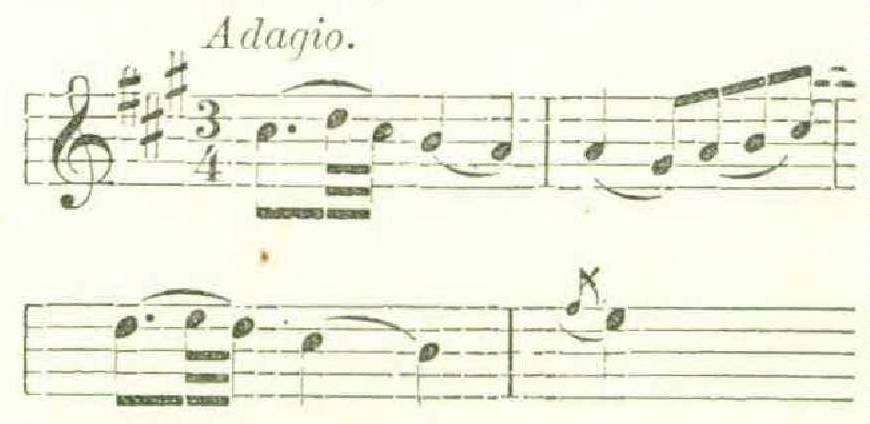
Will any one of them after playing it, or hearing it through to its “ dying close,” and feeling the while that they are dwelling in Elysium, tell me what it means, or even what it expresses? I am sure that there are very few of the thoughtful among them who would not, after brief consideration, shrink from the undertaking. Hardly less sure am I that, if half a dozen of them were to attempt it without consultation, there would be half a dozen answers. For that exquisitely beautiful conception of Haydn’s would lend itself to the expression of at least so many kinds of emotion. Why is it, when in this passage of the andante of the Cminor symphony
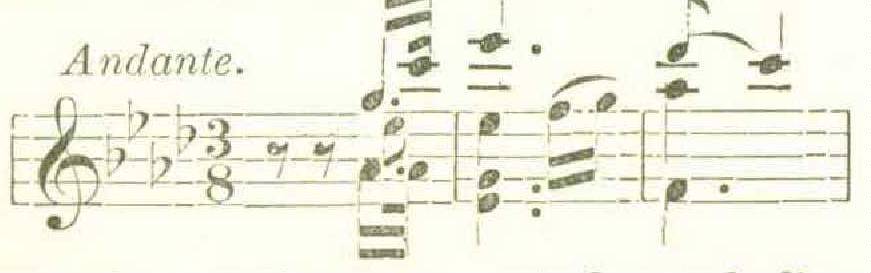
the oboe steals up to meet the coyly lingering flute, we follow with such exquisite delight its meek approach? The musician indeed may talk of passage from dominant to tonic, and suspended harmony of seventh, and inverted chord; but all that refers to mere processes of art, like the painter’s conformity to laws of perspective, or the medium in which he mixes his colors. It helps us not one whit to the knowledge of what is meant by these three notes which give us such delight. And when, at the end of this movement, the passage
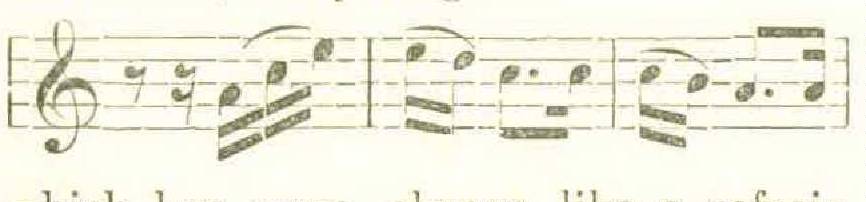
which lias come always like a refrain after the theme, comes for the last time, and instead of hearing just what we have heard so manv times before we hear
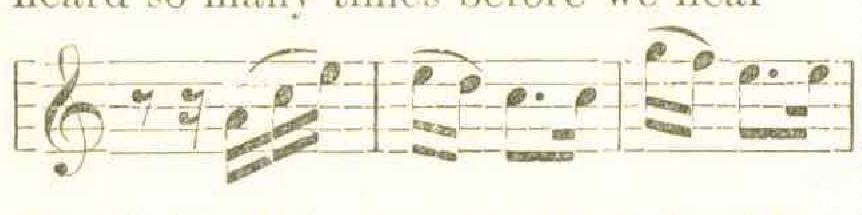
wliy is it that we are pierced with a pleasure so poignant, a delight so keen, as to seem like the dividing asunder of soul and spirit? Why, in tjie midst of the colossal majesty of tha finale of this symphony, do wo drop suddenly upon a brief and softly suggested reminiscence of the preceding scherzo ? Who can tell why? but who lias ever wished it otherwise? Could Beethoven himself have given any other reason than that so he felt it and so be willed it? He wrote a great concerto for the violin; can anyone tell what it means, even what it expresses, particularly in the second and third movements? What does Bach!S great ehacone for the same instrument mean? Did anyone, even hearing it as Wilheluij plays it, ever attach to it any meaning or any shadow of any meaning? And yet it stands and will ever stand as one of the great compositions for the greatest of musical instruments. Who that has hung with a suspense of delight almost: painful upon the long-drawn cadences of the andante of the Jupiter symphony has ever found in it a meaning, a Suggestion, a revelation, I might almost ask an expression, of any feeling or of any mood of mind? Or who, venturing upon such au interpretation, will find another enthusiast to accept his reading? What can be hoped in this respect when Schubert says of the allegretto of the seventh symphony that we hear in it the wedding march and the opening and shutting of the pew doors! Shade of Beethoven! the barriers of the grave are impregnable, or yon would have burst through them upon the world in Titanic fury at this assertion. That movement, so charged with the mystery of human sadness, so full of unresigned endurance, almost of woe, through which break at times vistas of a heaven of serenest joy! — and to have a man who is regarded as an eminent musician and critic talk to us of the slamming of pewdoors!— what hope is there for us of any satisfying musical interpretation? Let us listen, commune with our own hearts, and be still.
This difference of interpretation is itself also the consequence of a difference of organization, or at least of development, in the interpreters. It cannot be otherwise. For, as the Arab sheik said, the speaker is one and the hearer is another. Wlmt Iliindel, Mozart, or Beethoven utters, he utters for himself. Thus his own soul speaks to him what thus he speaks to his world of listeners. What they may understand depends not on him, but on them. They will feel and understand as it is given to them to do. That adagio of Haydn s, first mentioned above, one of tlie fullest in expression that he wrote, may express love, or sad* ness, or religious fervor, or placid joy, according to the organization of the hearer. We can only be sure of this: that it is an expression of beauty which sprang from a certain mood of the composer’s soul, and which will probably induce a like mood in persons of like organization to his; in others differently constituted but yet musically sensitive, other moods; but in all such persons a sense of beauty, a sensation of pleasure. For music is somewhat like a witticism, of which Shakespeare tells ns that the prosperity lies in the ear of him that hears it, never in the mouth of him that speaks it. And this difference of apprehension indicates and indeed implies also an entire inability on the part of some to apprehend and comprehend what is clear and beautiful to others. Which inability I believe to be largely congenital, and not much removable by education and culture. Carlyle says, propitiating opinion for M ilhelm Mcister: “ A picture of Raphael, a Greek statue, a play of Sophocles or Shakespeare, appears insignificant, to the unpracticed eye; and not until after long and patient and intense examination do we begin to descry the earnest features of that beauty which lias its foundation in the deepest nature of man, and will continue to be pleasing through all ages.” This theory, which is prevalent, and which appears under another form in the notion about the superior strength of acquired tastes, I do not believe in, or at. least I do not believe it to be of general application to those who have a natural capacity for art. It. lias some truth as applied to the appreciation of technical excellence, but none, I believe, in regard to the higher beauty, the imaginative, the poetic purpose of the artist. According to my observation, at the point of capacity of appreciation in this respect at which a man stands in early fffe will he stand throughout life. He may, and if he has a sensitive nature wl the capacity of observation he will, sot only advance in his appreciation of technical excellence, but confirm himself in his appreciation by study. But he who when confronted with a great work of art fails entirely to recognize its beauty is not likely to be brought to feel that beauty by reexamination.
So, at least, I have found it. In aesthetics conclusions must be chiefly drawn from one’s own experience and from tlie personal observation of others. I shall therefore, not apologize for reference to such sources of knowledge. It is well known that the C-minor symphony was rejected by the Philharmonic Society of London upon the first trial after the receipt of the score from Beethoven. Yet it is certainly on the whole the greatest work of its composer, and the greatest existing symphony. Does it require studv to appreciate it? Must there be long and patient examination to discern its beauties? I cannot think so. I grew up entirely out of the range of instrumental music, even of an inferior order. I had heard nothing orchestral but a few operatic overtures, when at about twenty years of age I heard my first symphony of any sort; and that symphony was tlie C-minor. My delight was unspeakable; and I understood ihe work, as I believe, perfectly. I afterwards by repeated hearing and by study (before two years bad passed I bad arranged this symphony from the score for piano-forte, flute, violin, and violoncello) discovered beauties of construction and of detail; but tlie poetic purpose of the work and tlie beauty of its musical ideas were as clear to me on tlie first hearing as they are to-day. My experience I believe to have been that of many others of my generation. We, if we had been a Philharmonic society, would not have thrown this score scornfully aside at the first hearing. And the number of those who are like-minded has, 1 believe, increased largely with advancing years; and that not because, or but indirectly because, of musical education and culture. 1 have found that this power of appreciation exists in others, as it did in me, entirely irrespective of cultivation or even of experience. I have had opportunities of observing two young persons who had no musical education, and who heard little or no music of any kind in their home; and they, even before they were old enough to have such musical culture as comes from social experience, took to Mozart, and even more to Beethoven, like young ducks to water. No art pleasure to them was equal to that of hearing Beethoven’s symphonies, which they understood and discussed intelligently at their first hearing of them. It is so with all art. Any person who, having the works of Shakespeare, or of Raphael and Titian within reach, does not feel and enjoy their beauty in the early years of adolescence, is not likely ever to attain to their appreciation. In music such facts as the rejection of the C-minor symphony by a body of experienced musicians, and its instant appreciation afterwards by music-lovers of no experience, show that the development of man with the progress of the ages fits one generation for the quick apprehension of that which those of an earlier generation would understand with difficulty if at all. There can be, I think, no doubt of the fineness and delicacy of Shakespeare’s musical organization; and yet I believe that if he could be brought back to earth in all the fullness of his marvelous powers, and the quick intensity of his poetic feeling, he not only would not admire, but could not be taught to apprehend a Beethoven symphony. He belonged to a different period of musical development. Therefore when I read not long since in a leading newspaper that “ the first, tiresome Beethoven symphony given in this country was played in Boston on the 10th of February, 184 1,” I did not set down the writer of the paragraph as necessarily a man of stolid nature, or as incapable of the delights of poetry and art. I merely saw that his physical organization did not make him sensible to the pleasure of the higher music; and in that he not impossibly might find fellowship with Tennyson and Thackeray and Ruskin.
How, then, is it to be known that certain music is higher than other music? that what some persons, who perhaps have to a certain degree a pleasure in music, regard as a tiresome Beethoven symphony is really a grand work of art? I can only tell how I know it. 1 remember one afternoon when I was going about depressed in gloom, my heart like lead, weary of my life; there came into my mind suddenly, T know not why, I know not how, that mighty passage in the first movement of the C-minor symphony, beginning
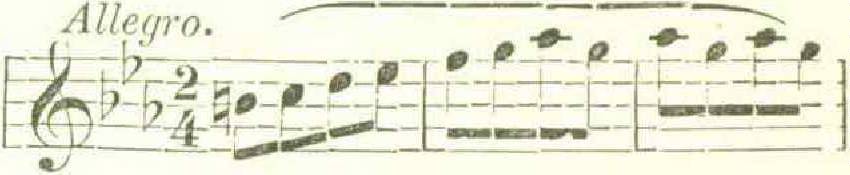
and ending after about seventy bars with a return to the dominant theme of the movement. I had not heard the symphony, or indeed music of any kind, for some years; but this passage on the instant took possession of me as if it were uttered from the clouds, and kept possession of me all that afternoon and night until I slept, tramping through my brain with heroic tread; and it set me up like a tonic, so that the next day I was a man again, fit lor work. But non-musical people might say this was purely personal to me; besides, I myself can see that the entrance of the passage into my mind might have been a consequence rather than a cause,—the accompaniment of a nervous reaction. Even in that ease, however, the character of the passage receives an illustration from my experience. I have said that I can do no more than tell my readers how I know that certain music is great, and that other, in which many people find pleasure, is not. Of the beauty of this music, I mean that of Bach, Handel, Haydn, Mozart, and Beethoven, and particularly of the second, the fourth, and the fifth, and of that of some of the elder Italian composers, I cannot dispute. It is a final fact, which 1 accept without question, as I accept the pleasure to my eye of red upon blue. I am content with this final fact. But, moreover, this music awakens in me, and in others of like musical sensibility, certain sensations or emotions ; and because 1 feel that these sensations or emotions of pleasure elevate me and are of the same grade as those which I receive from the poetry of Shakespeare and Dante, and the greater works of Raphael, Titian, and Michael Angelo, I rate the works to which I owe these musical sensations as of the same grade in art as those others to the effects of which theirs conform. I admit that although I have thought of the matter much, I can give no other reason for mv belief in the superiority of the works if those musical composers.
This reason, however, will show that the acceptance of the opinion that musical sensibility is the result of physical organization, and that music is without intellectual or moral purpose or significance, does not imply a degrading judgment of the art. For it bestows upon the large number of those who are susceptible to it a pleasure so great, so invigorating, and so innocent that it adds largely to the sum of human happiness. And as all happiness gives elevation to man’s character and dignifies his life, music has thus indirectly a moral value.
Richard Grant White.
- As to the unreason and utter lack of meaning vn the phrase “ the exception which proves the rule,” as commonly used, see Words and their Uses, Appendix.↩