Principles of Criticism
THE value that men have set upon art and literature proves that these have ministered to some deep-seated and permanent human desire. What is this desire ? Or if there be more than one, which is the deepest seated and most permanent — in other words, the paramount — desire? The true answer to this question, if we can discover it, must furnish us with a much-needed test for literary and art values. It must, in short, furnish a basis, and the only correct basis, for the criticism of all literary and art products.
For, obviously, before we are in a position to determine the worth of a thing, or the relative worth of any two or three things of the same general sort, we have to inquire, What purpose is this thing intended to serve ? What is it expected to do ?
Now it is precisely on this point that there seem to have been very confused ideas among critics, — and by this is not meant professional critics only, but all those who have attempted, either for themselves or for others, to form correct estimates of the value, or comparative values, of works of literature and art. Professional critics, especially (for it is they, especially, who have seemed to feel that they must not trust to their instincts, which would often have done better for them, but must make at least a show of having some well-understood basis of critical principles), have apparently been in a position not unlike that of a layman at some mechanics’ fair, who undertakes to pass judgment on a machine of whose purpose and uses he has next to no idea.
Perhaps the novel and the poem have been the most conspicuous examples of this failure, on the part of ordinary criticism, to base itself on any clear understanding of what these forms of the literary art are essentially for. One novel will be praised on the ground that it has a moral purpose, another on the ground (as by that distinguished critic, M. Taine) that it has not a moral purpose ; one on the ground that it paints actual facts from the life, another on the ground that it depicts an ideal world ; one on the ground that it gives pleasure, another on the ground that it gives information : and so on. If the novel has not all these objects in view (and some of them are a little inconsistent with each other), which of them has it ? And if several of them, which object is the essential one, — the one which being accomplished, the novel cannot be a thoroughly poor one, or which being unaccomplished, it cannot be a thoroughly good one ?
So with the poem. The reason that the critics have, through all time, been so ludicrously incapable of making an estimate of any given work of poetry (except in the case of an imitation, where a verdict on the original had already been furnished them) that should be corroborated, unless through accident, by the test of time is that there has been no clear and well-settled opinion as to the true purpose of the poetic art. Is it to move us to “ pity and terror,” and at the same time do to these feelings some ambiguous thing which Greek scholars never have been exactly able to make out, as Aristotle said ; or, is it to “ please,” as everybody else has always said, till De Quincey blew one of his withering blasts at that shallow notion, but as the average critic apparently still continues to believe ? Is its true function best fulfilled by being so intelligible that everybody can understand it, or by being so unintelligible that nobody can, except the poet himself, and he only before it gets cold ? Is it true that a poem cannot be a true poem unless it is “ short; ” or are we still permitted to believe that the Iliad is, after all, a sort of poem ?
In seeking for reliable principles on which just criticism may be based, we must, if possible, find those which are broad enough to include all art. Otherwise we should suspect them of not being fundamental principles. For literature is, in fact, one of the fine arts. Not everything that is written, of course, belongs to literature proper ; but when a written product becomes a part of what has well enough been called belleslettres, — as a poem, for example, in contradistinction from a Patent Office Report, — it belongs to the art of literature, and is closely allied to the other fine arts ; giving us, like them, that immediate and direct satisfaction of a high order which we call aesthetic pleasure, or delight. Literature, as we shall see, gives us much more than this, but this it gives us in common with the other arts.
If, then, we ask for a test or criterion for art in general, the reply may be made, The true test is that it shall be beautiful. But the underlying question is. What is “ beauty,” and what things are “ beautiful ” ?
Evidently beauty is not a simple quality, apprehended by a distinct inner sense, the “ sense of beauty,” though it has sometimes crudely been so considered. It is plain enough, on inflection, that beauty is a complex thing, and requires analysis. All great works of art, and especially of the literary art, are more than merely beautiful, but we may first of all investigate this quality.
Let us take, to begin with, as the simplest of the arts, that of visible form. Its simplest element is the line ; then the curved line, as of the mountain or wave outline. Its highest and most complex product is the statue, or group of statuary.
The writers on aesthetics, in their attempts to furnish an analysis of the beautiful, have seemed to hover at a greater or less distance around a central idea, none — unless it be Mr. Herbert Spencer, whose views have been expressed only in scattered suggestions — precisely hitting it, and yet few being far away from it. We mean the idea that beauty gives us activity of mind and feeling. Hogarth, for example, speaks of the quality of variety in lines as an element of their beauty. The waving line, or undulating curve, he calls especially the “ line of beauty,” because it gives the eye much variety of direction without displeasing it (without hindering it, we should prefer to say) by sudden changes of direction. Sir William Hamilton, in likewise attributing the effect of beauty to the union of variety with unity, explains our delight in it by the fact of its giving full play at once to the imagination through variety, and to the understanding through unity. Alison, attributing the entire effect to the association of ideas, makes beauty to consist in the power of giving active emotions, as of cheerfulness or sadness, and of awakening trains of corresponding ideas in the mind. Mr. James Sully points out the imperfection of this theory in its exclusion of the element of direct aesthetic pleasure derived from color, form, or tone. Mr. Herbert Spencer, following a hint derived from Schiller, considers the aesthetic activities to be essentially the play of the mind. He grades aesthetic pleasures according to the number of powers called into activity : the lowest being the pleasure of mere sensation, as from tone or color ; next, the pleasure of perception, as from combinations of color, or symmetries of form ; and highest, the pleasure of the aesthetic sentiments proper, composed of multitudinous emotions excited in the mind by associations, some of them reaching far back in the race experience of man.
The central idea, round which these and other theories cluster, is that of increased activity as the essential effect of beauty on the mind.
In the two arts of form and of tone, the simplest elements — the straight line and the single tone — may be considered as correspondent. For the tone differs from mere noise in being produced by periodic vibrations, so that in its apprehension our consciousness is continuous ; whereas in hearing a mere noise, owing to the interferences of the jumbled vibrations, our consciousness is interrupted and intermittent. Precisely so, an irregular and confused multitude of dots made by the pencil on paper would be a noise in visible form ; while a continuous row of dots, that is to say a straight line, would be a tone in form. In the tone as in the line the consciousness is unhindered and continuous. Again, just as we may have a noise of tones which, although musical tones separately, are clashed together in discord, so we may have a noise, so to speak, of lines clean and straight in themselves, but thrown into a tangled mass which the eye cannot follow.
Rising a step higher, we have the curve in form, answering to the melody in music. In either case, its effect is a succession of changes of impression, but of such a nature that the consciousness may be continuous in apprehending them. A jagged and irregularly angular line, on the other hand, would correspond to a haphazard succession of tones, regardless of the conditions of melodious arrangement, since both produce checks and interruptions of the flowing continuity of consciousness. Hogarth’s line of beauty, in other words, is the pleasantest melody of form, because it gives to conscious apprehension the greatest total of sight activity without check.
But a harmony, whether of audible tones or of visible forms, is still more delightful than a melody. Such a harmony of forms we get in the symmetry of two curves above and below a horizontal line, as in the arch of a bridge reflected in a stream, or on the two sides of a vertical line, as in the shapely tree. Its simplest elements might be represented thus : —
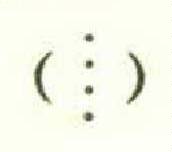
More graceful still is the symmetry of two undulating curves, answering to each other, and thus furnishing both melody and harmony. And this brings us to the elements of one of the beautiful forms of ancient art. For, joining the extremities of the two curves, we have the vase. If now we add to each side another answering pair of such curves, we have it with the double arms of the Greek amphora. And if we add still another such pair at the top, we have reached a hint of the very outlines of that winch we consider the most graceful of all forms, the human figure. For it would require but slight touches to suggest the head and the veritable arms and limbs of the statue.
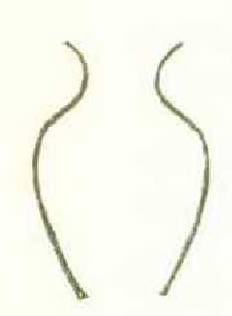
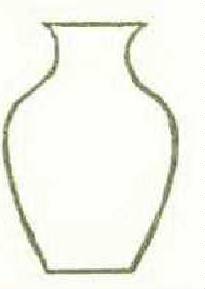
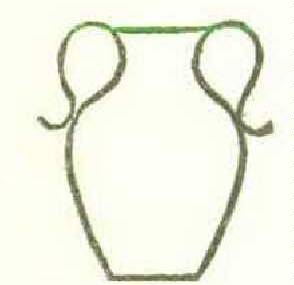
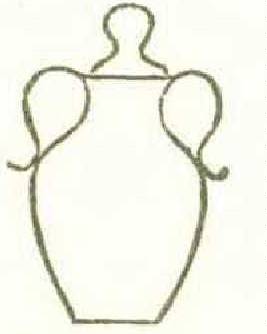
No doubt there is much in the beauty of the human form besides the mere symmetry of graceful lines ; much that depends on the association of ideas, as, for example, the suggestion of force and activity in muscular curves, —
That sweeping downward breathe, in rest, of motion.”
The important thing to notice is that just as the simple grace of the mere outlines is explicable through their ministering to sight activity, so the complex beauty is woven of a thousand threads of vague suggestion, all linked with ideas-of health and strength and mysterious life-functions, and so all centring in the satisfaction of the one desire for full existence.
But complex as the quality of beauty is in the actual human figure, it is even more so in the work of plastic art. A statue which was merely an exact copy of life — a photograph in marble — would not by any means give us all the æsthetic delight of which art is capable. In fact, it would not be art at all. It is only when the artist bodies forth some conception of his own mind that we are greatly stirred. Then, besides the immediate beauty of the melodies and harmonies of lines, and the mediate beauty, through associated ideas, of the supple and forceful forms, we have in some pathetic or heroic group in marble a world of quickened thoughts and feelings. In one of Wilhelm von Humboldt’s Letters to a Lady, he says, —
“ The beauty of a work of art is, for the very reason that it is a work of art, much freer from imperfections than nature, and never excites selfish emotions. We observe it attentively, we wonder at it more and more, but we do not form any connection between it and ourselves. To the beauty of sculpture applies what Goethe has said so finely of the stars : ‘ We never desire the stars, although we take such pleasure in their light.’ ”
Now the explanation of this superiority of art to nature, aesthetically, is to be found in the fact that any personal relation to self narrows and lessens the spiritual activity. And the same explanation is applicable to the connection of aesthetic pleasures with the play impulse. For the compelling of any impulse toward the accomplishment of some set purpose must confine its force. The stream of spiritual activity is controlled into some single channel, and there is no longer that free swing of all the powers which is the essence both of “ play ” and of aesthetic delight. In other words, if we enjoy play more than work, and art more than nature, it is because we have through their means a greater total of conscious life.
The art of tone has this advantage over the arts of painting and sculpture as the direct source of power upon the spirit, that music is a natural and universal means of expression. There can never be “ symphonies of color,” as has been imagined, for the reason that nowhere in the world is color naturally (as distinguished from artistically) employed to express anything. Tone, on the contrary, is universally so employed. Mr. Spencer, in his Essay on the Origin of Music, and elsewhere, has admirably shown how this expressive use of tone runs through all the higher grades of the animal kingdom. When the dog barks or howls, and the bird pipes or complains, and the child sings or cries, it is the beginning of music. For it is the beginning of the use of tones to express feeling. Ordinary human speech is not speech alone, conveying ideas, but music as well, conveying feeling. If we listen to an animated conversation from an adjoining room, where the articulation of words is not quite audible, we shall find that it is song, rather than speech, that we hear. The voices go up and down the gamut, the intervals and the tempo increasing or diminishing as the feeling changes. The staccato, highkeyed utterances of pleasure ; the slow, minor cadences of sorrow ; the deep monotone of determination ; the tremolo of passion, — all these are nothing but the song within the speech. Whenever speech ceases to convey merely cold intellectual ideas, and becomes emotional, the voice tends more and more toward song, ranging more widely through the gamut, and taking on the cadences of music proper. Perhaps even among the very elements of speech, in the vowels, namely, we have the beginnings of music as expressive of feeling. For while the consonants seem to be mere checks or interruptions of the breath, expressing the limitation of our consciousness to definite ideas, the vowels are pure tones, each having a natural pitch of its own (which one may readily detect by whispering them loudly), and expressing the play of feeling upon these ideas. This may possibly help to explain the ablaut, or change of vowel to express tense in the verb ; as, sing, sang, sung. We do not overlook the theory which explains this by the effect of the ancient reduplication ; but it sometimes happens in philology, as in society, that one cause gives rise to a form, and another makes it permanent. At any rate, the present fact is that, while the consonants remain the same in the different tenses in this example, as expressing the unchanged idea of the action, the vowels change, as the attitude or feeling of the mind toward the action changes, whether present, or just finished, or wholly past.
The reason, then, that music has a much greater direct power over the feelings than any other art is that music alone is based on a natural means of emotional expression. But its power of expression does not stop with the feelings. Inextricably bound up with every human feeling is a host of ideas associated with it in the mind, — for every feeling a host of ideas, for the reason that the possible feelings are few, while ideas are innumerable. Accordingly, music, whose power of direct expression is almost limited to the emotions, expresse different ideas to different persons, — or to ourselves at different times,—according as the particular emotion is associated in experience with one set of ideas or another. The sonata which to an Alpine goatherd would express a thunder-storm among rocky peaks to a sailor might with equal distinctness express a tempest at sea. The larger and deeper the life experience of the listener, the more a symphony will mean to him in ideas ; or the fuller his emotional endowment, the more it will mean to him in feeling, — always provided that it is a great work, a work of genius, to which he listens. Of course much can some out of a symphony only if much originally went into it.
The secret of all art is then within the reach of our hand when we have realized one single fact concerning man. As we look out upon life we see its myriad activities all springing from certain desires. But there is one desire among them which is permanent, and paramount to all. It is not the desire for mere pleasure, for it often overrides that ; it is not the desire for mere happiness, even, for it often overrides that. It is the desire for life : not the poor negative desire to escape death and cling to existence, merely, but the aspiration for full and abounding life. To be alive in every faculty ; to have the greatest possible total of conscious being, in physical impression and effect, in intellectual force and grasp, in emotional glow, in the out-stream of the active will ; in short, completely to be and live, this is the one paramount human desire. There is only one thing we really dread : it is death. There is only one thing we really desire : it is life.
And now where is there to be found a perpetual source of this power and activity that we perpetually desire ? Nowhere but in the expressed power and activity of other human spirits, — and that is art.
We have seen that in their very elements the arts are based on the ability to satisfy this desire. For the beauty of form consists in giving the sense of sight its greatest total of unchecked apprehension ; and the beauty of tone, both in those consecutive harmonies which we call melodies and in massed harmonies, in giving the sense of hearing its greatest total of uninterrupted impression. And when we pass beyond mere sensuous delight we find the same essential effect — but on the mind now, and the whole soul — from the ideas and feelings expressed by the artist.
The test, then, for all art is that, expressing much life, it shall give much life. That painting, statue, symphony, is the greatest which adds the greatest total to our conscious existence. But we must mark well a distinction here. There are higher and lower grades or planes of existence. But by what test ? By no other than this same test, — their tendency for or against renewed and increased life in the whole nature. That pleasure is low which tends to belittle the nature ; that one is high which tends to enlarge it. That art is low which only stimulates feelings and ideas most apt to brutalize ; that is to say, to restrict and narrow (for that is the distinction between brute and man, — the one little, the other large, in powers and possibilities). That art is high which awakens feelings and ideas that are vital with tendencies toward more and still more of attainment and being.
And here we see the distinction between mere prettiness and genuine beauty. A patch of color on the wall may be called pretty, as pleasing the color sense alone ; still more so, if it gratifies also the form sense by its outline. But it falls short of beauty because it fails to awaken in us any of the higher activities of our inner nature. Decorative art is only pretty ; it touches but the surface of the mind. Decorative poetry, in the same way, suggests only pretty images of color or form. We pass along a picture gallery, or we turn the leaves of a volume of verse. As we pause before some painting, or some poem, the question is, What does this give me ? It may be that it gives the imagination some pretty image of nature. This is something. It may be that it gives the feeling, also, some touch of suggested peace or tranquillity. That is more. But if it be a great picture, or a great poem, the whole spirit in us is quickened to renewed life. Not only our sense of color and form, our perception of harmonious relations, but our interest in some crisis of human destiny, our thought concerning this, a hundred mingled streams of fancy and reflection and will impulse, are set flowing in us ; because all this was present in the man of genius who produced the work, and because his “ expression ” of it there means the carrying of it over from his spirit into ours. If it is a work of the very greatest rank, we are more, from that moment and forever. For out of the life the artist or the poet has given us will be born successive new accessions of life perpetually.
The art of literature is the highest of the arts because its power of expression is greatest. The effect of music may be more intense, at a given moment, but its range is not so wide, nor its effect so enduring. And poetry is the highest form of the literary art, by our test, as having the fullest expressive power ; since it not only expresses thought, like prose, but feeling also.
That poetry contains in itself the elements of the lower arts a moment’s reflection will show. In the first place, it contains the elements of the arts of form, of which sculpture is the purest example. For it conveys a troop of images, appealing to the inner eye, instead of the outer. In the second place, poetry contains the elements of music. For in its rhythm, its rhyme, its music of many sorts, a succession of melodies and harmonies are heard ; by the inner ear, when read silently, or by the outer, when read aloud. The verse form is most fitly used, therefore, when it is used for the expression of thought and feeling together ; of thought, in other words, which is aglow with feeling, and feeling which is illuminated by thought. It is equally an impertinence to use the verse form — that is, the musical form — for dry, cold ideas, or for mere vague feeling, unlighted by thought. The former is for speech unaccompanied by music ; the latter is for music unaccompanied by speech. A man may say — not sing — a mathematical demonstration ; he may sing — not say — an outburst of emotion. For this reason, instruments are better than voices for great music. Or if the voice must be used, it is best if the words are in a foreign tongue which is unfamiliar to the listener. In this way the speech element of an opera, nearly always foolish, is concealed ; and the music element, when really good, has its opportunity. It is conceivable, to be sure, that there might be (as Wagner dreamed and seemed on the verge of accomplishing) an action so high, expressed in speech so noble and significant, that it would not belittle its accompanying music in making it limited and definite in its suggestion. A good deal of our modern verse errs in the reverse direction ; that is to say, it is mere music, — flowing rhythm, and sounding rhymes, and a pretty babble of insignificant “ words, words, words,” — expressive, thus, of some vague atmosphere of feeling, without any thought. But this would have been more fitly expressed in music proper ; it is only a part, and the lesser part, of the requirement in poetry.
In illustration of the statement that poetry contains in itself the elements of the arts of form, as giving a succession of beautiful images, we may take a single passage from Longfellow’s Evangeline. Here, close together (using the poet’s own words), we have the morning of June with its music and sunshine, the gleam of water, the silvery sand-bars, the dusky arch and trailing mosses of the cypress, the moonlight indistinctly gleaming through the ruined cedars, the pendulous stairs of the grape-vines with humming-birds rising and descending, the measureless prairie at night with the fireflies floating above it, the southward rivers running to the sea side by side like the great chords of a harp in loud and solemn vibrations. Moreover, each idea brings with it to the mind a complex of associated thought and emotion ; and not merely from our own individual life experience. The human race has come a long way. As we read the line in the Lady of the Lake,
it is not alone the intrinsic beauty of the scene that interests us. We could imitate the effect, so far as the bodily eye is concerned, by a candle glancing on a scrap of crinkled tin. Nor is it any definite association of our own past enjoyment in connection with such a scene. There are associations — as Mr. Herbert Spencer has pointed out— too vague and dim to define ; faint reverberations of whole aeons of human, and perhaps of animal, experience. The deep forest was once full of the dread of unknown dangers and the expectancy of unknown delights ; the shadow of the mountain had for man the chill of supernatural visitations ; by the moonlit rill the savage — and, ages before, the wilder creature of the woods — sought and slew his prey, or sought and won his mate.
To illustrate the inclusion of the elements of the art of tone, also, in poetry, we may take the same poem, Evangeline. To begin with, the metre is music. The accents, following each other in rhythmical order, give us not only the element of time, such as a metronome would give, but a veritable tune, as well. If we recite the line, —
we find not only that it is capable of being written in bars of ⅜ time, with eighth and dotted eighth and sixteenth notes, but that the accented tones are given on a different pitch, each dactyl making a cadence, or phrase, of three different tones.
These lines of English hexameter (that is, accent hexameter) seem to follow each other like ocean waves on the shore. The first half of the line is the wave rolling in ; then it pauses, toppling into a crest, and crumbles down into foam in the last half. As we might represent it, —
So wave after wave of the sonorous verse rolls in, timing itself (as Dr. Holmes suggests of another metre) to the very ebb and flow of our blood and our breathing : a phrase to each pulsebeat, and a line to each breath.
The rhyme system of verse, again, is entirely music. There are three sets of rhymes, in reality : the initial, or consonant rhyme (or alliteration) ; the medial rhyme, or chime of the vowels in the interior of the words ; and the final rhyme. We may note, first of all, that as in rhythm, so in rhyme, we have the principle that lies at the foundation of music, — unity in variety ; the greatest total of conscious impression being received through chords, — that is, through a variety of tones made possible to apprehend by their relations of agreement, or unity. If we take the old couplet (which is truly poetry, too, as being wise as well as musical),
Is the burden of my song,”
we notice first, as most obvious, the final rhyme. The books define rhyme badly, as being the agreement between two sounds. That really makes but half a rhyme. We must have the difference, as well as the agreement ; the variety, as well as the unity. In other words, ong and ong. in this example, are not rhymes : they are identical sounds ; they constitute a unison, not a harmony. But long and song are rhymes, since now a different consonant precedes each.
The initial rhyme involves the same principle, only reversed ; the unity being now in the consonants, the variety in the following sounds. The important part which this initial rhyme plays in verse is often overlooked, from the circumstance that the alliteration is so commonly concealed ; as in this line : —
The r of rest rhymes with the r of already, the l of slumber with the l of longed, and the s of beside with the s of slumber, though all these are concealed to the eye by not being visibly initial letters. This consonant rhyme, by the way, addresses the mind as well as the ear (as might be expected from the more intellectual character of the consonants) ; the alliteration in good verse always striking the emphatic syllable, and (as Mr. John Earle neatly expresses it) marking out to the mind “ the crests of the thought,” as in the line just quoted.
The medial rhyme, or chime of interior vowels, also plays a concealed part in the music of the best verse. Taking again the couplet, “ Love me little,” etc., if we utter the vowels alone we shall hear their chime. Moreover, since each vowel has a natural pitch of its own, by whispering the vowels in these lines vigorously, we shall hear a distinct tune of different notes, which might be written upon a staff in musical notation.
The best verse in which to study these various musical elements is that of Mother Goose. And this for two reasons : first, because it is a kind of profanation to make a corpus vilum of good poetry for dissection ; and secondly, because the lines of Mother Goose have been preserved purely on account of this very perfection of musical form, having had no other, or little other, raison d’être. Out of thousands of jingles repeated to children, the fittest only have survived, and these are, accordingly, very perfect specimens so far as the outer shell of poetry is concerned. A college class, for example, in studying verse with a thoroughly scientific analysis, could not do better than to provide themselves with copies of this immortal bard for class-room use. If one were to exhaust completely the possibilities of analysis of, say, this quatrain,
And a jolly old soul was he ;
He called for his pipe, and he called for his bowl,
And he called for his fiddlers three,”
he would know a great deal about the very imperfectly understood science of English verse.1
But a genuine poem, while containing (by its images to the inner eye, and its music to the inner ear) these elements of the lower arts, goes beyond them in expressing more fully than any other form has been found able to do the soul of the writer to the soul of the reader. In this way it stands as the highest species of its own — which is the highest — genus, the art of literature. And the other — the prose — forms of literature must be ranked precisely according to this power of expressiveness.
We might draw off in a tabular scheme the different forms of literature, classified on this basis. At the bottom we should have those written works which are books, indeed, but not yet literature ; as the almanac, the arithmetic, the receipt-book, the text-book on natural science. These, and a vast number of others, do not belong to the art of literature, or to literature proper, simply because they do not express the writer, and therefore have no power (to come back to our test of criticism) to stir or quicken the reader. They are merely fact-books. Rising a little higher in our table of forms, we may put down certain books which, though still fact-books, begin to convey something also of the observer’s own personality. Such are certain books of travel, or of the higher natural science. They begin to be literature, because they begin to be humanly expressive. A little higher in our tabular scheme will come books of human science, wherein the writer is more apt to give something of himself (not narrowly, as an individual, but as one representing universal human nature) together with his objective results. Especially is this true as we rise into the region of the profounder human problems, where our books are fact-books, to be sure, but the “ facts ” are now of such breadth and importance that we incline rather to call them “ truths.”
More and more fitly may those works be called truth-books as we rise to the region of literature proper. Here, also, we classify and rank according to expressive power. The essay expresses more than the history, because the writer is more free to reveal his own inner life in his work ; and it contributes to us, of course, just in proportion to what it takes from him. The more life goes in, the more life comes out. And above the essay ranks fiction, on this same ground. And among the different forms of fiction the novel stands the highest, as being the epitome, not only of what the writer has seen, but of what the writer has lived, and been, and now is. Highest of all, as we have said, is the poem ; because here the writer felt the most freedom, and could therefore exert the most power. Keble was perhaps the first to point out that the verse form is not only a concealer, but a revealer. That is to say, it reveals just because the writer felt that he was concealed. The mask becomes itself the most transparent sort of window.
And which form of poetry shall we set highest, by our test, — the narrative, the dramatic, or the lyric ?
We may be helped to answer this by observing a fact, which is either a mere coincidence, or goes far to corroborate our view of the true basis of our valuation of literature. It is the fact that just in proportion with the increase of expressive power, in our tabulated scheme of literary forms, goes also an increase in permanence of value in the world. The mere fact-books are superseded, and become valueless. The truthbooks become more and more of permanent value as we rise to their higher regions. And we are most apt to find that the thing that has survived time and storm in the world’s shifting history is some frail bit of a lyric poem ; because this holds in its crystalline heart the life of a man ; and when we are dead — or half dead — spiritually, out breaks again from the heart of the crystal that spark of abounding life which is the thing that of all others we desire.
When a mind expresses in a book its mere perception of some external object, it is not yet literature. Before the same object every one’s perception, if normal, would be the same. The expression of it in writing can add nothing to our inner life beyond what the object itself would add.2 It is only when the writer, like the coral insect, builds himself into bis work, expressing inner states of thought, feeling, or purpose, either of his own individuality, or, best of all, of the universal human being, that the book becomes literature. Literature, for this reason, always has a “ style : ” an expression characteristic of the man, the reflex of something his own ; through which, at least, the truth — however universal — had to pass. As in other arts, if a painter exactly represented an actual laughing child, or if a musician exactly copied the wailing of a hurt child, it would not yet be art, for it would convey nothing to us beyond what the external object itself would convey, so in literature, if a poet exactly paints in words a white rose, it may be very pretty, but it is not yet a genuine poem. But let him give us the rose, plus his feeling and thought about it, — sincerely his, but based on what is ours also, and man’s universally, — and it is a poem. Or let it be a fact instead of an object, — say, the falling of an apple to the ground in a garden. When a writer describes it just as it is, and nothing beyond it, we say it is a “ fact ” that the apple falls. When he gives it to us plus some activity of his reason which links it with the revolving moon, expressing now the law of universal gravitation, we say it is a great “ truth.” And if, in its expression, he adds also the free play of his own mind and feeling upon it, he may give us a work of pure literature ; perhaps — most likely, in this case — a lyric poem.
The secret of all art, then, is simply this open secret : that it is the giver of what we most of all desire, abounding life. It draws upon an inexhaustible supply. For it is not merely the artist’s own individual spirit which is imparted to us ; the greater the genius, the more deeply his fountain drinks of the tides of the common humanity. And it is genius alone that knows to stir in us those truths, emotions, impulses, that are wrought into our inmost being by the long race experience. We are seldom thoroughly awake and alive. Like the little fitful spire of violet flame that we sometimes see hovering and playing over the surface of a coal fire, so our consciousness plays about the different tracts of the otherwise dormant mind : now here, now there ; now sensation, now memory, now one or another of the emotions, starts for the instant into fluttering life, then darkens back into unconsciousness. What we desire is the glow and illumination of the whole spirit ; and it is art, and especially the literary art, that best ministers to this desire.
It is not enough that a picture, or a novel, or a poem, should move us : the question is, What does it move in us ? How much of the whole possible range of our inner life does it awaken ? Nor is mere intensity of impression any sufficient test. For one must inquire, Whither does this tend, — toward further renewal of full existence, or toward reaction and stagnation ? Some feelings are kindled only to smoulder away and leave dead ashes on an empty hearth within the spirit ; others tend to kindle on and on, awakening thought, rousing to vigorous action. Nor are the most easily moved activities always the most important ones in the effect of art and literature. Laughter and tears lie on the surface of the mind : the gleam and the dusk may interchange quickly at any passing cloud. It is the great motive powers down deep in the soul that most contribute to abounding life, and whose awakening most surely proves the presence of genius : the sense of right and justice ; the feelings of pity, awe, aspiration ; love, too, — not the sodden sort of love, which is dear to the decorative poets in their maudlin moods, but mother-love, and father-love, and menschen-liebe, and love of friend, and lover’s love, that desires not selfish possession, but the infinite welfare of its object, and for this will die or will live.
The test, then, for literature, as for all art, is its life-giving power. In the essay, for example, perfection would consist in giving us, through that free and unpremeditated play of the whole bevy of spiritual faculties (which is the characteristic of this literary form), the widest excursions possible to the mind’s lighter and leisure hours. In the novel, it would consist in imparting to us profound life-truths, pure emotions, noble intentions, in connection with the opportunity to re live, or live in imagination, the most significant experiences of human existence. In the poem, the requirement is that it shall be full of lovely images, that it shall be in every way musical, that it shall bring about us troops of high and pure associations, — the very words so chosen that they come “ trailing clouds of glory ” in their suggestiveness ; and in its matter, that it shall bring us both thought and feeling, for whose intermingling the musical form of speech alone is fitted ; and that, coming from a pure and rich nature, it shall leave us purer and richer than it found us.
Wordsworth said a profound thing, and said it very simply, as he knew how to do, when he gave as the criterion of a book that “ it should make us wiser, better, or happier.”And if it be the greatest sort of book, will it not do all three ?
E. R. Sill.
- The work of Sidney Lanier on English verse may be recommended as the only one that has ever made any approach to a rational view of the subject. Nor are the standard ones overlooked in making this assertion.↩
- This bears on the question of the comparative values of natural science and the humanities in education. A fish in a book can be expected to go no farther toward educating a mind than a fish in a pool. It can stimulate observation, and attract a dormant attention, and reveal many interesting facts about the non-human world, but that is all. Whereas a man’s life in a book can renew and increase the whole intellectual and spiritual life.↩