The Lark and the Gamut
—While I lived in town I knew, through occasional walks, the lark just enough to distinguish its song from that of other birds in a general and indefinite way. But since I have spent a few weeks in the country, where I hear these birds all day and every day, I have been not a little struck by the observation that their melodies, though very short, are not only numerous, but can in most cases be correctly reduced to our present human system of notes.
There is greater wealth and more poetry and nobility in the tones of a nightingale, but this nobleman does not seem to visit Colorado ; and the timbre of the lark’s voice is so sonorous and its modulation so great that it is, from an æsthetic standpoint, decidedly king among the birds of this region.
The bird of which I am speaking here is not the same known as the lark at the East. It seems to have its home in the Mississippi Valley as far as the Rocky Mountains. Here it is known as the “ meadow lark.” and is probably what ornithologists call Alauda magna, for it is decidedly larger than other larks. It has a grayish-brown plumage, the breast being of a dull yellow.
Early in the morning the lark begins with a loud call, —
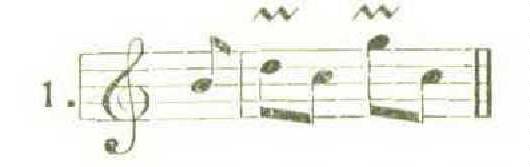
as if to say, “ Why do you sleep yet ? ” And after repeating this several times he follows it up with
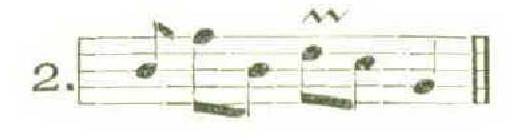
meaning, perhaps, “The sun has risen now ! ” But I have not yet mastered Volapük, much less the language of the birds, and will only try to render, so far as I can, their notes intelligible, without attempting further to suggest possible words to them.
Next to the forms given comes a song which begins with two high notes, the second a minor third above the first; but these are followed by an indefinite gay warble or twitter, which defies all attempts at musical notation.
When, during a walk, I approach a lark sitting on a fence or tree, he generally gives a sharp " jip " at intervals of a few seconds, which may possibly be a warning to his family hidden in their nest near by. Another single tone is a sweet, coaxing “ tioo,” which sounds as if he were inviting his mate to join him.
In most of their tunes the larks give a shake to the accented notes, or precede them by a grace-note ; for instance : —
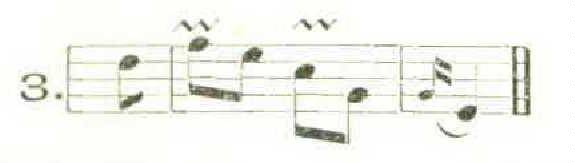
The following few notes, which form a short but complete musical thought, and which I have heard only a few times,
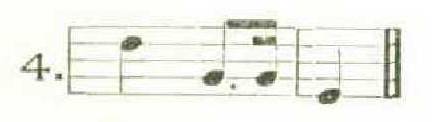
seem to be a theme which they develop to several variations, some of which are heard much oftener than the plain theme. I will give only a few of them : —
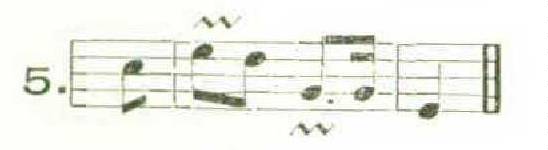

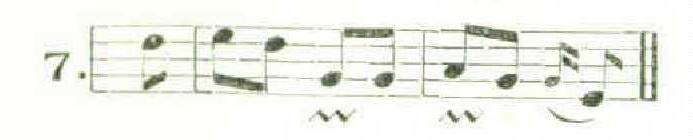
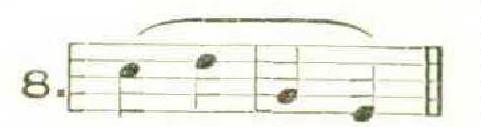
(My notation of these tunes must not mislead the reader to think the lark sings always in the key of C. I use this key throughout merely for the sake of simplicity.) The same thought as in No. 4 appears, though rarely, in even, well-drawn notes, without any shake or other ornament; changing that which in the other variations had been a gay allegro to a sedate andante, and suggesting the tastefully handled bow of a ’cello : —
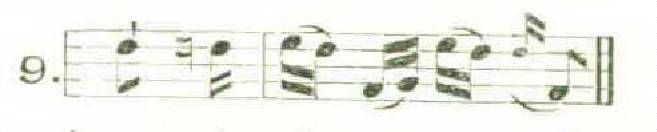
While these variations, like the theme, close with the tonic chord, one lark transfers it to the dominant: —
The dominant chord seems, on the whole, to be their favorite; and it was a severaltimes - repeated dominant seventh chord that first attracted my attention to the melodious character of the lark’s song, and that I hear just, now as I am writing this down. In the form
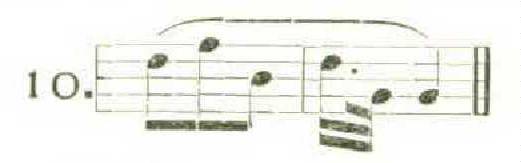
it is one of the most common songs among them; and equally common is the following, which, beginning a third lower, and proceeding by the same rhythm and the same general intervals, but on the same scale, becomes a minor seventh chord ; —
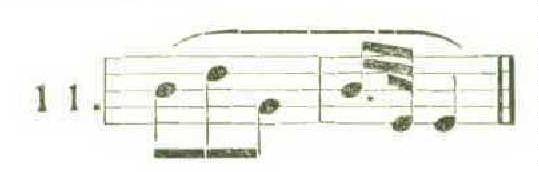
On the other hand, sometimes, though quite rarely, the bird begins a third higher than in No. 10, and thus reaches the dominant ninth chord : —
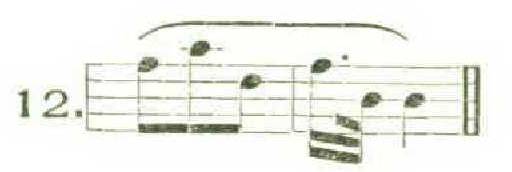
Every musician knows the peculiar character of this chord, which seems born of an exuberant joy or of an irresistible longing to rise from this mundane dust to freedom in a higher sphere. Some such feeling is, more than by No. 12, suggested by another division of this chord : —
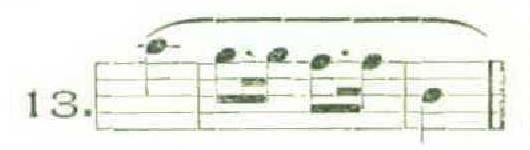
Frequently, of an evening, I pass a little grove, and there abides the only bird from which I have heard this last melody. Though I have never seen it, I know by the timbre of the voice and the vigor of the tone that it is a lark. His song sounds like a hymn of praise, thanking Nature for the joy, peace, and liberty of life.
There is no doubt that individual larks have different tunes, as some which I always hear around my house I do not bear elsewhere, and vice versa ; but most, if not all, larks sing several tunes. One day, after having, on the preceding evening, heard that last melody in the dominant ninth chord, I heard, though at another point, what may be called the answer to it: —
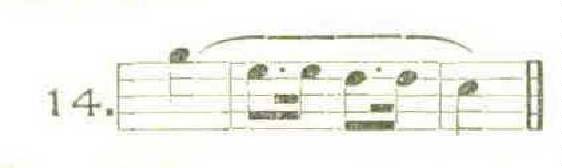
A similar difference in taste between individual birds I observed in another tune, which I have heard at various times and in various places : —
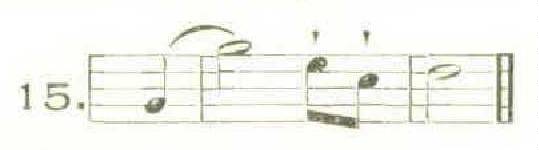
But about half a mile from my house there stands a solitary tree, an inhabitant of which varies this tune in a peculiar manner : —
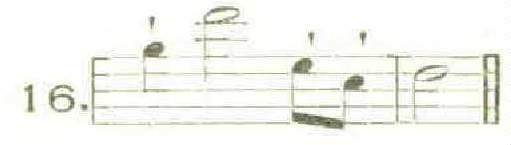
This bird has evidently a copyright on this variation, for I have never heard it except from that tree or its close vicinity. The following tune, also, I have heard only in the neighborhood of one particular spot : —
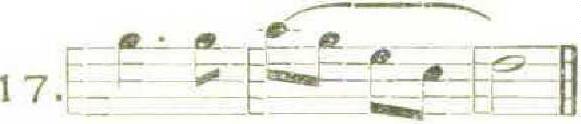
Ami this is the case with the last instance I shall record. About two miles from my bouse lives a friend of mine, with whom I pass many a pleasant hour. One day, while sitting and chatting in his cozy study, I heard a melody which was new to me. Though I had no doubt, from the character of the voice, that it came from a lark, still, to make the matter sure, I asked him what bird this was ; for he is a great sportsman, and quite familiar with the birds. He said without hesitation that it was a lark. What caused my surprise was that this short melody was in a minor key: —
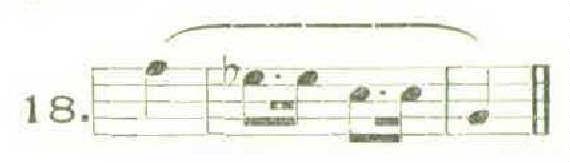
Although a minor key does not always and necessarily give an impression of sadness, and is, for instance, often used with great effect in humorous songs (perhaps with a shade of irony), in this song of a little bird it sounded decidedly like a mournful plaint, as if the sad singer had lost his mate.
The list of melodies here given does by no means exhaust the larks’ repertory, for when I go several miles from home I sometimes hear a new tune, or a variation different from those with which I am familiar. Frequently a lark sounds two or three tones which can readily be repeated in their proper intervals, but then follows them up with a merry, playful effusion from throat and tongue which derides all systematic music and is utterly inimitable. This is the case when the bird is on the wing, and then his noisy, jubilant warble closely resembles the song of the German lark when rising. It seems as if in these cases the bird dropped from the plane of æsthetic development to that of pure nature, — a result, no doubt, of heredity from ancestors that sang thousands of years ago.
That the deep and long-drawn notes of the nightingale are the expression of melancholy is merely a poetic fancy; and so with other birds, the lark among them. What sounds sad or joyous to us may not be so at all to the bird. Attempted interpretations of this kind will always remain fancies. But of what the lark here has convinced me, and what I have tried to demonstrate with the examples given, is, that man is not the only creature that has, in his musical evolution, attained to the superior level of the diatonic scale. Yet he is in advance of the lark in this point, — that he has recognized the æsthetic necessity of closing a cadence with the tonic chord.