Penelope's Progress: Her Experiences in Scotland. Part First. In Town
XII.
IT is our last day in “ Scotia’s darling seat,” our last day in Breadalbane Terrace, our last day with Mrs. M’Collop; and though every one says that we shall love the life in the country, we are loath to leave Auld Reekie.
Salemina and I have spent two days in search of an abiding-place, and have visited eight well-recommended villages with that end in view; but she disliked four of them, and I could n’t endure the other four, though I considered some of those that fell under her disapproval as quite delightful in every respect.
We never take Francesca on these pilgrimages of disagreement, as three conflicting opinions on the same subject would make insupportable what is otherwise rather exhilarating. She starts from Edinburgh to-morrow for a brief visit to the Highlands with the Deeyells, and will join us when we have settled ourselves.
Willie Beresford leaves Paris as soon after our decision as he is permitted, so Salemina and I have agreed to agree upon one ideal spot within thirty-six hours of our quitting Edinburgh, knowing privately that after a last battle royal we shall enthusiastically support the joint decision for the rest of our lives.
We have been bidding good-by to people and places and things, and wishing the sun would not shine and thus make our task the harder. We have looked our last on the old gray town from Calton Hill, of all places the best, perhaps, for a view ; since, says Stevenson, from Calton Hill you can see the Castle, which you lose from the Castle, and Arthur’s Seat, which you cannot see from Arthur’s Seat. We have taken a farewell walk to the Dean Bridge, to look wistfully eastward and marvel for the hundredth time to find so beautiful a spot in the heart of a city. The soft flowing water of Leith winding over pebbles between grassy banks and groups of splendid trees, the roof of the little temple to Hygeia rising picturesquely among green branches, the slopes of emerald velvet leading up to the gray stone of the houses, — where, in all the world of cities, can one find a view to equal it in peaceful loveliness ? Francesca’s “ bridge-man,” who, by the way, proved to be a distinguished young professor of medicine in the university, says that the beautiful cities of the world should be ranked thus, — Constantinople, Prague, Genoa, Edinburgh ; but having seen only one of these, and that the last, I refuse to credit any sliding scale of comparison which leaves Edina at the foot.
It was nearing tea-time, an hour when we never fail to have visitors, and we were all in the drawing-room together. I was at the piano, singing Jacobite melodies for Salemina’s delectation. When I came to the last verse of Lady Nairne’s Hundred Pipers, the spirited words had taken my fancy captive, and I am sure I could not have sung with more vigor and passion had my people been “ out wi’ the Chevalier.”
But shouther to shouther the brave lads keep ;
Twa thousand swam oure to fell English ground,
An’ danced themselves dry to the pibroch’s sound.
Dumfounder’d the English saw, they saw,
Dumfounder’d they heard the blaw, the blaw,
Dumfounder’d they a’ ran awa’, awa’,
Frae the hundred pipers an’ a’ an’ a’! ’’
By the time I came to “ Dumfounder’d the English saw ” Francesca left her book and joined in the next four lines, and when we broke into the chorus Salemina rushed to the piano, and although she cannot sing, she lifted her voice both high and loud in the refrain, beating time the while with a braidsword paper-knife.
CHORUS.
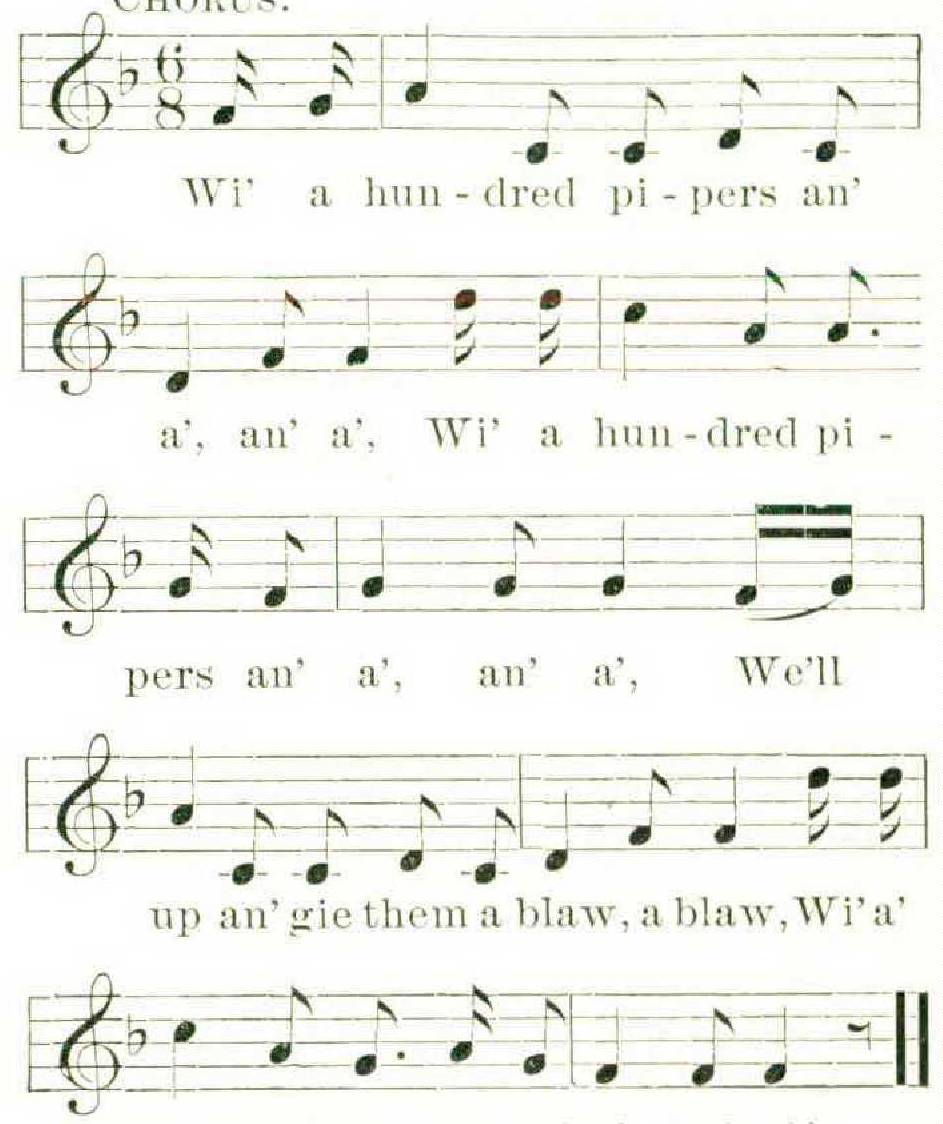
Wi’ a hun - dred pi-pers an’
a’, an’ a’, Wi’ a hun - dred pi -
pers an’ a’, an’ a’, We’ll
up an’ gie them a blaw, a blaw, Wi’ a’
hundred pi-pers an’ a’ an’ a’!
Susanna ushered in Mr. Macdonald and Dr. Moncrieffe as the last “ blaw ” faded into silence, and Jean Deeyell came upstairs to say that they could seldom get a quiet moment for family prayers, because we were always at the piano, hurling incendiary statements into the air, — statements set to such stirring melodies that no one could resist them.
“ We are very sorry, Miss Deeyell,” I said penitently. “We reserve an hour in the morning and another at bedtime for your uncle’s prayers, but we had no idea you had them at afternoon tea, even in Scotland. I believe that you are chaffing, and came up only to swell the chorus. Come, let us all sing together from ‘ Dumfounder’d the English saw.’ ”
Mr. Macdonald and Dr. Moncrieffe gave such splendid body to the music, and Jean such warlike energy, that Salemina waved her paper-knife in a manner more than ever sanguinary, and Susanna hesitated outside the door for sheer delight, and had to he coaxed in with the tea-things. On the heels of the teathings came the Dominie, another dear old friend of six weeks’ standing; and while the doctor sang Jock o’ Hazledean with such irresistible charm that everybody present longed to elope with somebody on the instant, Salemina dispensed buttered scones, marmalade sandwiches, and the fragrant cup. By this time we were thoroughly cosy, and Mr. Macdonald made himself and us very much at home by stirring the fire; whereupon Francesca embarrassed him by begging him not to touch it unless he could do it projoerly, which, she added, was quite unlikely from the way in which he handled the poker.
“ What will Edinburgh do without you ? ” he asked, turning towards us with flattering sadness in his tone. “ Who will hear our Scotch stories, never suspecting their hoary old age ? Who will ask us questions to which we somehow always know the answers ? Who wall make us study and reverence anew our own landmarks ? Who will keep warm our national and local pride by judicious enthusiasm ? If you continue loyal, I think you will do as much for Scotland in America as the kail-yard school of literature lias done.”
“ I wish we might also do as well for ourselves as the kail-yard school has done for itself,” I said laughingly.
“ I think the national and local pride may be counted on to exist without any artificial stimulants,” dryly observed Francesca, whose spirit is not in the least quenched by approaching departure.
“ Perhaps,” answered the Reverend Ronald ; “ but at any rate, you, Miss Monroe, will always be able to reflect that you have never been responsible even for its momentary inflation! ”
“ Is n’t it strange that she cannot get on better with that charming fellow ? ” murmured Salemina, as she passed me the sugar for my second cup.
“If your present symptoms of blindness continue, Salemina,” I said, searching for a small lump so as to gain time, “ I shall write you a plaintive ballad, buy you a dog, and stand you on a street corner! If you had ever permitted yourself to ' get on ’ with any man as Francesca is getting on with Mr. Macdonald, you would now be Mrs. — Somebody.”
“ Do you know, doctor,” asked the Dominie, “ that Miss Hamilton shed real tears at Holyrood, the other night, when the band played ‘ Bonnie Charlie’s now awa’ ’ ? ”
“ They were real.” I confessed, “ in the sense that they certainly were not crocodile tears ; but I am somewhat at a loss to explain them from a sensible, American standpoint. Of course my Jacobitism is purely impersonal, though scarcely more so than yours, at this late day ; at least it is merely a poetic sentiment, for which Caroline, Baroness Nairne is mainly responsible. My romantic tears came from a vision of the Bonnie Prince as he entered Holyrood, dressed in his short tartan coat, his scarlet breeches and military boots, the star of St. Andrew on his breast, a blue ribbon over his shoulder, and the famous blue velvet bonnet and white cockade. He must have looked so brave and handsome and hopeful at that moment, and the moment was so sadly brief, that when the band played the plaintive air I kept hearing the words. —
Should he no come back again.’
He did come back again to me that evening, and held a phantom levee behind the Marchioness of Heatherdale’s shoulder. His ‘ ghaist ’ looked bonnie and rosy and confident, yet all the time the band was playing the requiem for his lost cause and buried hopes.”
I looked towards the fire to hide the moisture that crept again into my eyes, and ray glance fell upon Francesca sitting dreamily on a hassock in front of the cheerful blaze, her chin in the hollow of her palm, and the Reverend Ronald standing on the hearth-rug gazing at her, the poker in his hand, and his heart, I regret to say, in such an exposed position on his sleeve that even Salemina could have seen it had she turned her eyes that way.
Jean Deeyell broke the momentary silence : “ I am sure I never hear the last two lines, —
Will ye no come back again ? ’
without a lump in my throat,” and she hummed the lovely melody. “ It is all as you say purely impersonal and poetic. My mother is an Englishwoman, but she sings ‘ Dumfounder’d the English saw, they saw,’ with the greatest fire and fury.”
XIII.
“ I don’t think I was ever so completely under the spell of a country as I am of Scotland.” I made this acknowledgment freely, but I knew that it would provoke comment from my compatriots.
“ Oh yes, my dear, you have been just as spellbound before, only you don’t remember it,” replied Salemina promptly. “ I have never seen a person more perilously appreciative or receptive than you.”
“ ‘ Perilously ’ is just the word,” chimed in Francesca delightedly ; “ when you care for a place you grow porous, as it were, until after a time you are precisely like blotting-paper. Now, there was Italy, for example. After eight weeks in Venice you were completely Venetian, from your fan to the ridiculous little crêpe shawl you wore because an Italian prince told you once that centuries were usually needed to teach a woman how to wear a shawl, but you had been born with the art, and the shoulders ! Anything but a watery street was repulsive to you. Cobblestones ? ‘ Ordinario, súdicio, dúro, brútto ! A gondola ? Ah, bellissima ! Let me float forever thus, piano, adagio, solo ! ’ You bathed your spirit in sunshine and color ; I can hear you murmur now, ‘ O Venezia benedetta ! non ti voglio lasciar !
“ It was just the same when she spent a month in France with the Baroness de Hautenoblesse,” continued Salemina. “ When she returned to America it is no flattery to say that in dress, attitude, inflection, manner, she was a thorough Parisienne. There was an elegant superficiality and a superficial elegance about her that I can never forget, nor yet the extraordinary volubility she had somehow acquired, — the fluency with which she expressed her inmost soul on all topics without the aid of a single irregular verb, for these she was never able to acquire ; oh, it was wonderful, but there was no affectation about it; she had simply been blotting-paper, as Miss Monroe says, and France had written itself all over her.”
“ I don’t wish to interfere with anybody’s diagnosis,” I interposed at the first possible moment, “ but perhaps after everybody has quite finished his psychologic investigation the subject may be allowed to explain herself a trifle from the inside, so to speak. I won’t deny the spell of Italy, but I say the spell that Scotland casts over one is quite a different thing, more spiritual, more difficult to break. Italy’s charm has something physical in it; it is born of blue sky, sunlit waves, soft atmosphere, orange sails and yellow moons, and appeals more to the senses. In Scotland the climate certainly has naught to do with it. but the imagination is somehow made captive. I am not enthralled by the past of Italy or France, for instance.”
“ Of course you are not at the present moment.” said Francesca, “ because you are enthralled by the past of Scotland, and even you cannot be the slave of two pasts at the same time.”
“ I never was particularly enthralled by Italy’s past,” I argued with exemplary patience, but the romance of Scotland has a flavor all its own. I do not quite know the secret of it.”
“ It’s the kilties and the pipes,” said Francesca.
“No, the history.” (This from Salemina.)
“ Or Sir Walter and the literature,” suggested Mr. Macdonald.
“ Or the songs and ballads,” ventured Jean Deeyell.
“ There ! ” I exclaimed triumphantly, “ you see for yourselves you have named avenue after avenue along which one’s mind is led in charmed subjection. Where can you find battles that kindle your fancy like Falkirk and Flodden and Culloden and Bannockburn ? Where a sovereign that attracts, baffles, repels, allures, like Mary Queen of Scots, — and where, tell me where, is there a Pretender like Bonnie Prince Charlie ? ”
“We must have had baffling mysteries among our American Presidents,” asserted Francesca. “ Who was the one that was impeached? Wouldn’t he do ? I am sure Aaron Burr allures and repels by turns; and, if he had been dead a hundred and fifty years, and you would only fix your wandering fancy on him, Mr. William Jennings Bryan is just as good a Pretender as the Bonnie Prince.”
“ Compare the campaign songs of the one with the ballads inspired by the other,” said Salemina sarcastically.
“ The difference is not so much in the themes; I am sure that if Lady Nairne had been an American she could have written songs about our national issues.”
“ I believe she could have made songs about almost anything,” I agreed ; “ but fancy her bursting into verse over our last campaign, — let us see how she might have done it on the basis of the Hundred Pipers, and I went to the piano and improvised, —
O wha is makin’ the blaw, the blaw ?
Bonnie Willy the king o’ the pipers, hurra !
Wi’ his siller sae free an’ his siller for a’!
Dumfounder’d, good Democrats saw, they saw,
Dumfounder’d, Republicans heard the blaw,
Dumfounder’d they a’ marched awa’, awa’,
Frae Willy’s free siller an’ Willy an’ a’!
They all laughed as good-humored people will always laugh at good-humored nonsense, and Francesca admitted reluctantly that our national issues were practical rather than romantic at the moment.
“ Think of the spirit in those old Scottish matrons who could sing, —
My rippling-kame and spinning-wheel,
To buy my lad a tartan plaid,
A braid sword, durk, and white cockade.' ”
“Yes,” chimed in Salemina when I had finished quoting, “ or that other verse that goes, —
I bare them toiling sairlie ;
But I would bear them a’ again
To lose them a’ for Charlie ! '
Is n’t the enthusiasm almost beyond belief at this distance of time ? ” she went on ; “ and is n’t it a curious fact, as Mr. Macdonald told me a moment ago, that though the whole country was vocal with songs for the lost cause and the fallen race, not one in favor of the victors ever became popular ? ”
“ Sympathy for the under dog, as Miss Monroe’s countrywomen would say picturesquely.” remarked Mr. Macdonald.
“ I don’t see why all the vulgarisms in the dictionary should be foisted on the American girl,” retorted Francesca loftily, “ unless, indeed, it is a determined attempt to find spots upon the sun for fear we shall worship it ! ”
“Quite so, quite so!” returned the Reverend Ronald, who has had reason to know that this phrase reduces Miss Monroe to voiceless rage.
“ The Stuart charm and personal magnetism must have been a powerful factor in all that movement,” said Salemina, plunging hastily back into the topic to avert any further recrimination. “ I suppose we feel it even now, and if I had been alive in 1745 I should probably have made myself ridiculous. ‘ Old maiden ladies,’ I read this morning, ' were the last leal Jacobites in Edinburgh ; spinsterhood in its loneliness remained ever true to Prince Charlie and the vanished dreams of youth.' ”
“ Yes,” continued the Dominie, “ the story is told of the last of those Jacobite ladies who never failed to close her Prayer-Book and stand erect in silent protest when the prayer for ' King George III. and the reigning family ’ was read by the congregation.”
“ Do you remember the prayer of the Reverend Neil Mc Vicar in St. Cuthbert’s ? ” asked Mr. Macdonald. “ It was in 1745, after the victory at Prestonpans, when a message was sent to the Edinburgh ministers, in the name of ‘ Charles, Prince Regent,’ desiring them to open their churches next day as usual. McVicar preached to a large congregation, many of whom were armed Highlanders, and prayed for George II., and also for Charles Edward, in the following fashion : ' Bless the king ! Thou knowest what king I mean. May the crown sit long upon his head ! As for that young man who has come among us to seek an earthly crown, we beseech Thee to take him to Thyself and give him a crown of glory!’”
“ Ah, what a pity the Bonnie Prince had not died after his meteor victory at Falkirk ! ” exclaimed Jean Deeyell, when we had finished laughing at Mr. Macdonald’s story.
“ Or at Culloden, ' where, quenched in blood on the Muir of Drummossie, the star of the Stuarts sank forever,’” quoted the Dominie. “ There is where his better self died ; would that the young Chevalier had died with it! By the way, doctor, we must not sit here eating scones and sipping tea until the dinner-hour, for these ladies have doubtless much to do for their flitting ” (a pretty Scotch word for “moving”).
“We are quite ready for our flitting so far as packing is concerned,” Salemina assured him. “ Would that we were as ready in spirit! Miss Hamilton has even written her farewell poem, which I am sure she will read for the asking.”
“ She will read it without,” murmured Francesca. “ She has lived only for this moment, and the poem is in her pocket.”
“ Delightful! ” said the doctor flatteringly. “ Has she favored you already ? Have you heard it, Miss Monroe?”
“ Have we heard it! ” ejaculated that young person. “We have heard nothing else all the morning ! What you will take for local color is nothing but our mental life-blood, which she has mercilessly drawn to stain her verses. We each tried to write a Scotch poem, and as Miss Hamilton’s was better, or perhaps I might say less bad, than ours, we encouraged her to develop and finish it. I wanted to do an imitation of Lindsay’s
Within whose bounds richt blithefull have I been! ’
but it proved too difficult. Miss Hamilton’s general idea was that we should write some verses in good plain English. Then we were to take out all the final g’s, and indeed the final letters from all the words wherever it was possible, so that full, awful, call, ball, hall, and away should be fa’, awfu’, ca’, ba’, ha’, an’ awa’. This alone gives great charm and character to a poem; but we were also to change all words ending in ow into aw. This doesn’t injure the verse, you see, as blaw and snaw rhyme just as Well as blow and snow, beside bringing tears to the common eye with their poetic associations. Similarly, if we had daughter and slaughter, we were to write them dochter and slauchter, substituting in all cases doon, froon, goon, and toon, for down, frown, gown, and town. Then we made a list of Scottish idols,— pet words, national institutions, stock phrases, beloved objects, — convinced if we could weave them in we should attain ‘atmosphere.’ Here is the first list; it lengthened speedily: thistle, tartan, haar, haggis, kirk, claymore, parritch, broom, whin, sporran, whaup, plaid, scone, collops, whiskey, mutch, cairngorm, oatmeal, bræ, kilt, brose, heather. Salemina and I were too devoted to common sense to succeed in this weaving process, so Penelope triumphed and won the first prize, both for that and also because she brought in a saying given us by Miss Deeyell, about the social classification of all Scotland into ‘ the gentlemen of the North, men of the South, people of the West, fowk o’ Fife, and the “ Paisley bodies. " ’ We think that her success came chiefly from her writing the verses with a Scotch plaid lead-pencil. What effect the absorption of so much red, blue, and green paint will have I cannot fancy, but she ate off — and up — all the tartan glaze before finishing the poem ; it had a wonderfully stimulating effect, but the end is not yet!”
Of course there was a chorus of laughter when the young wretch exhibited my battered pencil, bought in Princes Street yesterday, its gay Gordon tints sadly disfigured by the destroying tooth, not of Time, but of a bard in the throes of composition.
“ We bestowed a consolation prize on Salemina,” continued Francesca, “ because she succeeded in getting hoots, losh, havers, and blathers into one line, but naturally she could not maintain such an ideal standard. Read your verses, Pen, though there is little hope that our friends will enjoy them as much as you do. Whenever Miss Hamilton writes anything of this kind, she emulates her distinguished ancestor Sir William Hamilton, who always fell off his own chair in fits of laughter when he was composing verses.”
With this inspiring introduction I read my lines as follows : —
AN AMERICAN LADY’S FAREWELL TO EDINBURGH.
THE MUSE BEING SOMEWHAT UNDER THE INFLUENCE OF THE SCOTTISH BALLAD.
Sin’ I hae dwelt i’ this ;
To bide in Edinboro’ reek
Wad be the tap o’ bliss.
You bonnie plaid about me hap,
The skirlin’ pipes gae bring,
With thistles fair tie up my hair,
While I of Scotia sing.
The haggis an’ the whin,
The 'Stablished, Free, an’ U. P. kirks,
The hairt convinced o’ sin, —
The parritch an’ the heather-bell.
The snawdrap on the Shaw,
The bit lams bleatin’ on the braes, —
How can I leave them a’ !
An’ bonnets o’ Dundee ?
The haar, an’ cockileekie brose,
The East win’ blawin’ free !
How can I lay my sporran by,
An’ sit me down at hame,
Wi’oot a Hieland philabeg
Or hyphenated name ?
The Southern men I lo’e,
The canty people o’ the West,
The Paisley bodies too.
The pawky fowk o’ Fife are dear, —
Sae dear are ane an’ a’,
That e’en to think that we maun part
Maist braks my hairt in twa.
An’ dye my tresses red ;
I’d deck me like th’ unconquer’d Scots
Wha hae wi’ Wallace bled.
Then bind my claymore to my side.
My kilt an’ mutch gae bring ;
While Scottish songs soun’ i’ my lugs
McKinley ‘s no my king, —
Has turned me Jacobite;
I 'd wear displayed the white cockade,
An’ (whiles) for him I’d fight!
An’ (whiles) I 'd fight for a that’s Scotch,
Save whuskey an’ oatmeal,
For wi’ their ballads i‘ my bluid,
Nae Scot could be mair leal !
Somebody sent Francesca a great bunch of yellow broom, late that afternoon. There was no name in the box, she said, but at night she wore the odorous tips in the bosom of her black dinner-gown, and standing erect in her dark hair like golden aigrettes.
When she came into my room to say good-night, she laid the pretty frock in one of my trunks, which was to be filled with the garments of fashionable society and left behind in Edinburgh. The next moment I chanced to look on the floor, and discovered a little card, a bent card, with two lines written on it: —
Will ye no come back again ? ”
We have received many invitations in that handwriting. I know it well, and so does Francesca, though it is blurred ; and the reason for this, according to my way of thinking, is that it has been lying next the moist stems of flowers, and, unless I do her wrong, very near to somebody’s warm heart as well.
I will not betray her to Salemina, even to gain a victory over that blind and deaf but very dear woman. How could I, with my heart beating high at the thought of seeing my ain dear laddie before many days !
Love is like a dizziness:
It winna let a pair body
Gang aboot his business.”
PART SECOND. IN THE COUNTRY.
XIV.
Made o’ gilded leather,
And she ’s put on her Hieland brogues
To skip amang the heather.
And she ’s east aff her bonny goon
Made o’ the silk and satin.
And she ’s put on a tartan plaid
To row amang the braken.”
We are in the East Neuk o’ Fife ; we are in Pettybaw ; we are neither boarders nor lodgers; we are residents, inhabitants, householders, and we live (live, mind you) in a wee theekit hoosie in the old loaning. Words fail to tell you how absolutely Scotch we are and how blissfully happy. It is a happiness, I assure you, achieved through great tribulation. Salemina and I traveled many miles in railway trains, and many in various other sorts of wheeled vehicles, while the ideal ever beckoned us onward. I was determined to find a romantic lodging, Salemina a comfortable one; and this special combination of virtues is next to impossible, as every one knows. Linghurst was too much of a town ; Bonnie Craig had no respectable inn ; Whinnybrae was struggling to be a wateringplace ; Broomlea had no golf course within ten miles, and we intended to go back to our native land and win silver goblets in mixed foursomes; the “new toun o’ Fairloch ” (which looked centuries old) was delightful, but we could not find apartments there ; Pinkie Leith was nice, but they were tearing up the “ fore street ” and laying drain-pipes in it. Strathdee had been highly recommended, but it rained when we were in Strathdee, and nobody can deliberately settle in a place where it rains during the process of deliberation. No train left this moist and dripping hamlet for three hours, so we took a covered trap and drove onward in melancholy mood. Suddenly the clouds lifted and the rain ceased ; the driver thought we should be having settled weather now, and put back the top of the carriage, saying meanwhile that it was a very dry section just here, and that the crops sairly needed shoo’rs.
“ Of course, if there is any district in Scotland where for any reason droughts are possible, that is where we wish to settle,” I whispered to Salemina; “though, so far as I can see, the Strathdee crops are up to their knees in mud. Here is another wee village. What is this place, driver ? ”
“ Pettybaw, ma’m; a fine toun ! ”
“ Will there be apartments to let there ?”
“ I couldna say, ma’m.”
“ Susanna Crum’s father ! How curious that he should live here! ” I murmured ; and at this moment the sun came out, and shone full, or at least almost full, on our future home.
“ Petit bois, I suppose,” said Salemina ; “ and there, to be sure, it is, — the ' little wood ’ yonder.”
We drove to the Pettybaw Inn and Posting Establishment, and alighting dismissed the driver. We had still three good hours of daylight, although it was five o’clock, and we refreshed ourselves with a delicious cup of tea before looking for lodgings. We consulted the greengrocer, the baker, and the flesher about furnished apartments, and started on our quest, not regarding the little posting establishment as a possibility. Apartments we found to be very scarce, and in one or two places that were quite suitable the landlady refused to do any cooking. We wandered from house to house, the sun shining brighter and brighter, and Pettybaw looking lovelier and lovelier; and as we were refused shelter again and again, we grew more and more enamored. The blue sea sparkled, and Pettybaw Sands gleamed white a mile or two in the distance, the pretty stone Gothic church raised its carved spire from the green trees, the manse next door was hidden in vines, the sheep lay close to the gray stone walls and the young lambs nestled close beside them, while the song of the burn, tinkling merrily down the glade on the edge of which we stood, and the cawing of the rooks in the little wood, were the only sounds to be heard.
Salemina, under the influence of this sylvan solitude, nobly declared that she could and would do without a set bathtub, and proposed building a cabin and living near to nature’s heart.
“ I think, on the whole, we should be more comfortable living near to the innkeeper’s heart,” I answered. " Let us go back there and pass the night, trying thus the bed and breakfast with a view to seeing what they are like, — though they did say in Edinburgh that nobody thinks of living in these wayside hotels.”
Back we went, accordingly, and after ordering dinner we came out and strolled idly up the main street. A small sign in the draper’s window, heretofore overlooked, caught our eye. “ House and Garden To Let. Inquire Within.” Inquiring within with all possible speed, we found the draper selling winseys, the draper’s assistant tidying the ribbon-box, the draper’s wife sewing in one corner, and the draper’s baby playing on the clean floor. We were impressed favorably, and entered into negotiations without delay.
“ The house will be in the loaning; do you mind, ma’m ? ” asked the draper. (We have long since discovered that this use of the verb is a bequest from the Gaelic, in which there is no present tense. Man never is, but always to be blessed, in that language, which in this particular is not unlike old-fashioned Calvinism.)
We went out of the back door and down the green loaning, until we came to the wee stone cottage in which the draper himself lives most of the year, retiring for the warmer months to the back of his shop, and eking out a comfortable income by renting his hearthstone to the summer visitor.
The thatched roof on the wing that formed the kitchen attracted my artist’s eye, and we went in to examine the interior, which we found surprisingly attractive. There was a tiny sitting-room, with a fireplace and a microscopic piano ; a dining-room adorned with portraits of relatives, who looked nervous when they met my eye, for they knew that they would be turned face to the wall on the morrow ; three bedrooms, a kitchen, and a back garden so filled with vegetables and flowers that we exclaimed with astonishment and admiration.
“ But we cannot keep house in Scotland,” objected Salemina. “Think of the care ! And what about the servants ? ” “Why not eat at the inn?" I suggested. “ Think of living in a real loaning, Salemina!
The Flowers of the Forest
Are a’ wede away.’
Look at the stone floor in the kitchen, and the adorable stuffy box-bed in the wall! Look at the bust of Sir Walter in the hall, and the chromo of Melrose Abbey by moonlight! Look at the lintel over the front door, with a ship, moon, stars, and 1602 carved in the stone ! What is food to all this ? ”
Salemina agreed that it was hardly worth considering; and in truth so many landladies had refused to receive her as a tenant, that day, that her spirit was rather broken, and she was uncommonly flexible.
“ It is the lintel and the back garden that rents the hoose,” remarked the draper complacently in broad Scotch that I cannot reproduce. He is a houseagent as well as a draper, and went on to tell us that when he had a cottage he could rent in no other way he planted plenty of vines in front of it. “ The baker’s hoose is verra puir,” he said, “ and the linen and cutlery verra scanty, but there is a yellow laburnum growin’ by the door : the leddies see that, and forget to ask about the linen. It depends a good bit on the weather, too ; it is easy to let a hoose when the sun shines upon it.”
“ We are from America, and hardly dare undertake regular housekeeping,” I said; “ do your tenants ever take meals at the inn ? ”
“ I couldna say, ma’m.” (Dear, dear, the Crums are a large family !)
“ If we did that, we should still need a servant to keep the house tidy,” said Salemina, as we walked away. " Perhaps housemaids are to be had. though not nearer than Edinburgh, I fancy.”
This gave me an idea, and I slipped over to the post-office while Salemina was preparing for dinner, and dispatched a telegram to Mrs. M’Collop at Breadalbane Terrace, asking her if she could send a reliable general servant to us, capable of cooking simple breakfasts and caring for a house.
We had scarcely finished our Scotch broth, fried baddies, mutton-chops, and rhubarb tart when I received an answer from Mrs. M’Collop to the effect that her sister’s husband’s niece, Jane Grieve, could join us on the morrow if desired. The relationship was an interesting fact, though we scarcely thought the information worth the additional threepence we paid for it in the telegram ; however, Mrs. M’Collop’s comfortable assurance, together with the quality of the rhubarb tart and mutton-chops, brought us to a decision. Before going to sleep we rented the draper’s house, named it Bide-a-Wee Cottage, engaged daily luncheons and dinners for three persons at the Pettybaw Inn and Posting Establishment, and telegraphed to Edinburgh for Jane Grieve, to Callender for Francesca, and to Paris for Mr. Beresford.
“ Perhaps it would have been wiser not to send for them until we were settled,” I said reflectively. “ Jane Grieve may not prove a suitable person.”
“ The name somehow sounds too young and inexperienced,” observed Salemina, “and what association have I with the phrase ‘ sister’s husband’s niece ’ ? ”
“ You have heard me quote Lewis Carroll’s verse, perhaps : —
Upon the chimney-piece ;
He looked again and found it was
His sister’s husband’s niece :
“ Unless you leave the house,” he said.
“I ’ll send for the police ! ” ’
The only thing that troubles me,” I went on, “ is the question of Willie Beresford’s place of residence. He expects to be somewhere within easy walking or cycling distance, — four or five miles at most.”
“ He won’t be desolate if he does n’t have a thatched roof, a pansy garden, and a blossoming vine,” said Salemina sleepily, for our business arrangements and discussions had lasted well into the evening. “ What he will want is a lodging where he can have frequent sight and speech of you. How I dread him! How I resent his sharing of you with us ! I don’t know why I use the word ‘ sharing,’ forsooth ! There is nothing half so fair and just in his majesty’s greedy mind. Well, it’s the way of the world ; only it is odd, with the universe of women to choose from, he must needs take you. Strathdee seems the most desirable place for him, if he has a mackintosh and rubber boots. Inchcaldy is another town near here that we didn’t see at all, —that might do; the draper’s wife says that we can send fine linen to the laundry there.”
“ Inchcaldy ? Oh yes, I think we heard of it in Edinburgh ; it has a fine golf course, I believe, and very likely we ought to have looked at it, though for my part I regret nothing. Nothing can equal Pettybaw ; and I am so pleased to be a Scottish householder ! Are n’t we just like Bessie Bell and Mary Gray ?
They biggit a bower on yon burnside,
An’ theekit it ower wi’ rashes.’
Think of our stone - floored kitchen, Salemina ! Think of the real box-bed in the wall for little Jane Grieve ! She will have red-gold hair, blue eyes, and a pink cotton gown. Think of our own cat! Think how Francesca will admire the 1602 lintel! Think of our back garden, with our own neeps and vegetable marrows growing in it ! Think how they will envy us at home when they learn that we have settled down into Scottish yeowomen !
It’s oh, for a patch of land !
Of all the blessings tongue can name,
There’s nane like a patch of land ! ’
Think of Willie coming to step on the floor and look at the bed and stroke the cat and covet the lintel and walk in the garden and weed the neeps and pluck the marrows that grow by our ain wee theekit hoosie ! ”
“ Penelope, you appear slightly intoxicated ! Do close the window and come to bed.”
“ I am intoxicated with the caller air of Pettybaw,” I rejoined, leaning on the window-sill and looking at the stars as I thought: " Edinburgh was beautiful ; it is the most beautiful gray city in the world ; it lacked one thing only to make it perfect, and Pettybaw will have that before many moons.
An’ Willie’s woundrous bonny;
An’ Willie’s hecht to marry me
Gin e’er he marries ony.
From where my love repaireth,
Convey a word from his dear mouth,
An’ tell me how he fareth. ’ ”
XV.
Gae tak’ them far frae me ;
And bring to me a wooden dish,
It’s that I ’m best used wi’.
And tak’ awa’ thae siller spoons
The like I ne’er did see,
And bring to me the horn cutties,
They ’re good eneugh for me.”
Earl Richard’s Wedding.
The next day was one of the most cheerful and one of the most fatiguing that I ever spent. Salemina and I moved every article of furniture in our wee theekit hoosie from the place where it originally stood to another and a better place: arguing, of course, over the precise spot it should occupy, which was generally upstairs if the thing were already down, or downstairs if it were already up. We hid all the more hideous ornaments of the draper’s wife, and folded away her most objectionable tidies and table-covers, replacing them with our own pretty draperies. There were only two pictures in the room, and as an artist I would not have parted with them for worlds. The first was The Life of a Fireman, which could only remind one of the explosion of a mammoth tomato, and the other was The Spirit of Poetry Calling Burns from the Plough. Burns wore white knee-breeches, military boots, a splendid waistcoat with lace rufiles, and carried a cocked hat. To have been so dressed he must have known the Spirit was intending to call. The plough-horse was a magnificent Arabian, whose tail swept the freshly furrowed earth. The Spirit of Poetry was issuing from a practicable wigwam on the left, and was a lady of such ample dimensions that no poet would have dared say “ no ” when she called him.
The dining-room was blighted by framed photographs of the draper’s relations and the draper’s wife’s relations; all uniformly ugly. (It seems strange that married couples having the least beauty to bequeath to their offspring should persist in having the largest families.) These ladies and gentlemen were too numerous to remove, so we obscured them with vines and branches ; reflecting that we only breakfasted in the room, and the morning meal is easily digested when one lives in the open air. We arranged flowers everywhere, and bought potted plants at a little nursery hard by. We apportioned the bedrooms, giving Francesca the hardest bed, — as she is the youngest, and was n’t here to choose, — me the next hardest, and Salemina the best; Francesca the largest looking-glass and closet, me the best view, and Salemina the biggest bath. We bought housekeeping stores, distributing our patronage equally between the two grocers ; we purchased aprons and dusters from the rival drapers, engaged bread and rolls from the baker, milk and cream from the plumber, who keeps three cows, interviewed the flesher about chops ; in fact, no young couple facing love in a cottage ever had a busier or happier time than we had ; and at sundown, when Francesca arrived, we were in the pink of order, standing in our own vine-covered doorway, ready to welcome her to Pettybaw. As to being strangers in a strange land, we had a bowing acquaintance with everybody on the main street of the tiny village, and were on terms of considerable intimacy with half a dozen families, including dogs and babies,
Francesca was delighted with everything, from the station (Pettybaw Sands, two miles away) to Jane Grieve’s name, which she thought as perfect, in its way, as Susanna Crum’s. She had purchased a “ tirling-pin,” that old-time precursor of knockers and bells, at an antique shop in Oban, and we fixed it on the front door at once, taking turns at risping it, until our own nerves were shattered, and the draper’s wife ran down the loaning to see if we were in need of anything. The twisted bar of iron stands out from the door and the ring is drawn up and down over a series of nicks, making a rasping noise. The lovers and ghaists in the old ballads always “ tirled at the pin,” you remember; that is, touched it gently.
Francesca brought us letters from Edinburgh, and what was my joy, in opening Willie’s, to learn that he begged us to find a place in Fifeshire, and as near St. Rules or Strathdee as convenient ; for in that case he could accept an invitation to visit his friend Robin Anstruther, at Rowardenuan Castle.
“ It is not the visit at the castle I wish so much, you may he sure,” he wrote, “ as the fact that Lady Ardmore will make everything pleasant for you. You will like my friend Robin Anstruther, who is Lady Ardmore’s youngest brother, and who is going to her to be nursed and coddled after rather a baddish accident in the hunting-field. He is very sweet-tempered, and will get on well with Francesca ” —
“ I don’t see the connection,” rudely interrupted that amiable young person.
“ I suppose she has more room on her list in the country than she had in Edinburgh ; but if my remembrance serves me, she always enrolls a goodly number of victims, whether she has any use for them or not.”
“ Mr. Beresford’s manners have not been improved by his residence in Paris,” observed Francesca, with resentment in her tone and delight in her eye.
“ Mr. Beresford’s manners are always perfect,” said Salemina loyally, “and I have no doubt that this visit to Lady Ardmore will be extremely pleasant for him, though very embarrassing to us. If we are thrown into forced intimacy with a castle” (Salemina spoke of it as if it had fangs and a lashing tail), “what shall we do in this draper’s hut?”
“ Salemina ! ” I expostulated, “ the bears will devour you as they did the ungrateful child in the fairy-tale. I wonder at your daring to use the word ‘hut’ in connection with our wee theekit hoosie ! ”
“ They will never understand that we are doing all this for the novelty of it,” she objected. “The Scottish nobility and gentry probably never think of renting a house for a joke. Imagine Lord and Lady Ardmore, the young Ardmores, Robin Anstruther, and Willie Beresford calling upon us in this sitting-room! We ourselves would have to sit in the hall and talk in through the doorway.”
“ All will be well,” Francesca assured her soothingly. “ We shall be pardoned much because we are Americans, and will not be expected to know any better. Besides, the gifted Miss Hamilton is an artist, and that covers a multitude of sins against conventionality. When the castle people ‘tirl at the pin,’ I will appear as the maid, if you like, following your example at Mrs. Bobby’s cottage in Belvern, Pen.”
“ And it is n’t as if there were many houses to choose from, Salemina, nor as if Bide-a-Wee Cottage were cheap,” I continued. “Think of the rent we pay, and keep your head high. Remember that the draper’s wife says there is nothing half so comfortable in Inchcaldy, although that is twice as large a town.”
“ Inchcaldy ! ” ejaculated Francesca, sitting down heavily upon the sofa and staring at me.
“ Inchcaldy, my dear, —spelled caldy, but pronounced cawdy ; the town where you are to take your nonsensical little fripperies to be laundered.”
“ Where is Inchcaldy ? How far away ? ”
“ About five miles, I believe, but a lovely road.”
“ Well,” she exclaimed bitterly, “ of course Scotland is a small, insignificant country; but, tiny as it is. it presents some liberty of choice, and why you need have pitched upon Pettybaw, and brought me here, when it is only five miles from Inchcaldy, and a lovely road besides, is more than I can understand ! ”
“ In what way has Inchcaldy been so unhappy as to offend you ? ” I asked.
“ It has not offended me, save that it chances to be Ronald Macdonald’s parish, — that is all.”
“ Ronald Macdonald’s parish ! ” we repeated automatically.
“ Certainly, — you must have heard him mention Inchcaldy ; and how queer he will think it that I have come to Pettybaw, under all the circumstances ! ”
“ We do not know ‘ all the circumstances.’” quoted Salemina somewhat haughtily : “ and you must remember, my dear, that our opportunities for speech with Mr. Macdonald have been very rare when you were present. For my part, I was always in such a tremor of anxiety during his visits lest one or both of you should descend to blows that I remember no details of his conversation. Besides, we did not choose Pettybaw ; we discovered it by chance as we were driving from Strathdee to St. Rules.
How were we to know that it was near this fatal Inchcaldy ? If you think it best, we will hold no communication with the place, and Mr. Macdonald need never know you are here.”
I thought Francesca looked rather startled at this proposition. At all events she said hastily, “ Oh well, let it go ; we could not avoid each other long, anyway, though it is very awkward, of course ; you see, we did not part friends.”
“ I thought I had never seen you on more cordial terms,” remarked Salemina.
“ But you were n’t there,” answered Francesca unguardedly.
“ Were n’t where ? ”
“ Were n’t there.”
“ Where ? ”
“ At the station.”
“ What station ? ”
“ The station in Edinburgh from which I started for the Highlands.”
You never said that he came to see you off. ”
“ The matter was too unimportant for notice ; and the more I think of his being here, the less I mind it, after all; and so, dull care, begone ! When I first meet him on the sands or in the loaning, I shall say, ‘ Dear me, is it Mr. Macdonald ! What brought you to our quiet hamlet ? ’ (I shall put the responsibility on him, you know.) ' That is the worst of these small countries, — people are continually in one another’s way ! When we part forever in America, we are able to stay parted, if we wish.’ Then he will say, ‘ Quite so, quite so; but I suppose even you, Miss Monroe, will allow that a minister may not move his church to please a lady.' ‘ Certainly not,’I shall reply, ‘ eespecially when it is Estaiblished ! ’ Then he will laugh, and we shall he better friends for a few moments ; and then I shall tell him my latest story about the Scotchman who prayed, ‘ Lord, I do not ask that Thou shouldst give me wealth ; only show me where it is, and I will attend to the rest.' ” Salemina moaned at the delightful prospect opening before us, while I went to the piano and caroled impersonally:—
And leave my love behind me ?
Why did I venture to the north
With one that did not mind me ?
I’m sure I’ve seen a better limb
And twenty better faces ;
But still my mind it runs on him
When I am at the races ! ”
Francesca left the room at this, and closed the door behind her with such energy that the bust of Sir Walter rocked on the hall shelf. Running upstairs she locked herself in her bedroom, and came down again only to help us receive Jane Grieve, who arrived at eight o’clock.
In times of joy, Salemina, Francesca, and I occasionally have our trifling differences of opinion, but in hours of affliction we are as one flesh. An all-wise Providence sent us Jane Grieve for fear that we should be too happy in Pettybaw. Plans made in heaven for the discipline of sinful human flesh are always successful, and this was no exception.
We had sent a “ machine ” from the inn to meet her, and when it drew up at the door we went forward to greet the rosy little Jane of our fancy. An aged person, wearing a rusty black bonnet and shawl, and carrying what appeared to be a tin cake-box and a baby’s bath-tub, descended rheumatically from the vehicle and announced herself as Miss Grieve. She was too old to call by her Christian name, too sensitive to call by her surname, so Miss Grieve she remained, as announced, to the end of the chapter, and our rosy little Jane died before she was actually born. The man took her curious luggage into the kitchen, and Salemina escorted her thither, while Francesca and I fell into each other’s arms and laughed hysterically.
“ Nobody need tell me that she is Mrs. M’Collop’s sister’s husband’s niece,” she whispered, " though she may possibly be somebody’s grandaunt. Does n’t she remind you of Mrs. Gummidge ? ”
Salemina returned in a quarter of an hour, and sank dejectedly on the sofa.
“ Run over to the inn, Francesca,” she said, “ and order us bacon and eggs at eight-thirty to-morrow morning. Miss Grieve thinks we had better not breakfast at home until she becomes accustomed to the surroundings.”
“ Had we better allow her to become accustomed to them ? ” I suggested.
“ She came up from Glasgow to Edinburgh for the day, and went to see Mrs. M’Collop just as our telegram arrived. She was living with an ‘ extremely nice family ’ in Glasgow, and only broke her engagement in order to try Fifeshire air for the summer; so she will remain with us as long as she is benefited by the climate.”
“ Can’t we pay her for a month and send her away ? ”
“ How can we ? She is Mrs. M’Collop’s sister’s husband’s niece, and we intend returning to Mrs. M’Collop. She has a nice ladylike appearance, but when she takes her bonnet off she looks seventy years old.”
“She ought to keep it off, then,” returned Francesca, “ for she looked eighty with it on. We shall have to soothe her last moments, of course, and pay her funeral expenses. Did you offer her a cup of tea and show her the box-bed ? ”
“Yes ; but she said the coals were so poor and hard she couldna batter them oop to start a fire the nicht, and she would try the box-bed to see if she could sleep in it. I am glad to remember that it was you who telegraphed for her, Penelope.”
“ Let there be no recriminations,” I responded; “ let us stand shoulder to shoulder in this calamity, — is n’t there a story called Calamity Jane? We might live at the inn, and give her the cottage for a summer residence, but I utterly refuse to be parted from our cat and the 1602 lintel.”
Kate Douglas Wiggin.
(To be continued.)