The Delusion of Abbreviating
“Sir Walter Scott, Bart.,” on the title-page of a book of poems, puzzled me considerably in my childhood, but before many days I shaped to my satisfaction a definition of “ Bart.: ” some one more than bard and less than magician. When, years after, I heard this word translated into “baronet,” I suffered genuine anguish in losing a word which I had invested with splendid personality, and ever since I have resented abbreviation.
Why do we abbreviate? That we do is manifest enough if one glances over a newspaper where throngs of amputated words are to be seen, not only in advertisements, but, as well, in columns of news. We recognize in Jap., ad., tel. con., Rt. Rev. J. C. Smith, D. D., etc., a larger something for which these hieroglyphics stand. The speech of our young people is a tissue of condensed syllables; Webster’s Dictionary records over a thousand curtailed forms in common use. The tendency toward abbreviation is to be observed everywhere except in the lecture and in the sermon, though there are critics who desire it even there.
All that may be said in defense of abbreviation is that it saves space. We cherish, also, a delusion that it saves time, but is it really any easier to write @ for at ? Is this, strictly speaking, an attenuated form? Our familiar correspondence is full of abridgments, spontaneous contractions that bring nothing but bewilderment to the reader who tries in vain to decipher them. Consider the serious student working with a new volume in which much time and space have been economized by the lavish use of abbreviation. He is constantly turning back to the table of abbreviations, trying to fix upon his mind the signification of the various short-cuts used by the writer. Probably there is not a single page over which he does not pause, losing the thread of the argument, falling into confusion, simply because of this mania for brevity. “ Brevity is the soul of wit,” but we have assumed that brevity is the soul of writ.
In addition to the inconveniences that attend the use of abbreviation, there are two positive dangers. In the first place, it is to be feared that ignorance is fostered by it. Who can tell at a glance the difference between Litt. D. and L. H. D., or explain correctly the concealed origin of viz., or find language for 16mo ? Cf. and sc. have been the confounders of many boys and girls at school. Have not intelligent persons searched the map of England for Hants, and searched in vain ? Are not Miss., Mass., Cinn., Pa., shameless concessions to those who dare not spell ?
The second danger, to be feared remotely, is that the zeal for reducing all w*ords to the lowest possible terms will tear our best literature to “shreds and patches.” It is not utterly inconceivable that, a few centuries hence, we may have new editions of the standard poets, not abridged, but, to suit the taste for saving space, abbreviated in some such fashion as this sonorous Miltonic line. —
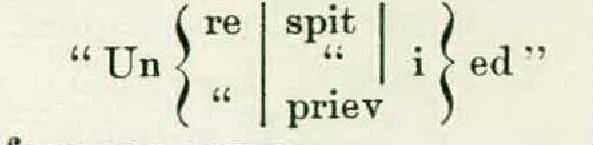
or this famous verse, —
“ 2 b, or not 2 b : that is the ? ”