Eliana: The Latest Windfall
AFTER all that has been accomplished by my contemporaries and myself in the direction of gradually building up the correspondence of Charles and Mary Lamb within a fair distance of exhaustion, additions to all our stores are continually presenting themselves until it becomes difficult to foresee when the end will be reached. The multiplication of letters and notes is mainly due to the release of Lamb in 1825 from his official duties, or to the long retention of papers of this sort in the hands of descendants of the recipients; and it is an absolute matter of fact that even now there are important letters to John Chambers, Miss Fryer, and others, undiscovered, and those to Chambers more than possibly lost. Nor should we be surprised at the volume of material, known and unknown, when we perceive, on Lamb’s own showing, that during the years of greater leisure he dispatched as many as twenty communications in a single day.
It has been my fortune to accumulate, since the appearance of my last Elian volume in 1900, apart from a sheaf which I contributed to Mr. Lucas’s and Mr. Macdonald’s editions, about fifty unpublished epistles, not inferior on the whole to those in type, if we except the journal-like ones to Coleridge, Southey, and others, belonging to the eighteenth or very early years of the nineteenth century, when the members of the circle were young and comparatively obscure. From the sources which I indicate, and elsewhere, there is much new light to be obtained on Lamb’s life and writings, and it is my aim in the present case to limit myself to a sketch or précis of this freshest treasure trove, with extracts of striking or illustrative passages. It is assuredly singidar that of a man and a household living among us, so to speak, within a generation or so, the personal and literary history should remain a work of the future: and yet we wonder at the difficulties attendant on learning more about Shakespeare. Is it generally known that John Lamb, the father, was a clever modeler in clay, and that his profile portrait of his master, Samuel Salt, is still extant, or that the grand ambition of John, the brother, was to produce a play, and his most heartfelt mortification the rejection of his attempts by the managers ? Anecdotes of Charles are occasionally regained from those, now themselves advanced in years, who received them from the lips of friends of the humorist, such as that one where Lamb, seated in the coach on his return home from Highgate, where he had visited Coleridge at Gillman’s, is accosted by an old lady with the inquiry whether he is full inside, and replies, “Yes, ma’am, that last bit of pudding at Gillman’s did it.” He once mischievously spoke of the surgeon as Killman.
Through the Novellos Lamb seems to have acquired a sort of musical taste and insight, and in a letter or two to Vincent of that ilk he employs the refrain Da Capo, which we encounter in the Concertos at Covent Garden Theatre in 1791. But this point and numberless others must be reserved for a suitable and convenient opportunity, and I now proceed to my appointed task.
The body of unedited correspondence in my hands extends from 1821 to the last week in August, 1834, exactly four months prior to the close of that distinguished career. So far as I am able, I propose to place the reader in possession of the substance and salient features of those effusions, of which the characteristics are so exceedingly familiar; and I commence with the only letter hitherto found to Miss Humphreys, who belonged to Lamb’s Cambridge coterie and the Isola tie. It is dated 1821, announces Emma’s early departure for Cambridge, where she was to rejoin Mrs. Paris, gives Mary’s and his own love to all true Trumpingtonians (Mrs. Paris resided in Trumpington Street), admits Emma’s addiction to making dog’s-ears in books (of which he was not himself guiltless), and is subscribed “Yours Truly, foolish C. L.” In a note of the same year to Robert Baldwin he asks him to keep a little room for him in the London till the 18th, as he does not like to have a number quite Elialess. On the 29th of November, 1823, Crosthwaite is charged with a note to Wordsworth to report a visit from the Monkhouses and Miss Hutchinson at Colebrook Cottage, where he hopes some day to see W. himself. In 1824 we find Alaric Watts sending a handsome copy of the Souvenir, and soliciting a contribution from Lamb for the next volume. Lamb describes himself as dried up, but will see what he can do. He had shown the volume to Coleridge, who was pleased with it. He begs Watts not to trouble again to give him a superfine copy, as an ordinary one would be good enough. This one puts his poor collection to the blush. A letter to Allsop, which has so far been misplaced, just succeeds the retirement. The Lambs had gone down to Enfield; Mary is ill, Miss James is in attendance; and Lamb has had bad nights. Allsop has been attending to some business. But he can keep the £81. 4. 6 till they meet, as Lamb has plenty of current cash. This note is dated September 14, 1825, not 1827.
A very curious letter to Hone, of or about 1827, contains a droll figure of Miss Lamb drawn by Hood, representing her in a coal-scuttle bonnet, mounting a stile; above, in her brother’s hand, is “Ride a cock-horse,” and beneath “Mrs. Gilpin riding to Edmonton.” It was intended for insertion in the Table Book, where there is an erroneous and misleading account, signed A Sojourner at Enfield. He invites Hone to slip down some day to Enfield and go a-greendragoning. He was at this date familiar enough with Edmonton, although he did not settle there until 1833.
There is in this parcel a series of letters to Moxon between 1827 and 1833, which have so far been withheld from the editions, and which Moxon himself sold about fifty years since to a private collector. There comes, in one of July 27, 1827, a response to an invitation for Emma Isola to go to Vauxhall, apparently with her future husband, but the scruples of an aunt, who is described as “a queer one,” interpose, and it is made peremptory that there shall be a chaperone. Lamb has been writing letters till he can no longer see. The relations between the Lambs and the Kenneys and Holerofts had been early and remained steadfast; the correspondence which passed on the Lambs’ side has been slowly emerging from sundry obscure and mysterious recesses, and my store embraces two or three rather material omissions. In a letter to Miss Louisa Holcroft, who successively became the wife of Dr. Badams (1832) and of the Baron de Merger, Lamb begins by declaring that his sister has written her last letter in this world, but reassures the lady by explaining that Mary is extant and sleek, but has left him writing legatee. The Kenneys were then residing in Brunswick Square, and Lamb shrinks from calling on Kenney, lest he should be suspected of coming to be repaid for the hospitality shown to him at Enfield. He inquires about the small Kenneys, the second family, and wants to know whether they lie three in a bed. A note to Hone of December 15, same year, condoles with him on a loss in his family, and points to one of the severe trials of Lamb during his sister’s illness. It was the eleventh week. The notes to Moxon go on with brief intermissions. They are chiefly on current matters of business or commission. He hopes that the Keepsake he asked Mrs. Hazlitt to return has arrived. It had a blot on it when it first came. He will be glad to see Moxon, either with his switch in his hand or with Hunt’s Lord Byron or Hazlitt’s Napoleon under his arm. Under February 18,1828, Mary Lamb is said to be in no immediate want of books, as she has had “a damned consignment of novels in MS. from Malta,” which he says “I wish the Mediterranean had in its guts.” This unwelcome present was from Lady Stoddart. A notelet of September 25 following, to Mrs. Hood, finds the Lambs a little embarrassed by visitors, — Martin Burney, his sister and her husband, Coleridge, etc., and it is extremely noteworthy from the subscription, “believe us ever yours affectionately, C. Lamb,” because such an unusual form of words accentuates the peculiar regard which I think the Lambs entertained for the Hoods. In December, Lamb, in his quality of amanuensis for his sister, thanks Louisa Holcroft for her handkerchief, and intimates that Mary would have preferred blonde to white sarsenet trimmings. He was not to tell her, but maybe it would be a hint for the next. Lamb has an attack of something, — an eruption, — and describes his symptoms. He is told that it is very catching, and cautions Louisa that she might, as he makes out, take it in a piece of plumcake. He dreads the possibility of spreading the contagion through the postman to the whole village. A vein of pleasant hyperbole pervades the whole. The attack may have been a slight one of erysipelas, which was to recur.
Since 1806 he had known Elliston, who took the name part in the ill-fated farce of Mr. H. The actor does not come to the surface again till his friend had become a personage of distinction and could afford to look back on his early dramatic efforts with indifference. But the truth is that Lamb never renounced the hope of success in this direction, and I have above noted that his brother was haunted by a similar aspiration. In 1829 Lamb wrote a farce, to which he gave the title of The Pawnbroker’s Daughter, not impossibly a reminiscence of the Bartrum episode, and in 1830 inserted it in Fraser’s Magazine, but he did not do so until he had appealed to Elliston to produce it at the Surrey Theatre, and as the manager’s reply is one of a slender salvage, no letter to the Lambs being at one time known to exist, I append it: —
SURREY THEATRE, March 14, 1829.
MY DEAR SIR, — I was delighted to find you had not forgotten me, and shall with much pleasure renew your acquaintance. The Farce you have sent me, I regret to say, would not in my opinion be suited to the interest of the theatre, and therefore I return it. I have a tolerably good house, 84 Great Surrey Street, Blackfriars Road, where I shall be always happy to see you, and I request you to believe that I am,
Very truly yours,
R. W. ELLISTON. CHAS. LAMB ESQRE.
The communications to Moxon are incessant. Under September 22, 1829, he asks for the loan of the Garrick Papers or Anne of Geierstein, but does not want Mrs. Jameson or Lady Morgan. Mary is hopelessly ill. He will be glad to talk over Moxon’s ramble with him. On the 12th of May, 1830, he sends him criticisms on his Sonnets, and thinks that he is destined to shine in them.
I now come to two letters, the first from Dorothy Wordsworth to Mary Lamb, January 9, 1830, the other to Lamb from Wordsworth himself, January 10, 1830, both further additions to the hitherto recovered epistolary remains of this kind. I shall print them as they stand, with the very obliging permission of the representatives of Wordsworth : —
TO CHARLES LAMB
Sunday, Jany. 10th, 1830.
MY DEAR LAMB, — A whole twelvemonth have I been a letter in your debt — for which fault I have been sufficiently punished by self reproach. I liked your play marvellously, having no objection to it but one, which strikes me as applicable to a large majority of plays, those of Shalcespear himself not entirely excepted, I mean a little degradation of character, for a more dramatic turn of Plot.
Your present of Hone’s Book was very acceptable, and so much so, that your part of the Book is the cause why I did not write long ago. I wished to enter a little minutely into notice of the Dramatic Extracts, and on account of the smallness of the print deferred doing so till longer days would allow one to read without candle light which I have long since given up. But alas when the days lengthened my eyesight departed, and for many months I could not read three minutes at a time. You will be sorry to hear that this infirmity still hangs about me, and almost cuts me off from reading altogether. But how are you, and how is your dear Sister ? I long much, as we all do, to know. For ourselves, this last year, owing to my Sister’s dangerous illness, the effects of which are not yet got over, has been an anxious one, and melancholy. But no more of this — my Sister has probably told everything about the family, so that I may conclude with less scruple, by assuring you of my sincere and faithful affection for you and your dear Sister.
WM. WORDSWORTH.
My Son takes this to London.
Sunday, 10th.
My brother has given me this to enclose [in] my own. His account of me is far too doleful. I am, I assure you, perfectly well and it is only in order to become strong as heretofore that I confine myself mainly to the house — and yet were I to trust my feelings merely I should say that I am strong already. His eyes, alas! are very weak and so will I fear remain through life; but with proper care he does not suffer much. D. W.
[Endorsed] CHARLES LAME, ESQRE.
Enfield Common,
Enfield.
TO MARY LAMB
RYDAL MOUNT, 9th Jany. 1830.
MY DEAR FRIEND, — My Nephew John will set off tomorrow evening to Oxford to take his Master of Arts’ Degree and thence proceed to London where his time will be so short there is no chance of his being able to see you; but there is a possibility that your brother may happen to be in town at the same time — in which case it would grieve him, & us at home not less that he should not see him, — therefore if it should happen that your brother is in town anytime from the 17th to the 26th of this month pray desire him to inquire for the Revd. J. Wordsworth at Mr. Cookson’s, No. 6 Lincoln’s Inn. There he will be sure to learn where John may be found, of which at present he knows no more than that he will not lodge at Mr. Cookson’s, though he will certainly call there & leave his address immediately after he reaches Town.
I do not write merely for the sake of seeing your Brother (& you also if you happen to be in London) but to inquire after you both, for now that our good friend Henry Robinson is absent you might as well also be living in Rome for anything we hear concerning you; and believe me we are often uneasy in the thought that all communication seems cut off between us; and sincerely and earnestly do we all desire that your Brother will let us have a post letter (no waiting for Franks or private conveyances) telling us himself how you live, what you are doing, — and whom you see, of old friends or new — as visitors by your fireside — I do not ask you, Miss Lamb, to do it, for I know you dislike the office, but dear Charles L. you whom I have known almost five & thirty years — I trust that I do not in vain entreat you to let us have the eagerly desired letter at your earliest opportunity, which letter will, we hope, bring us tidings of H. C. Robinson. We have not heard anything concerning him since his departure from England, though he promised absolutely to write on his arrival at Rome — and if his intentions were fulfilled he must have been a resident there for many weeks. Do you see Talfourd ? Does he prosper in his profession ? What Family has he ? &c. But I will not particularize persons but include all in our general inquiry letter (Miss Kelly amongst the rest). Tell us of all whom you know in whose welldoing you know us also to be interested; but above all be very minute in all that regards your own dear selves, for there are no persons in the world, exclusive of members of our own Family, of whom we think & talk so frequently or with such delightful remembrances. Your removal from London (though to my thought London is hardly London without you) shall not prevent my seeing you both in you own Cottage, if I have to go there again — but at present I have no distinct plans heading me thither. Now that Mr. Monkhouse is gone, our family have no absolute home there, and should we go it will probably be in our way to the continent, or to the southern shores of England: — Wishes I can now and then at least indulge of at last re-visiting Switzerland — and again crossing the Alps & even stretching on to Rome; but there is a great change in my feelings respecting plans for the future. If we make any, we entertain them as an amusement perhaps for a short while, but never set my heart upon anything which is to be accomplished three months hence, & have no satisfaction whatever in schemes. When one has lived almost sixty years, one is satisfied with present enjoyment, & thankful for it, without daring to count over what is to be done six months hence. But, forgive me, I go on prosing & do not say a word to satisfy your desire to know how we are all here & what doing. To begin, then, with the heads of the house — My Brother & sister are both in excellent health. In him there is no failure except the tendency to inflammation in his eyes, which disables him from reading much or at all by candle light — & the use of his pen is irksome to him: however he has a most competent and willing amanuensis in his Daughter, and she takes all labour from Mother’s and Aunt’s aged hands. His muscular powers are in no degree diminished — indeed I think that he walks regularly more than ever, finding fresh air the best bracer of his weak eyes. He is still the crack skater on Rydal Lake, and as to climbing of mountains, the hardiest & the youngest are yet hardly a match for him. In composition I can perceive no failure, & his imagination seems as vigorous as ever. Yet he shrinks from his great work — and both during the last & present winter has been employed in writing small poems. Do not suppose, my dear Friend, that I write the above boastingly — Far from it! It is in thankfulness for present blessings — yet always with a sense of the probability that all will have a sudden check, and if not so the certainty that in the course of man’s life but a few years of vigorous health and strength are allotted to him. For this reason my sister & I take every opportunity of impressing upon him the necessity of applying to his great work — & this he feels — resolves to do it, and again resolution fails, — and now I almost fear habitually, that it will be ever so. I have told you she is well, and indeed I think her much stronger than a few years ago, and (now that I am for the whole of this winter set aside as a Walker) she takes my place, & will return from an eight mile walk with my Brother unfatigued. Miss Hutchinson & her sister Joanna are both with us — Miss H. is perfectly well and Joanna very happy, though she may always be considered as an invalid. Her home is in the Isle of Man, & with the first mild breezes of spring she intends returning thither with her sailor brother Henry — they too “toddling down the hill” together. She is an example for us all. With the better half of her property she purchased Columbian bonds—at about 70 — gets no interest & will not sell, consequently the cheapness of the little Isle tempted her thither on a visit, & she finds the air so suitable to her health and everything else so much to her mind that she will, in spite of our unwillingness to part with her, make it her home. As to her lost property, she never regrets it. She has so reduced her wants that she declares herself to be now richer than she ever was in her life, and so she is; for she has always a little to spare at the end of the year, and in her little way can always assist the distressed. I believe you never saw Joanna, & it is a pity, for you would have loved her very much. She possesses all the good qualities of the Hutchinsons. My niece Dora, who remembers you always with the greatest affection, has lately been in much better health than within the last few years. She is [a word lost] & very active and a most useful personage at home — her Father’s helper at all times, and in domestic concerns she takes all the trouble from her Mother & me. I trust that in the course of a year or two she may become strong; but now is no walker — cannot climb a mountain. It is not improbable that her Father may take her to Cambridge in the spring, & if so to London, & in that case they would see you: but no plans are laid, though now & then Dora amuses herself with talking about it. As for myself, you will be glad to hear that I am perfectly well; but after this pleasant assurance I must tell you that my health had a sad shaking last April, when I was with John in Leicestershire. The disorder was imflammation of the Bowels. In June I left that country & from want of care have had two or three attacks but neither so severe nor of the same kind: however enough to convince me of the necessity of great care; & therefore now though perfectly well I am acting the invalid — never walk except in the garden, & am driven out whenever weather permits by my Niece in the poney chaise. By these means I hope to resume my former habits next summer — during the present winter laying in a stock of strength. My dear Friend, your eyes are weak, & you will find this a sad troublesome prosy letter, & vexed I am, for (using proper discretion) I might have told all I have told in one half the number of lines. Pray forgive me, & entreat your kind Brother to scrawl me a written assurance that you do so, and with that to send us a minute account of all that concerns yourselves and as much about Mutual Friends as he has leisure for and inclination. My Brother, Sister, Miss H. & Dora unite with me in sincerest good wishes for the coming year & every succeeding one of your lives — & that they may be many. God bless you both, & my dear Miss Lamb Believe me ever your affecti. Friend
D. WORDSWORTH.
Strange that I should have written this long letter without a word of our absent William to whom you were so kind when a London School-boy. He has been at Bremen since last June. When he left Rydal Mount his health was but indifferent but in Leicestershire he recruited & left England in good health, but at first the change of climate, habits, &c., &c. disagreed with him, & he was very unwell, yet always wrote in good spirits. I am happy to tell you that his late letters have only spoken of “excellent health,” but it is nearly two months since his last, & we are anxiously expecting letters. He is much attached to the excellent Family with whom he lives; and we have reason to believe that his time passes profitably.
In common with the other conversers on paper of the first era, Wordsworth presents himself very rarely in later days, when his old friend had gained success in literature, although the keynote of these two letters of 1830 betrays no sign of faltering attachment. Yet they were in London in 1831, and Lamb speaks of not having seen them, hardly expecting to do so.
A letter to Moxon of February, 1831, is written in the presence of a very severe winter, when the roads are made almost impassable by snow and ankle-deep slush. He alludes to the well-known case of Dyer, and his lines on Rogers, which were subsequently suppressed, but on which Dyer brooded long after. Moxon is desired to exhibit a letter of apology to Rogers to convince him that Dyer meant no offence, yet, as Lamb puts it, “this unique recantation is like a dirty pocket handkerchief muck’d with tears of some indigent Magdalen. There is the impress of sincerity in every pot-hook and hanger.” It appears that Satan in Search of a Wife, a sequel to sundry Satanic productions by his friends, is not selling: he thinks he must bear part of the loss: Moxon is indispensable in attending to small matters in London, lending books, returning books borrowed, and delivering messages to “the dead people,” those to whom the Lambs at a distance seem dead. We gain fresh insight into Lamb’s reading tastes and resources in this batch of notes. He would like Collier’s book, probably The History of Dramatic Poetry, just come out (1831), and the sixth volume of Nichols’s Literary Illustrations of the Eighteenth Century. Wordsworth did not approve of “Nicky,” — Lamb’s Satan aforesaid, — whereas, says Lamb, “he and I used to dispute about Hell Eternities, I taking the affirmative. I love to puzzle atheists and — parsons.” Talfourd has been complimenting him upon a performance of which he knows nothing in the Toiler. Lamb has been busy in support of Coleridge’s application for a pension, and has an interview with Lord Grey. “ I was received by the Great Man with the utmost cordiality (shook hands with me coming & going); a fine, hearty Gentleman, & as seeming willing to relieve any anxiety from me, promised me an answer through Badams in two or three days at farthest.” But Gillman marred the scheme by what Lamb terms an “extraordinary insolent” letter in the Times. An application had been previously made to the Chancellor. At this juncture, in Lamb’s opinion, Coleridge’s life was never worth two years’ purchase. We hear here of the Sugdens as visitors to Enfield, and Lamb has been informed that Kenney has cleared £100 by his play, and thinks that Moxon is a damned fool if he does not exact his tithe of him — some loan, it is to be apprehended; and probably he had lent K. money, too, for he subscribes himself “ Your Brother Fool, C. L.”
A letter of 1831 to the same correspondent has already been printed, but from a recent comparison with the autographs it is to be inferred that the two notes have been rolled into one, and the second incompletely rendered. I refer to the one mentioning George Dawe, R. A., and to Moxon’s venture called Peter’s Net. The second seems to open with the words, “ Send, or bring me Hone’s No. for August,” and continues, “ Hunt is a fool, and his critics.” — Most of the note is as it occurs in print , but the editors omit at the conclusion: “Sis a coxcomb. W - is a -and a great Poet.” I presume that these lines were written in August - September, 1831, from the reference to Hone. In December he writes to Moxon: “Nothing with my name will sell, a blast is upon it. . . . Being praised, and being bought, are different things to a book. Fancy books sell from fashion, not from the number of their real likers.” In January, 1832, Moxon has made the acquaintance of Rickman. Lamb wants Moxon to bring the last Blackwood with him, and finishes by a grotesque attempt to draw a corkscrew, below which is C. L. fecit and “C. Lamb born 1775, flourished about the year 1832.” The same year saw the end of Lamb’s pensioner, Mrs. Reynolds, and Lamb calculates that, as a second pensioner is in the workhouse, he is a gainer of £42 a year: but Moxon is not to disclose this, or other candidates will spring up. Alas! this twelvemonth also witnessed the death of Admiral Burney. Payne the bookseller, his son-in-law, acquainted Lamb; but the latter had already seen the sad news in a paper. “Half of the pleasantness,” he says to Payne, “of the better half of my life was from the society in James Street. It lasted longer than such friendships are used to do: Mary sends her very kindest love to Sally — tis her old appellation, and returns forcibly on this occasion.”
Great news! Moxon has arranged to move into Bond Street. Lamb, his sister, and Silk-Cloak (Talfourd) congratulate. “Rogers approving, who can demur? Tell me when you get into Dover Street & what the No. is — that I may change foolscap for gilt & plain Mr. for Esq. I shall mister you while you stay.” Lamb humorously addresses his friend, “Dear Murray! Moxon I mean,” and alludes to his “fallen predecessor in Albemarle Street, “ for whom he suggests Pope’s line, —
There is an illusory catchword at the foot of the first page, and overleaf is written: “Here’s nothing over here.”
The second series of Elia was issued in 1833 and led to a threat of an injunction against Moxon by Taylor, who had brought out the former volume, and claimed a copyright in those papers which had subsequently appeared. On March 6, 1833, Lamb wrote to Talfourd, congratulating him on the birth of a son, to whom he eventually stood sponsor, and soliciting advice. He also wrote to Moxon directing him to send copies of Elia to Coleridge and Bernard Barton, and to contrive a way of making one reach Savage Landor. The subscription is: “We join in triple love to you, Elia & Co.” Nothing further seems to be ascertainable except that, writing on March 30, he tells Moxon that he will speak to him about the matter. Lamb averred that he had made no bargain with Taylor, and we find that gentleman a little later in friendly communication. The letter to Talfourd found him on the Oxford Circuit. There is a very remarkable paragraph in it rather foreign to Lamb’s usual style. “Talking of accidents in families,” he says, “what an egregious piece of duplicity has Proctor [sic] plaid off.” He insinuates a playful doubt in his signature, whether his nom de plume belongs to him any longer: it is “C. L. (Elia, qu.)”
The Moxon marriage was now drawing near. It seems to be the event intended in a note of April 25, 1833, where Lamb says: “We perfectly agree in your arrangement. It has quite set my sister’s mind at rest.” He asks Moxon to come over, as he desires to have him there “un Westwooded,” and he talks of getting a bottle of choice port. He has transferred some stock to Emma. Not very long before he had had a misadventure at Forster’s and burned his shin, so that he had to nurse his leg.
Forster saw a good deal of Lamb during these latter or last years. A note of June 3, 1833, found Lamb at his old amusement of writing acrostics, which required, as he informs his acquaintances, a steady hand to form the initial letters. He wants to see Forster to-morrow, and adds: “N. B. Tomorrow is Today with you. Set off.”
The reception of a gift copy of Elia, 1833, afforded Wordsworth an occasion, of which he availed himself, to thank the author, and send quite a news-letter. The house at Rydal Mount was not just then a cheerful one, and the writer may have sympathized with the troubles of the man whom he addressed, and who had been the friend of his youth. This makes the fourth item here now first reclaimed from those hundreds on hundreds of messages by post delivered to Lamb and his sister, and as a general rule destroyed after a perusal or, at all events, reply: and the present writer has so far succeeded in bringing together from a variety of sources about a dozen. Others may be latent somewhere.
TO CHARLES LAMB.
RYDAL MOUNT,
May 17, or thereabouts.
Mr DEAR Lamb, — I have to thank you & Moxon for a delightful vol. (your last, I hope not) of Elia. I have read it all except some of the popular fallacies which I reserve not to get through my Cake all at once. The Book has much pleased the whole of my family, my Wife, Daughter, Miss Hutchinson, & ray poor dear Sister, on her sick-bed, they all return their best thanks. I’m not sure but I like the Old China & the Wedding as well as any of the Essays. I read, love me and love my Dog to my poor Sister this Morning, while I was rubbing her legs at the same time. She was much pleased, and what is rather remarkable, this morning also I fell upon an Anecdote in Madam D’Arblaye’s life of her father where the other side of the question is agreeably illustrated. The Heroes of the tale are David Garrick and a favorite little Spaniel of King Charles’s Breed, which he left with the Burneys when he & Mrs. Garrick went on their Travels. In your remarks upon Martin’s Pictures I entirely concur — may it not be a question whether your own Imagination has not done a good deal for Titian’s Bacchus and Ariadne ?
With all my admiration of that great Artist, I cannot but think that neither Ariadne or Theseus look so well on his Canvass as they ought to do. But you and your Sister will be anxious if she be with you to hear something of our poor Invalid. She has had a long & sad illness — anxious to us above measure, and she is now very weak and poorly — Though she has been out of doors three times since the warm weather came. In the winter we expected her dissolution daily for some little time. She then recovered so as to quit her bed, but not her room, and to walk a few steps; but within these few days the hot thundery weather has brought on a bilious attack which has thrown her back a good deal & takes off the flesh which she was beginning to recover. Her Spirits, however, thank God, are good and whenever she is able to read she beguiles her time wonderfully. But I am sorry to say that we cannot expect that whatever may become of her health, her strength will ever be restored. I have been thus particular knowing how much you & your dear Sister value this excellent person who in tenderness of heart I do not honestly believe was ever exceeded by any of God’s Creatures. Her loving kindness has no bounds. God bless her forever & ever! —
Again thanking you for your excellent Book, and wishing to hear from you & your dear Sister, and with best love to you both from us all I remain, my dear Lamb,
Your faithful Friend,
W. WORDSWORTH.
[Endorsed] CHARLES LAMB, ESQ.,
c/o Mr. Moxon,
Bookseller,
Dover St.
I next offer, for the sake of juxtaposition, four notes to Moxon sent between June 14, and October 17.1833, where the central theme is the union of the poetpublisher and Lamb’s young protégée at the close of July in that year. In the first of this quartette, Emma seems to be staying at a friend’s. Lamb has met Miss Norris, daughter of that oldest of friends, the last to call him Charlie ; and after almost a life-time another friend of Salutation and Cat days, nay, of earlier than those, Valentine Le Grice,has reappeared, and given Lamb a dinner at Johnny Gilpin’s at Edmonton, “where,” writes Lamb,“ we talked of what old friends were taken or left in the thirty years since we had met.” Now the peroration to letters to Moxon begins to anticipate and to be in the dual number: “Bless you both, C. L.” The next is most painful from a cause ou tside the immediate matter, — very immediate indeed, for it is dated July 28, just two days only prior to the marriage. It apparently refers to Martin Burney, and to a distressing communication from Matilda Betham, Lamb says, “I have a dreadful letter from Miss Betham which I should not attend to but that the situation she describes is what I foresaw was inevitable.” He begs Moxon to see Payne (Burney’s brother-in-law) or Foss and try what can be done “to recover M. B. to a state of respectability.” He is doing his best to present a suitable appearance at the forthcoming event, and he signs himself “Yours (both) affectionately, C. L.” His correspondent is now unfailingly armiger.
In the third of the batch the scene has changed to Edmonton; the young wife is expected; dinner is at two; Moxon is to be there as well, and the bottle of super-excellent port or its fellow rises once more to the surface. M. and he are to discuss it, after deducting some for the ladies. Miss Betham’s “ exquisite verses ” are named; but there are no farther allusions to the Burney case. The conclusion is: “Your loving friends, C. Lamb, M. Lamb.” A letter of October 17, 1833, exhausts the supply at my command, so far as Moxon goes, just at present. Lamb wants books. Mary is ill again — probably after the excitement caused by the wedding. The Moxons are welcome to Edmonton, whenever they choose to come down. There are omnibuses in opposition to the stages, and cheaper, — only 1s. 3d. Moxon is to assure Emma that he is very good, but he adds: “ We are poor devils, that’s the truth of it.” Ryle of the India House and another friend have been dining with them. The landlady guessed Ryle to be nearly the same age as Lamb. “He always had an old head on young shoulders. I fear I shall always have the opposite.” A quaint illustration of old-fashioned plain speech occurs just below, where the writer refers to Emma’s sister Harriet, who is ill at Dover Street, but has to return in due course to Cambridge to take up her duties at Mrs. Paris’s: “Devil take us both,” exclaims Lamb, “if both our bowels don’t bleed for her. So does [sic] E’s, I know.”
I have to return to the Holcrofts. Louisa had now married Dr. J. Badams. and they were resident at Paddington. On the last day of 1832 Lamb dispatched a rather lengthy letter of which the principal point and interest lie in the account of a murder in which the writer was at first suspected of being an accessory or accomplice in consequence of his having proceeded to the Crown and Horseshoe at Edmonton to get an additional pint of porter for Moxon, who was expected, and meeting there four men playing at dominoes, of whom one persuaded him to join them. He played with Danby, who recognized an old Temple acquaintance, being the son of a hair-dresser there, on whom Jem White once played one of his hoaxes. After the game Lamb returned home, but to his infinite surprise was summoned before the magistrate the next morning to depose to what he knew of the business. He was treated, however, with the utmost delicacy by Mr. Creswell, and at once discharged. The whole case is in the Annual Register; but Lamb only occurs in the current newspaper report as “a gentleman whose name we could not gather.” Forsan the said gentleman and the reporter had a friendly word together. The episode, however, sickened Lamb of the Crown and Horseshoe, and he would never enter the tap-room again. It was bad weather when he sent this strange story to Mrs. Badams, who related it to the present writer, when he met her abroad in his boyhood. He says: “cordial ill comes, not welcomes — Wretched New Year to you. Discompliments of the season:” and he makes the circumstances answerable for their inability to reach Paddington — perhaps till April. He offers, as the next best thing, their kindest congratulations on her marriage to Badams.
It was not till almost a month after the Moxon-Isola nuptials that Lamb took up his pen to give Mrs. Badams some account of the affair. “ I was at church as the grave Father, and behaved tolerably well, except at first entrance when Emma in a whisper repressed a nascent giggle.” Emma was “as pretty as Pamela.” Lamb tripped at the altar and was rebuked by the parson. “I am not fit,” he says, “for weddings or burials.” He proposes to visit the family at Paddington shortly, and to have a game of whist with the Doctor. He speaks of staying the night. “ My lodgings,” says he, “may be on the cold floor” — in reference to the song in the old play. The signature is “Yours truly, Charles and Mary Lamb.” The visit was paid, and the game came off; and Mrs. Badams seems to have invited their guest to explain to her the technical details on paper. At all events there survives an extraordinary composition, elaborately setting forth all the moves and directing the proper method for ensuring success. It seems that Lamb had gleaned from Captain Burney’s treatise some of the learning which he here displays; but he was himself quite a veteran and an expert. This unique lucubration opens without any date, address, or superscription, with a sort of diagrammatic sketch of the table and players: —
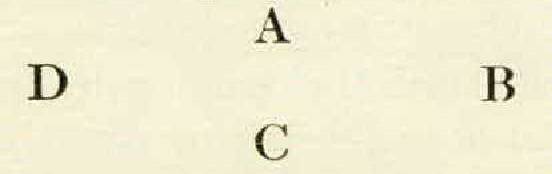
and then proceeds thus: —
“A sits with the left hand to B
B sits with the left hand to C
C sits with the left hand to D
D sits with the left hand to A.”
And then the writer elaborately describes the whole business, and provides for all known contingencies. At the end we have: “And this is all I know, or pretty nearly — Mister Badams may study Captain Burney’s little Treatise, but don’t you puzzle yourself with it yet. Milk for Babes. C. Lamb.” It may be held to have sufficed, if Mrs. Badams mastered even all that she found in the quarto sheet of paper.
I am sorry that this small group of correspondence reaches its close, so far as my existing information extends, under some unpleasant circumstances, which are noticed in a letter from Lamb to Badams himself, but of which the precise nature is left unexplained. Lamb seems to have been in a state of “heatedness,” to use his own words, after a long walk at Edmonton, and to have encountered some one who, he imagined, meditated taking a house in the neighborhood, and so, by bringing down “crowds of literary men,” destroying the quiet of the place. The sole conclusion to be drawn from the obscure wording is, that Badams was somehow involved, and received an affront. Possibly it was Badams who was on his way to the Lambs’, and was mistaken for some one else. At any rate, Lamb expressed the next day in writing his profound sorrow and spoke of the lines as “the most humble apology C. L. can offer.”
A Mrs. May, not otherwise recognizable, is the recipient about this time of a parcel of books. Perhaps it was the DogDays, 1833, for in a postscript ejaculates Lamb: “My! how hot it is.” This was pretty clearly a distinct person from the two Mays of earlier years.
In the autumn of 1834 he received from Hood a copy of Tylney Hall, and his last letter to that old and cherished friend embodies an appreciation of it. It is a delicate way of insinuating the obscurity of some of the poems, when the writer says that “the most inveterate foe to that kind of jokes not being expectant of ’em, might read it all through, and not find you out.” Mary has been ill, but is better. “She tries to make it out, & laughs heartily, but it puzzles her to read above a page or two a day.”
It is sufficiently familiar that Lamb outlived Coleridge only a few months, and throughout that brief interval he had his friend continually present to his mind. The name of Joseph Henry Green is almost equally well known as that of one of Coleridge’s literary executors; but no correspondence between Lamb and Green was on record or evidence until a note of August 26, 1834, barely a month after Coleridge’s death, casually fell in my way. It thanks Green for a copy of the will, which, saving the codicil, Lamb apprises him that he had already seen at Highgate. He and his sister are highly gratified by the affectionate remembrance, and Lamb will collect and send all the fragments they possess of his handwriting. But letters, he fears, they have none, “having been long improvident of preserving any.” In the will, dated 1829-30, Lamb is signalized as Coleridge’s “oldest friend and ever-beloved school-fellow.”
I have emptied my budget. I flatter myself that it is a farther step toward an adequate edition of the Correspondence, whenever that may, by some amicable and generous arrangement among those concerned, become possible. All those in the market are undeniably imperfect and unsatisfactory on different grounds, the writer’s of 1886 inclusive. But his successive labors since that date have achieved much toward the desired result. Much more remains to be done