The Father-Tongue
FOR the past three weeks my table companion at a London boardinghouse has been a cultured English woman. We talk a great deal together. I have been in England before and have studied the peculiarities of the spoken language. My companion has American relatives who visit her frequently. I think I know English, and she thinks she knows American. And yet, if either one of us speaks rapidly when the other is off her guard, even though it be but; to ask for the marmalade, or to cast, doubts on the candor of the weather-man, it is ten chances to one that the remark will not be understood.
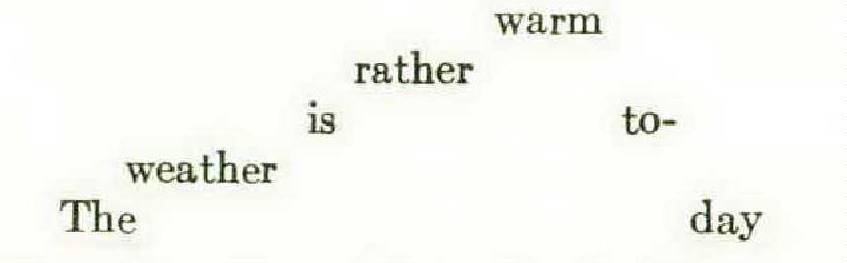
Such an experience makes one realize how minute are the factors upon which depends an instantaneous, involuntary apprehension of the vernacular. An accent here, an inflection there, a trifling pause before the cadence, — these are some of the ancient landmarks by which we recognize instinctively the verbal path. These failing, we are for a moment bewildered and think we have missed the way. There is a multitude of such slight differences between English and American speech, but of them all, the differences in modulation, in the so-called ‘speech-time,’ are perhaps the most disconcerting. The normal American modulation of a simple assertive sentence may be represented thus: —
That is, the voice, beginning at the tonic, ascends gradually in pitch for about a major fourth, to and through the word ’warm’; then drops back in the word ‘to-day’ to the tonic. That is all the tune there is. Usually the words are spoken unemotionally, somewhat monotonously, perhaps in a sort of recitative, with a rather dry, sharp articulation, especially if the speaker is from the middle West.
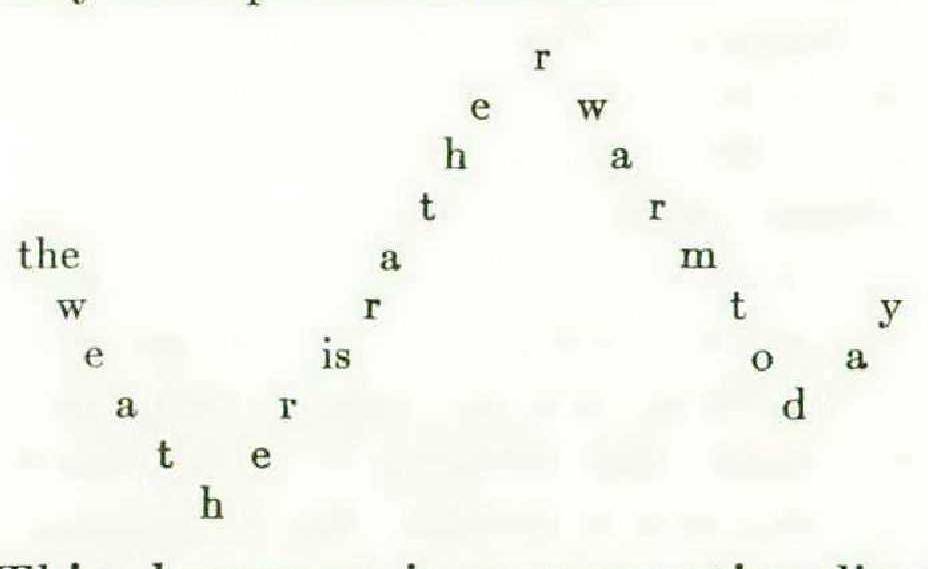
But my English friend, speaking the same words, with the same thought, behind them, uses a quite different, intonation. To my American ear her speech-tune seems highly emotional, highly complex. The variations of pitch may be represented thus: —
This, however, is a conventionalized diagram; it does scant justice to her sentence-modulation at its best. When she is in fine fettle her voice is as erratic as an aeroplane in a gale of wind. It shoots madly from one extremity of the vocal gamut to the other, usually with a leap skyward on the last syllable that is at worst a kind of shriek, and at best a forcible and eager interrogation.
When I am unexpectedly addressed, or sung at, in this fashion, I am simply thrown on my beam-ends. My mental processes, if they could be registered, would probably show the following sequence: —
‘Weather — she is talking about, the weather —evidently greatly excited — must be something very interesting and horrible — no, can’t be a tragedy, because she is smiling—concealed joke, perhaps — and it’s a question — what does she want to know? — Well, I give up — I ’ll have to ask her to repeat.
And I do.