Musical Indigestion
Long after it was heard no more.
— WORDSWORTH: The Solitary Reaper.
I
ON the way home from an evening of music why do we usually fall to humming or whistling some melody from last week’s concert? The thing is so unnatural! It seems as if the normal mind ought to be reverberating the strains to which the body is still sympathetically vibrating. Why, then, instead of mulling over the two symphonies, the three solos, and the overture to which our ear-drums have just ceased rolling an accompaniment, do we insist on turning so far back into the musical past ?
After long puzzling over this problem I have come to believe that we are led to do so by much the same causes that occasionally lead us after a hearty dinner to recall how greedy we were at luncheon. Reversion to last Saturday’s treat after the Tuesday concert simply means that our musical digestions are days behind with their work.
The reason for this state of affairs is that concert programmes are too long. During the musical season their size keeps concert-goers in perpetual arrears; therefore most of the hearers, performers, and critics who form the bulk of the musical world, suffer from a chronic complaint, which may be termed musical indigestion.
Most programmes to-day are vast museums of Tone; and those of us who stay till the last note are often affected as unpleasantly as was the dear old missionary with the beauty-loving soul who spent five hours inspecting every single statue and painting in the Vatican, and then tottered away, exclaiming that art was a mighty ungodly thing after all.
Musical indigestion is the worst enemy of the art of creative listening. One often notices how splendidly creative an audience is for the first hour, and how rapidly thereafter it grows destructive. The more ‘ resonant ’ the listeners are, the faster they use up their available supply of creative energy, the sooner they reach that condition to which Charles Lamb’s amateur organist friend Nov— used to reduce that destructive listener after the first few pieces of his interminable programme.
‘But when this master of the spell,’complained Lamb, ‘ not content to have laid a soul prostrate, goes on, in his power, to inflict more bliss than lies in her capacity to receive, — impatient to overcome her “ earthly ” with his “heavenly,”—still pouring in, for protracted hours, fresh waves and fresh from the sea of sound, or from that inexhausted German ocean, above which, in triumphant progress, dolphin-seated, ride those Arions Haydn and Mozart, with their attendant Tritons, Bach, Beethoven, and a countless tribe, whom to attempt to reckon up would but plunge me again in the deeps, — I stagger under the weight of harmony, reeling to and fro at my wits’ end.’
This sort of thing was bad for Lamb, and for his amateur friend, too, although in general the player can with impunity partake more heartily than the hearer, because his music is to a certain extent predigested by familiarity; and because the fun and excitement of playing, together with his quickened intellectual activity, help along the assimilative processes.
For all that, long programmes often get musicians into a pitiable condition, and I can perfectly understand the action of my professional friend who was walking home once after having played in an orchestra for half the night. Yielding to an overpowering wave of disgust, he stuffed his trombone into the first drain he saw, with such vicious exultation that he had no small difficulty in recovering it the following morning.
The most wretched victim of indigestion is undoubtedly the music critic of the average metropolitan newspaper. He is treated on the Strassburg principle that the more you can cram into a goose, the more valuable you make the goose. ‘Critics,’ declared the uncompromising Tolstoï, ‘have always been people less susceptible than other men to the contagion of art. For the most part they are able writers, educated and clever, but with their capacity of being infected by art quite perverted or atrophied. And therefore their writings have always largely contributed, and still contribute, to the perversion of the taste of that public which reads them and t rusts them.’ Now I think it unfair of the rugged Russian to blame any one under present conditions for being a bad music critic. He should have emptied the vials of his scorn exclusively upon our system, for it can hardly fail to turn good critics into bad. It is a system which, if adopted by the wholesale liquor houses, would compel their tasters to consume at least a gallon of each variety before pronouncing judgment upon it.
One day at dinner little Anita had a third helping of beef before realizing with a groan of despair that there was ice-cream for dessert. Suddenly the despair vanished. ‘The capathity of the human thtomick,’ she was overheard to observe to herself, ‘ith three pinth; — but it’ll thtretch!’
So will the musical stomach,—but only with the gravest consequences. During the season a music critic in New York City averages ten performances a week. Now, a corresponding regimen for geese or tasters soon results in pâté de foie gras or delirium tremens. The journalistic process produces, at the best, various forms of musical indigestion, with one symptom common to all: an utter loathing for music in any form.
All glory and honor and laud be unto the small group of noble characters who, by some miracle, manage to remain good critics despite the disease which is undoubtedly tearing at their vitals. These hero critics represent the sheer triumph of spirit over flesh. They form a distinguished band of Scævolalike stoics who continue calmly delivering their illuminating discourses on the nature of the divine fire while burning their hands to a crisp in a mundane one. But these persons are all too rare. The average critic sinks completely under his affliction. Happy is he whose paper affects a savagely pessimistic pose. He can obey the promptings of his agonized inner man by laying about him and sparing not. He is permitted to lake out his sufferings alike on the just and the unjust, and sincerely to portray all music in the repellent terms which a Strassburg goose might use in composing an anserine menu.
Equally blessed is the satellite of one of those fashionable sheets whose philosophy of music-criticism is preoccupied by the problem, ‘Wherewithal have we been clothed?’ From his column you somehow manage to receive the impression that the Rhenish Symphony began with a sunburst of incomparable brilliants, disclosed an exceedingly low-cut scherzo, a slow movement in creamy satin with pink pipings overlaid by gold net, followed by a broadly scored finale, two to two and one half yards in length. Most of the critics, however, have a far worse time of it. Their plight is aggravated by the necessity of working for those roseate journals whose advertising policy dictates that at present everything is disposed for the best in the best of possible worlds. So these wretched men are obliged to simulate perfect health and an insatiable appetite for music, and to flatter all musicians alike, because the first groan would lose them their weekly honorarium. But they know how to spare themselves.
One type slits his mouth into the perpetual grin of The Man Who Laughs. During a concert he tries to deafen his poor ears by concentrating his attention on some minor point of the performance and then writing about that point the quaintest, gayest, most lilting little essay imaginable. And next morning the public holds its sides and exclaims how true it all is and how deliciously The Man does hit it off, never realizing that a criticism of that concert is yet to be read. One scarcely knows whether this method is more unfair to the public or to the hapless tenor or fiddler or conductor who happens to be the first handy ear-tab for The Alan Who Laughs.
Another favorite defense against musical indigestion is for the critic simply to relax the muscles of his imagination and then set down on paper the shoes and ships and sealing-wax,— the anything and everything that happens to occur to him at the moment, as an interpretation of the ‘meaning’ of the music. Let it again be emphasized that the poor critic is more to be pitied than scorned. I ascertained this from a season’s personal experience on a weekly, when I felt the fewest and lightest of the daily critic’s pangs.
The moral of all this is: let us cease our orgies of gorging, and let us begin Fletcherizing. This will relieve the situation at once for hearers and performers. And the choiring critics will lift up their voices (though a little out of tune, I fear) and call us blessèd.
II
The worst thing that musical indigestion accomplishes is to atrophy, or at least weaken, the musical memory. It is as hard for the ordinary man to emerge from the ordinary long concert, or from a debauch of music-reading, with a clear idea of any one thing that he has heard or played, as it was for our old missionary to emerge from his extended rush through the Vatican with a pellucid idea of the Laocoön. And, often repeated, this relaxing, confusing experience is apt to get one’s memory, or latent memory, into the worst of habits.
Musical indigestion is therefore the chief enemy of the sport of amateur automusicianship, the practice of which is conditioned by a sound musical memory. Before going further it may be well to state that the automusician has no necessary connection with such automatic devices as the mechanical piano. His only mechanical piano is more than likely to be inside of his own skull. This, however, is a superb and indispensable instrument. In fact, one is almost tempted to paraphrase Dr. van Dyke’s bon mot about the two kinds of biographers, and to say that there are only two kinds of musicians: automusicians and aut-not-to-musicians. But this would, after all, be a rather too extreme way of declaring that it is harder to be a great musician without a capacious memory than for a rich man to see how the other half lives through the eye of a hypodermic needle.
Little will be said here about the value of a musical memory to the performer, because this every one concedes. But not every one knows that much of the player’s most valuable practice is often done apart from musicbook and even instrument. Happy the one whose memory so outruns his fingers that he may walk troutward-bound through Maine woods while slashing away at those Gordian knots into which Max Reger has tied every page of his sonatas. How three and four times blessèd is he to whom it is granted to work out the cadenza of the Dvorak ’cello concerto on the seam of his trousers while the elevator is stuck between floors!
‘We musicians know’ that slavery to the printed note is often the final and most fatal bar to spontaneity in performance. Even without all this anxious groping of the eye among the ugly lines and spaces, the player’s attention is distracted quite enough, God wot, by the base, physical properties of his instrument, by the acoustics, or a cut finger, or ‘the unfit, contrarious moods of men’ in the audience, or by a dozen things else. Woe unto him who is obliged to distract his attention still further from the real matter in hand by squinting at the rude, inky symbols of the composer’s meaning through that last straw — vision. It were better for his spontaneity that a millstone were hanged about his neck and fitted up with harp-strings, and he were allowed to improvise upon them, fancy-free.
Musicians feel the visual handicap so keenly that many orchestral conductors go to the extreme of committing their scores, which means remembering anywhere from twenty-five to two hundred and fifty notes a second for an entire evening, to say nothing of remembering which instrument plays which note, and how loud or soft, with what sort of bowing or tonguing or drum-sticking, how the phrases are to be sculptured, how fast the composer intended each part to be played, and like details. One stands agape at the magnitude of such a task. But a moment’s reflection will show that the very magnitude of that other, spiritual, task involved in the interpretation of an orchestral score, supplies one set of human faculties with quite enough to do without compelling the interpreter to be always racing with his eyes as well, and fumbling pages with his fingers.
Von Bülow, one of the most eminent conductors of his time, was so impressed by the drawbacks of the printed page that he actually tried to make each man in the Meiningen orchestra learn his own parts. If he had succeeded I think that he would have advanced orchestral art an epoch or so. But he failed. The men simply could not. do it because, I suspect, they were all suffering from indigestion, brought on by overmuch reading at sight, and interminable programmes.
We are not talking here, though, about remembering music for pay, but for pleasure. Every one who does the latter— professional or not—is worthy to be called an amateur automusician. But nobody should be thus honored unless he loves music well enough to master it, and make it his own for the pure joy of being able to start the inner machine at will, morning or evening, in bed, in the bath-tub, or up in an airship.
As for the listener, his memory is harmed by too much music far more than the old missionary’s would have been harmed by too much sculpture twice a week. Because the full enjoyment of this art, more than of any other, needs the aid of memory. Except to the fortunate few who can appreciate a book of printed notes as others would a printed novel, music is an evanescent thing. It does not stay on forever like the Laocoön or the Last Judgment or St. Peter’s. It does not even go on forever like Tennyson’s brook (except, perhaps for those who happen to live next door to a conservatory). It appears to us, a transient gleam, and then, —
Lighting a little hour or two, —
is gone. ‘And the place thereof shall know it no more,’ — unless, indeed, one has had the presence of mind to treasure up a little of the precious, white powder in the private cold-storage plant we call memory. Thus, to speak of ‘a melting melody’ is, alas! to employ a double entendre.
This evanescent quality makes it providential that more of music can be remembered with a given exertion of memory than of the material of any other art, because music is more economical of its material. It can take one small form of notes and repeat it over and over again with various slight modifications, and finally build a whole piece out of it. How easy it would be to grow familiar with a streetscape by Whistler if it were composed in this thrifty musical fashion of nothing but the same strip of asphalt, seen from various aspects and in a variety of lightings. ‘Repetition is the fundamental principle in all musical construction,’ writes Mr. Krehbiel (who is, by the way, one of the hero critics already referred to). ‘While the exercise of memory is a most necessary activity in listening to music, it lies in music to make that exercise easy. There is repetition of motives, phrases, and periods in melody; repetition of melodies in parts; and repetition of parts in the wholes of the larger forms.’ Beethoven began his Fifth Symphony with a motive of four notes which he described as Fate knocking at the door. Mr. Krehbiel has shown how these four notes, in a general way, might be said to run not only through the whole symphony, but also through certain other compositions of the same period. Thus it is evident that when one has mastered this tiny formula he has made more or less his own an entire crosssection of the master’s career.
This, then, is a characteristic tendency of music: to sum itself up in one small motive, much as a nation sums itself up on some national holiday by flying its flag from every other window. By rare good fortune this tendency harmonizes beautifully with the ways of the human mind. The psychologists say that it is natural for us to simplify everything for ourselves, —to remember a certain dog, for instance, by a white spot on his left ear, or a certain symphony by taking a mental snap-shot of its few chief themes. In The Origins of Art, Yrjö Hirn declares that, ‘the art of arranging great complexes of intellectual and emotional elements around single focal points, is not only natural to man, but may be greatly developed by exercise. Music lends itself most readily to this act of arrangement. It requires a very learned scholar to reconstruct, even approximately, from a foot a marble Hercules that he has seen a score of times. But to reconstruct the Fifth Symphony in a rough-and-ready way from the Fate motive and a handful of other fragments is well within the capacity of not a few amateurs.
It is interesting to know that the act of creative listening is a powerful aid to the memory. The more we give out at a concert, the more we receive from it. And at the musical board there is never any extra charge for food taken away from the table. The more we resound the players’ and composer’s emotion back to them, the more are we aided in our unconscious efforts to pack the good things into portable shape for home consumption. For emotion not only makes the mental snapshot sharper: it also stimulates the summarizing instinct. The more emotionally a large work of art affects us, the more we are instinctively moved to sum it all up in a single impression which shall re-create the whole for us, just as we carry away the worth of the Mona Lisa in the memory of the haunting eyes alone; and just as the whole mystery of life is brought home to the poet by the flower in the crannied wall. ‘The soul, of its own unity,’ wrote Carlyle in Sartor Resartus, ‘always gives unity to whatever it looks on with love.’
To be without a musical memory; to be forever obliged to depend on some player, or even some machine, whenever you crave music, is like being so deaf that your only communication with the sons of men must be through the mediation of the valet whom you have hired simply on account of his Bull-ofBashan voice. Or, if not as desperately situated as this, at least the musically oblivious stands to the man with automusic in his soul as the traveler who must depend on corporation steam stands to him who fares to the gay chug-chug of his own motor.
The automusician finds things so convenient! He does n’t have to wait for the musical train to rumble formally in and bear him away on precise iron ribbons only approximately where he wants to go, — or perhaps, indeed, in the opposite direction,—and with all manner of annoyances like a conceited, overbearing conductor, noisy fellow passengers, blockades, wrong signals, and so on. At any moment he may jump into his own crankless car, grasp the wheel and go exactly where he lists. He may drive through that bit of sunset-colored marshland a score of times, or bide ten hours motionless on the bank of the Rhine, if it please him. What is more, there are no traps, no regulations against speeding, to offset this kind of travel. He can arrive anywhere in no time, or in any other tempo he fancies. In his car he is practically omnipotent, — and omniscient, too, if contrapuntally inclined. His vehicle is even amphibious. The whole world stands open before him, where to choose, if we except certain neoromanticist quicksands which only the most diabolically perfected memorymachines may negotiate.
The cultivation of the sport of automusic is the only hope of emancipating the art from its present thralldom to performance, as the invention of printing emancipated the drama. In this reading age, we pity the illiterate who can enjoy Shakespeare only by paying for a seat in a stuffy theatre. And yet, until we can learn to revel in Beethoven while walking to work in the morning, or at least to hold him bound on our knees and enjoy him before the evening blaze, we shall remain as illiterate in music as the theatre-slave is in poetry. Ignorance and inertia alone are delaying that next great step in the development of music, — the complete cooperation of stage and audience, which can only come about when the latter turns creative. For memory is one of the chief aids to the development of creativeness in listening, because it affords such unexampled facilities for the practice of the art. A man performing music mentally to himself is the only performer who is his own best hearer.
‘Well, then,’ some reader may ask, ‘what must I do to be saved from musical indigestion, and to cultivate a musical memory?’
You must do four things to music: — read, mark, learn, and inwardly digest it.
READ. Psychologically speaking, there are two types of persons: the ‘visual,’ and the ‘auditory.’ The first perceive best with their eyes; the second, with their ears. If you are of the visual type and have not yet learned to read music fluently, your greatest musical pleasure may be still before you. How do you know that — once you have become musically literate — you may not enjoy reading a volume of Brahms as much as you now enjoy a volume of Locke? And as for your memory, quite unwittingly you may have possessed all this time the musical retentiveness of a very Von Bülow, except that this faculty has required of you, not earbut eye-service. Perhaps it has only been waiting to reveal itself until you pay it the small compliment of learning to read; because your memory is so constructed that it does not recall first how the notes sound as easily as it recalls how they look on the page. If, on the other hand, you are of the auditory type, you should learn to read, anyway; because nobody is purely visual or auditory. And besides, you need more than a bowing acquaintance with notation to be in a position properly to —
MARK. In a fraternity of creative listeners called the Ear Club, that used to attend the Thomas Orchestra in the old days, we developed a novel system of ‘marking’ new melodies that took our fancy, which amounted to a rude but wonderfully simple method of musical shorthand. It did not pretend to furnish a finished record, but only a prop to memory. There was none of the scientific-looking paraphernalia about it that makes even a hymn-book formidable to a philistine; there were no lines or spaces, no clefs, accidentals, or tails to the notes. Each note was represented merely by a pencil dot. Its relative length was crudely shown by the horizontal distance between it and the next dot; its relative pitch, by its vertical distance from its neighbors. The measures might be indicated or not, at pleasure. Thus, if we wished to help ourselves remember the ‘ Hymn to Joy ’ from the Choral Symphony, we would mark on the margin of our programmes something like the following: —
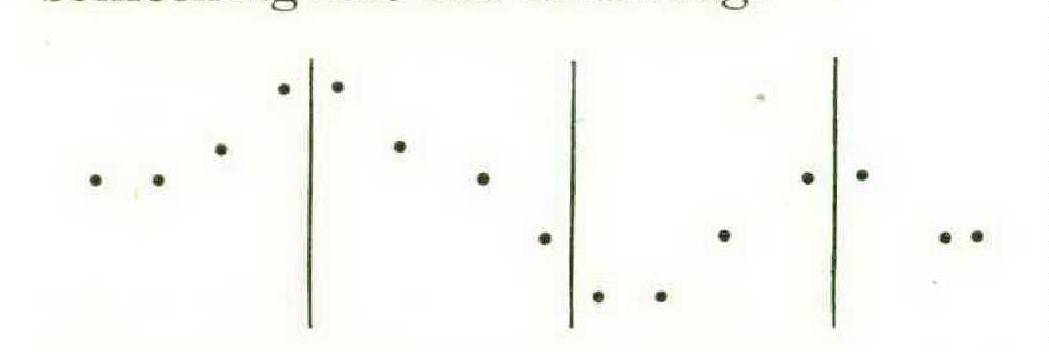
More important than this sort of marking is the marking upon the tablets of your mind such things as how this motive or that plays hide-and-seek among the bars with its playmates, the various instruments. For the mere ability to tell which instrument of them is ‘ it ’ is a wondrous aid to memory. To do this you must learn a little about musical form and instrumentation. And once you have made yourself intelligent enough to mark, you will be convinced that a musical memory is one of the most delightfully entertaining things that the First Composer ever invented.
LEARN. Deliberately set your memory certain musical tasks to be completed within a given time. And, as a relaxation from work, play such memory-games as ‘Whistle,’ which was set forth in ‘A Defense of Whistling,’1 or that anomalous sport, specially made for picnic parties, where you think of some melody and tap its rhythm on your neighbor’s foot with your own, scoring one if he fails to guess it, and losing the ‘serve’ if he succeeds.
INWARDLY DIGEST. There is no other thing of beauty on earth that men dally with more, and think about less, than music. And this, despite the fact that one small liqueur-glassful of Chopin prelude thoroughly digested, made bone of a man’s bone and flesh of his flesh, holds for him infinitely more pleasure and profit than a Heidelberg tun of Tone to be drained at a sitting; or — to change the figure —than a cloud-burst of ninety and nine symphonies that slip his memory because he has put on his mental oil-skins.
There is something both laughable and repellent in the spectacle of concert-goers sitting year after year and swallowing their musical roast-andboiled whole, as though it were quite predigested and required no further exertion from them; as though, in fact, we had already arrived at the state of things predicted by some European savant, when science will kindly replace these very fallible organs of ours called stomachs with neat, hygienic ones of German-silver, so that, instead of solemnly gathering thrice a day about the family board, we shall when hungry simply turn a Germansilver stop-cock in our left wrists, and insert a pellet of concentrated turkeywith-cranberry-sauce, and, in a single drop from a medicine dropper, administer to ourselves the essence of a quart of (dealcoholized) Tokay. When this time comes, the sweet influences of the Pleiades will doubtless be captured and used to flavor chewing-gum, and phonograph records of the bands of Orion will be on sale at all music stores, and musicians will have learned to save the public time, as well as energy, by playing a symphony not horizontally but vertically, in one massive but predigested chord.
Under our primitive twentieth-century conditions, however, it is well known to the learned few that cake is none the less in need of Fletcherizing because it happens to be angels’ food, and that the man who supposes that he has digested music before devoting as much time to thinking about it as he has devoted to hearing it, is not only befooling himself and ruining his digestion, but absolutely affronting the creator of this beauty, and the player who has been re-creating it, and the creative listener in the row behind who has been re-recreating it. The sooner people discover that the musical world was never exempted from the primal curse — or blessing — of toil, the better. In the sweat of thy brow shalt thou become musically well-bred.
In order to achieve this end, the first thing to do is to restrict yourself to hearing no more music than you are sure of being able to digest. Until programme-makers have learned to send their audiences away still ready for one more course, it might be a wise plan to begin by leaving the hall in the middle of every concert, and taking yourself on a quiet, musical walk in order to reconstruct as best you may what you have just heard. And do not forget to take along your whistle. In these digestive strolls that convenient amateur instrument is at its very best. A habit like this will guard you from a glut of Tone, and insure you quite as much time for meditation as for listening.
If, for any reason, you are unable to leave the hall betimes, it is much better even to take forty winks than to make a glutton of yourself. In this respect old Peter the Great was far in advance of modern practice. He once took a nap at the Opera and, on awaking, was asked if the performance had wearied him.
‘Not in the least,’ replied Peter; ‘on the contrary, I liked it to excess. So I went to sleep from motives of prudence.’
Doubtless the monarch indulged later on in a good-night stroll, and gave the act or two which he had heard a thorough thinking over.
The prudent napper will, however, be very careful not to exert a destructive influence on the performers. He will either retire to the rear of the box, or else decline so low in his orchestra chair as to become invisible from the stage.
Under a sparing regimen like that just outlined, the musical memory will grow by leaps, and will soon be found one of the most delightful assets vouchsafed to mortals. Memory in hand, you can go back and lord it as in the days of Haydn and Mozart, when the best music the world over was the perquisite of royalty and nobility alone. For you will find your memory as good as a whole emperor’s retinue of orchestras and singers, while less cumbersome, and far easier on the feelings of the performers.
You will come to know one of the joys that make leisurely browsing in a library such a delight to the booklover with the well-stocked brain — the joy of discovering relationships. You will know what a lark it is to trace the genealogy of some Debussy or Loeffler idea back to Brahms, and from Brahms to Mendelssohn, from him to Schubert, and then back to Mozart and Bach, and Buxtehude and Palestrina, and so on until it grows dim in the mists of dawn. This and a hundred other joys will come to you, until you are convinced that music never, never renders up its deepest pleasures, its profoundest help in time of need, its sublimest messages to men, until they have learned to remember and to digest it. Then you will be one of those fortunate ones
Through dusky lane and wrangling mart,
Plying their daily task with busier feet,
Because their secret souls a holy strain repeat.
I said just now that a musical memory was as good as a whole retinue of players and singers. In many ways it is far better, and especially on account of the perfection of the performance, — its sensuous wonder, with all the ugly shortcomings hidden and all the excellences glorified. It is at one of these retrospective concerts that we mortals receive in full measure the benefit of that divine law which always mars, however slightly, the perfection of any actually present pleasure in order that it may endue the distance with what Ruskin calls, ‘ that sweet bloom of all that is far away.’ For a performance on the stage of memory is able to include all the virtues and expunge all the vices of past music. This is the most beautiful thing about a vigorous musical memory, that it lets us enjoy the far away at the closest possible range, with all its bloom fresh upon it.
Are sweeter.
The critic who ridiculed ‘unheard melodies’ as ‘a contradiction in terms’ was having a sadly unimaginative moment. For who does not know that the poet meant those ditties which have ’no tone’ for any ear save that inner one ‘which is the bliss of solitude’?
It was my good fortune to learn about the perils of musical indigestion and the pleasures of memory from the members of the Ear Club. For very much as Keats, in a delicious letter to Reynolds, once advocated a ‘sparing touch of noble books,’did these truly creative listeners preach musical temperance. And many of my rarest memories of the old Thomas Orchestra cluster, not about the Auditorium, but about, the shores of Lake Michigan where I would take my single symphony or overture, to ‘wander with it, and muse upon it, and reflect from it, and bring home to it, and prophesy upon it, and dream upon it’; to pipe it to the choir of the winds, to hum it to the gentle string-murmur of the ripples, or with some heavy theme strive to out-roar the drum-battery of the breakers.
One Friday afternoon gleams out above all. First on the programme came the lovely Symphonic Variations of Dvorak. Next appeared Nordica. But before the first note of her aria I was off for the old haunts on the shore, fairly ‘evaporating’ Dvorak, as Stevenson would say. Undaunted by any wide demand, memory ran blithely, and soon the piece became but one variation of a larger set in which the rich undertone of the great city, the serried ranks of saffron clouds, the swooping gulls, and the emerald field of foamflashing waters bore part. And for the finale the sun, slanting through the towers of the metropolis, seemed by some divine chemistry to draw forth all the nobility and beauty hidden beneath, and to waft them, a broad crimson harmony, out toward the shoreless horizon.
As we grow older and perhaps a little harder of hearing, we notice that the heard melodies begin to lose some of their old, piquant charm. But, as more than compensation, those unheard seem to grow sweeter and sweeter. Perhaps it was not such a harsh fate, after all, that closed Beethoven’s ears to the crude strumming and scraping and tooting of his own day, while opening them more and more to those ineffable strains which he wove into his swan song.
Never again, I suppose, shall we scattered members of the Ear Club be so susceptible to the mitigated pleasures of the heard melodies as in those young years of the virginity of sense. And no orchestra may now thrill us quite so deeply as a stroll in the happy autumn woods of memory, where each yellowing leaf flutters in an old programme-book. Gone are the discordant influences of the Philistine, forgotten all the flaws of rendition. Unalloyed and ideal those soundless symphonies float out upon the pure ether of the past, dross-purged in the kindly reaches of the years. As the inner eye wanders over that beloved section of the Auditorium there appear, through the tense atmosphere of Tone, visions of the dear familiar faces. The air of ‘ Waldweben ’ commences its soft stirring in the depths of the enchanted forest, and the bird begins the same old song it sang to Siegfried when, all the world was young.
- In the Atlantic, for September, 1910.↩