The Sunset of the Confederacy: Iii
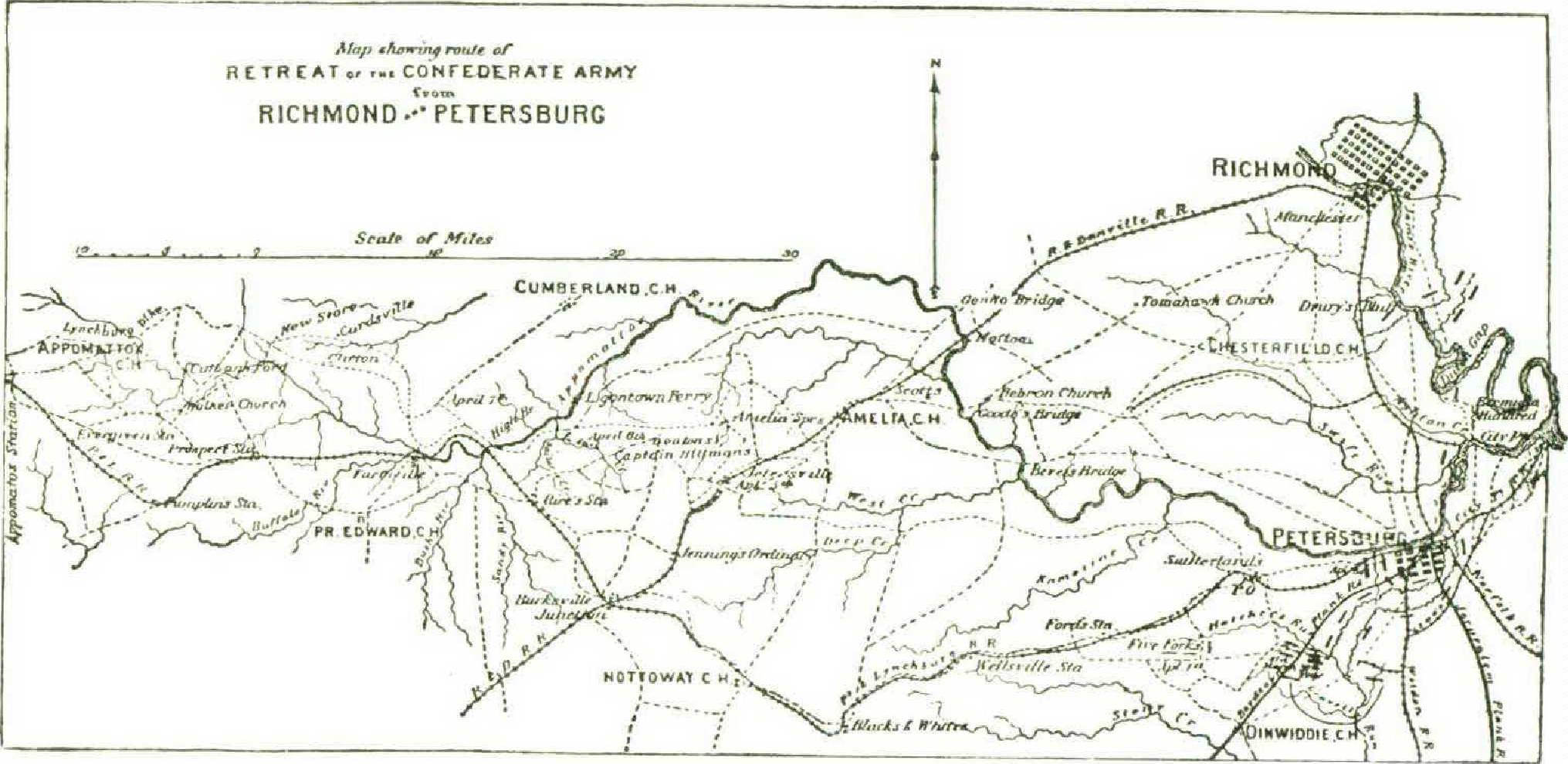
I
IT was about daylight when Lee himself left his camp near Amelia Springs to join Longstreet, then well on his way to Rice’s Station, nine miles west of Burkeville. Alexander, Longstreet’s chief of artillery, and a man of courage, rare spirit, and mild bearing, says that the troops halted for a short rest just before dawn, that Longstreet and his staff went on to Rice’s Station; and that he himself, as morning was breaking, selected a line of battle which they were to occupy on arrival. But, as will be seen, our cavalry struck in behind them, and only a part of Anderson’s corps immediately in their rear, and so much only of the cavalry as was under my friends Munford, Rosser, and the young, handsome, joyous-hearted Dearing, ever saw Alexander’s line of battle.
Anderson fell in behind Longstreet with the forces he had brought up on the south side of the Appomattox, Mahone in the lead, followed by Pickett, and he by Bushrod Johnson. Ewell came next, with Custis Lee; then Kershaw, who had been on the move all night, but had covered eight or nine miles only, owing to the congested state of the road, packed with their own and Anderson’s troops and trains, and obstructed by half-burned and abandoned wagons, the havoc of Davies’s raid. Bringing up the rear was heroic Gordon, and it was after nine o’clock as he rose above the hill west of Amelia Springs.
Early in the morning there was a heavy April shower, but by this time, nine o’clock, the sky was free and the sun was warm. Truly, all nature was smiling: but let the sun shine and the rippling brooks glint, the lilacs and the peach trees blow, and now that the rain has stopped let the pee-wee sing near his home under the bridge, the bluebird warble in the old orchard, and the larks flute in the meadows; yes, let all the fields and fresh-leaved woods rejoice; on and on by them all in their happiness and suggestions of home went the Army of Northern Virginia, weak for want of food and sleep, and low at heart. Toil on, veteran heroes of so many fields; a few days more and it will all be over. Hark! Those are Gordon’s guns you hear.
The Army of the Potomac, strangely enough, did not know of Lee’s retreat till they moved in battle array, at. 6 A.M., to engage him: Griffin on the right, Humphreys on the left, the Sixth Corps under Wright in reserve. They soon found out, however, that he had gone,and they then broke from line into columns, and on reaching Flat Creek near Amelia Springs, Humphreys’s advance, the Twenty-sixth Michigan, spied across the open country, a mile or more away, the rear of Gordon s division.
The news was sent to Meade, and at once Humphreys and Griffin were turned to the left, and Wright was brought back to Jetersville and told to follow Sheridan, who, with Crook in advance, had set out to strike the road at Deatonsville. Griffin swung wide, clear around to the right and north of the retreating column, but Humphreys at once sent the Second Corps after Gordon, who on every rise made a stand, compelling Humphreys to form in line of battle; yet so eager were the men, so sure were they now of victory, that the delays were only momentary, and like hounds, that catch sight of and smell the blood of the wounded deer, they bayed louder and fiercer, and ran faster.
Sheridan, about noon, gained a position not far from Sandy Creek, several miles west of Deatonsville, from which through a gap in the woods he descried the retreating column and threw Crook against it. But Ewell and Anderson, as soon as he began to threaten, faced their divisions to the left and flung him back viciously while the trains filed by. Sheridan, seeing Crook’s repulse, brought up Merritt, but soon made up his mind not to try again for the trains at that point, and sent him and Crook farther along to the left with orders to look for a weaker spot, keeping with him a brigade of cavalry for effect. He then rode to the top of a hill and scanned the uplifted silent country. Off on a sun-bathed ridge, that rose beyond the mile of intervening timber, his eye fell on Gordon’s skirmishers slowly falling back before Humphreys. He then, accompanied by Miller’s battery and Stagg’s brigade of cavalry, followed the path of Merritt and Crook until he reached another overlooking point and discovered, on a parallel ridge below him, the Confederate trains in full view, hurrying with all speed, and flanked by infantry and cavalry. Miller at once opened on them, and Stagg was ordered to charge them, Sheridan’s aim being to check these forces till Crook, Custer, and Merritt had reached a position to strike the road ahead of them.
Stagg’s Michigan men charged gallantly but were signally repulsed, and just as they were reforming up came the head of the Sixth Corps, the same that made that famous march to reach Gettysburg. The point at which Sheridan made his drive was vital, for it was where the road, which has already been referred to, and which the harassed troops were gladly taking, breaks off northward, a mile or more east of Captain Hillsman’s plantation. Moreover, Gordon was not up.
While the Sixth Corps was forming to do what Stagg had tried so gallantly and failed to do, Sheridan wrote to Grant, — his dispatch was dated 12.10 P.M., — ‘The trains and army (Confederate) were moving all last night and are very short of provisions and very tired, indeed. I think now is the time to attack them with all your infantry. They are reported to have begged provisions from the people of the country all along the road as they passed. I am working around farther to the left.’ As a matter of fact, they had only a few grains of parched corn, and one officer in his diary recorded that he that day traded his necktie with a poor family for a bit of corn-bread. Before Wright’s troops were ready Gordon came, and thinking that the troops in advance had gone that way, followed the trains northward, Humphreys at his heels.
Meanwhile Anderson had kept moving and was across the creek, and Ewell with Custis Lee’s division behind him was over, too, Kershaw standing the Sixth Corps off as well as he could. Kershaw had barely gained the hill when Anderson sent word back to Ewell to come to his aid, for Custer and the rest of the cavalry had broken in ahead of him. Loyally, Ewell, the maimed, venerable old fellow, started with Custis Lee’s division to help Anderson; but he had hardly got under way before the Sixth Corps came out upon the Hillsman farm, and began to form line of battle, which made it. necessary for Ewell to halt and look after his own rear.
So he faced Custis Lee about and formed along the open brow of the sassafrasand pine-tufted hill, Kershaw on the right, and Lee on the left; the ravine scored out the face of the hill where the nose would be. There, with flags over them, they lay, from the road down into the ravine and up its northern bank, and every man in that line knew that a crisis was coming. For Anderson behind them to the west was engaged, and, in full view on the valley’s eastern brink, the Sixth Corps was massing rapidly. They could see the regiments pouring into the fields at double quick, the battle lines, blooming with colors, growing longer and deeper at every moment, and batteries at a gallop coming into action front. They knew what it all meant; they had been on the fields of Antietam, Gettysburg, and Spottsylvania.
Sheridan and Wright, mounted, were in the dooryard of the Captain Hillsman house, and with glasses in their hands were scanning eagerly the opposite slopes, the former more impatient than usual, for now above the tree-tops beyond Ewell, thin, hesitating, gray smoke rose silently, telling him that Custer and Crook had struck the trains, and he wanted the final blow given at once. Take a close look at Sheridan, note that face, for he is the very spirit of war.
The sun is more than half-way down, and oak and pine woods behind them crowning the hill are laying evening’s peaceful shadows on Ewell’s line; and on Sheridan’s its long afternoon beams glint warmly from intrepid Cowan’s bronze guns, and sparkle on the steel barrels of the shouldered arms of the moving infantry, for they are getting under way. Sheridan’s battle-flag, which has waved on many good fields, is fluttering behind him; his horse Rienzi, as usual, is champing the bit, trumpeters are ready to sound the advance, and before her mighty harp, War’s stern musician is ready to sweep the iron strings. Seymour’s and Wheaton’s men are approaching the creek, but let us hurry over to Custis Lee’s lines, to a spot on the open, rounded eastward-sloping knoll, where lies Major Stiles’s battalion. We shall remember that when we saw them last they were listening to him as he read the soldier psalm, and that then they knelt with him as he led them in prayer in the dimly-lighted little chapel on the banks of the James, and we shall not forget that there was one boy as he read who met his look with swimming eyes.
They are all lying down, loaded guns in their hands, and the major, that young, rare, transparent gentleman, is walking behind them, talking softly, familiarly, and encouragingly, warning them not to expose themselves, for Cowan’s batteries have opened and the fire is accurate and frightfully deadly.
It is no place, reader, for you or me. Let the major tell the story. ‘A good many had been wounded and several killed when a twenty-pounder Parrott shell struck immediately in my front on the line, nearly severing a man in twain, and hurling him bodily over my head, his arms hanging down and his hands almost slapping me in the face as they passed. In that awful moment I distinctly recognized young Blount, who had gazed into my face so intently Sunday night.’
Reader, excuse the oath, but, by God! this narrative must break; for my pen halts as my heart bleeds. Those tears in that poor boy’s yearning eyes touched it deeply, and I had so hoped that he would be spared. Sing on, Valley of Sailor’s Creek, sing on to the memory of that tender-hearted hero; and oh, Peace, blessed Peace! come and save the world from the sacrifice of youths like this.
II
And now to go on: — Until our infantry had reached the creek the artillery’s fire had been fast and dreadfully fatal; then it stopped, and all was still as the grave, as the men made their way through the thickety banks and formed on the farther side. I ’ll not try to give all of the details of the bloody engagement, but Stiles’s men under his orders reserved their fire till our lines were close up. Then they let go a crashing volley, — their execution was frightful, — and at once charged our centre with fury, and drove it back in confusion across the creek.
But, meanwhile, our troops on the left and right had been successfully crowding their opponent’s flanks into the bowl-like hollow of the ravine’s head, and there the Thirty-seventh Massachusetts, most of whom were from the laurel-blooming hills of Berkshire, had the fiercest, most hand-tohand and literally savage encounter of the war, with the remnant of Stiles’s battalion and that of the marines from the Confederate ships which had lain in the James.
They clubbed their muskets, fired pistols into each other’s faces, and used the bayonet savagely. At the reunions of the Thirty-seventh Massachusetts, I used to see one of the Berkshire men who had been pinned to the ground by a bayonet thrust clean through his breast, coming out near his spine; this brave fellow, Samuel E. Eddy of Company D, ‘notwithstanding his awful situation,’ says the historian of the regiment, ‘succeeded in throwing another cartridge into his rifle, the bullet from which was next moment sent through the heart of his antagonist. The Confederate fell across the prostrate Unionist,’ who threw aside the body, withdrew the bayonet from his own horrible wound, rose to his feet, and walked to the rear.
And yet looking at him you would have seen a quiet, self-respecting, high-minded man; and I think that some of those beautiful, blue-tinted Berkshire Hills glory in the spot that holds his gallant clay.
Keifer, who commanded one of Wright’s brigades, chiefly of Ohio men, — and the state is proud of him and them, — says, ‘One week after the battle I revisited the field,’ — he was on his way back from Appomattox, — ‘and could then have walked on Confederate dead for many successive rods along the face of the heights held by the enemy when the batt le opened.’
These men were put in a trench and Mrs. Hillsman told me that a mother, one of unmistakable breeding, who lived in Savannah, shortly after the battle came there to look for her son. A deluging rain had swept the shallow covering of earth away, and among the festering bodies she found that of her boy by a ring still circling his ashy shrunken finger.
On my trip to the field last October, I stood alone on the bank of the trench; it was in a little cradling ravine, green grass carpeted it, and an openeyed daisy lifted its innocent face to the sky, its gaze perhaps following the track of those upward-gone spirits; all around was still, a white cloud or two floated in the east, and the day was done. I paused a while, t he mood was deep, and soft and tender were the murmurs that floated down about me.
The end of the carnage came quickly; for our cavalry, having torn and scattered Anderson, Pickett and Johnson, charged down on poor old Ewell; and he, seeing that all was lost, surrendered himself and his command. The captives amounted to thousands.
Anderson, Pickett, Wise, Johnson, and Fitzhugh Lee, with their disorganized forces, only a remnant in some cases, broke off through the woods and over fields toward High Bridge on the Appomattox where, in the forenoon, a small force sent out by Ord to burn the bridge was almost annihilated by Rosser, Munford, and Hearing; the latter, a loved classmate of mine, was mortally wounded, and I never see the name High Bridge that his handsome cheery face does not come back and that I do not hear again his happy voice. His body rests at his old home in Lynchburg, within sight of the Blue Ridge whose azure sky-line from boyhood was so familiar to his open, noblybeaming eyes.
While all this was going on, Humphreys had pursued Gordon like a tempest and finally drove his rear-guard viciously across the creek, capturing many wagons, some guns and prisoners. Anderson and Ewell not coming up, Lee at Depot became concerned and sent Pendleton, his chief of artillery, back to learn the reason why. The news he brought was astounding, and with burning, fighting spirit Lee himself in the dusking evening arrayed Mahone to check Merritt’s cavalry, who were still active.
The sun had gone down red, signaling rain, and now night has fallen and the last shot has been fired, Merritt has withdrawn in front of Lee, and Sheridan’s camp-fire is lit. He has sent word of his overwhelming success to Grant, who is in bivouac near Burkeville, saying, ‘Up to the present time we have captured Generals Ewell, Kershaw, Barton, Corse, Defoe, and Custis Lee, several thousand prisoners, fourteen pieces of artillery, and a large number of wagons. If the thing is pressed, I think Lee will surrender.’ ‘He is lying on the broad of his back on a blanket, with his feet to the fire, in a condition of sleepy wakefulness. Clustered about are blue uniforms and gray in equal numbers, and immediately around his camp-fire are most of the Confederate generals. Ewell is sitting on the ground hugging his knees, his face bent dowm between his arms.’ So reports Sheridan’s faithful and brilliant staff officer, Newhall.
Ewell’s brave old heart was beating low: neither he nor any of his comrades was in a mood to talk, yet sadly he told Wright that their cause was gone and that Lee should surrender so that no more lives be wasted. Later, with his natural love and affection, he sent for Stiles, and in the presence of a halfdozen generals complimented him on the conduct of his battalion. The night drew on.
General Kershaw, Colonel Frank Huger, and several other Confederate officers were guests of Custer at his headquarters. Huger and Custer had been fellow cadets in the same company, D, at West Point. The former, like Kershaw, was from South Carolina and of distinguished Huguenot birth, to which his look and bearing bore daily witness; the latter was from Ohio and was then about twenty-six years old, of heavy build and full of natural joy.
After his promotion to a generalcy Custer dressed fantastically in olive corduroy, wore his yellow hair long, and supported a flaming scarlet silk necktie whose loose ends the wind fluttered across his breast as, with uplifted sabre, he charged at the head of his brigade, followed by his equally reckless troopers who, in loving imitation, wore neckties like his own.
Custer was always a boy, and absolutely free from harboring a spirit of malice, hatred, or revenge. Whenever fortune made any of his West Point friends prisoners, he hunted them up, grasped their hands, with his happy smile, and, before parting, tendered generous proffers of aid.
The next morning, when his division started on the pursuit of Lee’s army, he happened to ride by Kershaw, surrounded by Confederate prisoners, and lifted his hat to them. Kershaw lifted his and exclaimed, ‘There goes a chivalrous fellow, let’s give him three cheers’; to which Custer responded by ordering the band just behind him to strike up the Confederate tune ‘The Bonny Blue Flag,’ and the prisoners screamed their fierce ‘rebel’ yell with delight.
III
While Sheridan, Wright, and Humphreys were pursuing, and finally wreaked such signal disaster upon Lee’s retreating forces, Grant and Meade remained near Jetersville. Close by was a house that had an upper piazza from which toward noon, across the count ry and three or four miles away, they caught sight of a bare knoll over which the Confederate trains were passing, Gordon and Humphreys having a running fight at their rear. No news from the front of any great importance arrived till Sheridan’s dispatch dated 12:20 P.M. (already given), to which Meade responded by renewed orders to Wright and Humphreys for act ion and pursuit more vigorous than ever, if possible.
Toward sundown, and still unaware of the day’s good fortune, Grant and Meade separated; the former set out for Burkeville, and the latter took the road to Deatonsville, and about half-past eight came to the bivouac by the roadside which Lyman, having galloped ahead, had selected some two miles beyond the village. He had barely ridden into camp when up came a fast-riding aide from Sheridan with a dispatch addressed to Grant — Sheridan thinking he was with Meade — announcing his Sailor’s Creek victory. Meade exclaimed with surprise and impatience, ‘Where was Wright?’ Had Wright been one of the smooth, keen, foxy men of the world he would have started an aide to Meade before the smoke had lifted from the victorious field that his troops with Custer had won; but he was of that other class of the old-time West Point men, men who did not boast, who shunned newspaper fame and made companions of honor, modesty, and duty. But very soon Meade heard from him and Humphreys direct, and was comforted.
Grant at Burkeville did not hear the news till midnight and at once wrote to Meade, ‘Every moment now is important to us,’ and ordered Griffin, in bivouac near Ligontown to the right of Humphreys and near the Appomattox, to start by the most direct road without delay for Prince Edward Court House, seven miles south of Farmville; adding that Mackenzie’s cavalry, then with Ord, confronting Longstreet at Rice’s Station, had been ordered to the same place and would be under way by 2 A.M. That these moves were made to head off Lee from reaching Danville is clearly obvious.
During the evening, before Grant had heard of Sheridan’s success, he had had a long talk with a prisoner, an old army surgeon, a Doctor Smith, a Virginian, who had resigned at the breaking out of the war. The doctor in the course of his interview7 repeated what Ewell, his relative, had said to him at some time in the course of the previous winter, to the effect that he thought the cause was surely to be lost in the end, and that the South ought to ask for peace.
I think I can see Grant’s old friend at perfect ease, and looking with kindliness into his steady mild blue eyes, for Grant’s old army friends always met him with frankness and irust whether he was in sunshine or shadow; and I think I can hear Grant responding with his unaffected, low voice, one of noticeable purity and pleasingly vibrant. As will be seen, the interview had its fruit.
Grant and Meade had the lulling of victory to go to sleep on, but not so Lee. The day had gone fearfully against him, and with it had gone about all hope of reaching Danville. But affectionate Lynchburg, with its line of works and abundant supplies, seeing his baffled, dismal plight from the top of the neighboring Blue Ridge, beckoned and beckoned to him, and he gave orders to fall back on Farmville, the first stage thitherward. According to Mahone, he was somewhat disturbed as to how to get away from their immediate position at Rice’s Station, and asked his advice. Mahone, who knew the country, suggested that Longstreet should take the river road to Farmville while he would strike across country to High Bridge and cross the river there.
High Bridge, ten miles below Farmville, is an airy structure on piers that, at the centre, are nearly one hundred feet high, spanning the Appomattox, whose valley at that point is comparatively narrow and whose banks are willow-fringed. Nearby is a common country bridge whose roadway, after traversing a little crescent intervale on the north side, comes to the feet of heaving, leaning fields whose background is timber, lifting a crown of green up against the remote and mute horizon line.
Wallace, Wise, Moody, Ransom, the remnants of Bushrod Johnson’s and Anderson’s divisions, which Sheridan’s cavalry had disrupted just before the battle of Sailor’s Creek, shoaled to this bridge and crossed it about 11 P.M. Gordon, who had gone into bivouac on the direct, road to High Bridge, aroused his men after a few hours’ rest, resumed the march, and was over the river before daylight. Mahone reached the bridge just after Gordon had cleared it, but the sun was up as his rear-guard was crossing.
Latrobe, Longstreet’s adjutant-general, in his orders, written by candlelight and issued about nine o’clock, directed that the trains and such batteries in position as were not necessary should be started at once for Farmville; that Field’s division should retire first, followed by Heth and Wilcox; that the sharpshooters should be withdrawn an hour after the troops had marched; and that Rosser’s cavalry should bring up the rear; closing the orders with the injunction, ‘Every effort must be made to get up all stragglers and all such men as have fallen asleep by the camp-fires or by the wayside.’ Lee himself left by ten o’clock, and Longstreet’s troops were moving by twelve. Alexander says, ‘ 1 remember the night as peculiarly uncomfortable. The road was crowded with disorganized men, and deep in mud; we were moving all night and scarcely made six miles.’
Of all these unhappy nights — and bear in mind that they had marched practically every night except, the first since they set out on the retreat I think this must have been about the dismalest. Hope had parted company with them, defeat had laid its hand heavily on them, it was pitch-dark and drizzling, — the rain had come that the red setting sun had foretold, — the famishing horses were falling, the men were sleepy, wet, and hungry. Act through mud, up hill and down, listening to the call of duty, they went, till many out of pure weakness could no longer drag one foot after another, and reeled into the woods, dropped limply down, and laying their cheeks on the drenched leaves went to sleep, some to the very long, long sleep. Those whose strength held out plodded on and on, wondering at every step they took how much farther it was to Farmville. When morning broke, the fields and woods by the roadside were dotted with squads of men tired and sick at heart, moving as in a dream.
IV
Now mark the contrast. At that very hour, sunrise, our troops were all under way in pursuit, and the historian of one of the regiments in the Sixth Corps says, ‘The men were singing, laughing, joking, and apparently happy. Along the road were evidences of the rapid retreat of the enemy, all sorts of ammunition strewn around loose, dead horses lying where they dropped, others abandoned because they could no longer carry their riders, and here and there a dead soldier, lying in the road where he had halted ior the last time, with every appearance of having died from hunger and exhaustion.
‘Soon,’ says one of Humphreys’s corps, in the track of Gordon, ‘we began to come upon whole packs of wagons burned as they stood, artillery ammunition scattered by the roadside, and caissons partially destroyed.’ In fact, there was scarcely a rod of the way that did not have its mute witnesses to the demoralization of the retreating forces.
Of course, all these signs of distress only quickened our advance, and soon brought Humphreys to the vicinity of High Bridge. The Nineteenth Maine, a regiment that in the Wilderness won great honor for its far-away Pine Tree State, now leading its valiant corps, carried the approaches to the burning wagon-road bridge, which Mahone had set fire to, as well as to the lofty railroad structure, after crossing.
The tall woodsmen from Maine rushed down and, by one means and another, put out the fast-creeping blaze, all the time under severe fire from Mahone’s rear-guard. The little blue-eyed, cool, ambitious man, witnessing the efforts to save the bridges, started a brigade back to drive our men away till t he fire could do its work, but the Nineteenth Maine, its courage drawn from the timbered reaches of the Penobscot and Kennebec, stood its ground till help came, and then, in turn, drove Mahone’s brigade back across the intervale up to the hills, where they abandoned ten guns.
By nine o’clock the whole Second Corps was over, and Humphreys, on reporting the fact to Meade, said he could see a column of the enemy’s infantry some two miles distant moving northwestward. What he saw were Gordon’s and Mahone’s columns on what is known as the Cumberland Church Road, a road which comes into the Appomattox Court House and Lynchburg Road about three or four miles above Farmville. So much for Humphreys, Gordon, and Mahone.
Alexander says that Longstreet got to Farmville about sunrise; there they met a train that had come down with supplies from Lynchburg, but before the rations could all be delivered our cavalry appeared. For Sheridan started Crook — imagine an open-faced, blue-eyed man with a splaying, tawny beard and an aquiline nose — early toward High Bridge; but he, soon running up against Humphreys, pulled his left bridle-rein and struck across the country and presently fell in with the head of Ord’s troops on the trail of Longstreet’s column. At Bush River, which is but little more than a goodsized creek, about half-way from Rice’s Station to Farmville, Crook’s advance came up with Rosser’s and Fitz Lee’s people lining its opposite bank.
But by the time the cavalry got ready to attack, the infantry, who had actually marched as fast as the mounted force, — so fleet were they now, hearing the call of the end, — hurried to his ranks and together they charged across and swept the enemy’s cavalry away from the ridge. Then, with Danby’s brigade of infantry, Crook pushed on after them. Wright, who had started from Sailor’s Creek, had only got as far as Sandy Creek by noon, and reported to Meade that Griffin himself, on his way to Prince Edward Court House, wars there, and the head of his column drawing near.
Sheridan, accompanied by Merritt’s and Custer’s divisions of cavalry, had set out for Prince Edward Court House by way of Rice’s Depot, and at midday was halting near there for lunch, ‘under the great branches of some splendid oaks that stood in the dooryard of a fine old house,’ says the observing Newhall, his prince of staff officers.
Meade, who was still unwell, took the road to High Bridge, reached there at eleven o’clock and established his headquarters. Grant left Burkeville about seven and overtook Wright’s corps this side of Farmville, the troops cheering him well as he rode through them. Keifer in his Four Years of War says, ‘The roads were muddy and much cut up by the Confederate army. Grant was dressed to all appearances in a tarpaulin suit,’ — it was still raining a little, — ‘and he was even to his whiskers so bespattered with mud, fresh and dried, as to almost prevent recognition. He, then as always, was quiet, modest, and undemonstrative. A close look showed an expression of deep anxiety.’
Meanwhile Crook had got to Farmville and charged into the village, the disorganized enemy supply-trains making all haste to get out of his reach by crossing to the other side of the river, abandoning many wagons; and before three o’clock a part of Ord’s command, the head of Wright’s corps, had reached there. When they came in, Grant was sitting on the upper porch of the village tavern, smoking calmly.
The sky cleared about noon and every old white-and-pink-blooming apple tree, the fields and woods sprinkled with flowers, yellow, white, and blue dogwood, and blazing azalea, began to rejoice.
But not so those weary, hungerfeeble, Confederate veterans throwing up a line of works across the road above Farmville to stay the inexorable Humphreys until the famishing horses dragging artillery and trains could get a little start for Appomattox. No, there was no rejoicing among them, let the fields, sky, and brooks smile and gurgle as they might; and I have no doubt that more than one of the tired men, their heads bowed down, envied the dead in Cumberland churchyard. Yet their courage rang like an anvil when Humphreys struck at them late in the afternoon.
V
Here is what had gone on, meanwhile, at Lee’s headquarters, as reported by my friend Alexander, who only last autumn crossed that other great river. When I shall cross, too, I hope some one will lead me to him for he was good, soothing, and winsome company.
‘About sunrise, we got to Farmville and crossed the river on a bridge to the north side of the Appomattox, and here we received a small supply of rations.
‘Here we found General Lee. While we were getting breakfast, he sent for me and, taking out his map, showed me that the enemy had taken a highway bridge across the Appomattox near the High Bridge, were crossing on it, and would come in upon our road about three miles ahead. He directed me to send artillery there to cover our passage and, meanwhile, to take personal charge of the two bridges at Farmville (the railroad and the highway), prepare them for burning, see that they were not fired too soon, so as to cut off our own men, or so late that the enemy might save them.
‘ While he explained, my eyes ran over the map and I saw another road to Lynchburg than the one we were taking. This other kept the south side of the river and was the straiģhter of the two, our road joining it near Appomattox Court House. I pointed this out, and he asked if I could find some one whom he might question. I had seen at a house near by an intelligent man whom I brought up, and who confirmed the map. The Federals would have the shortest road to Appomattox Station, a common point a little beyond Appomattox Court House. Saying that there would be time enough to look after that, the general folded up his map and I went to look after the bridges.
‘As the enemy were already in sight, I set fire to the railroad bridge at once, and, having well prepared the highway bridge, I left my aide, Lieutenant Mason, to lire it on a signal from me. It also was successfully burned. In The End of an Era, by John S. Wise, he has described an interview occurring between his father, General Wise, and General Lee, at Farmville at this time, which I quote: —
‘ “ We found General Lee on the rear portico of the house I have mentioned. He had washed his face in a tin basin and stood drying his beard with a coarse towel as we approached. ‘General Lee,’ exclaimed my father, ‘my poor brave men are lying on yonder hill more dead than alive. For more than a week they have been fighting day and night, without food, and, by God! sir, they shall not move another step until somebody gives them something to eat.’
‘ “ ‘ Come in, General,’ said General Lee, soothingly. ‘They deserve something to eat and shall have it; and, meanwhile, you shall share my breakfast.’ He disarmed everything like defiance by his kindness. . . . General Lee inquired what he thought of the situation. ‘Situation?’ said the bold old man. There is no situation. Nothing remains, General Lee, but to put your poor men on your poor mules and send them home in time for the spring ploughing. This army is hopelessly whipped, and is fast becoming demoralized. These men have already endured more than I believed flesh and blood could stand, and I say to you, sir, emphatically, that to prolong the struggle is murder, and the blood of every man who is killed from this time forth is on your head, General Lee.’
“ This last expression seemed to cause General Lee great pain. With a gesture of remonstrance, and even of impatience, he protested. ‘ Oh, General, do not talk so wildly! My burdens are heavy enough! What would the country think of me, if I did what you suggest?’
Country be d—d,’ was the quick reply. ‘ There is no country. There has been no country, General, for a year or more. You are the country to these men. They have fought for you. They have shivered through a long winter for you. Without pay or clothes or care of any sort, their devotion to you and faith in you have been the only things that have held this army together. If you demand the sacrifice, there are still left thousands of us who will die for you. You know the game is desperate beyond redemption, and that, if you so announce, no man, or government, or people, will gainsay your decision. That is why I repeat that the blood of any man killed hereafter is on your head.’ General Lee stood for some time at an open window looking out at the throng now surging by upon the roads and in the fields, and made no response.” ’
Well might Lee say, ‘My burdens are heavy enough!’ and Alexander adds that General Wise had in no way exaggerated them.
This heart-sick volcano-like eruption of Governor Wise — he was then aged, and Lyman describes him when two days later and after the surrender he came to see his brother-in-law, General Meade, as ‘an old man, with spectacles and a short white beard, a stooping sickly figure with his legs tied round with gray blankets’ — shoots up once more into the clear light of national events, recalling the conditions and passions of my youth, and if for a moment I dwell on them, it is because out of them I saw the tragedy of the war between the states burst upon us all.
It was Wise’s fortune to be the Governor of Virginia (the Old Dominion had not then been dismembered) when the trial and execution of John Brown for murder at Harper’s Ferry took place. The event startled the country from shore to shore and lifted Wise and Brown into flaming notoriety; and they two, predestined actors in one of Fate’s dramas, held the stage for months. Wise, as governor, went to Charleston and had an interview with Brown just before he was led out to the gallows, and was deeply impressed by the tall, roughly-framed, cool, shock-haired, blue-eyed man, secure against any shake of Fortune, whose utterances showed that he had thought profoundly on life’s mysteries. More, the Governor saw clearly that Brown was fortified with a virtue upon which he, Wise, prided himself: indomitable courage.
And now because I lived through it all, — my room-mate at West Point was a Southerner and intimate friends from the South were all around me, and I know how much Brown’s attempt had to do with bringing on the war,—allow me to make a few reflections on this interview, and, to confess, moreover, that I am prone thereto for the sake of the narrative, which depends upon it for life and worth. Reader, let me tell you that that meeting of Governor John A. Wise of Virginia and John Brown of fadeless history was a meeting face to face of the representatives of two mutually antagonistic forces which, from the dawn of civilization, let peace have bloomed or sung as it may, have never laid down their arms. The one feeding in spirit on the idea of the brotherhood of man and contemplating with lonely rapture, as he toiled, the laying down of his life, if need be, for the freedom of his brother-toilers, black or white; and the other, born into the purple, the Gates of Opportunity wide open in front of him, ambition leaping freely and clutching highest honors, musing, not on the humanities, but on the priceless idea of Democracy, till he, also, contemplated with a noble rapture the laying of his life down, if need be, for that basic principle which in his mind, as in that of all mankind, is just as dear as Freedom itself: that is, the right of a people to govern themselves.
There they stood, looking keenly into each other’s face, each trying to read to the bottom the other’s heart, John Brown and Henry A. Wise, living, breathing types of two old and mutually distrusting forces; one in a broad sense a child of Fortune and sipping the wine of Success, the other, in God’s providence, a son of Toil and drinking to the lees the distillations of obscurity and failure; and before the grass had matted over Brown’s grave their political embodiments rushed at each other and clenched in a deadly struggle, for the fullness of time had come.
Brown’s bloody intent, involving as it did a universal massacre, caused the South to shudder, recalling the frightful butcheries of San Domingo. Unfortunately the unscrupulous among the Southern fire-eaters translated Brown’s demoniacal attempt as duly expressing the real and true feelings of the entire North; and their orators, after Mr. Lincoln’s election as president, lashed themselves into delirium and clamored for secession with its inevitable war. Finally the challenge was thrown down, with wild screams of defiance, by the thousands who had clung to the Union.
The challenge was accepted, the tragedy began; slavery, as an institution for the South to fight for, disappeared in a twinkling, and in the North the question whether one state or a dozen states could throw the star of our country from its course became the inspiring, living issue.
Well, well! But, as St. Juliana said, ‘All is well and all shall be well ’; yet how little did Governor Wise dream that day in Charleston that in less than six years he would be on the hills above Farmville in the hopeless wreck of the last fighting force of the South. But so it had come to pass, and I pity the old man, with spectacles and gray beard, who, under the awful disappointment of defeat, and worn out with worry and hunger, unbolted the door of his heart. He has long since gone to his grave on the eastern shore of his beloved Chesapeake, and I am sure he sleeps quietly, for I have heard the lulling of the waves on those long sandy beaches myself.
(To be continued.)