The Laboratory Reacts
[THE following extracts from letters of three representative English physiologists with whom it was my privilege to be associated in their laboratories four years ago reflect the war from an unusual and interesting angle. Of the writers, Professor Sherrington is a man of nearly sixty, Professor of Physiology at Oxford, whose researches on the central nervous system are so important that he is held by many to be the foremost physiologist in England. KeithLucas is the foremost of a younger group of physiologists in Cambridge — scarcely forty years old, but already well on his way to revolutionize current knowledge concerning the excitable tissues. A.V. Hill is a still younger man, a mathematician as well as a physiologist, who has made important contributions to the thermodynamics of muscle. Much of his time had been devoted to military training before the war began.
These letters were all written to me without any thought of a wider audience; but the extracts are now published with the writers’ consent.
A. F.]
From C. S. Sherrington
December 8, 1915.
This war absorbs all energies and persons here. The unpreparedness of the country was a terribly costly mistake; thousands of splendid young lives have been sacrificed, and will be, by it; and so needlessly. The country seemed to have forgotten that it was part of Europe, and that the German menace could be really seriously meant, because we were in the twentieth century! And a selfish false socialism was being inculcated by agitators, who lived by their agitation, among the ‘workmen.’ If any good has come from the war as yet to us, it is that these chimeras are gone. The change is enormous, as if, in a space of eighteen months, a generation’s period had passed through. As a small instance, B. Shaw’s plays, that claimed to be the intellectual novelties of their day, are dead; Bergson spoke of them in London the other day as no longer readable, as of ‘une mode démodée, une affectation passée.’ Certainly they would bore every one now, and it is difficult to trace in what their interest ever lay, so tedious they are become. . . . As for me, I am feeling the remoteness of my work from the great practical effort now in hand. We have left in the Laboratory only three English students — unfit for service. But I have in my senior class five Americans, you will like to hear, and good fellows they are. One has just got a long scholarship. And the rest of the class are South Africans, and New Zealanders; and women. They and the ‘Colonials’ are pressing forward for medical qualifications — the former for civil, the latter for Royal Army Medical Corps work. After the laboratory work is done I give my time to ‘helping’ at the hospital. I should have liked to enter R.A.M.C., but consulted the University’s wishes: these were that for the present I should stick to the Laboratory, which is of course frightfully short-handed, as the assistants have practically all gone into the army. In the summer the shortage of labor for ‘munitions’ led me to get taken on as a workman (unskilled, of course) in a munitions factory at.
As for personal news, Keith-Lucas is in the aircraft corps; A. V. Hill, a captain of infantry; young Mating (1st class Hon. in Physiol, three years ago) has a Victoria Cross for repeatedly bringing in wounded under enfilading machine-gun fire. But five of our old lab. set have been killed. . . . M., a young Australian, of great promise, whom I think you met at a Physiol. Society’s meeting at University College in London, was one of the first killed at Gallipoli, and Jenkinson, the experimental embryologist, almost on the same day.
Every town has now its military hospital, and I have for one purpose or another visited many of them. It is a strange sight to see men from Australia, and Canada, and Yew Zealand lying side by side with ‘home’ people from Liverpool, London, etc. Also many of the Belgian wounded are brought over here still.
It was a motor-car works in time of peace, but now converted into a 3-inch shrapnel shell factory. I was there three months, and it was getting more workers and machine-plant every week. Its output was 24,000 shells a week when I first went, and at the end, when I left, had risen to over 50,000. What it may be now, I do not know. They were working day and night without stop. I was on day-shift; the day-shift hours were 7.30 A.M. to 8.30 P.M. every week-day and 8 to 5 on Sundays. We had one hour for dinner (in a canteen, sixpence a head, plenty of fair food, but such table-cloths! Their only pattern was spots of spilled victuals!), and one half-hour for tea-supper at 5.30 (fourpence). We work-people were an odd assembly: some middle-aged, experienced workmen, old hands, sprinkled among the new ones to teach and to do the skilled processes; then, many hands from all sorts of steel trades but unskilled in this one; then many more, either very young or quite old, from various other than steel trades — brass-workers, wood-workers, even clerks, greengrocers, fish-sellers, haberdashers, hairdressers! given simple machining and gradually moving up to more skilled tools; then women, mostly strong young people, wives and sisters of men in the ranks serving somewhere. Many of these women had picked up the lathe-work quickly and managed the power-driven tools excellently.
Some of the women were Belgian and French refugees: then, a heavy sprinkling of men, Belgian refugees of all classes of social rank. Next me at a bench for some weeks was an elderly Brussels advocate, highly educated and splendid for perseverance at his new job — shell-gauging. He had a lame son at a lathe in the works. The boy had been shot through the thigh (although a lad and a civilian) before escaping. The father told me a manager of the works had taken them both into his house from the second day of their arrival and treated them as part of his family. Another Belgian I met — we ‘ dined ’ next each other several times — was an old count, a dignified, white-haired old fellow, dressed perforce very unsuitably for his greasy, oily labor there. He apologized at meals for the black dirt ingrained on his hands, poor old chap! His house had been looted, and his son and servants shot. He never complained of the work, but the life and the company must have been hard for him to bear.
With me were some colleagues from here, the Professor of Mineralogy for one. He was, however, a skilled hand with a lathe and had higher work than the rest of us. Our work was mainly gauging, and filling the shells and fitting on the fuse-sockets. Each shell contained 144 bullets and required over eighty separate ‘ processes ’! . . .
Our boy — now eighteen — is in the Third Battalion, Oxfordshire Light Infantry. I hope he will not be sent to the front until he is nineteen. He was to have gone up to Cambridge this October, to my old college, Caius. But he felt it his duty to give that up and enter the service. He likes his comrades; many of them are University men. But the physical work and long hours of training, and exposure to weather are rather a strain at his age. However, he stands it well so far.
From Keith-Lucas
March 25, 1915.
I have most interesting work at the Royal Aircraft Factory designing and testing new devices. I get a lot of flying, usually two or three times a week, and I believe the work I have done has been of some use. It was a strange chance my going there. I had joined the Honorable Artillery Company all except the final swearing, when, on the very morning I was to be sworn in, the Superintendent of the Aircraft Factory ordered me to go there and carry out some research work for the improvement of certain instruments on aeroplanes. I applied to the Cambridge University War Board to ask which I was to do, and they said I was to go to the R.A.F. So there I am. . . .
It pleases me to hear you say that this is some of your fight too. I believe it is. If I did n’t believe it was the fight of every one who cares for freedom I should n’t be tootling about the sky in aeroplanes. It is my own conviction that in science as much as in politics this is a fight for freedom. The country in which V. smashed the apparatus put up by one of his underlings to test a question which V. had not suggested, or where F. could not write the results of his researches on ‘all or none’ until he left the University of X, where Y was professor and held opposing views; the country where ' Es ist leicht zu sehen ’ and ‘ Man muss annehmen ’ take the place of observation, and the professors set up a hierarchy of science — that sort of place will be more and more a drag on the real progress of science, though it may believe, as many folk in other countries seem to believe too, that masses of papers at 40 marks per Drückbogen can take the place of observation and originality.
That is my view of the case. I fear German scientismus as much as German militarismus, and I believe the origin of both is the same.
Send me your paper. It is a relief to hear from a place where truth still ranks before gain.
From A. V. Hill
May 24, 1915.
Thank you very much for sending me the reprints, which I will store, to study at a more hopeful and happier day. There is n’t much time or inclination to read about mammalian reflexes at present, as you may guess. . . .
I have just received proofs of my Ergebnisse (on ‘Thermodynamik d. Muskels’) article, which I never expected to see again. I sent it to Asher last July, and remember writing to him that apparently the greatest crime in history was just going to be perpetrated. That was just before war was declared, and I never heard from him, so thought the paper was lost. And here it is in German, nicely translated, one hundred and fifty pages of it, on my desk. It is queer reading one’s own effusion in German at a time like this, and I’m blessed if I have the heart or the time to read the proofs of it. The great school of physiology at Cambridge is scattered, and one wonders if it will ever be the same again. Gaskell and Mines are dead; Adrian and Peters at St. Bartholomew’s Hospital; Fletcher, Secretary of the Government Research Committee; Bancroft in France investigating chlorine poisoning; me attached to the General Staff of the East Anglian Division, to instruct 16,000 men in musketry; Langley, Hardy, and Shone left to carry on in the colossal new laboratory. All my nice apparatus standing idle until Kaiser Bill is done in — or I am. And why? History may tell us in fifty years, and perhaps you in America can tell us now.
I wish that you would join in too, to overthrow this spectre of international lawlessness. You could n’t make much difference now, but it would tend to brotherliness between us. If the war lasts another eight months you might make some difference by then.
I am sorry for the Germany I knew — the Germany of kindly, generous, exact, hard-working people. But apparently one has been misled. I always felt, as I watched and reflected on the savagery of student duels (maintained by a conscious brutality of outlook on life), that the peace of the world was n’t safe. But one hoped that that savagery was dying.
Last year I had three alien enemies in Cambridge working with me. Weizsacker did some very pretty work on the thermopiles and muscles. Parnas did some really first-rate work on the heat of oxidation or removal of lactic acid in fatigued muscles, and found that the acid was not oxidized wholly because the heat was much too small. The experiments were absolutely fundamental, as they confirmed entirely all the views on muscles that we have put forward in Cambridge these last three years. And Wengraf, a poor onelegged fellow, a satellite of Parnas’s, arrived in Cambridge a week before the war. They were both caught by the war. Parnas (who weighs twenty-five stone) was interned with a lot of acrobats at Warwick, after he had continued his experiments for six weeks; Wengraf tried to dodge home again, and nobody has heard of him since, either in Strassburg or in England. He is lost: the Lord knows what happened to him. In the meantime I was marching up and down East Anglia, waiting for a raid. I returned to Cambridge to the dépôt of the regiment, and saw Parnas several times, and he asked me to dinner one day. Then, at midday.
I got a hurried note saying, ‘You had better not come to dinner, as I am in gaol’; where he remained two months, and was then allowed by the Home Office to go home. I wonder if he has turned his hand to making poisonous gases for our fellows yet? Apparently we are going to retaliate in kind. I was up at the War Office about, it four days ago. It is horrible, but we can’t leave these poor fellows who are dying for civilization and us in Flanders without any means of reply to this devilry.
I wonder if you believe all these stories of brutalities in America? There is no doubt of them. Do you believe about explosive bullets? I saw an officer of the General Staff on Saturday night who showed me one of five hundred explosive bullets that he had acquired from the Austrians, when he was attached to the Russian General Staff in Galicia. There is no doubt about it. They burst directly they get inside you, and pretty well blow your back off. He brought them home and has tried a few on sheep to see the result. They use them in their blasted machine-guns, and the ‘excuse’ they give, if they are captured with them, is that they are used in ranging, and in order to show you where they strike the ground. Incidentally they don’t seem to mind hitting people with them, when they cause horrible mutilations. I saw the section of one, held together by varnish — a nice little thing like this:
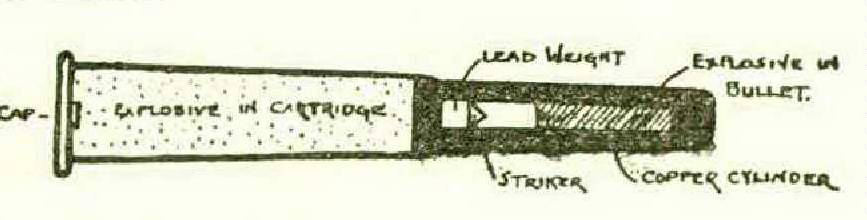
When the bullet hits, the lead weight jumps forward, hits the little striker, which detonates the explosive, and then the victim goes to bits. Nice bit of devilry, is n’t it?
All this on behalf of die Kultur!
From A. V. Hill
December 15, 1915.
It is quite a physiological day for me. For the first time in twenty months I have seen Starling. He is an R.A.M.C. major. He has a research job in connection with gas-poisoning and was lecturing here to-day to two hundred young officers on the subject of ‘gases’ and ‘gas attacks.’ I heard of his coming and went to the lecture, donned a mask, and had a talk with him. I said to him, ‘Whoever would have thought you would have come to this?’ His reply was, ‘Whoever would have thought you would have come to this?' with the accent on the you. Anyhow, here we are, six inches of mud, rain, rain, rain. No work can be done outdoors, and all because of W. Hohenzollern. Starling looks very well; has done no research since the war; has published two volumes of collected works. Tells me Bayliss —whose new book is most excellent — is pegging away, and Lovall Evans is getting qualified.
Last Sunday I was home. A Belgian called Liebrecht turned up to see me. A little fair man, with a German name, and hair standing on end. I said to myself, ‘This fellow is either an escaped Hun or a Belgian who ought to be fighting,’ and was correspondingly cool to him. Anyhow, I found out soon that he was in a khaki uniform under his mackintosh; that he was an officer in the Belgian R.A.M.C., had been in the trenches fifteen months, and was a physiologist at Louvain before the war. He had three days’ leave in England, so had paid a pilgrimage to the Mecca of Physiology (as once was), had called on Langley, and, being interested in calorimeters, had marched along on the chance of seeing the inventor of sundry such. So we had a long talk and he was a nice boy. The striking things were (1) his extraordinary detachment — coming straight from the trenches in muddy Flanders, he immediately returns to his first love, Physiology. (2) The complete absence of bitterness. If my university had been bust up, my home wrecked, friends killed, and country ruined and enslaved, I should feel so infuriated that if I got hold of a Hun I would disembowel him alive — or I feel I should. He merely said it was a great pity, because the Germans were very clever physiologists. We parted, saying au revoir at the Physiological Congress in Paris next summer! There won’t be any Huns there I expect, if wo have peace by then. . . .
Cambridge is now filled with a sad lot of cranks, who believe the war is a very sad thing and ought to be stopped. They talk a lot and make a devil of a fuss and won’t do anything useful. The so-called Union of Democratic Control is run by some pure-mathematicians (and others of the same kidney) at Trinity, who fancy themselves cleverer than their fellows; and they held meetings in, and wrote letters addressed from, the college, until the Council came down and said they were to do it no more in college. Now they are whining about freedom of thought. But the pacifists in this country number about one thousand, all told, I should think, and most of them are simply people who suffer from a constitutional inability to agree with their fellow-countrymen.
Yes, I am still at my job. I have invented an optical sight for the British service rifle, which seems fairly effective. The War Office has taken two hundred, and a good number are gone to the Dardanelles.
I am glad you and your friends sympathize with us. It gives one a greater sense of the justice of our cause; because one always feels one may be prejudiced one’s self. Though how we could have avoided this with prudence and honor, I completely fail to see. Some day I hope we will shake hands about it again. In the meantime help us by investing all your spare cash in our loans, and if possible by selling American securities and buying British or French war loans with the proceeds. You really can help that way. And especially tell your friends to do it, too.
I don’t think any one here thinks your people will join in this show, especially with your present administration, that is ‘too proud (sic) to fight.’ But dearly as I should love you to join in, it would n’t help much for the next six to nine months, though I don’t suppose it will be over for another eighteen, and during the last nine you could help. Yes, I reckon we are fighting your fight, too. Life would be a burden with’the Prussian Schützleute to order one around, and your turn for Blut and Eisen and Kultur would soon arrive if we were done in. . . .
One can see no end in sight. And half the best fellows one knew getting blotted out! Still, we have to go on as if we liked it. I expect the Huns like it a lot less than we do by now. And we must win through in the end. Then what an orgy of Physiology and Physical Chemistry there will be! . . .
From A. V. Hill
March 14, 1916.
Thank you so much for your letter of sympathy for our good cause. I like Royce’s speech very much and agree completely with the sentiments in it. There are a lot of d—d nincompoops in this country who are always braying about their rights, and never reflecting on their duties, and I personally hate them as much as I hate people who have ‘conscientious objections’ to doing their duty. I like the remarks about Cain. Have you heard of the German pastor who has been writing hymns lately and began a patriotic, address to the Almighty with the words: —
Seraphinen, Zeppelinen . . .
I have n’t much time to write now, so must wait for a better occasion. But if you will come here I will give you a job.. . .
P.S. The pin which catches these sheets together is a War-Office pin. Just like other pins, for a wonder! Most of their things are quite unlike other people’s!
P.S. Your letter was opened by Censor. I don’t know what he thought you could tell me that I was too young and innocent to read!
From A. V. Hill
June 18, 1916.
Very many thanks for your letter, which was ‘opened by Censor’ but not expurgated. I am here waiting for the clouds to go more than 2,000 feet up, and have been waiting these nine days. I want them, in fact, to go more than 16,000 feet up, as I have an important investigation on hand for the Director of Naval Ordnance; I am afraid I am sailing rather close to the wind already, so for fear of the Censor I will stop. But they show no signs of going more than 2,000 feet up, as it is a steady north wind with sea-mists, so I look like being here for three months. It is also abominably cold.
Wish you could see this town now. As you know, it is on the border of hostilities. You will find white ensigns in abundance here. The Huns bombarded it once, but no serious harm was done. There is one fine ruin here, but that is the result of a fire three years ago, much to one’s disappointment.
I am still attached to the Munitions Inventions Department. The Censor won’t mind if I tell you one or two of the inventions we receive, for obvious reasons, unless he is as feeble-minded as the gentleman who expurgated the line from the ‘Recessional,’ ‘the captains and the kings depart’ by cutting out ‘and the kings.’ One very helpful one was from a lady who desired to exterminate Zeppelins. She argued: ‘The clouds float in the air, and the clouds are made of water. Ice floats in water, so ice will float in air. Let us freeze the clouds, therefore, and send up anti-aircraft guns in balloons to fire upon them.’ She admitted that she did not know exactly how to freeze the clouds, but she left that to the experts. They all leave practical details like that to the experts. A gentleman invented a circular gun which shot round corners, and not only provided working drawings of his invention, but also a beautiful water-color picture of the Huns being exterminated by its mediation. Another chap is blessed with ‘perspective ideas’ and thinks he can find ranges without a base by the aid of perspective. He wanders around with a certificate signed by an adjutant to the effect that he actually has found three ranges correctly. The number he has found incorrectly is not stated. I was warned against him months ago, and sure enough he turned up. Then there are two Peruvians from your land who have a sort of kaleidoscope which they fixed at Jersey City and shot a few rooks with. This was paid for — I dare not tell you how much — and was sent here. Woolwich Arsenal reported on this device and their minute ran: ‘If this is all that can be produced in the U.S.A. it is cheering to find that this country is already so far ahead of them.’ I am afraid I shall be treading on the Censor’s toes again soon, so had better shut up. But I may add that all our inventions are not like that, and I dare say we shall help to harry the Hun a bit.
It is my wedding day to-day, and I wanted to get home — a rare enough treat. . . . But I am much more fortunate than most of the poor devils by land and sea that are carrying on this blasted war. At any rate, there is no immediate prospect of being shot, which is gratifying to one’s relations — perhaps not so gratifying to one’s self.
I have some splendid people assisting me. A Fellow of Trinity, nowagunner officer, and a very able mathematician, who was in bed nine months after being wounded in Winston Churchill’s picnic party to the Dardanelles. An ex-demonstrator in the Cambridge Engineering Laboratory, who has made a really valuable invention which is being adopted by us and the French army. For about one pound it accomplishes what has previously needed apparatus costing a hundred pounds. A boy who is the best mathematician of his year at Cambridge, very able and willing. An old mathematical Fellow of King’s, who is gradually learning how to make himself useful; and another boy. Being a mathematician myself, I know how to deal with these chaps and to keep them in the paths of reason. When they are not busy I find them calculating T on a slide rule using the series
π=2/1X2/3X4/3X4/5X... to infinity.
This series requires about a million terms to give π correct to the third place of decimals. It is a very good occupation while waiting for the clouds to go up a bit in this climate. They may succeed in proving that π7r is not 22/7, as commonly assumed, which will be very valuable.
I am sure the Censor will not pass that, as no doubt the Huns assume that π is 22/7, and giving them the tip that it is n’t might help them greatly in navigating. After their ‘victory’ in the North Sea (or German Ocean) they may desire to navigate farther afield, so may need a more accurate value of π to help them. So don’t let it out.
I have just been working with a Lieutenant Commander Damant, R.N., who is a physiologist and a member of the Physiological Society. He is interested in diving, and therefore in air-pressures. Did you ever meet him? He remembers hearing me read papers on rats residing in thermos flasks, and on the heat-production of frogs’ muscles, and on other pleasantries of my youth. . . .