The Fallacy of a German Peace: How Cheaply Germany Has Fought the War
AT the beginning of 1916, I said in my book The Pan-German Plot Unmasked, —
‘Finally, when all negotiations’ for an armistice have fallen flat and Germany’s situation has become still more critical, we shall see Berlin play her trump card. Protests against territorial annexations will become insistent beyond the Rhine, secretly sanctioned by the German Government, which will finally say to the Allies: “Let this slaughtering of one another cease! We are willing to listen to reason; we resign our claims to those territories of yours now occupied by our armies. The game has been played to a draw; so let us treat for peace on that basis.”
‘On the day when this proposition is put forward, the Allies will find themselves face to face with the most subtle move yet made by Berlin — the most insidious German snare. Then, above all things, must the steadfastness, the perspicacity, and the unity of the Allies be most brilliantly made manifest. The trick of the “drawn game,” if successful, would involve an overwhelming triumph for Germany and an irreparable tragedy for the Allies and for the liberty of the world.’
Only a few months after these lines were printed, the prophecy began to be fulfilled more and more completely. Every possible step has been taken by Germany to bring about peace on the basis of a draw. The slogan, ‘Peace without annexations or indemnities,’ was coined to that end. At first the Allies believed that this formula originated in Russia; as a matter of fact, however, it was worked out in Berlin and then suggested to the Russian Socialists through secret agents whom Germany has successfully established in the Petrograd Soviet. These Socialists, doubtless well-meaning, but overfond of theories and always ready to embrace the wildest utopian schemes, — ignorant, too, of all realities, as has been shown by the steady aggravation of the general situation in Russia since they came into power with the Revolution, — have declared enthusiastically for the ‘ peace without annexations and indemnities.’ As there exist also in the other Allied countries groups of Socialists with a stronger grip on theories than on facts, and also because Allied sympathies naturally rallied strongly to the support of the Russian Revolution, the formula, ‘peace without annexations or indemnities,’ thanks to its apparent origin, has unquestionably made serious inroads on a certain section of Allied public opinion.
The Stockholm manoeuvres, engineered by all the powerful and varied means at the disposal of German propagandists, were designed to establish this formula as the fixed basis of all peace negotiations. When the astuteness of the Allied governments prevented the fulfillment of this attempt within the period desired by Berlin, the Vatican was persuaded through Viennese agencies to throw its influence on the side of peace as determined by Germany.
As a matter of fact, the Pope’s peace proposals, while not embodying the exact terms of the Kaiser’s formula, involved, in the last analysis, practically the same essential results. Berlin, therefore, in order to assure unceasing discussion of her formula, — a discussion tending at least to bring about an armistice, which would split up and morally disarm the Allies, thus making it possible for her to deal with them separately, — outdid herself in mobilizing toward oneend the most widely divergent forces, from the Maximalist anarchists of Petrograd to the most hidebound reactionaries of the Sacred College. The extent, the vigor, and the persistence of the amazing ‘pacifist’ offensive launched by Germany were such that the expressions ‘peace without indemnities or annexations,’ ‘drawn game,’ ‘white peace,’ ‘paix boiteuse,' have become as current in the Allied countries as though they had some established connection with reality. This is entirely contrary to the fact: with the best intentions in the world, peace without annexations or indemnities, as things stand now, is impossible. There can be no ‘ white peace,’ no ‘drawn game,’ no ‘paix boiteuse.’
To tell the truth, a section of Allied opinion has become befuddled by these formulae of Berlin, whose function is to accomplish in the moral order the same asphyxiating action as that of the gases employed on the battlefield by the German General Staff. The result of this moral intoxication is that important groups of the Allies begin to juggle with words and lose sight of facts. As the natural outcome of giving serious thought to impossibilities, grave errors are made in weighing the present situation, with an attendant weakening of the joint action of the Allied democracies. It is imperative, therefore, that the pursuit of Utopias, leading only to disaster, be abandoned, and that we return to those realities which alone can lead to victory and the establishment of a durable peace.
If the formula ‘peace without annexations and indemnities’ has been allowed to insinuate itself into the general discussion, it is only because great numbers of the Allied peoples fail to understand the overwhelming advantages which Germany, by means of the war, has been able to assure to herself for the present and the future. The object of this paper is to show just what these advantages are, and at the same time to brand the utter hypocrisy of the slogan, ‘peace without annexations and indemnities,’ which, regarded even in the most favorable light, would allow Germany to make off with immense booty, leaving the Allies to face the incalculable losses incurred by them in a war launched by their adversary.
The significance of the low rate of German exchange
The continual fall of German exchange is considered by many of the Allies as proof of the progressive and irremediable impoverishment of Germany. When, for instance, the mark drops 47 per cent in Switzerland, while the franc has depreciated only 13 per cent, Frenchmen are for the most part inclined to believe that the war has affected the two countries in relatively the same proportion; they then conclude that Germany’s financial situation is infinitely worse than that of France. In reality, such a comprehensive conclusion cannot be reached simply through the rise and fall of exchange, which only reflects certain special aspects of the financial situation of a country.
Among the various causes affecting exchange, there are two principal ones. The first is moral. It cannot be denied that the fluctuation of exchange responds to foreign confidence. If German exchange is low it implies, to a certain extent at least, the existence of a universal conviction that in the long run Germany cannot hold out against her formidable ring of adversaries. As a result, there is no great demand for the currency of a state whose credit, it is thought, must finally collapse.
It should be noted, however, that the reason for this fall of exchange is only a moral evaluation anticipating a probable outcome; it is not due to a mathematically certain estimate of what Germany now stands to win or lose as a result of the war.
The second great factor affecting exchange, on the other hand, is based on present realities which are susceptible of being accurately determined. Germany, since she has been blockaded by sea, exports infinitely less than formerly; consequently, her ability to settle her accounts in foreign countries is limited. When she was able to sell the United States a million marks’ worth of merchandise, she then had at her disposal a million marks with which to pay cash for such imports as she needed. Now that her exports have been so reduced, she has little money to spare for spending abroad. If she wishes to increase these foreign purchases, she must export her gold and consequently reduce the security behind her bank-notes. This results in a lowering of the basis of German credit, with a resulting drop in exchange.
We shall now see that this falling exchange, whatever its importance be, does not take into account all the elements of the general financial situation.
If the blockade of Germany seriously complicates her food problems, on the other hand it is in a way advantageous from a financial point of view. In a word, when Germany found herself blockaded she was obliged to evolve means of existing on her own resources or those of her allies. Our enemies had great difficulties of organization to overcome, but they turned them to good account; for if Germany’s exports are small, her imports have been correspondingly reduced. Hence she needs to send very little money abroad, a fact which is financially in her favor.
Now the case of France is radically different. The French government, feeling assured of the liberty of the seas and believing that the war would be a short one, found it more expedient to place enormous orders abroad than to rely on domestic resources to supply the nation’s need. As a result, French imports, according to published statistics, exceed exports by one billion of francs a month. This means that, as things stand now, France must pay to foreign countries the staggering sum of twelve billion francs a year, with no corresponding compensation, since her purchases consist of products which are destroyed in use. For this reason France is undergoing serious impoverishment while Germany gets off comparatively easily. It is therefore plain that the fluctuations of exchange bear little relation to those conditions which must be taken into consideration in making an appraisal of the general situation; they reflect, in fact, only a special and limited aspect of the financial situation as a whole. Popular conclusions drawn from the fall in the value of the mark are false when attempts are made to give them an absolute or general significance.
Why people are still ignorant of the vast advantages gained by Germany from the war
Many of the Allies are hoodwinked by the ‘great illusion’ which even now prevents them, to their endless detriment, from seeing things as they really are. In the Allied nations, in fact, people continue to speak of Germany, Austria-Hungary, Bulgaria and Turkey, as though these states remained just as they were before the war. Now these terms have no longer any relation to reality. The Quadruple Alliance of Central Europe is simply a great illusion, studiously fostered by William II, for by its means his plans are vastly facilitated. As a matter of fact, Turkey, Bulgaria, and AustriaHungary are not the allies, but the vassals, of Berlin, and their influence with her is less than that of Saxony or Bavaria. The rulers at Constantinople, Sofia, Vienna, and Budapest are simply marionettes moved by threads which are pulled by Berlin according to her strategic needs.
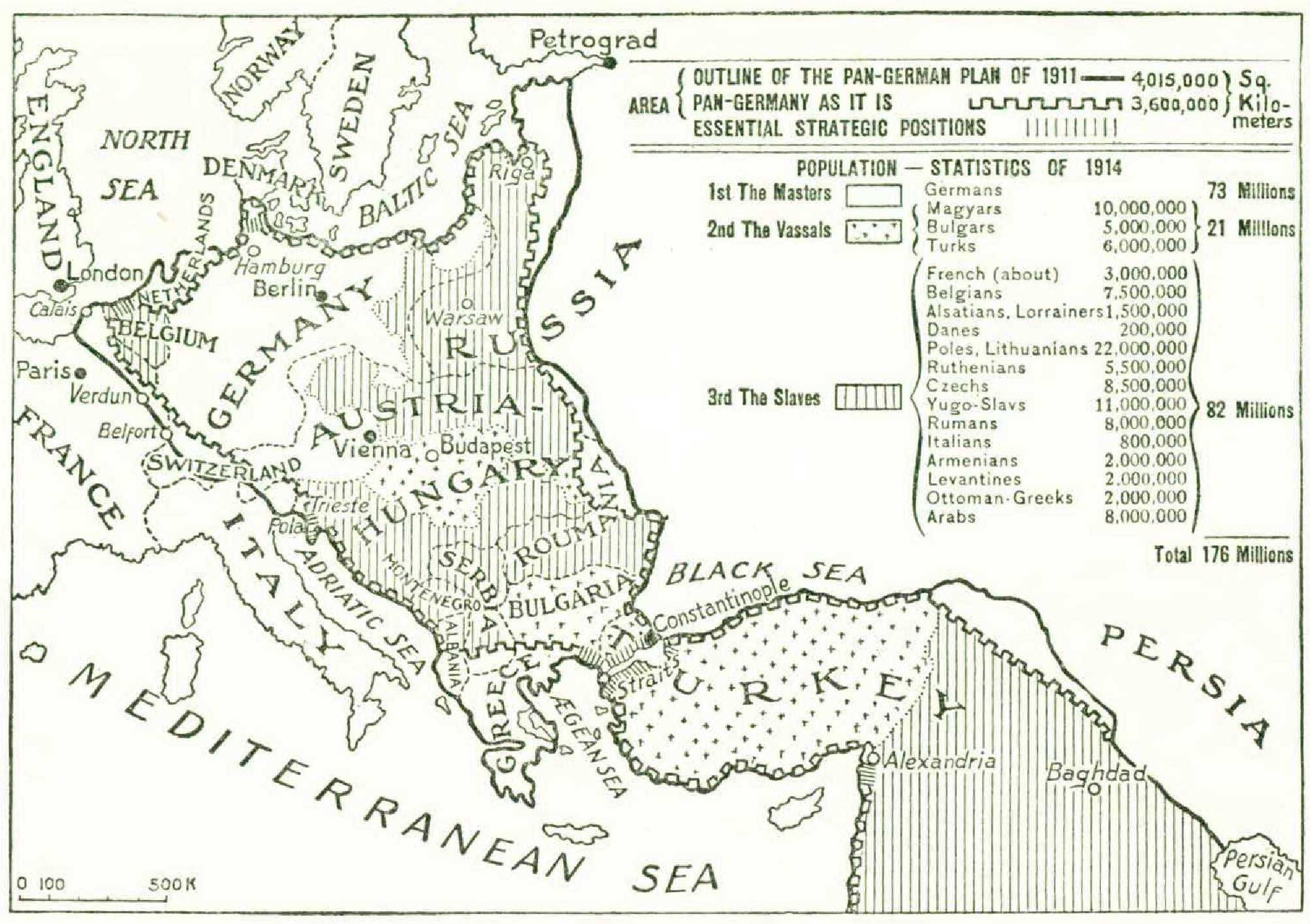
Very often we hear it said, ‘Germany has created Mitteleuropa.’ This is another mistake. Geographically speaking, Mitteleuropa includes only Central Europe; and Germany’s dominion is infinitely farther flung, extending as it does from the west front in France to the British front before Bagdad. If we wish to see things in the light of reality, we must say, for the present at least, ‘ There is no longer any Germany; instead, there is PanGermany. This is an essential assumption if we are to reason justly. The map of Pan-Germany at the beginning of 1917, accompanying this paper, shows clearly the essential, but all too little-known, elements of the present situation, which is characterized by the fact that 73 million Germans, aided by 21 million vassals, — Magyars, Slavs, and Turks, — have reduced to slavery 82 millions of Latins, Slavs, and Semites, belonging to thirteen different nationalities. Pan-Germany, which has now almost completely reached the limits set by the Pan-German plan of 1911, consists, therefore, of one vast territory containing about 176 million inhabitants and natural resources of the greatest variety.
I beg my readers to refer to this map of Pan-Germany every time it is made desirable by the text. This repeated study of the map is indispensable to a clear and complete comprehension of the demonstration which follows. As regards the profits which Germany has wrung from the war, it is particularly important, in order to grasp the idea of Pan-Germany; for it is the direct result of its creation that Germany, in spite of the losses and expenses inevitably incurred by a warring nation, has been able to assure herself of certain advantages which, considered as a whole, far outbalance her losses and expenses, as we shall see.
In order to understand the nature of these advantages, one point must first be made clear.
The war has cost the Germans comparatively little
For six fundamental reasons, the conduct of the war has really cost the Germans far less than it has cost their adversaries.
1.No Experimentation. Germany, in order to produce a vast output of various types of guns and projectiles economically evolved in times of peace, needed only to extend, by means of machinery of domestic manufacture, her arsenals and munition-factories, which before the war were already considerable. On the other hand, the production of war-material in France at the outbreak of hostilities was very slack, while in England and Russia it was almost negligible. In these three countries, therefore, it was necessary to improvise, as best might be, thousands of new plants, to equip them with machinery purchased in America at vast expense, and hastily to evolve new types of cannon, projectiles, and the rest. Now, improvisation, especially in war-time, means false starts and inevitable bad work, which must be paid dearly for. Germany was not obliged to incur these very considerable expenses.
2. Regulated Wages. The fact that the problem of German wages was worked out at leisure in exact correlation to productions whose types were exhaustively studied in the calm of peacetime certainly allowed the Germans to obtain war materials at a lower net cost than was possible for the Allies.
3. The Prevention of Waste. The absence of experimentation and the simple extension to war-work of highly efficient industrial methods tested in peace-time, naturally allowed the Germans to avoid in all spheres those immense losses of material of every nature whose bad effects and heavy cost were incurred by the Allies. This state of affairs in France caused losses which were as expensive as they w ere inevitable. One may imagine the conditions existing in Russia, where control is far more difficult of exercise than in France.
4. Cheap Labor. The Germans have forcibly enlisted the labor of about two million prisoners of war. Moreover, the official French report of April 12, 1917, concerning acts committed by the Germans in violation of international law, asserts that in the occupied territories deportation of workers has been a general measure. It has ‘ applied to the entire able-bodied population of both sexes, from the ages of sixteen to sixty, excepting women with young children.’
Now the Germans requisition labor from among 7,500,000 Belgians, 3,000,000 French, 4,500,000 Serbians, 5,000,000 Roumanians, 22,000,000 Poles, Ruthenians, and Lithuanians — a total of 42,000,000 slaves.
Let us see what sort of remuneration is made. Take the case of a young girl of Lille, twenty years old, who was forced to work for six months, harvesting and threshing wheat, and digging potatoes from six in the morning to twilight, receiving all the while the vilest food. For her six months of work she was given 9 francs, 45 centimes. The Germans, therefore, have at their disposal a vast reservoir of labor for which they pay next to nothing; moreover, the small amounts they do pay remain in Pan-Germany.
The Allies, on the contrary, pay high wages to their workers, and, when they run short, must needs pour out good gold in bringing reinforcements from Asia, Africa, and America. This means that a considerable part of the wages paid these foreign workmen will leave France or England for all time.
5. Free Coal and Iron Ore. In addition to their own mines, the Germans have seized important coal and iron mines in France, Belgium, and Poland. A vast proportion of their ore and coal therefore costs them nothing. Naturally, then, a German shell made with French iron and Belgian coal costs far less than a French shell made with American steel and English coal. As a result, the net price of a greater part of German munitions is much lower than that paid by the Allies.
6. Economical Transportation. By reason of the grouping of the Central Powers, — a result of the conquest of the Danube front by the Teutons, — Germany profits by a geographical situation which is infinitely more advantageous than that of the Allies, as regards not only the speed, but also the cheapness, of war transportation. It is evident that it costs far loss to send a shell from the Krupp factory to any one of the Pan-German fronts than to send an American shell to France, a Japanese shell to the Polish front, a French shell to Roumania via Archangel, or an English shell to the army operating in Mesopotamia. By the same token, the cost of transporting a soldier of Pan-Germany to any of the battle-fronts is infinitely lighter than the conveyance of Allied soldiers from Australia or America.
We should note that each one of these six factors which we have just enumerated reacts profoundly on the sum-total of general war expenses, and that, taken together, they involve a formidable sum. It can therefore truthfully be said that Germany carries on the war much more economically than the Allies. Figures are so far lacking which will give the true proportions, but we shall certainly remain well within the realities of the case if we conclude that, as a result of the six factors mentioned above, France must spend one hundred and fifty million francs for war material to every hundred million spent by Germany. When France, therefore, spends thirty billions, Germany evidently spends not more than twenty billions. And what is true of France applies even more accurately to some of the other Allied nations. This is a fact of the greatest general importance in coming to a true understanding of the financial situation created by the war — a fact which takes on its full significance when we realize that Germany is not only carrying on the war cheaply, but that she has been enabled, by means of this war, to win very important advantages.
They consist of seven principal elements. The last six of these, it should be noted without fail, depend solely on the existence of central Pan-Germany, — that is, on the hegemony exercised by Germany over Austria-Hungary, Bulgaria, and Turkey; they are therefore wholly independent of the first element, which relates to Germany’s occupation of enemy territories, particularly to the east and west.
This complex but vital subject I shall discuss in the next article.
The first element of German advantage: the booty acquired from the occupation of enemy territory
Germany is getting direct warprofits from the enemy territories occupied by her. These territories, listed in the ascending order of their richness, are: Montenegro, 14,000 square kilometres; Albania, 20,000; Serbia, 87,000; Roumania, 70,000 (Bulgaria and Austria-Hungary share the pillage of these four territories); dependent territories of Russia, 260,000; Belgium, 29,000; and France, 20,000; making a grand total of 500,000 square kilometres.
In order to realize as clearly as possible the importance of the booty wrung by Germany from this enormous area, we may establish by means of examples or statistics that this plunder comes from nine principal sources: —
1. Seizure of Human Material. — Throughout these 500,000 square kilometres of occupied territory, the Germans have scientifically enslaved 42,000,000 human beings, who furnish a vast amount of labor — this labor being all the cheaper because, as we shall see, the slaves are robbed in various ways.
2. Seizure of War-Material. — By reason of their lightning advances in Belgium, France, Serbia, and Roumania the Germans have taken possession of vast stores of war-material: cannon, rifles, munitions, wagons, locomotives, cars, as well as thousands of kilometres of railway, of which they make full use, representing a certain value of billions of francs. (The Belgian railway system alone is worth three billions.)
3. Seizure of Food-stuffs. — The official report of April 12, 1917, on the acts committed by the Germans in France contrary to international law, states: ‘The inhabitants, subjected as they were to annoyances of every sort, watched daily the theft of such foodstuffs as they happened to possess.’ Everywhere the Germans steal horses, cattle, domestic animals, grain, potatoes, food-products of all kinds, sugar, alcohol, all of which constitute the reserve supply of the occupied countries. Their harvests, too, are appropriated through the cultivation of productive lands by means of labor obtained almost without cost from the enslaved peoples.
4. Theft of Raw Materials.—Throughout the length and breadth of the occupied territories, the Germans, at the dictates of expediency, have seized raw materials: coal and iron ore, copper, petroleum, and so forth. Metals — bronze, zinc, lead, copper, tin — have been taken from private citizens, as well as textile fabrics — wool, cotton cloth, and the like. When one learns that from the cities of the North of France alone the Germans stole 550 million francs’ worth of wool, it is easy to see that this single source of plunder has been worth a number of billions to them.
5. Theft of Finished Products. — Everywhere in the occupied territories, so far as means of transportation permit, motors, steam-hammers, machinery, rolling-mills, lathes, presses, drills, electrical engines, looms, and so forth, have been taken to pieces by mechanics and transported into Germany. The total value of this stolen material in Belgium and the North of France alone — the richest industrial districts in the world — is almost incalculable.
6. Theft of Personal Property. — The official French report previously quoted states: ‘In the shops, officers and soldiers made free with whatever pleased their fancy. Every day the people witnessed the theft of property which was indispensable to them. At Ham, General von Fleck carried off all the furniture of M. Bernot’s house, where he had been quartered.5 The property thus stolen is sent to Germany, as is proved by this advertisement in the Kölnische Zeitung: ‘Furniture moved from the theatre of military operations to all destinations.’ From this source, war booty to the value of several billions has already been divided among an army of Germans.
7. Seizure of Works of Art. — The Germans have stolen countless works of art, ‘in order’ —so runs a recent official note of their government — ‘that they may be preserved as a record of art and civilization.5 ‘It would be impossible,5 declares Le Temps, ‘ to find a more cynical admission of the thefts committed by the German authorities in our museums and public buildings.5 If one remembers that this methodical pillage has gone merrily on among private individuals, drawing on the unlimited stores of works of art which have been accumulated throughout the centuries in Poland, and particularly in Belgium and France, it must certainly be seen that the value of these stolen art treasures is immense.
8. War Imposts. — Our official report establishes that ‘Requisitions have everywhere been continuous. Towns that have had to meet the expenses of troops quartered within their jurisdiction have been overwhelmed by huge levies.5
Belgium is staggering under an annual war assessment of 480,000,000 francs. Bucharest, after its capture by the Germans, was forced to pay a levy amounting to about 1900 francs per capita of the population. At Craiova the levy was 950 francs per capita. An edict forbids the circulation of paper money unless it has been specially stamped by the Germans, who retain 30 per cent of its nominal value.
In April, 1917, the Frankfurter Zeitung announced that the leaders of the Austro-German forces of occupation in Roumania would shortly call for an obligatory internal loan of a hundred million francs. In Poland, the German government has just issued a billion marks in paper money for enforced circulation. These are only single examples.
9.Theft of Specie, Jewels, and Securities. — In September, 1916, the Germans seized three quarters of a billion francs from the National Bank of Belgium in Brussels, which was subsequently transferred to Germany. In January, 1917, on the steamer Prinz Hendrick, they stole a million francs from a Belgian who was traveling from England, and took ten million francs’ worth of diamonds from the mail-bags. In the village of Vraignes, on March 18, 1917, the Germans, before evicting the inhabitants, stole from them the 13,800 francs they had in their possession. At Noyon — we learn from the official report already quoted — the Germans broke open and pillaged the safes of banks and private citizens before retiring from the town. The securities, jewels, and silver plate of Noyon represented a value of about eighteen million francs. And, as I have said, these are only random incidents.
Taking into consideration, then, the present high prices of food-products, coal, metal, petroleum, war-material, machinery, and the rest, it can be seen at a glance that each one of the nine sources of booty just enumerated, on which the Germans have been steadily drawing, in some cases for as much as three years, has unquestionably yielded the value of several billions of francs, — certain of them, perhaps, tens of billions. Hence we may reasonably conclude that, without fixing a definite figure for the yield of these nine sources, the total plunder has mounted well up in the tens of billions. Another basis for calculating the worth of the invaded territories to Germany lies in the fact that the national fortunesof these countries, according to ante-bellum statistics, amounted to about 155 billions of francs.
We shall now examine the six other elements of Germany’s present advantageous situation — those which result from the domination which the war has enabled her to exert over her own allies, Austria-Hungary, Bulgaria, and Turkey. This domination, amounting practically to seizure, has permitted her to fulfill the scheme of Central PanGermany as a result of the crushing of Serbia.
The second element of German advantage: the Pan-German loans
A portion of the approximate sum of 115 billion francs devoted by Germany, up to the end of July, 1917, to the carrying on of the war has enabled her to burglarize her own allies by taking advantage of the extremely bad financial situation which faced them at the end of the Balkan wars. As a result of this situation, Austria-Hungary, Bulgaria, and Turkey, in order to sustain the present long-drawn-out struggle, have been forced to draw on the credit of Berlin. The sum total of the loans made by Germany to her allies and secured by her own war loans cannot yet be verified, but there can be no doubt that it mounts up to a respectable number of billions.
These loans have worked out to the immense advantage of Germany, for the following reasons. It is proved by facts that, without the assistance of Austro-Hungarian, Bulgarian, and Turkish troops, and without the numerous products supplied her by the Orient, Germany would have been beaten long ago, even in spite of the Allies’ blundering. As these troops and resources are of priceless value to Germany, it would seem that she must have paid dearly for them, and in gold. However, as the reserve of the German Imperial Bank was 1,356,875,000 marks in July, 1914, and 2,527,315,000 in February, 1917, it is certain that Germany has not lent gold to her allies, — in large quantities, at any rate, — but only paper, whose value depends solely on the strength of German credit.
In reality, therefore, Germany, simply by keeping a printing-press busy turning out little stamped slips of paper, has obtained troops, food-stuffs, and raw materials which were indispensable to her in avoiding defeat; and at the same time she has so established herself as a creditor as to give her the right to exact final payment by her allies for advances which were primarily made to them in Germany’s own vital interest.
Now these obligations weigh so heavily on countries like Austria-Hungary, Bulgaria, and Turkey, already in sore stress, that they incur loans which no one of these three countries can ever hope to pay off unless a victory of the Allied democracies should shatter the financial yoke of Berlin.
In order to appreciate the nature of these loans and their consequences, the example of Turkey is particularly instructive. ‘Germany’s advances to Turkey in no way represent Turkish war expenses. We must add to them the requisitions made in the country itself, and the war-material purchased in Germany and Austria-Hungary which is yet unpaid for.’
At the beginning of 1917 Djavid Bey arranged in Berlin for a new loan of three million pounds, simply to enable Turkey to pay her debts to the Krupp firm, as well as the advances made her by the different groups of financiers and the German Minister of Finance. This means, therefore, that, when Germany sends arms to the Turks in order that they may use them to consolidate the Pan-German scheme, she also finds a means of making this consignment of arms serve to entangle the Turks still more hopelessly in the financial web. ‘In Pan-Germanist circles, there has been much discussion of the compensations which Turkey must make to Germany in return for services rendered in the course of the war. It is the unanimous opinion that Germany, without gaining any territorial acquisitions in Turkey, must have controlling rights in the Ottoman Empire, so that the Pera-Galata bridge may be as near Berlin as Constantinople.’
What has taken place in the spheres of finance between Berlin and Constantinople has, by the very nature of things, been duplicated between Berlin and Sofia, though of course in a less pronounced form. Germany, therefore, by means of paper loans based on her own credit, has caused colossal obligations to be assumed by her allies — countries representing vast areas of land: Austria-Hungary with 676,616 square kilometres, Bulgaria with 114,104, and Turkey with 1,792,900, or 2,583,620 square kilometres in all. Now these three countries are precisely the ones which are indispensable to the carrying out of the Central Pan-German ‘Hamburg to the Persian Gulf’ scheme; the loans, therefore, are PanGermanist loans.
It should be borne in mind, on the other hand, that although AustriaHungary, Bulgaria, and Turkey are financially encumbered in their quality of states, the exploitation of these countries by the Germans is very profitable. Their combined national fortunes were estimated, before the war, at about 269 billion francs. We must realize also that, although these loans granted by Berlin to her allies are merely paper loans, they bind Turkey, Bulgaria, and Austria-Hungary to Germany as closely as debtors can be bound to a creditor. None of these three countries can reasonably hope to get funds after the war from their present adversaries, who, it is certain, will have none too much money for their own needs; and so the financial situation as a whole combines with the enterprise shown by the Berlin General Staff to strengthen the grip that Germany has obtained over her allies through loans.
As this financial dependence of the three vassal states, with its tremendous consequences, is, as I have said, maintained simply by means of a printing-press and little slips of paper, which cost very little indeed; and since Germany receives in exchange for these slips of paper bearing her signature, men, food-stuffs, and supplies which, but for the action of the Allies, would enable her to establish Pan-Germany as mistress of Eu rope, we may safely say that the Pan-Germanist loans floated by Berlin at her allies’ expense constitute a powerful element of military advantage, which, if one only examine the conditions of its origin, must stand out as the most profitable and extraordinary swindle ever perpetrated.
The third element of German advantage: the value of a monopoly in exploiting the latent resources of the Balkans and Asia Minor.
The figure of 269 billions of francs quoted above takes no account of the enormous agricultural and mineral wealth, as yet unexploited and unappraised, of the Balkans and the Ottoman Empire. Now, the business of tapping these vast reservoirs is entirely in the hands of the Germans, as a result of the Pan-Germanist loans.
The fourth element of German advantage: the value resulting from the creation of an economic Pan-Germany.
Economic Pan-Germany, as it was outlined by List, Roscher, Rodbertus, and other German economists, may be defined as follows: A territory uniting under one supreme central control Central Europe, the Balkans and Turkey — a territory large enough to include military and economic resources entirely sufficient to provide for the needs of the population in times of war; and to assure its rulers in times of peace the domination of the world.
The seizure by Berlin of AustriaHungary, Bulgaria, and Turkey — all essential elements of Central PanGermany—was accomplished in three ways: militarily, by the supremacy acquired by the German General Staff over the troops of the vassal states; financially, by means of the paper loans granted by Germany; and diplomatically by the treaties signed in Berlin on January 11, 1917, establishing the strongest sort of German protectorate over the Ottoman Empire. This done, the consolidation of PanGermany was quickly undertaken by Berlin in a great number of ways.
Control of Customs. — As the establishment of the great Pan-German Zollverein (Customs Union) was not to be accomplished at one stroke, the Kaiser’s government set about preparing the necessary steps. Numerous conferences held at Berlin and attended by German, Austrian, and Hungarian statesmen and business men, resulted in the following essential provisions. (1) An economic customs agreement of long duration, which would make a single economic unit of Germany and Austria-Hungary; (2) To bring this about gradually, a progressive increase of duty — free articles, and a unification of the customs charges on certain goods; (3) a close economic union between Austro-Germany and Bulgaria and Turkey, to be arranged and established with the greatest possible expedition.
Ethnographic Control. — Certain nations afford considerable resistance to the Hamburg-Persian Gulf scheme. The Serbians, who are morally irreducible, are an obstacle to the permanent establishment of the Pan-German nexus between Hungary and Bulgaria; and without this the entire Pan-German programme falls flat. The systematic destruction of the Serbian people has been entrusted to the Bulgars, who, under pretext of quelling insurrections, slaughter not only the Serbian men, but also women and children, down to babies at the breast. In the Ottoman Empire the Armenians happen to occupy those regions which were characterized in the Reichstag by Herr Delbrück as ‘Germanic India.’ Berlin therefore puts to good use the Turks’ inherited taste for massacres of Christians. Already more than one million Armenians have been got out of the way.
Agricultural Control. — The food crisis in Germany has led Berlin to proceed with the greatest haste toward utilizing the rich farming districts which the fortunes of war have put within her grasp. Hundreds of experts, with thousands of agricultural implements, have been sent to Roumania, Serbia, and Asia Minor. In this latter country, two cultural centres in particular have received attention. In the province of Adana cotton-growing is being developed; on the plains of Anatolia the intensive cultivation of grain is in progress. These energetic efforts have had a two-fold result: the Turks will not revolt against Germanic domination — because of starvation, if for no other reason; and, by reason of the increasing yield of Serbian, Roumanian, and Turkish lands, more of which are continually being brought into service, the food-supply of the Cent ral Empires becomes more and more completely assured.
Banking Control. — The exploitation of Eastern Pan-Germany calls for vast capital. The German, Austro-Hungarian, Bulgarian, and Turkish banks have formed powerful combinations. As leaders of this movement in Germany we find the Deutsche Bank, the Dresdner Bank, the Kölnische Bankverein; in Austria-Hungary the Vienna Kredit-Anstalt and the Hungarian Bank of Credit in Budapest.
Economic Control. — As the rapid exploitation of the latent resources of the Balkans and Turkey is the principal economic object of the Germans, they have just established, in coöperation with King Ferdinand, the ‘Institute for Furthering Economic Relations between Germany and Bulgaria,’ In order to facilitate the Germanic penetration of Turkey, ten thousand Turkish boys between the ages of twelve and eighteen years are to come to Germany for their technical education. These young Turks, living in German families, learning German, and saturating themselves with German ideas, will soon be able collaborators with the Teutons themselves in germanizing Turkey and exploiting the numerous concessions which, if the war turns out successfully for them, will be wrung from the Ottoman government by the subjects of the Kaiser.
Railway Control. — The railway systems of European Pan-Germany have been brought to the highest degree of perfection. In Turkey, German officers are absolutely in control of the railroads. Out of the 2435 kilometres which separate Constantinople from Bagdad, only 583 kilometres of line remain to be constructed — and this distance is traversed by automobile roads. As for the Turkish railroads belonging to French and English companies, the German government has suggested that the Turks ‘purchase’ them. One should cherish no illusions as to the real meaning of this word ‘purchase.’ It means, according to Turco-German methods, that the expenses involved in this purchase should be set down against the war damages which the Central Powers consider to be due them from the Allies.
Canal Control. — The canal project, outlined as far back as April 26, 1895, by the Pan-Germanist Dr. G. Zoepfl, was taken up and begun by the Economic Congress of Central Europe, which met at Berlin on March 19, 1917. This project is made up of the following elements: (1) Union of the Rhine with the Danube by the opening up to navigation of the Main and of the canal from the Main to the Danube; (2) Completion of the central canal joining the Vistula and the Rhine; (3) The Oder-Danube canal, joining the Baltic to the Black Sea; (4) Opening to navigation of the Rhine as far as Bâle; (5) Union of the Elbe with the Danube by means of the river Moldau; (6) Union of the Weser with the Main by means of the Fulda-Werra; (7) Connection of the Danube and the Vistula by means of canals; (8) Union of the Danube with the Dniester by means of the Vistula; (9) Opening to navigation of the Save; (10) Opening to navigation of the Morava and the Vardar as far as Saloniki. The Danube is the base of this gigantic programme of construction. — ‘The Danube means everything to us,’ declared General von Groener, in December, 1916.
This rapid sketch of the preparations now going on in the economic sphere of Pan-Germany will permit any clearthinking man to understand the crushing power which will lie in this formidable system when all its latent resources have been developed by the Germans to the profit of their hegemony. The organization of Pan-Germany is only in its first stages; nevertheless, the concentrated military, economic, and strategic strength which it has already put at the disposal of Berlin is so great that it permits Germany to baffle her far more numerous, but widely scattered, adversaries. What, then, would be the strength of a completely organized Pan-Germany? It is undeniable, in fact, that a methodical, big-scale development of all the mineral, vegetable, animal, and industrial products of economic Pan-Germany, together with the low-cost transportation afforded by a complete system of canals, would make it possible for the Germans to pay high wages to their own workmen, and yet at the same time bring about such a reduction of net prices in every line of industry as to force Pan-German products on the whole world by sheer cheapness.
It is easy to see, then, that in the face of economic Pan-Germany’s overwhelming methods any economic revival on the part of the European nations now allied would be impossible. The economic ruin of the Allies, after so exhausting and costly a war as this, would by the nature of things bring about their political subjection to Berlin. Besides, there is not a country in the world which could escape the clutches of economic Pan-Germany on the one hand, or the consequences of the irremediable ruin of the Allies on the other. The fact that Pan-Germany is organizing itself is an ominous event which should receive the concentrated attention of all the world’s free peoples; for it places in German hands the elements of such an overwhelming economic power as has no precedent in the world’s history.
The fifth element of German advantage: the value of military PanGermany
Berlin relies, above all else, on her military resources to render secure for all time that economic Pan-Germany which is destined to provide her, in peace time, with a permanent means of acquiring wealth and world-dominion. Military Pan-Germany is therefore the complement and the pledge of economic Pan-Germany. The Kaiser’s successful seizure, through the fortunes of war, of new sources of man-power — Austro-Hungarian, Bulgarian, and Ottoman soldiery; of new strategic points or regions of exceptional importance, located in invaded countries or in those of his own allies, has furnished him with the basis of military PanGermany. In 1914, Prussian militarism held sway over only the 68 million inhabitants of the German Empire. At the beginning of 1917, it had been extended by consent or by force to the 176 million people of Pan-Germany.
This result — evidently the consequence of an immense extension of exclusive influence throughout Central and Eastern Europe — has permitted the German General Staff to take over at will certain strategic points or regions of the greatest importance, over which it exerted no direct influence before the war. Zeebrugge, on the North Sea, for instance; Trieste, Pola, and Cattaro on the Adriatic; the Bulgarian coasts of the Ægean; the Ottoman Straits; the Turkish, Bulgarian, and Roumanian shores of the Black Sea, have always been strategic points or regions of exceptional value.
This value, however, has become vastly greater now that these points or regions form part of a single military system under the directing and organizing power of the Berlin General Staff. At present, these essential strategic points and regions are the strongholds of the Pan-German frontiers. They are, in fact, connected by continuous fortifications, defended in the most effective way the world has ever known by an intensive system of barbed-wire entanglements, deep-dug subterranean shelters, machine-guns, and heavy artillery. The internal military organization of Pan-Germany is being carried forward with uninterrupted speed. Factories of war-material have been judiciously distributed throughout the whole territory, with the double object of utilizing raw materials near their source of origin, thus avoiding useless transportation, and of making possible the swift dispatch of munitions to any threatened sector of front. For this reason the Krupp firm, at the outbreak of war, established important branch factories, not only in Bavaria, but also in Bulgaria and Turkey.
The railway system and strategic automobile roads in Pan-Germany have been developed very swiftly, notably in the Balkans and in Turkey, where the need was relatively great. Back of every military front railroads running parallel with this front have been constructed, so that reinforcements may be sent to any given point with the maximum of speed. All this, taken as a whole, converts Pan-Germany into one gigantic, extremely powerful fortress.
A new phase is now in preparation. The Kaiser’s General Staff, not content with holding the high command of all forces in Pan-Germany, are determined to standardize as far as possible their arms, their munitions, and their methods of instruction. The Deputy Friedrich Naumann — one of the sponsors of the Mitteleuropa idea — is plainly smoothing the way toward this end, which, because of geographic reasons, most intimately concerns AustriaHungary. In the Vossische Zeitung he has just outlined a scheme of ‘full and complete harmony of the Central Empires in so far as military matters are concerned.’ He boldly adds an avowal which is well worth remembering. ‘ Mitteleuropa is in existence to-day. Nothing is lacking save its organs of movement and action. These organs can be provided by its two emperors, since they have at their disposal the necessary elements for the creation of a common army.’ This prophecy merits our close attention; for it is readily seen that, if the unification of the Armies of the two Central Empires were to take place, neither Bulgaria nor Turkey, on whose military resources the German General Staff is getting an increasingly firm grip, could prevent the absorption of their armed forces into the PanGerman system.
As for the military strength of PanGermany, it is an easy matter to estimate it. Even if the Kaiser’s armies were to withdraw from Russia, Poland, Belgium, and France, Pan-Germany would still include 150,000,000 people. Now, as Germany has mobilized about 20 per cent of her own population and that of her allies, — who have become vassals, — we see that Central Pan-Germany can count upon approximately 30,000,000 soldiers. Prussian militarism, whose destruction by the Allies has become the true, legitimate, essential aim of the war, has therefore become far more widespread, through the carrying out of the ‘ Hamburg-Persian Gulf’ scheme than it was in 1914. It is proved by well-established facts that Berlin, while vigorously pushing a peace campaign destined to disunite the Allies, is doing everything in her power to turn Pan-Germany into a fortress the strength of which is unexampled in the world’s history. In any case it is undeniable that, as military PanGermany is a pledge of the success of economic Pan-Germany, its establishment constitutes an important element of advantage for the German cause. This will be further proved when we come to examine the two final elements of advantage.
The sixth element of German advantage: the importance of the vast economic profits which accrue to Berlin at the expense of Russia through the establishment of Pan-Germany.
We need only glance at the map to realize that a really free Russian republic could never range itself on the side of Pan-Germany. It is self-evident that, if Pan-Germany were to succeed in splitting Europe in two, her economic and military pressure toward the East would be irresistible. The countless agents whom Berlin already maintains in the immense territory of Russia would find their work becoming easier and easier. Following up the hypothesis, then, Russia, succumbing to insoluble financial problems and unending internal difficulties, would break up from the Baltic to the Pacific, into a series of anarchistic republics — all of which is according to the plans of Lenine, who is a creature of Berlin. After that there would be nothing to prevent German influence from becoming the controlling force in the economic exploitation of the immense natural riches of European and Asiatic Russia.
We are well within the bounds of reason in predicting such a possibility. The fact that German agents have already succeeded in stirring up most serious trouble throughout the length and breadth of Russia — that they have provoked separatist movements in Finland,Ukrainia,and the Caucasus, and that all China is seething with disturbances which react on Asiatic Russia — proves to the satisfaction of the most skeptical that the break-up of Russia into little States inevitably subject to the political and economic influence of Berlin would be an inevitable consequence of a successful Pan-Germany.
It is plain, therefore, that the huge profits which the Germans would stand to gain by such a state of affairs a direct result of military Pan-Germany — form an element of advantage worthy of being considered by itself.
The seventh element of German advantage: the transfer to Germany of at least twenty-one billion francs of French credit.
The creation of military and economic Pan-Germany makes possible a method of securing war-booty planned in advance by the Pan-Germanists, which may be stated as follows: The transfer to Germany of funds owed to one of her enemies by another enemy, or by one of her own allies.
In order to understand this method of extortion one need only read a passage from Tannenberg’s book Greater Germany, published in French translation in 1916 by the firm of Payot. This work possesses exceptional interest for two reasons: first, it appeared in Germany in 1911; its publication therefore was evidently inspired, as in many other cases, by the ruling class at Berlin, in order to prepare the German people for war by promises of colossal booty; second, the facts of the case show that the German General Staff, ever since the outbreak of hostilities, has been modeling the political conduct of the war on the exact lines laid down by Tannenberg, who may be said to have officially declared the PanGerman scheme of 1911.
Now, independent of the 35 billion marks — nearly 44 billion francs - which were to be imposed on France in the coming war by way of regular war indemnity, Tannenberg, in Article 5 of the hypothetical treaty, outlined the following additional extortion:-
‘France cedes to Germany her claim to the 12 billion marks (15 billion francs) lent by her to Russia.’ This means nothing more or less than a cession of credit.
On page 308 of Payot’s edition, Tannenberg indicates as follows the use to be made by Germany of these Russian debts to France: —
‘We shall not be able to give thanks to Holy Russia for this splendid sum, for she has made such vile use of these billions that to-day almost nothing remains. There is no question of reimbursement. Russia is not a mortgaged property subject to payment of interest, which can be sold when this interest is not promptly forthcoming on the day it is due. However, we shall be able to collect our money in another way, simply by taking in exchange for these credits the territories of the Poles in Posnania, East Prussia and Upper Silesia; of the Lithuanians on the banks of the Niemen; of the Letts on the Duna; of the Esthonians on the Embach and the regions bordering on the rivers of the northern coastal country; of the Czechs in Bohemia, Austrian Silesia, and Moravia; of the Slavs in Southern Ukrainia, Carinthia, Styria, Croatia, Dalmatia, Goerz, and Gradiska, in so far as they come within the southern and eastern limits of Greater Germany.
‘This procedure enables us to kill three birds with one stone. Russia rids herself of the burden of debts and interest-paying which is crushing her; the Slavs of the West and South become citizens of a Slavic country; and we Germans obtain, free of debt and incumbrance, the much-needed territories for colonization.’
These words were written in 1911. On May 24, 1917, the Tägliche Rundschau of Berlin thus exposed Germany’s future attitude toward Russia:
‘If we reach an agreement with the new Russian government, or with the government which succeeds it, so much the better; but in making our terms we shall deliberately turn to account the internal situation of the ancient empire now in revolution. It is more essential to-day than ever before that we should push our claims against Russia for indemnity and for the annexation of that territory which we so sorely need for colonization.’
The similarity between this programme of annexation and indemnity, written so recently, and Tannenberg’s outline, published six years ago, is indeed striking.
Let us now see how, in the present state of affairs, Tannenberg’s plan fora transfer of credit could be worked out. Suppose we make a hypothesis.
In the first place it is evident that if Russia shall continue to submit to anarchy fostered by German agents, her financial situation, already perilous, will no longer permit her to pay the interest on her bonds held abroad. Again, if Pan-Germany, now momentarily established, continues to exist, Berlin will be able to take over Russian obligations to France without the necessity of a formal treaty. In fact, the tremendous pressure against Russia, exerted by the mere geographical contact of Pan-Germany as she lies athwart Europe would practically render unnecessary the formal cession of French credit. Berlin, taking fullest advantage of the situation, would then say to Petrograd, ‘We consider that France owes us a considerable sum by way of war-indemnity. We are unable to collect this, but you Russians also owe an indemnity. We therefore assume the position of France as your creditor, and, as the strength of PanGermany has put you practically at our mercy, we demand the payment of your debts in such and such a form.’
What resistance could disorganized Russia make to this claim, presented with true German cynicism?
Russian extremists need not hope, as certain of them do, to avoid paying the debts contracted by the old régime. If they do not care to fulfill their obligations to France, which is working hard to sustain the Russian Revolution, they will have to pay those same debts to Berlin, where full use would be made of them to exploit the Russian people.
Moreover, the ‘purchase’ of Frenchand English-owned railroads in Turkey, suggested several months ago by Berlin, of which we have already spoken, proves convincingly that the Germans intend also to follow out the system of transferring credits in cases where money is owed by Germany’s allies to Germany’s enemies. For a long time great numbers of Frenchmen purchased the state obligations of Austria-Hungary, Serbia, Bulgaria, Roumania, and Turkey. It is impossible to give the exact amount of French money thus invested in Pan-Germanized Central and Eastern Europe, for the securities of the above-mentioned countries were generally floated in several foreign financial centres at once; but persons who have the most thorough knowledge of French investments make a minimum estimate of six billion francs. As for the French money invested in Roumania and Serbia it will vanish into thin air as soon as the Austro-German conquests are consolidated. As for investments in Austria-Hungary, Bulgaria, and Turkey, the assumption by Germany of French credits — supposing peace to be concluded on the basis of the present warmap — would be easily accomplished if she reasoned as follows with her allies:
‘France now owes you war indemnities which you cannot collect. By putting them down against the obligations owed by you to France, you cancel this debt. However, we Germans have lent you during the war great sums, and furnished you with supplies without which you could never have continued the struggle. Since you cannot meet these obligations we shall secure ourselves, in part at least, by assuming France’s position as your creditor.’
On the whole, if the present state of things were to continue, Berlin, by the process of transferring credit, would be able to cause France the very considerable loss of about fifteen billion francs owed her by Russia, and six billions owed by Germany’s vassal states — a total of at least twenty-one billions. Now that the Pan-German scheme has for the moment been accomplished, we can truthfully say that twenty-one billions of French money, at the lowest estimate, represented by Russian, Austrian, Hungarian, Serbian, Bulgarian, and Turkish securities, have been virtually Pan-Germanized.