The Contributors' Column--March Atlantic
William McFee is a British sailor who has spent most of his life going round the world and back again. Since the war opened, he has been engineer on a refrigerating ship, dodging submarines between Cairo and Salonika. Now, at length, he has been relieved and awarded a commission in His Majesty’s Navy. One thing he has inherited from the East is time —time to think, time to write, and time to be friendly.
As a correspondent, he writes as no one else does, though a few people still can talk so, sheet after sheet rippling on, now lazily, now excitedly. His topic is the universe, and when that gives out, he can talk just as well about nothing at all.
Let us talk, then [so he runs on in his last letter], about the weather. How lew, when you come to think of it, can talk about the weather! I do not mean the meteorological side of climatic conditions, but the human side and the divine side of the weather. My friend, the second officer, interprets all weather in terms of his feet. I do not know just what his complaint is, but if you praise the weather, he invariably informs you that it is bad for his feet. His chest troubles him too when the wind blows and the white clouds rush laughing across the deep blue of a Syrian sky. As for the tropic night, when the warm wind touches one’s cheek like the soft kiss of a dream child’s lips, and the blue vault is clotted thick with flashing Stars above the gaffs of the anchored vessels, that is bad for his eczema, and he suffers agonies which are untold, —except to me.
And so on and so on through pages enough to bring him back from the wars to the easy-chair on the other side of the fire, and to give you feelings friendly as the aroma of an Havana.
Starting with the topic of Miss Repplier’s essay, it would be interesting to speculate whether any American woman before her has learned to express herself so competently, so pithily, and so resourcefully, — or, to go further, and wonder whether any woman has ever written in English a series of essays displaying so complete a mastery of literary method as Miss Repplier’s dozen volumes. Laura Spencer Portor draws her material of ‘ Adventures in Indigence ’ from the storehouse of her very human personal experience. William Charles Scully, whose ‘ Odyssey of the Sockeye Salmon ’ in the Atlantic for August, 1916, will be remembered, is an English hunter and explorer, who makes his headquarters in Cape Colony. Last summer he acted as chairman of a parliamentary commission which endeavored to settle ‘ The eternal disputes between European and Native over the land.’ His last letter gives one an inkling of the adventurous possibility of his mature years. ‘ I have been unwell,’ he writes, ‘ and as a doctor has ordered me an open-air life, I am going diamonddigging for a few months, but I shall take my typewriter (the machine, I mean) with me.’ We only hope that it is Golconda he has found. Ruth Comfort Mitchell is a Californian poet and writer of stories.
Margaret Sherwood, Professor of English Literature at Wellesley, is, happily, one of the most familiar of Atlantic authors. Cornelia Throop Geer is not Irish at all, as she ought to be, but the daughter of an American clergyman. She was graduated at Barnard College, and is now an instructor of English at Bryn Mawr. Arthur E. Morgan, president of an engineering company at Dayton, Ohio, is a student of education entirely unridden by convention. Much of his education is finding expression in a school at Dayton, which has been founded largely through Mr. Morgan’s influence. The April number will see the conclusion of Elizabeth Hasanovitz’s story, which she tells precisely as it happened. The origin of Katherine Mayo’s profound interest in the Pennsylvania State Police was told in this column in the February Atlantic. Mary Herrick Smith, who sends us the touching little sketch, ’ The Spirit of ’17.’ is sister of the Honorable Myron T. Herrick, once governor of Ohio and formerly ambassador to France.
L. V. Shairp, a Scotsman of experience in the administration of public charity, and a writer of high repute on subjects connected therewith, is now Secretary to the Council of the Charity Organisation Society of Glasgow. He gives the following additional details as to certain of the matters discussed in his paper, which will be of interest to Americans who wish to profit by his thoughtful example.
The National Relief Fund was at once opened in the name of the Prince of Wales, and local committees were formed in every borough on a municipal basis, upon which voluntary charitable organizations were represented. These committees were intrusted with the administration of the National Relief Fund, and formed centres to which discharged soldiers, among others, could apply. They did to some extent coördinate relief work. On the other hand the Soldiers and Sailors Help Society —a voluntary agency established during the South African War, 1899-1902, and having representatives, if not committees, in most towns in the United Kingdom — existed for the special purpose of assisting discharged men disabled or otherwise. In some places this society worked independently; in others, it became merged in the larger committee. In 1915 a Statutory Committee was formed in London for the purpose of taking over all assistance work for the benefit of discharged officers and men, including the provision of facilities for training, or ‘refitting.’ This Committee was assisted by local representative committees, which nominally superseded the National Relief Fund Committees, but were virtually the same. The Statutory Committee, being provided with funds by Parliament, but being unprepared immediately to deal with cases, the Central Committee of the National Relief Fund in London, began to subsidize the Soldiers and Sailors Help Society direct, and continued to do so for nearly a year, until in July, 1916, the Statutory Committee and its local representative committees were ready to begin their work. As the War went on and the task grew greater, a further change was called for: the Statutory Committee was dissolved and the Pensions Ministry, with a Labour Minister in charge, was formed. The local committees, now known as Local War Pensions Committees, continued to do valuable work by giving assistance in various ways, mainly by temporary grants of money to discharged service men. Some of the committees also made local arrangements for training in various industries and occupations, of which the most general appears to be motor-driving. But on the whole it cannot be said that they have seriously tackled the question of reëducation.
What this reëducation means to the men may be inferred from the old and new employments listed at a typical institution.
Before the War Slater
Chimney-sweep
Outfitter’s assistant
Laborer
Gardener
Farm laborer
Gardener
Collier
After leaving Roehampton
Commercial instructor
Clerk
Chauffeur
Mechanic
Switchboard attendant Cinema operator. Antique-furniture restorer Leather-worker
Noel Buxton, Liberal M.P. for North Norfolk since 1910, has been a profound and enthusiastic student of the ‘ Near East ’ in every aspect, and is a recognized and respected authority on the innumerable questions arising in connection therewith. He is the author of a number of books on various phases of the general subject. Vernon Kellogg, a distinguished American biologist, whose competence to write with authority of Mr. Hoover’s activities since the outbreak of the war is already well known to our readers, has been his friend since college days — a friendship cemented by years of common service in the Belgian cause, and sealed by partnership in the task in which the energies of both are now engaged. To all who have not read his remarkable volume, Headquarters Nights, we commend the judgment of Brand Whitlock, who writes: —
I read it at a sitting, and never grew tired at all, as Kipling says in his poem. It not only has the value of a scientific treatise, it not only shows the results of careful and accurate observation, it is not only written in a pure and beautiful style, but it has this supreme quality of a work of art, that it is interesting to the point of fascination. . . . You have written a very great book, my dear friend.
Arthur Symons is an English poet and man of letters, who has contributed not infrequently to the Atlantic.
Andre Cheradame’s earlier papers have already been issued by the Atlantic Monthly Press, in a pamphlet which is being very widely distributed. The next article in his important series is planned for the April number of this magazine.
Octave Forsant, School Inspector at Rheims, accompanies the specimen compositions of his pupils based upon episodes of the bombardments, with extracts from the journal which he has himself kept during the days of martyrdom. Of General Palat, whose paper on ‘French and German Theories of War ’ was invited by the editor, a leading American military historian writes: ‘General Palat’s volumes on the Franco-German War are very decidedly the best thing on the subject. Unlike the succession of Professors at the École Supérieure, he has shown himself capable of appreciating the strong side of Von Moltke, not losing himself in mere criticism of the deficiencies. . . . His judgment on any particular point or any particular book is always one of the keenest of military judgments set out with a fine lucidity.’ Gustavus Ohlinger is a lawyer of Toledo, and President of the Toledo Commerce Club.
Through the generosity of friends of the Atlantic a number of contributions have gone through this office to the Prefect of Meurthe-et-Moselle, to aid him in his tremendous task of re-creating about Nancy the homes and farms ingeniously and wantonly destroyed by the Germans. Our readers, therefore, will be much interested in a letter recently received from him, telling how the citizens of Lorraine, forgetful of their own extremity, have in high French fashion turned aside from their task to pay tribute to the spirit of the American Army.
OFFICE OF THE PREFECT
Nancy, 30 December, 1917.
MY DEAR ATLANTIC, —
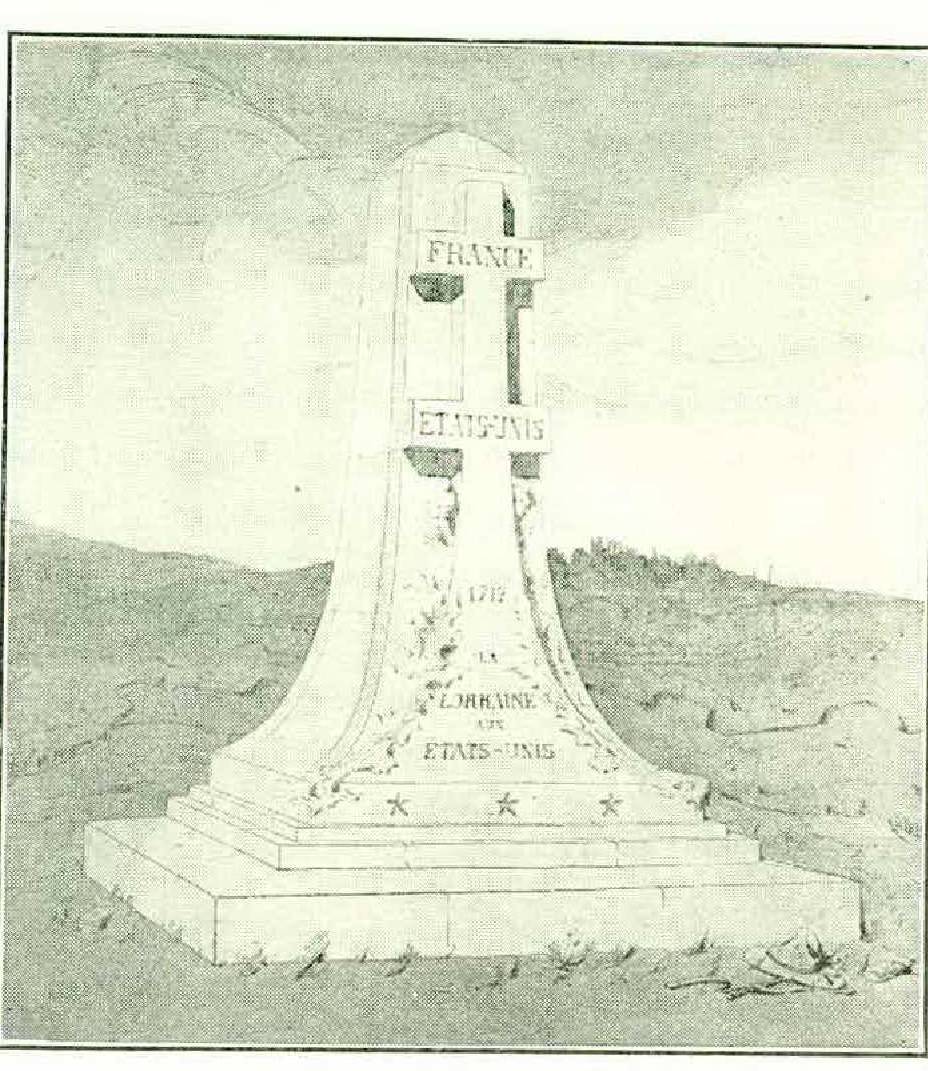
The hazards of war have decreed that the first soldiers of the army of the United States to fall ‘on the field of honor’ should be stricken on Lorraine soil.
They were: -
1. Corporal James B. Gresham (of Evansville)
2. Private Thomas F. Enwright (of Pittsburg)
3. Private Merle D. Hay (of Glidden)
all belonging to Company F, 16th Regiment of Infantry — 1st Division.
They were buried on November 3, 1917, in the little cemetery in Bathelémont, a quiet little village of Meurthe-et-Moselle, not far from Nancy.
After the war France and the United States will desire, doubtless, to commemorate their brotherhood in arms by a monument worthy of this great historical event. But I have thought that a temporary memorial might well he erected even now, in that little Lorraine village so near the front, which has been necessarily abandoned by the whole of its civil population and upon which enemy shells are constantly falling. The expense will be borne by all those communes of Meurthe-et-Moselle not under invasion; they have all expressed a wish to be associated in this fraternal homage to the American army.
I have asked the excellent artist, Louis Maporelle (of Nancy), to preparea plan. The stones for it are now being cut at the School of Apprenticeship in Construction, instituted during the war at Nancy. I send you by this post a photograph of the clay model. You will see that the monument is, as is fitting, quite simple. It has no other ornament than the cross and thistles symbolical of Lorraine, and the stars suggestive of the glorious flag of the United States.
Through the medium of your eminent Ambassador to France, Mr. Sharp, who did us the honor, a few months ago, to visit the mangled and martyred communes of Lorraine, I am sending to President Wilson a model of the monument, reduced in size. It would be most agreeable to me that this photograph should be first reproduced in the Atlantic Monthly, for whose readers of both sexes as fur yourself, I cherish a sentiment of profound gratitude.
Believe me, etc.
LEON MIRMAN.
At last the prophet has as good a show in his own country as anywhere else Guessing when the war will end is inexpensive, and the first prize is a reputation for wisdom more than mortal. In the privacy of print, therefore, we will pass on to our closer friends the following tip just sent us from California.
Los ANGELES, CAL., Jan. 18, 1918.
A prophetic blast from a distant planet.
I just received a wireless message from Madam Blavatzky, to the effect that the War will cease, and a general and universal peace compact will be established, within sixty days from January 10th, 1918.
Put that prophecy in your pipe and smoke it.
KIMBERLY KOHL.
It is not too much to say that the candor and deep conviction of Dr. Odell’s paper on Peter sitting by the Fire have stirred in no ordinary way the conscience of a large spiritual community. Many letters about it have reached this office which we should greatly like to print, did space permit; but, on account of its representative and official character, we must find room for the following communication from the Moderator of the General Assembly of the Presbyterian Church in the United States of America.
February 1, 1918.
To THE EDITOR OF THE ATLANTIC MONTHLY
DEAR SIR: —
Your Monthly comes regularly to my home and is read with the very deepest interest and with the greatest personal profit by all the members of my household.
I am just in receipt of the February Number and I have read the letter which the Reverend Joseph H. Odell writes to you, and which is printed in your ‘Contributor’s Column,’ and also his article — ‘ Peter sat by the fire warming himself.’
In no spirit of controversy, but in fairness to the ministers of the Presbyterian Church for whom I can speak officially, and for that matter, for the ministers and representatives of the Church generally with whose work I am acquainted because of observation and travel, I must send you this communication.
In the first place my official duties have taken me through the Presbyterian churches in the larger cities East of Omaha. I have talked with three thousand of our ministers. I have seen them on their knees in prayer and in consecration to God, asking that He use them in this time of crisis in the Church. I have known the Church intimately for many years. I have never known Presbyterian ministers, so far as I have conferred with them, to be so eager to serve as at the present time.
Second: The President of the United States in my hearing requested the National Service Commission of the Presbyterian Church to urge the ministers tc keep the Church at the high tide of spiritual life, if the Church would serve the Government, and our ministers have been following out the instructions of the President in keeping the home fires burning and in strengthening the work at the home base, realizing that when the reconstruction days are on and the war is over, that the home Church must be alive spiritually, or the soldier life cannot be absorbed into the Church life.
Third: The Government placed the work of caring for the soldiers in the hands of the Young Men’s Christian Association under the direction of Dr. John R. Mott and his Committee, and the Government did well, but the Young Men’s Christian Association is the Church in action. I have heard Dr. Mott say this recently. It is folly to say that because the Association is active the Church is idle. I am sure that no one would be more willing to agree to the statement which I now make than the leaders of the Y.M.C.A. If the church members who were contributors to the more than Fifty Million Fund should be eliminated, the Fund would be seriously affected, and if the workers of the Y.M.C.A. who are active church members, and in many cases ministers, should be withdrawn from the field, the Y.M.C.A. would suffer an irreparable loss. Why then is it not true that the Church is acting through the Y.M.C.A.? Some of the leading Presbyterian ministers of the United States are freely giving their services to the Association at home and abroad, and their churches are continuing their support and supplying their pulpits in their absence. Our own General Assembly in session in Dallas, Texas, in May, 1917, appointed a National Service Commission composed of one hundred and fifty leading ministers and laymen headed by Dr. John F. Carson, of Brooklyn, N.Y. This Commission has wrought well. It has, in sympathy with the Young Men’s Christian Association, supplemented their work in camp and cantonment, and has in every cantonment its ministerial representatives recognized in most instances by the Commandants whose hearty approval is given to the efforts they are putting forth.
Fourth: I have traveled extensively throughout the United States, and wherever there is a camp or cantonment to-day, the nearby churches arc working to the limit of their ability to care for the soldiers when they visit the towns and cities. I have never seen more superb Christian work than that which is being done in these churches and under the direction of these pastors. What I can say about the Presbyterian Church I can also say about, other evangelical churches. I know from observation that the Church is not indifferent, and that the ministers are rallying to meet this tremendous and unexpected emergency. I have only words of praise and commendation for the churches of the United States.
Cordially yours,
J. WILBUR, CHAPMAN.
From the humbler ranks of those beneath the banners of the churches come letters like this.
To THE (DEAR) EDITORS OF THE ATLANTIC MONTHLY: —
May not an old woman sitting beside a bereaved hearth-stone send thanks from her inmost heart for the fearless and illuminating article of Joseph Odell in your current issue? Oh, that it could be sent abroad into the shattered and disorganized world: that hope send up its feeble flame on lonely hearthstones: believing in the coming of a new yet old belief and application of that belief! God bless — nay, He has blessed, and will, the man who dared speak, and speak the truth! I honor, more than words may convey, the publishers of such an article; a new love leaps into life for the brave Atlantic. Long may it live to have its being in our homes.