The Peace Congress and the Balkans
I
IN view of the gigantic series of world-problems awaiting solution at the hands of the Peace Congress, the settlement of the Balkan question may seem to many a minor and secondary task. It must not be forgotten, however, that the stupendous conflict which has involved the whole civilized world arose in the Balkans, where prolonged misery and unrest, due to the subjection of the native populations to alien and unsympathetic rule, had long threatened to light the spark which eventually produced the great conflagration. The Near East had long been a centre and focus of the bitterest racial animosities, a hot-bed of diplomatic intrigue, the home of rebellions, the cockpit of Europe. The danger of further trouble is still there. The triumph of the Allies has not provided a remedy for the situation; should it be followed by new arrangements ignoring the rights of nationalities, another period of conspiracies and struggles, of savage revolts and merciless repression, will be the inevitable sequel. The trouble may, or may not, spread to neighboring countries ; in any case the verdict of posterity will be the same.
The responsibility of the Congress for its treatment of the Balkan question is therefore grave indeed. We must hope that its activity will prove beneficial to humanity, and escape the reprobation which has overtaken the illfamed treaties of Berlin and Bucharest. It would indeed be a scandal if the League of Nations, which, as many of us hope, will be inaugurated at the close of the war, were to find its aut hority invoked for the maintenance of decisions calculated to prolong the state of discord in the Balkans; that it should exercise its power for such a purpose would be a greater scandal still. The possibility that such decisions may be arrived at, even with the best intentions, should not be ignored. The longstanding traditions of European diplomacy cannot be abolished in a day; the leopard does not change his spots; the practice of secret and illicit bargaining is not extinct, and compacts may be made, as they have been made since the beginning of the war, in violation of the principle of nationalities. Those who have made such compacts may feel bound in honor to maintain them, but it remains to be seen whether America will consent to ratify them.
In regard, especially, to questions pending between the Balkan States, America possesses the inestimable advantage of neutrality. Her voice at the Congress should be that of an arbitrator, and the last word will probably be hers. She will doubtless decline to append her signature to any arrangements infringing the rights of nations, however small or helpless or antipathetic to her friends those nations may be. Her representatives will find themselves in conference with colleagues, who will be influenced by a natural and, indeed, laudable sentiment of loyalty to those who have fought and suffered on their side, or who, whatever their personal convictions may be, will regard themselves as bound to act in harmony with the trend of public feeling in their respective countries. This feeling has been inspired, if not created, in Britain and France by the censored press, but more by the arguments of a voluminous ex parte literature, to which practically not a word has been heard in reply.
Of the making of books and pamphlets to serve the purposes of this unilateral Balkan controversy there has been no end. The claims of Serbia, Greece, and Roumania have alone been heard. Bulgaria remains dumb, while the voices raised on behalf of Montenegro and Albania are scarcely audible. The American representatives at the Congress will, no doubt, be thoroughly familiar with the Balkan question in all its bearings, and will, of course, have expert advice at their disposal; in affording this, some of the American missionaries, who have spent their lives in contact with the Balkan peoples, can render inestimable services. But personal knowledge is not enough; the delegates, in pleading the cause of justice, must feel that they have American opinion behind them. The days when diplomatists could despise and rebuff the profane crowd are over; to-day they must have a mandate from public opinion. How far the American democracy has been informed in regard to Balkan questions is unknown to the writer, but he has reason to believe that it is more enlightened and more receptive of instruction than the British public, whose opinions have crystallized for four years under the narrowing influence of a one-sided literature and the control of a rigorous and not very intelligent censorship. It is only at the moment of writing that the restrictions which would prevent the dispatch of this article to the United States have been removed, — at the express request of President Wilson, — and today, more than two months since the cessation of hostilities in the Balkans and on the eve of the meeting of the Peace Congress, British editors have received a special injunction ‘to refrain from speculations as to, and discussions of, the probable terms of peace.'
It is precisely during this fateful interval between the cessation of hostilities and the adoption of decisions on which the future happiness of the world depends, that speculation and discussion, hitherto impossible, are especially desirable. Above all, the expression of expert opinion is peculiarly needed in regard to the intricate and dangerous Balkan question. Happily, it is not stifled in the United States. Knowledge is power, and American opinion, once it grasps the essential features of the problem with its characteristic acuteness and insight, may well prove a determining factor in the decisions of the Congress and prevent the perpetration of injustice and wrong. Some of these features have been distorted, others completely obliterated in the war-time literature of Western Europe, which has been disfigured by recklessness of statement partly due to bellicose enthusiasm and partly to partisanship, but still more to assured and prolonged immunity from criticism and exposure.
American opinion has scarcely, perhaps, been victimized to the same extent. What is needed for the formation of a sound judgment with regard to the Balkan question is (1) some knowledge of the main facts of its historic evolution, and (2) a fairly clear idea of the racial distribution in the Balkan Peninsula, which must form the basis of a just and permanent settlement. Furthermore, inasmuch as the Congress may be expected to constitute the ultimate Court of Appeal in regard to the charges and counter-charges of ‘ atrocities’ and contraventions of international and common law freely brought against each other by the rival Balkan States, it is necessary in the interests of justice, not indeed to strike the ‘balance of criminality,’ for that would be impossible, but (3) to realize the stage of civilization which has been attained in the Balkans, and to judge the excesses which have been committed in the light of provocation received.
II
In regard to the three subjects of inquiry above suggested, a few indications may be furnished which, though necessarily brief, may prove useful at the present juncture. The modern history of the Balkan question may be said to begin with the Berlin Treaty which followed the Russo-Turkish war of 1877-1878. The war had resulted in the virtual extinction of Turkish domination in Europe, and had it been succeeded by a just repartition of territories in accordance with the principle of nationalities, the terrible racial struggles of the past half-century would have been avoided. After the cessation of hostilities Russia had exacted from Turkey, by the Treaty of San Stefano, the creation of a Bulgarian principality, including Macedonia, with frontiers practically coinciding with the limits of the race. That treaty has always been regarded by the Bulgarians as their national charter; all their subsequent efforts have aimed at its revival, and the date of its signature is kept as a national holiday. But the Powers, headed by Britain, Germany, and Austria, intervened; the Berlin Treaty followed; and the new Bulgarian state was subjected to a tripartite division: some two million Bulgars obtained national independence under Turkish suzerainty; nearly a million in Eastern Roumelia were given autonomy under a Turkish governor; while more than a million in Macedonia were handed back to the tender mercies of the Turks, receiving nothing but a promise of reforms, which was never fulfilled. The mutilated Bulgarian principality was all but strangled at its birth; it began its career under the rule of a nephew of the Tsar, and to all appearance was destined to become a humble appanage of the Russian Empire. But the Bulgarians are a virile, courageous, laborious, and persevering race, and the story of how the slaves of yesterday shook off Russian tutelage, achieved union with their brethren in Eastern Roumelia, repulsed the treacherous attack of the Serbian King Milan, established a powerful organization in kindred Macedonia, denounced the suzerainty of Turkey, and, becoming the most powerful military state in the Peninsula, led the great crusade of the Balkan nations against Ottoman tyranny, is, perhaps, the most entrancing in the annals of modern Europe.
The maiming of Bulgaria was not the only crime committed by the Powers which dictated the Berlin Treaty. Bosnia and Herzegovina, the lawful inheritance of Serbia and Montenegro, were handed over to Austria, Greece was denied Crete, and Russia was allowed to annex Roumanian Bessarabia. The Armenians, like the Macedonian Bulgars, were put off with promises of reform. The concurrence of France in these deplorable arrangements was rewarded by an assurance of the reversion of Tunis; while Britain, by a separate compact with Turkey, obtained authorization to occupy Cyprus. Germany alone, satisfied by the humiliation of Russia, obtained no territorial advantage, Prince Bismarck, who openly declared that all the Christians of the Balkans were not worth the bones of a Pomeranian grenadier, playing the part of ‘honest broker’ in the complicated series of transactions.
The result of this bargaining away of the rights of weak and defenceless peoples was only such as might be expected. The mills of the gods grind slowly, and not till 1903 did the Bulgarian population of Western Macedonia, after twenty-five years of intolerable suffering, raise the standard of revolt. The usual Turkish barbarities followed, and the scandal became such that the Powers were compelled to do something. The programme of reforms devised by Austria and Russia having proved a complete failure, Great Britain associated herself with the latter power in the preparation of a more drastic scheme. But this was rejected by Turkish chauvinism; the Young Turk revolution broke out, and, as in 1876, a ‘Constitution’ was promulgated, with the express object of thwarting foreign interference. Incredible as it may seem, the Powers expressed belief in the sincerity of Turkish intentions, and withdrawing their officials from Macedonia, left the hapless population to its fate. Allowed to work their own sweet will, the Young Turks, at that time the darlings of society and journalism in London and Paris, proceeded to carry out a revolting campaign of repression in Macedonia and Albania, with the object of finally extinguishing all national movements in the interests of ‘Ottomanism.’ The European press, largely under Jewish influence, maintained an indulgent silence, and the governments looked on without protest while the Young Turks chastised the subject races in both countries with scorpions. The cup was at last full, and the Christian populations, hitherto employed as scourges for each other by the consummate skill of the deposed Sultan, but now subjected to indiscriminate persecution by fanatical theorists and sabreurs, drew together under the influence of common sufferings. The dream of their friends, who had hoped against hope to unite them against the oppressor, became a reality.
The reconciliation, which began in Macedonia, spread to the courts and cabinets of Sofia, Athens, and Belgrade, and in April, 1911, the first overtures were made from Athens to Sofia through the agency of the writer, suggesting a defensive alliance. Soon after, an arrangement was concluded between Bulgaria and Serbia. Great secrecy was maintained throughout; the Young Turks, in their blind confidence, failed to descry the danger, and in the autumn they found themselves at war with a Balkan League. A few weeks later the battle of Lulé Burgas sealed the doom of Turkish rule in Europe.
Unhappily the splendid achievement of the allies was dimmed by sordid disputes for the possession of the spoils. While the Bulgarian troops were still confronting the main Turkish army in Eastern Thrace, the Serbians and Greeks proceeded to ‘ peg out ’ claims in Macedonia and Western Thrace, and even to oust the small Bulgarian garrisons which remained in those regions, notwithstanding the principle of condominium established in the SerboBulgarian compact. The Bulgarian priests and schoolmasters were persecuted, the schools closed, and the revolutionary leaders of the people arrested and punished as vagabonds and brigands.1 The war of liberation rapidly degenerated into a war of conquest.
There was still a hope that a peaceful settlement between the allies might be attained when the Balkan Conference met in London in December, 1912. But the stars in their courses seemed to fight against the cause of concord. Everything depended upon whether a territorial arrangement could be arrived at by Greece and Bulgaria, whose respective claims had not yet been adjusted. The possession of Salonica was the real bone of contention; the seaport, which is mainly Turkish and Jewish, was claimed by Greece on the ground of prior occupation, while Bulgaria based her case on the commercial necessities of Macedonia, which province had been left within her sphere of influence by her treaty with Serbia.
Had MM. Venizelos and Gueshoff, both men of reasonable and moderate views, been enabled to meet in London, the question would doubtless have been settled and the Second Balkan War averted. For without the armed support of Greece Serbia would never have taken the step which directly led to the rupture — the repudiation of her treaty with Bulgaria. By that treaty, which derived additional solemnity from the signatures of Kings Peter and Ferdinand, the minutest details of the territorial question between the two countries had been settled. But the departure of M. Gueshoff for London had been countermanded at the last moment by King Ferdinand, and M. Daneff, who took his place, rejected the moderate proposals of M. Venizelos. That statesman, recognizing the necessity of a commercial outlet for Macedonia, offered Kavala instead of Salonica to Bulgaria, and proposed a frontier extending from the Ægean Sea near Orfano to the southern extremity of Lake Okhrida. There can now scarcely be a doubt that the rejection of the offer was ordered from Sofia.
Had the Conference been allowed to continue its deliberations in peace, the question might have been arranged; for King George of Greece was in harmony with the moderate programme of his prime minister, and King Ferdinand, who was never averse to a deal, might have been induced to sacrifice Salonica, which, in conversation with the Queen of Greece, he had incautiously described as the ‘Mecca of Bulgaria.’ But the Young Turks once more threw everything into the melting-pot, and Enver Bey’s coup d’état at Constantinople, ostensibly carried out with the object of saving Adrianople for Turkey, put an end to the discussions in London and entailed a renewal of the war. The delay in the negotiations gave time to Serbia and Greece to continue the process of forcible assimilation in the conquered regions, which exasperated Bulgaria, and destroyed all hope of a reconciliation.
A further complication was added by the demand now put forward by Roumania for a share in the spoils. In 1910 Roumania, then completely under the influence of Germany, made an offer of armed assistance to Turkey in case of a Balkan outbreak. When the outbreak came, she preferred to play the part of a disinterested spectator; at Bucharest, as at Berlin, a Turkish victory was anticipated. Having abstained from taking part in the war of liberation, she could not be admitted to the Conference, but a special delegate, M. Take Jonescu, was despatched to London, to demand a considerable slice of Bulgarian territory as the reward of Roumanian neutrality. M. Daneff treated this demand with a contempt which the sequel shows to have been unwise. At the time Bulgaria, surrounded by enemies avowed or concealed, would have done wisely to buy off one or more of her adversaries.
III
Shortly after the premature breakup of the Conference, Serbia, assured of the effective support of Roumania as well as of Greece, proceeded to take the step which led directly to the war between the allies — the denunciation of her treaty of alliance with Bulgaria. The treaty, which had been concluded under the auspices of Russia, was signed in February, 1912, some six months before the war. It was accompanied by a ‘secret annex,’ and a map which defined with the utmost clearness the territorial settlement between the two nations in Macedonia. The region north of the Shar mountains, known as Old Serbia, was definitely assigned to Serbia; to the south, a region commonly known as the ‘Contested Zone’ was left for the arbitration of the Russian Emperor in case the contracting parties should fail to come to an agreement; beyond the southern boundary of this region, which included Uskub and Kumanovo, Serbia pledged herself to make no territorial claim. The arrangement, which implied a large abandonment of Bulgarian claims, was made alternative to the establishment of Macedonian autonomy, which the Bulgarians, conscious of a kindred majority in the country, had always insisted upon, while the Greeks and Serbians demanded partition. A distorted interpretation of the treaty, and even a false text, were now issued at Belgrade, while Bulgaria, in conformity with the obligation of secrecy, refrained from divulging its terms.
As the world remained unconvinced, Serbian diplomacy adopted a new standpoint, and the doctrine rebus sic stantibus was advanced, according to which treaties are valid only so long as circumstances remain unchanged — an elastic principle, which would vitiate any international compact almost as soon as it was concluded. (It is doubtful, in fact, whether M. Pashitch ever intended to be bound by the agreement with Bulgaria, as in September, 1912, before the outbreak of the war with Turkey, he addressed a secret circular to the Serbian representatives abroad, instructing them to advocate an extension of territory in Macedonia beyond the limits fixed by the treaty.)
Nothing could be more unedifying than these manæuvres, which were carried out under the auspices of M. Hartwig, the Russian Minister at Belgrade, the principal author of the war between the Balkan allies. Serbia, balked of her desire to extend her territory to the Adriatic, owing to the decision of the Powers to create an Albanian state, was now encouraged to apply to Russia for compensation in Macedonia by means of a complete revision, or rather abolition, of the treaty, which limited Russian arbitration to the ‘Contested Zone.’ All that can be said for Serbia in this matter is that it was natural that she should seek consolation in some direction for the extinction of her hopes in Albania; but it was equally natural that Bulgaria, which had conceded to her a considerable kindred population under the treaty, should decline to make further sacrifices in consequence of an event for which she was in no way responsible. Her rulers failed to see the dangers which gathered round them.
In the spring of 1913 the relations between the allies went from bad to worse. The Greeks, after the mysterious assassination of King George at Salonika, redoubled their aggressions in Macedonia under the chauvinistic rule of his successor, and brought about a situation scarcely differing from open war with Bulgaria. The Bulgarian troops were still confronting the Turks, and the Greeks made the most of their opportunity to strengthen their position in Macedonia. When, in April, representatives of the allies were brought to London to sign a treaty of peace with Turkey drawn up by Sir Edward Grey, the Greek and Serbian delegates protracted the discussions to such an extent that Sir Edward, whose patience was at last worn out, courteously suggested their departure from London.
The signature of the treaty enabled the Bulgarians to transfer their wearied and exhausted forces to the Macedonian front, where they found themselves opposed to Greek and Serbian troops who had enjoyed some eight months of comparative rest.
Meanwhile the Serbo-Bulgarian conflict over Russian arbitration grew daily more acute, and the vacillating attitude of the cabinet of Petrograd began to excite suspicion at Sofia. In reply to a somewhat minatory letter from the Tsar, — who endeavored to avert the scandal of a conflict between the two Slavonic nations by a personal appeal to their rulers, — King Ferdinand adopted an independent tone which gave great offense to the Russian court and practically sealed the doom of Bulgaria. Shortly afterwards Roumania was given to understand that her participation with Greece and Serbia in the chastisement of the refractory state would not be regarded as a heinous crime at Petrograd.
In acting thus, Russia unconsciously played into the hands of Austria and Germany, which aimed at the destruction of the Balkan League. But these were the days of autocracy, when the personal feelings of the Tsar counted for more than the will or the interests of the entire nation. The Germanophil clique at the Court, moreover, aimed at the estrangement of Bulgaria from Russia. The efforts of Austria to sow discord among the allies were unceasing, and were well known to the writer, who spent this momentous time in the Balkan capitals.
At last, on the 29th of June, General Savoff, the Austrophil commander-inchief of the Bulgarian troops, acting without the knowledge of the Bulgarian government, issued an order to attack the Serbian and Greek armies. Two days later the order was revoked, the troops recalled, and the general dismissed — but in vain; the Greek and Serbian militarists, who had already decided on war, saw their chance, and the only result of the withdrawal of the troops was to give the enemy an initial advantage in the campaign that followed. A few days later, Roumania, setting aside the award of the ambassadors at Petrograd, by which her claims to ‘compensation’ had been settled, and Turkey, tearing up the Treaty of London, the ink of which was scarcely dry, fell upon Bulgaria from the north and east. The culprit state was crushed, and in the first week of August the delegates and military officers of the victorious allies assembled at Bucharest for the division of the spoil.
The so-called treaty, which was now drawn up in hot haste for fear of the intervention of the Powers, was in reality nothing more than a drum-head truce, and was so described by King Carol, one of the principal beneficiaries under its provisions. According to the Carnegie Commission it recorded ‘the illegitimate pretensions of victorious nationalities’; according to Mr. Asquith, it has been the especial source of continued discord in the Balkans. ‘The Treaty of Bucharest is founded on the ruins of violated contracts; it stands on the flimsy substructure of torn-up “scraps of paper.” It has not been recognized by any of the Powers, and, therefore, cannot be regarded as a legitimate substitute for previous arrangements which they have drawn up or sanctioned. It presents a series of grotesque frontiers, traced on vindictive lines, in violation of the principle of nationalities and in defiance of economic laws. It has condemned more than a million unhappy beings to conditions of existence which cause them to regret the rule of the Turks.’2 The acquiescence of the Bulgarian delegates was extorted by a threat of immediate occupation of Sofia by Roumanian troops.
It is quite unnecessary to criticize the terms of this scandalous compact, which will doubtless be set aside in toto by the coming Congress. The treaty, by creating a permanent breach between the Slavonic races of the Balkans, favored the aggressive designs of the Teutonic powers in the Near East. Its signature was hailed with enthusiasm by the Emperor William, who alone of European sovereigns accorded it his recognition,3 and was followed almost immediately by a proposal made by Austria to Italy, to derive profit from the real sit uat ion by a joint attack on Serbia. In fact, Serbia had been weakened rather than strengthened by the incorporation of a large alien population, and, as events soon showed, by the vengeful hostility of her humiliated neighbor.
Although the Western Powers, and especially Great Britain, were responsible for the Treaty of London, not a finger was lifted on any side to prevent its violation. The danger to peace was alleged as an excuse for inaction: we have seen how peace was preserved. A little later, after the outbreak of the Great War and the adherence of Turkey to the Central Powers, the importance of Bulgaria’s geographical position came to be recognized in London and Paris, and half-hearted offers were made to remedy her wrongs in Macedonia. But the Western Powers were deterred from their endeavor by the absolute refusal of the Serbian military chiefs to yield an inch of the occupied territory. The chauvinists thus prepared the catastrophe which very soon overtook their country. Meanwhile Germany hastened to offer all Macedonia to Bulgaria, and to threaten her with the fate of Belgium in case of refusal. ‘Woe to him who resists my destructive sword,’ wrote the Kaiser to his sister, the Queen of Greece; and the same threat was conveyed to King Ferdinand through the Grand Duke Johann of Mecklenburg-Strelitz, a cousin of Queen Eléonore, who quartered himself in the palace at Sofia for several weeks in the summer of 1915, and never left until he had extracted a pledge of alliance from King Ferdinand. This took place, according to the certain information of the writer, at the end of August, 1915.
King Ferdinand’s decision, which was not in accordance with the general sentiment in Bulgaria, was due more to the fear of German vengeance, against which he saw no protection, than to belief in German promises. Had the Western Powers sent their troops to Macedonia — as they were advised to do — some six months sooner, they would have obtained the coöperation of Bulgaria, of which they had a definite offer in the spring. Bulgaria, which had borne the brunt of the war against Turkey and had suffered greater losses than all her allies put together, could not be blamed if she expected to receive her stipulated reward in kindred Macedonia, which had been guaranteed to her by a solemn treaty. But the Western Powers failed to procure her adequate reparation from Serbia or to offer her adequate protection against Germany. Had they secured the adhesion of Bulgaria, Roumania would at once, as M. Bratiano stated to the writer at the time, have taken up arms on their side; the forces of the three Balkan states, over a million men, could have been ranged on the Danube front, Serbia would have been saved, Turkey isolated, and all the disasters which followed, both in the Balkans and in Asia Minor, would have been averted.
IV
The Western Powers may or may not realize how largely they have been responsible for the fiasco in the Balkans and the consequent protraction of the war, but America will possess a clearer vision. She need not adjudge the blame, but she will see to it that no Balkan state shall be allowed to suffer permanent injury in consequence of the errors of others, or of the unjust denunciations of predatory rivals. An equitable, and therefore permanent, settlement can be arrived at only on the basis of a just repartit ion of territories in accordance with the principle of nationalities; if anything is to be learned from the sad history of the past it is this — that no Balkan nation or considerable fragment of a Balkan nation must be left under the rule of another. The legitimate aspirations of all the Balkan States, as Sir Edward Grey has pointed out in the House of Commons, must find satisfaction; there can be no ignoring of the rights of any of them, even of the smallest and weakest. ‘ The settlement must be just and free from any taint of vindictiveness; it must be imposed from above, and maintained under penalties, perhaps even manu militari, for a certain time, until the military and chauvinistic elements have been brought to reason, which have so often stifled the voice of good sense and overborne the wishes of the majority in those states.’4
If we are bent mainly on rewarding our friends and punishing our enemies, we may at once abandon all hope of effecting a settlement in the Balkans. Militarism and chauvinism, the root of all evil in these regions, must at the outset be dealt with firmly; but, together with the bitterness engendered by the war, they will subside under the working of an equitable arrangement. The old racial animosities, due partly to diversity of temperament and character, partly to antagonism of interests, will not disappear so quickly; but it is encouraging to remember that, at the time of the formation of the Balkan League, they showed a marvelous and, indeed, miraculous capacity for mitigation. The worst characteristics of each nation — the malicious mendacity and intrigue of the Greeks, the obstinate stupidity of the Bulgarians, the maudlin self-laudation of the Serbians — reappeared during the fratricidal war, and will continue to display themselves unless the powers undertake the education of these wayward children for a season, and provide them with an atmosphere in which their better qualities can grow and thrive.
When each of these nations receives its legitimate national expansion, they will cease to prey on each other, and devote themselves to the development of the great national inheritance to which they are severally entitled. Irredentism and, we may hope, militarism, will disappear forever. The repartition of the peninsula cannot be carried out successfully without a careful study of its ethnography, on which, in the main, it must be based, though natural features and economic and commercial considerations must also be taken into account in certain cases, the latter especially in the allocation of seaports; no state should be left without adequate and unrestricted communication with the sea. Strategical considerations, which figured so largely in the Treaty of Bucharest, may practically be ruled out of court.
For the racial distribution, the best information will be found in the works of impartial and authoritative travelers, many of whom wrote before the period of controversy, and of investigators who have made a study of the customs, languages, and dialects of the populations for scientific purposes.5
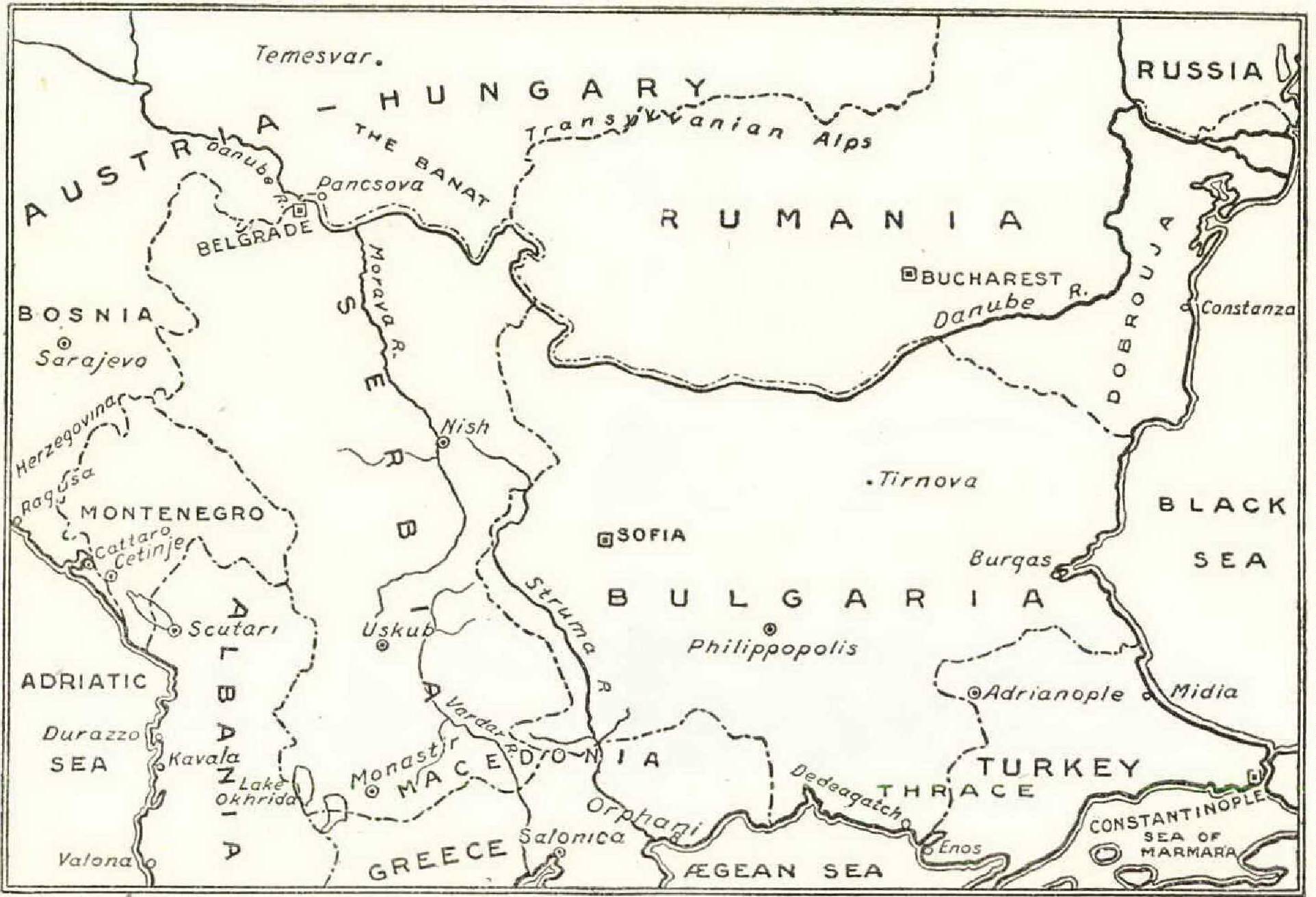
It is impossible to discuss ethnological claims within the limits of this article. Broadly speaking, Roumania is entitled to Bessarabia, Transylvania, the Banat (except perhaps the county of Torontal), and part of Bukovina; Bulgaria, to Macedonia south of the Shar range, to a considerable part of Eastern Thrace, and (for commercial reasons) to Kavala, and to the greater part of the Dobrudja; Serbia should be included in a large state or confederacy comprising the Croat and Slovene elements which were formerly subject to the Hapsburg monarchy, and should be accorded an extensive seaboard on the Adriatic. Montenegro — should she prefer independence to inclusion in this state — should obtain a reasonable share of Herzegovina, and the ports of Cattaro and Ragusa. Albania should enjoy the limits already assigned to her by Europe, including her natural seaports, and should receive a slight extension to the northwest. The Greeks, always a maritime race, should receive their legitimate expansion in the islands of the Levant (including the Dodecanese and Cyprus), together with a liberal slice of Asia Minor.
The intrusion of Italy into the Peninsula is to be deplored, not only on ethnical grounds, but because Serbia, if balked of her legitimate claims on the Adriatic, will, as in 1913, put forward illegitimate pretensions to Macedonia. Italy’s claims to dominate the Adriatic lose cogency with the downfall of Austrian naval power. If she must keep Valona, its limits should not exceed those of Gilbraltar.
The right of Bulgaria to Macedonia is undeniable: it is confirmed by clear historical evidence, by the authoritative writers mentioned above and a host of others, by the Americans and other foreigners who have spent their lives in contact with the people, and by a number of Turkish and international documents, such as the Firman creating the Exarchate, the Reform Scheme of the European Conference of 1876, the Treaty of San Stefano, and the Murzsteg Programme, which excluded the outlying Serbian and Greek districts from its area. No Greek can deny that the Greek Emperor Basil II, who put out the eyes of 15,000 Macedonians, assumed the title of Bulgaroktónos (‘Bulgarian-slayer’);6 no Serbian, by officially altering the name, can conceal the fact that the right branch of the Morava has been called ‘Bulgarska’ from time immemorial.
Finally, if the Congress is to assume or confer judicial powers in regard to offenses committed during the war, the greatest care must be taken to avoid the perpetration of a dire injustice in the case of any of the Balkan peoples. The standard of civilization in the Balkans is not that of Central Europe, and Bulgars, Serbs, and Greeks who murder and torture one another should not be placed in the same category as those representatives of Kultur who shot Miss Cavell and Captain Fryatt. Apart from the question of international law, it is doubtful whether any real improvement in the level of the world’s morality would be effected by instituting judicial proceedings against the Emperor William and his subordinates, who have resorted to frightfulness ‘with the humane object of shortening the war’; but it is certain that nothing but harm could result from an attempt to satisfy justice by means of judicial proceedings in the Balkans. The sad history of the Balkan races must not be forgotten. Since the days of ‘Bulgaroktónos,’ and long before them, Greeks, Bulgarians, and Serbians have slaughtered one another without mercy. Only recently, — in the case of the Bulgarians, within living memory, — have these races emerged from the night of Turkish tyranny, the Greeks alone with a vestige of ancient civilization which unhappily has not prevented them from pursuing ‘their methods of assimilation and extermination with more system and less humanitarian sentiment’ than their Serbian allies.
The important, careful, and impartial report of the Carnegie Commission should be in the hands of the members of the Congress, and, indeed, of everyone who desires to form a just opinion with regard to Balkan criminality. The Commission helped to expose in some degree the mendacity of the press campaign of 1913, conducted at a moment when the Bulgarians were cut off by their enemies from communication with Western Europe; and a renewal of its labors is desirable at the present juncture, when the circumstances are somewhat similar. A thoroughly impartial inquiry into the crimes committed on all sides should first take place, and, if trials there must be, all Balkan offenders alike should be impartially judged by neutral tribunals. A one-sided execution of justice will savor of vindictiveness and will fail to meet the approbation of the outer world or of the future historian.
- See the Report of the Carnegie Commission, pp. 50-56.↩
- Quarterly Review, April, 1915.↩
- See the congratulatory telegrams exchanged between the Kaiser and King Carol immediately after the signature. During the negotiations the Kaiser ‘fought like a tiger’ to secure Kavala for his brother-in-law, King Constantine, on whose aid he could count. The belief of M. André Chéradame (The Pan-German Plot Unmasked, pp. 29-31), that he was lashed into boundless fury by what took place at Bucharest, is erroneous. M. Chéradame is also mistaken in supposing that Sofia was at this time under German influence. As late as April, 1915, Bulgaria offered to place all her military and naval forces at the disposal of the Entente, in return for certain concessions in Macedonia. — THE AUTHOR.↩
- See ‘The Final Settlement in the Balkans,’ in theQuarterly Review for October, 1917.↩
- Among these, as regards Macedonia, may be mentioned Leake, Ami Boué, Cyprien Robert, Lejean, Tozer, Cousinéry Mackenzie and Irby, Hahn, Niederle, Jireìek, Louis Leger, Oblak, and Weigand; Victor Bérard, Evans, Chirol, Leon Lamouche (a very competent expert), and Brailsford should also be consulted. Europeans and Americans, official and unofficial, who have spent years in the interior can give valuable information on the racial question. The ethnological map of Kiepert (a travesty of this map, issued under Greek auspices in London, is to beavoided), recognized as authoritative at the Berlin Congress, is still of great value. — THE AUTHOR.↩
- The title has been rather illogically revived for King Constantine by his troops and the populace of Athens. — THE AUTHOR.↩