Tappers and Swingers
BACK in the nineties, in the little Atlantic town of my boyhood, there would come in the sunny days of April or early May a swelling musical cry of ‘Umper, umper, who’s got an egg?’
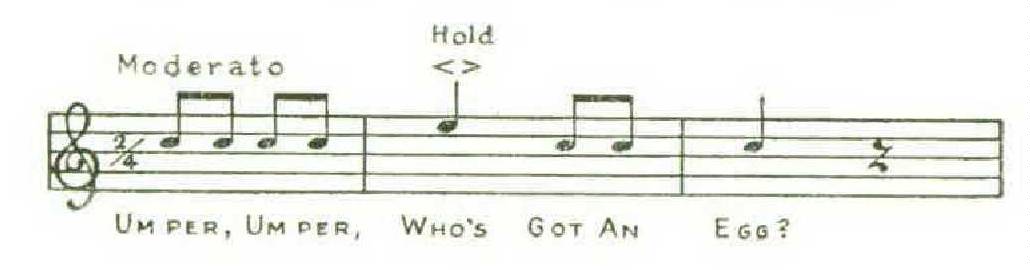
It was the call of ‘egg-picking’ time, and its pleasurably lingering defiance meant that some boy had secured a hen’s egg and, with it carefully stowed about his person, was strolling through the streets melodiously announcing his willingness to meet all comers in a ‘picking’ duel. And all boys within sight or hearing clustered eagerly to witness the combat that followed an acceptance of the stroller’s cry.
‘ Picking’ was an affair of some elaborateness and with a technique of intently meticulous care. Amid a babble of advice from the gathering audience the principals would suspiciously scrutinize the eggs to be opposed, to make sure that no ‘ringer’ — that is, some egg other than that of the hen — was being used. Following the inspection would come a verbal, and sometimes protracted, jockeying for position — preferences as to rôle of either ‘picker’ or ‘picked’ varying quite superstitiously. And then, with more argument as to rules and minute limits of protection, the thumbs and forefingers of the owner of the egg to be picked would encircle it defensively, so as to expose only its very tip, which was then delicately tap-tap-tapped — how breaths were held bated! — by the picker with the point of his egg until at last, one or the other of the fragile shells yielded and so became forfeit to the victorious possessor of the undamaged egg.
The object was not to break the shell completely — that was neither sporting nor good technique, because an egg merely dented could be thriftily carried home for the family larder (they were always fresh) or else used again by the winner for a ‘ butt pick, ’ while a broken egg advantaged no one. It was the actual yielding of the shell, however slight, that counted, and the smaller the dent, the greater the skill. Such was ‘picking’ — it called for the fine, the cameo touch.
It seems strange that so striking a bit of seasonal coloring has found no echo in our literature, but nowhere have I ever seen it mentioned. Definitely a game of early spring, I have always felt it represented some folk survival — possibly an obscure celebration of the resumption of prolific laying, or perhaps some symbolistic aid to the bursting forth of new life. The period of the game began abruptly, lasted two or three weeks, and then ended as suddenly and as mysteriously as it had begun. But while that boy season lasted no thunderous jousting of armored knights or clashing rapier play of strutting courtiers ever drew more breathless, head-clustered interest than did those battles of taps among those boys. There was the hushed fascination of the careful step upon thin ice — the heart-stopping thrill of failure or success that hung upon a quiet thread.
Sharply contrasted was another boyish folk way, the ‘burney-can’ — a sport of fall, and about which there was no hint of preciousness, nor a single trace of finely drawn effort.
The very freedom of the game was symbolized in its equipment, for the burney-can was simply any receptacle that would hold fire, and was most often merely an old tomato can with a large hole punched in one side, just above the bottom, for a draft, and with a long wire attached to form a looped handle some twenty-four or thirty inches in length.
Thus equipped, the boy would build in the can a fire of chips and small twigs, fan it into a blaze by a censerlike swaying to and fro, and then, as a glowing bed of coals accumulated, would begin the swinging that was the real delight.
With the red-hot embers held in place by mere velocity, the can would move more and more freely through steadily widening arcs, and with more and more speed until finally, at full arm’s length, the boy would be whirling it about his head in great flaring circles that varied from horizontal to vertical and all angles between, as skill and daring fancy dictated. And the admired boys, the champions, were those who attained such certainty, such speed and virtuosity, that each at the height of the sport seemed literally enringed with round after round of tempestuous fire.
What a spectacle that was, on those spacious open lots in the windy dusk of fall — that thrilling, swooping, flashing, impromptu play of circling flames that leaped and raged and roared from the can under the furiously fanning drive of the swing!
The burney-can! How little was required for that potent boyish magic! A battered tin, a rusty wire, a glow of odds and ends — that was all. And yet it richly satisfied. There was nothing indrawn about it, nothing withheld: none of the quiet concentration, the bottled-up intentness, of ‘picking.’ Rather the burney-can was a thing of freely open power, of broad delight, and of rare, soul-expanding beauty — that mad, lashing, dangerous, fiery tumult — to the boyish heart. No stationary bonfire could ever compete with it in pleasure: it held naught static. It was a moving, living symbol of man’s mastery over fire, and as such it must surely have echoed some similar folk rite. What an open-hearted joy it held!
Interesting as those games are, both in themselves and in their folk implications, there is an even greater interest in the differences they presented: differences that had typifying values and that demanded — and revealed — qualitative differences in their respective champions. For though, with the omnigerence of youth, all boys played both games, yet not all — nor even the same boys — attained excellence at both. The boy who consistently carried home the greatest number of slightly dented eggs was usually the calmly quiet boy, perhaps the rather lonely stand-offish boy, and never the outspoken, gusty ‘leader of the gang.’ It was the latter who shone exultantly with the burney-can, that wilder, even cruder, sport of vivid energy.
Those differences were not mere phases of childhood; they persisted and were only accentuated by the years that led to manhood. In fact there is a classification of tappers and swingers that, just as clearly as with those boys, divides all men, both past and present, in every walk and activity of life — in politics, in sport, in art, in religion, in literature, in thought. Theodore Roosevelt, for instance, would never have been a champion at ‘egg-picking.’ The tap was not for him.