The Contributors' Column
As one of Herbert Hoover’s closest friends, Vernon Kellogg (‘The President As I Know Him’) has had exceptional opportunities to study the man and his methods, He worked with Mr. Hoover as Director, in Brussels, of the American Commission for the Relief of Belgium, and later served as his assistant when Mr. Hoover was United States Food Administrator. In his own right Mr. Kellogg is an eminent zoölogist, having devoted a large part of his energies, since 1919, to the work of the National Research Council in Washington. Jael Kent gives a full account of herself in ‘ Beggars Can Choose.’
Margaret Culkin Banning (’ The Day in Court’) has published innumerable short stories and many novels, the latest being Mixed Marriage.Jared van Wage non, Jr. (' A Farmer Counts His Blessings’) tills the acres in up-state New York which belonged to his father and grandfather before him. Alastair Miller (‘Virginian Memories’) is an undergraduate at Christ Church, Oxford.
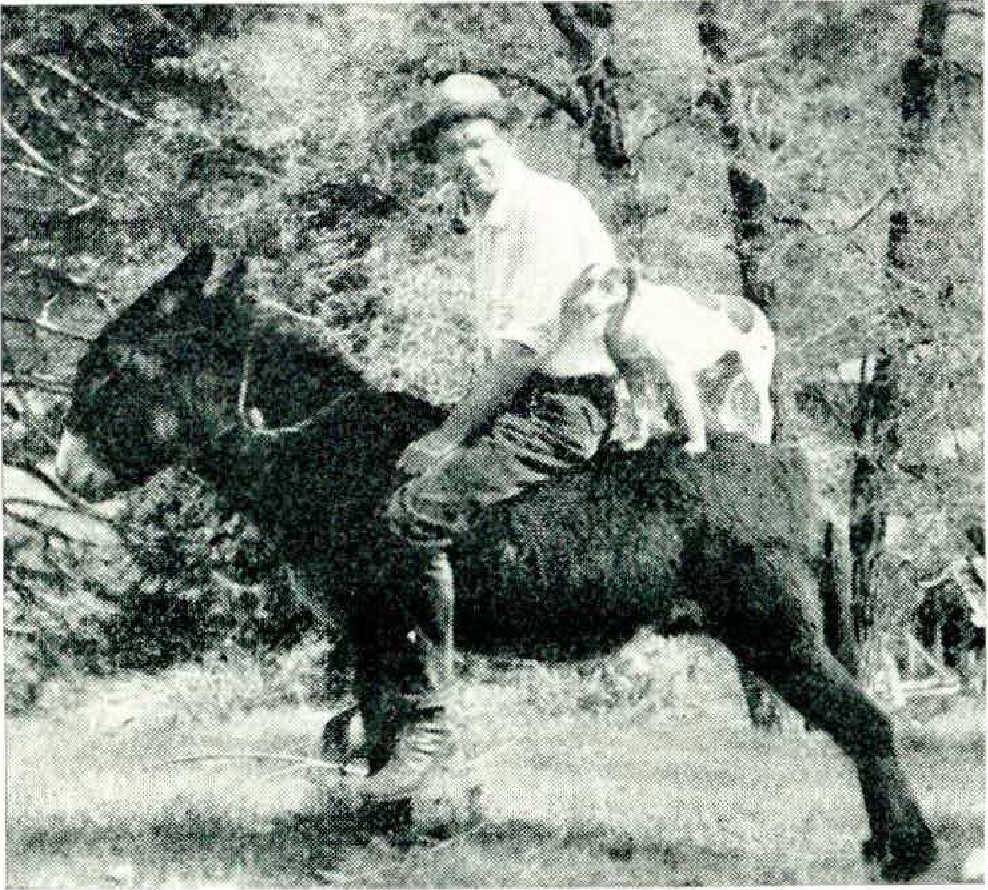
Formerly a member of the Atlantic staff, Arthur Pound (‘The Breaking Point’) has distinguished himself as a student of human problems in industry. Taking a vacation from his chosen held, he has just completed a volume on the Penns of Pennsylvania, to be issued this fall by Macmillan. H. A. Batten (’An Advertising Man Looks at Advertising’) is an officer and director of a large advertising agency. Δ A Cornell ornithologist, George Miksch Sutton (‘Quaint Folk, the Eskimos’) is rarely to be met with below the Arctic Circle. Not long ago he returned from Southampton Island, in Hudson Bay, only to go off on a new expedition to investigate bird life in the Great Bear Lake district of Northwestern Canada. Δ‘Aye, Aye, Mister Mate!’ is based upon an incident in Bill Adams’s own seafaring life, which he began at the age of eighteen as an apprentice in a square-rigger. The snapshot reproduced on this page shows him enjoying a land lubberly retirement aboard the sluggish craft Kilowatt, with Toby for mascot. Δ Formerly Assistant Professor of Economics at McGill University, B. K. Sandwell (‘The Plague of Rabbits in Poetry’) spends most of his time writing and lecturing. Δ Having made a lifelong hobby of collecting first editions and source material, Vincent Starrett (‘Enter Mr. Sherlock Holmes’) is writing a book about the greatest, detective of them all. Arthur C. Cole (‘Our Sporting Grandfathers’) is Professor of History in the Graduate School of Western Reserve University. Louis Reed (‘The Ghosts of Poca River’) is a lawyer in a small West Virginia town. Δ Author and playwright, Lee Wilson Dodd (‘On Learning to Read’) also teaches English at the Bread Loaf Writers’ Conference and at Sarah Lawrence College. Δ A graduate of the Harvard Medical School, Dr. Richard P. Middleton (‘Captain of the Men of Death’) practises in Salt Lake City. William C. White (‘Germany’s Lost Generation’) spent last year in the Reich observing the social and political ferment which is commonly known as Hitlerism. He is the author of a significant volume, These Russians, which gives a first-hand account of life as it is lived among the Bolsheviks. Although he had spent four years in Russia, he was planning to return when he was debarred at the border, so he stayed in Germany instead.
Footnote to footnotes.
My long-time-cherished, dear Atlantic,
I scarce find words to let you know
Of one near-negligible antic —
One smudge, as on Dianic snow —
That drives me (yes, I own it!) frantic.
However frivolous or solemn,
May pull a bone, or tell a fib,
Or flout a social what-d’ye-call’em —
Please let him rant or jest ad lib.;
Don’t add your footnote to his column.
Your classic pages to bedizen;
Though he may not say what he ought,
Such errors as he makes are his’n!
Don’t try to steer his vagrant thought,
Sit still with us — and grin and listen.
J. D. S.
Toronto, Canada
The rising tide of taxes.
Dear Atlantic, —
So well expressed, so accurate, and so convincing is Mr. Arthur Pound’s analysis of the farming situation that we have twice read his article in the March Atlantic, ‘Low Fever and Slow Fires,’ and wish to add a word in corroboration. Owning a 250-acre fruit farm, we fall into his category of independent. middle-class farmers. We live and feel what Mr. Pound describes; and one of the things we feel most keenly is the tax situation. Here are, some tax items taken from our farm accounts; —
| General Taxes | School Taxes | |
| 1914 | $147.00 | $81.00 |
| 1920 | 249.00 | 165.00 |
| 1930 | 530.00 | 197.00 |
| 1932 | 603.00 | To be assessedin October |
In 1920 this farm was able to pay an income tax on $750; for the past three years it has been necessary to borrow money for operating expenses. Yet, as the farm income decreased, thetaxes increased.
For these increases in taxation, what benefits have been derived by this particular farm family?
A water district with volunteer fire protection. (We have had no fire.) The same district-school building we had eighteen years ago, and no better teaching. A state trooper stationed in the village four miles away. A curb-to-curb pavement in the village. (The old road served us well enough; the new one is a benefit to tourists.) Poor aid, old-age pensions, child-welfare work, county nursing service, tonsil clinics, and soldiers’ bonus. (We have never used any of these services or benefits.)
Because a Congress, whose salaries we pay, has raised the tariff, we have to pay more for nitrate, sulphur, tractors, binding twine, mowing machines, knives, chicken feed, hoes, power sprayers, clover seed, shingles; and we have had retaliatory tariffs and embargoes placed against our apples for export in fourteen foreign countries. We have government employees, bureaus, commissions, departments, and printing bills fastened upon agriculture as the San José scale fastens upon the unprotected orchard trees. We have a Department of Agriculture which fifteen years ago began a mistaken propaganda of expansion with the slogan, ‘Two blades of wheat where one grew before,’ and in realizing this programme it has also come about that we now have two government servants being supported by taxes where one was supported before. We have Boulder Dam to add to the mountain of foodstuffs that are already piled up behind our tariff walls, a Farm Board that advises the ploughing under of every third row of cotton, and lecturers paid try our taxes who counsel farmers to ‘live in contentment without cash.’
The Atlantic is doing valiant service for agriculture in publishing articles such as Mr. Pound’s.
FLORENCE FORBES CORNWALL
Poultneyville, New York
A word of comfort.
Dear Atlantic, —
This excerpt, from a letter from a New York banker, is too good to keep to one’s self; —
‘I refuse to believe that the country is in a condition where all the wheels are just going to stop turning around for any very long period. For the moment, the tumult and the shouting has died, and the captains and kings have departed: the ancient sacrifice is very much in evidence, and is rather becoming to most!’
MRS. ARTHUR T. HADLEY
New Haven, Connecticut
Flexner and Plato.
Dear Atlantic,—
Dr. Abraham Flexner’s vigorous guardianship of the standards of higher educalion, much as one may admire it, suggests, nevertheless, the following from Plato’s Republic: —
‘Would not he who is fitted to be a guardian, besides the spirited nature, need to have the qualities of a philosopher?
’I do not apprehend your meaning.
‘The trait of which I am speaking. I replied, may be also seen in the dog, and is remarkable in the animal.
’What trait?
'Why, a dog, whenever he sees a stranger, is angry; when an acquaintance he welcomes him, although the one has never done him any harm, nor the other any good. Did this never strike you as curious?
‘The matter never struck me before; but I quite recognize the truth of your remark.
‘And surely this instinct of the dog is very charming; — your dog is a true philosopher.
‘Why?
‘Why, because he distinguishes the face of a friend and of an enemy only by the criterion of knowing and not knowing. And must not an animal be a lover of learning who determines what he likes and dislikes by the test of knowledge and ignorance?
‘Most assuredly.’
THEODORE H. EATON
Graduate School of Education
Cornell University
Quips with the soup.
Dear Atlantic, —
Beautiful composition makes a literary meal ‘fit to ask a man to,’ and quips with the soup are as entertaining as any with the fowl. I feel, therefore, that the Atlantic was entirely faithful to its sevenlv-five years of history in the Republic of Letters when it published Mr. Newton’s mu sings as he traveled westward. But the meal that was served us ended, it seemed, with the soup. It was Mr. Newton’s meal, of course; he was host, and a right merry host was he. But rude. Among his guests were bound to be decently educated people from many points westward. Deliberately to offend them was hardly polite.
It appears that Mr. Newton, with Mrs. Newton, left Chicago and the Rosenwaids as though he were Columbus shoving off from Spain into perilous, unknown waters. It is clear that he traveled over the Santa Fe railroad, without a stop, to the city of Santa Fe. In so doing, he crossed a small corner of only one of the lowly states he wrote of so familiarly. He was hundreds of miles from any of the others. I imagine that he conversed with no one on the train and spoke to no one, except poor Mrs. Newton, or the diningcar steward over the wretched minute steak. I am afraid that Mr. Newton was suffering that stuffy feeling one experiences on a long and inactive railway journey. It spoils the appetite and emphasizes any dullness of the mind. He tells us that he was so stupid that he could not read, so he settled back to musing about the universal lack of intelligence west of Michigan Avenue.
Had Mr. Newton been so unfortunate as to have birth forced upon him in the open spaces, he might sometime have made a journey eastward. In that event his nursings might have been in much the same vein: that New York City is filled with millions of very common folk, who infest every corner of street and subway; that the nice people had all gone to Reno to make that city a national scandal; that he intended to take dear little Delaware home for a mascot; that the only place he could get any thing fit to eat was in what they call ‘speak-easies,’ and that he was not accustomed to getting intoxicated every evening just to keep from starving to death.
Seriously, a real sense of proportion is a quality of the Supreme Intelligence only, and Mr. Newton is not that, nor am I. The point is that in spite of unusual training, even brilliance and distinction in one thing or another, no one can quite afford to repel the simple virtue of modesty.
GUILFORD JONES
Denver, Colorado
Revolution in reverse.
Dear Atlantic, —
I enjoyed Mr. Newton’s brief but pointed comment on the ‘backward states in the May issue. I should like to suggest that the slogan for the second revolution, which Mr. Newton proposes, be the reverse of that which brought on the first — ‘No Representation without Taxation.’
F. B. ALLEN
Washington. D, C.
Could the East have erred?
Dear Atlantic, —
I write from the ‘miserable’ city of Lincoln in Ihe ‘miserable’ state of Nebraska. We are not intelligent. We have nothing. We are sorry for Mr. Newton that we and he are on the same planet. But what can we do? We apologize.
Ask him, won’t you, to come again to the Middle West and slay longer. We should like to have him mingle with us — not appraise us with a fishy eye from the regal altitude of a Pullman berth, but jog along with us in the caboose of the local freight. We should probably like him; for ignorant, poverty-stricken folks often show amazing tolerance. As it is, he has simply aroused our bovine curiosity.
By the way, it was you folks down East along the Atlantic seaboard who rigged up this United States Constitution which allows Nebraska to have two Senators. It surely cannot be that you made a mistake!
T. F. A. WILLIAMS
Lincoln, Nebraska
The other cheek.
Dear Atlantic, —
Is Mr. A. Edward Newton a constitutional dyspeptic, or just car sick when he travels? His ‘Westward’ bewailings remind me of the wisdom of my adolescent grandson, aged sixteen years. When Mr. Newton returns to Eden, near Philadelphia, where he can really think, the world as God made it may look different to him. Anyway, we shall all continue to do the best we can in our ‘miserable Western states,’ while reading and enjoying everything Mr. Newton writes as fast as we can get it.
ANNA R. STRANGE
White River, South Dakota
Dr. Fosdick speaks to the point.
Dear Atlantic,—
The young man who tells us in the June number ‘What Collage Did to My Religion’ should read Harry Emerson Fosdick’s As I See Religion, especially Chapter I, ‘What Is Religion.’ I quote a few sentences, beginning on page II: —
‘Here, for example, is a youth in straits about his religion, He has been reared in an inherited faith. It has consisted largely of a regimented system of religious opinions. He was drilled in them and consented to them as naturally as he Consented to the fashion of his clothes or the articulation of his speech. Now. however, he has come to a university centre. He is surrounded by new ways of thinking and fresh methods of dealing with knowledge, His religion begins perilously to disintegrate. At first he desperately tries to defend it, but it falls to pieces. For a long while he clings to the shreds, but now even these have gone, He has lost his religion.
‘The first thing to be said is that any religion which can be lost like that had something deeply the matter noth it from the start, and that the youth would better not worry loo much about losing it. What he would better do is to forget, at least for the time being, religion theologically defined and ecclesiastically organized, and go within himself to discover what religion means as a psychological experience. What if that youth, having lost an external and inherited religion, should discover that he is himself incurably religious and so come through to a religion which he will not need to defend, because it defends him, or laboriously carry, because it carries him, no longer weight to him but wings!’
C. W . D.
Winter Park, Florida
Real estate manipulation.
Dear Allantic, —
In your April issue there is an article eatitle ‘Milking Time,’ by Thomas F. Murray, which purports to describe an evil which is widespread in New York City real estate. That this evil exists in the outlying sections, I have no doubt, but I can assure you that nothing of this extreme character has occurred in the well-settled, substantial. residential section of Manhattan.
In the section cast of Central Park, with which I am familiar, there was an instance where owner, about to default, went to several of tenants who had long leases at high rentals and collected bonuses for their cancellation. This unethical practice, raised a storm of protest from other East Side owners, and I doubt if it will be repeated, even though equities are disappearing as rents are reduced.
The idea given in ‘Milking Time’ that the practice is general throughout the city is rather unfortunate, since it would indicate that the ownership of residential properly in New York Cily has fallen to a very low plane — which I am glad to say is not true. Then; may be such practices as Mr. Murray relates in the outlying boroughs of the Bronx, Kings, Queens, and Richmond, which could not be perpetrated in the belter-established sections of the city. I wish that the article could have made this clear. ‘Milking Time’ is no more representative of the standards of real estate practice in New York City than the operations of a bucket shop would be of the legitimate securities business.
DOUGLAS L. ELLIMAN
New York City
Dear Atlantic, —
I want to congratulate you on Thomas F. Murray and his article entitled ’Milking Time’ in the April issue. It is very ably done. It is cheerful to see a magazine like the Atlantic willing to attack the problem of real estate manipulation. Please extend my congratulations to Mr. Murray for the good job he has done.
ARTHUR HOLDEN
New york City
Thoreau and Tomlinson.
Dear Allantic, —
Last night I was reading Thoreau is Letters, and in one of them, written at the time of the panic of 1857, he set down his ideas concerning it. His wise and just observations would apply as well or better to-day than they did then. What a blessing it would he if business men had at least a grain of the common sense with which Henry Thoreau was so splendidly endowed!
In this connection, I was reading a short time ago an appreciation of H. M. Tomlinson; and the man who wrote it made the enormous mistake of saying that Tomlinson’s style derives from Conrad. His style is Thoreau and no one else. Years ago, when I first read Tomlinson, I said to myself, before I had finished half a dozen pages, ‘This man is a great Thoreau lover.’ I was much interested to learn, two years ago when I was in Boston, that when Tomlinson was in Boston one of the first things he did was to go to Walden. Samuel Merwin told me that. He piloted Tomlinson around the place, and he told me that Tomlinson picked up a pebble near the site of Thorcau’s hut and put it in his pocket.
JAMES NORMAN HALL
Papeete, Tahiti