When We Were Very Young: Autobiography of Alice B. Toklas. Ii
I
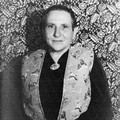
GERTRUDE STEIN was born in Allegheny, Pennsylvania. As I am an ardent Californian and as she spent her youth there I have often begged her to be born in California, but she has always remained firmly born in Allegheny, Pennsylvania. She left it when she was six months old and has never seen it again, and now it no longer exists, being all of it Pittsburgh. She used however to delight in being born in Allegheny, Pennsylvania, when during the war, in connection with war work, we used to have papers made out and they always immediately wanted to know one’s birthplace. She used to say if she had been really born in California as I wanted her to have been, she would never have had the pleasure of seeing the various French officials try to write Allegheny, Pennsylvania.
When I first knew Gertrude Stein in Paris I was surprised never to see a French book on her table, although there were always plenty of English ones; there were even no French newspapers. ‘But do you never read French?’ I, as well as many other people, asked her. ‘No,’ she replied, ‘you see I feel with my eyes and it does not make any difference to me what language I hear; I don’t hear a language, I hear tones of voice and rhythms; but with my eyes I see words and sentences and there is for me only one language and that is English. One of the things that I have liked all these years is to be surrounded by people who know no English. It has left me more intensely alone with my eyes and my English. I do not know if it would have been possible to have English be so all in all to me otherwise. And they none of them could read a word I wrote, most of them did not even know that I did write. No, I like living with so very many people and being all alone with English and myself.’
One of her chapters in The Making of Americans begins: ‘I write for myself and strangers.’
She was born in Allegheny, Pennsylvania, of a very respectable middleclass family. She always says that she is very grateful not to have been born of an intellectual family; she has a horror of what she calls intellectual people. It has always been rather ridiculous that she who is good friends with all the world, and can know them and they can know her, has always been the admired of the precious. But she always says some day they, anybody, will find out that she is of interest to them, she and her writing. And she always consoles herself that the newspapers are always interested. ‘They always say,’ she says, ‘that my writing is appalling, but they always quote it, and what is more, they quote it correctly; and those they say they admire they do not quote.’ This at some of her most bitter moments has been a consolation. ‘My sentences do get under their skin, only they do not know that they do,’ she has often said.
She was born in Allegheny, Pennsylvania, in a house, a twin house. Her family lived in one and her father’s brother’s family lived in the other one. These two families are the families described in The Making of Americans. They had lived in these houses for about eight years when Gertrude Stein was born. A year before her birth, the two sisters-in-law, who had never gotten along any too well, were no longer on speaking terms.
Gertrude Stein’s mother, as she describes her in The Making of Americans, a gentle pleasant little woman with a quick temper, flatly refused to see her sister-in-law again. I don’t know quite what had happened, but something. At any rate the two brothers, who had been very successful business partners, broke up their partnership; the one brother went to New York, where he and all his family after him became very rich, and the other brother, Gertrude Stein’s family, went to Europe. They first went to Vienna and stayed there until Gertrude Stein was about three years old. All she remembers of this is that they used to play in the public gardens and that often the old Kaiser Francis Joseph used to stroll through the gardens, and sometimes a band played the Austrian national hymn, which she liked. She believed for many years that Kaiser was the real name of Francis Joseph, and she never could come to accept the name as belonging to anybody else.
They lived in Vienna for three years, the father having in the meanwhile gone back to America on business, and then they moved to Paris. Here Gertrude Stein has more lively memories. She remembers a little school where she and her elder sister stayed, and where there was a little girl in the corner of the school yard and the other little girls told her not to go near her, she scratched. She also remembers the bowl of soup with French bread for breakfast, and she also remembers that they had mutton and spinach for lunch, and, as she was very fond of spinach and not fond of mutton, she used to trade mutton for spinach with the little girl opposite. She also remembers all her three older brothers coming to see them at the school and coming on horseback.
The family remained in Paris a year, and then they came back to America. In New York the New York family tried to reconcile Gertrude Stein’s mother to her sister-in-law, but she was obdurate. This story reminds me of Miss Etta Cone, a distant connection of Gertrude Stein. When I first met her in Florence she confided to me that she could forgive but never forget. I added that as for myself I could forget but not forgive. In this case Gertrude Stein’s mother was evidently unable to do either.
Gertrude Stein has never ceased to be thankful to her mother for neither forgetting nor forgiving. ‘Imagine,’ she has said to me, ‘if my mother had forgiven her sister-in-law, and my father had gone into business with my uncle, and we had lived and been brought up in New York — imagine,’ she says, ‘how horrible. We should have been rich instead of being reasonably poor, but imagine how horrible to have been brought up in New York.’
After a short stay in Baltimore at the home of her grandfather, they took the train to California. They came by slow stages to San Francisco, and settled down in Oakland. She remembers there the eucalyptus trees, seeming to her so tall and thin and savage, and the animal life very wild. But all this and much more, all the physical life of these days, she has described in the life of the Hersland family in her Making of Americans. The important thing to tell about now is her education.
II
Her father, having taken his children to Europe so that they might have the benefit of a European education, now insisted that they should forget their French and German so that their American English would be pure. Gertrude Stein had prattled in German and then in French, but she had never read until she read English. As she says, eyes to her were more important than ears, and it happened then as always that English was her only language.
Her bookish life commenced at this time. She read anything that was printed that came her way, and a great deal came her way. In the house were a few stray novels, a few travel books, her mother’s well-bound gift books — Wordsworth, Scott, and other poets — Bunyan’s Pilgrim’s Progress, a set of Shakespeare with notes, Burns, Congressional Records, encyclopædias, et cetera. She read them all, and many times. She and her brothers began to acquire other books. There was also the local free library, and later in San Francisco there were the mercantile and mechanics libraries with their excellent sets of eighteenth-century and nineteenth-century authors.
From her eighth year, when she absorbed Shakespeare, to her fifteenth year, when she read Clarissa Harlowe, Fielding, Smollett, et cetera, and used to worry lest in a few years more she would have read everything and there would be nothing unread to read, she lived continuously with the English language. She read a tremendous amount of history. She often laughs and says she is one of the few people of her generation that had read every line of Carlyle’s Frederick and Lecky’s England, besides Charles Grandison and Wordsworth’s longer poems. In fact she was, as she still is, always reading. She reads anything and everything, and even now hates to be disturbed, and above all, however often she has read a book and however foolish the book may be, no one must make fun of it or tell her how it goes on. It is still, as it always was, real to her.
The theatre she has always cared for less. She says it goes too fast, the mixture of eye and ear bothers her, and her emotion never keeps pace. Music she only cared for during her adolescence. She finds it difficult to listen to it, it does not hold her attention. All of which, of course, may seem strange, because it has been so often said that the appeal of her work is to the ear and to the subconscious. Actually, it is her eyes and mind that are active and important and concerned in choosing.
She has never been able or had any desire to indulge in any of the arts. She never knows how a thing is going to look until it is done, in arranging a room, a garden, clothes, or anything else. She cannot draw anything. She feels no relation between the object and the piece of paper. When, at the medical school, she was supposed to draw anatomical things she never found out in sketching how a thing was made concave or convex. She remembers when she was very small she was to learn to draw, and was sent, to a class. The children were told to take a cup and saucer at home and draw them, and the best drawing would have as its reward a stamped leather medal, and the next week the same medal would again be given for the best drawing. Gertrude Stein went home, told her brothers, and they put a pretty cup and saucer before her and each one explained to her how to draw it. Nothing happened. Finally one of them drew it for her. She took it to the class and won the leather medal. And on the way home, in playing some game, she lost the leather medal. That was the end of the drawing class.
Life in California came to its end when Gertrude Stein was about seventeen years old. The last few years had been lonesome ones, and had been passed in an agony of adolescence. After the death of first her mother and then her father, she and her sister and one brother left California for the East. They came to Baltimore and stayed with her mother’s people. There she began to lose her lonesomeness. She has often described to me how strange it was to her, coming from the rather desperate inner life that she had been living for the last few years to the cheerful life of all her aunts and uncles. When later she went to RadclifFe, she described this experience in the first thing she ever wrote.
III
And so Gertrude Stein, having been in Baltimore for a winter and having become more humanized and less adolescent and less lonesome, went to Radcliffe. There she had a very good time.
She was one of a group of Harvard men and Radcliffe women, and they all lived very closely and very interestingly together. One of them, a young philosopher and mathematician who was doing research work in psychology, left a definite mark on her life. She and he together worked out a series of experiments in automatic writing under the direction of Münsterberg. The result of her own experiments, which Gertrude Stein wrote down and which was printed in the Harvard Psychological Review, was the first writing of hers ever to be printed. It is very interesting to read, because the method of writing to be afterwards developed in Three Lives and The Making of Americans already shows itself.
The important person in Gertrude Stein’s Radcliffe life was William James. She was the secretary of the philosophical club and amused herself with all sorts of people. She liked making sport of question asking, and she liked equally answering them. She liked it all. But the really lasting impression of her Radcliffe life came through William James.
It is rather strange that she was not then at all interested in the work of Henry James, for whom she now has a very great admiration and whom she considers quite definitely as her forerunner, he being the only nineteenth-century writer who, being an American, felt the method of the twentieth century. Gertrude Stein always speaks of America as being now the oldest country in the world, because by the methods of the Civil War and the commercial conceptions that followed it America created the twentieth century, and since all the other countries are now either living or commencing to be living a twentieth-century life, America, having begun the creation of the twentieth century in the sixties of the nineteenth century, is now the oldest country in the world.
In the same way she contends that Henry James was the first person in literature to find the way to the literary methods of the twentieth century. But, oddly enough, in all of her formative period she did not read him and was not interested in him. But as she often says: ‘One is always naturally antagonistic to one’s parents and sympathetic to one’s grandparents. The parents are too close, they hamper you, one must be alone.’ So perhaps that is the reason why only very lately Gertrude Stein reads Henry James.
William James delighted her. His personality and his teaching and his way of amusing himself with himself and his students all pleased her. ‘Keep your mind open,’he used to say, and when someone objected, ‘But Professor James, this that I say is true,’James said, ‘Yes, it is abjectly true.’
Gertrude Stein never had subconscious reactions, nor was she a successful subject for automatic writing. One of the students in the psychological seminar of which Gertrude Stein, although an undergraduate, was at William James’s particular request a member, was carrying on a series of experiments on suggestions to the subconscious. When he read his paper upon the result of his experiments, he began by explaining that one of the subjects gave absolutely no results, and as this much lowered the average and made the conclusion of his experiments false he wished to be allowed to cut this record out. ‘Whose record is it?’ said James. ‘Miss Stein’s,’ said the student. ‘Ah,’ said James, ‘if Miss Stein gave no response I should say that it was as normal not to give a response as to give one, and decidedly the result must not be cut out.’
It was a very lovely spring day, Gertrude Stein had been going to the opera every night, and going also to the opera in the afternoon, and had been otherwise engrossed, and it was the period of the final examinations, and there was the examination in William James’s course. She sat down with the examination paper before her and she just could not. ‘Dear Professor James,’ she wrote at the top of her paper, ‘I am so sorry, but really I do not feel a bit like an examination paper in philosophy to-day,’ and left. The next day she had a postal card from William James, saying, ‘Dear Miss Stein, I understand perfectly how you feel. I often feel like that myself.’ And he gave her work the highest mark in his course.
When Gertrude Stein was finishing her last year at Radcliffe, William James one day asked her what she was going to do. She said she had no idea. ‘Well,’ he said, ‘it should be either philosophy or psychology. Now for philosophy you have to have higher mathematics, and I don’t gather that that has ever interested you. Now for psychology you must have a medical education; a medical education opens all doors, as Oliver Wendell Holmes told me, and as I tell you.’ Gertrude Stein had been interested in both biology and chemistry, and so medical school presented no difficulties.
There were no difficulties except that Gertrude Stein had never passed more than half of her entrance examinations for Radcliffe, having never intended to take a degree. However, with considerable struggle and enough tutoring that was accomplished, and Gertrude Stein entered Johns Hopkins Medical School.
Some years after, when Gertrude Stein and her brother were just beginning knowing Matisse and Picasso, William James came to Paris and they met. She went to see him at his hotel. He was enormously interested in what she was doing, interested in her writing and in the pictures she told him about. He went with her to her house to see them. He looked and gasped. ‘I told you,’ he said, ‘I always told you that you should keep your mind open.’
IV
After having passed her entrance examinations she settled down in Baltimore and went to the medical school. The first, two years of the medical school were all right. They were purely laboratory work, and Gertrude Stein, under Lewellys Barker, immediately betook herself to research work. She began a study of all the brain tracts, the beginning of a comparative study. All this was later embodied in Lewellys Barker’s book.
She delighted in Doctor Mall, professor of anatomy, who directed her work. She always quotes his answer to any student excusing himself or herself for anything. He would look reflective and say: ‘Yes, that is just like our cook. There is always a reason. She never brings the food to the table hot. In summer of course she can’t because it is too hot. In winter of course she can’t because it is too cold. Yes, there is always a reason.’ Doctor Mall believed in everybody developing their own technique. He also remarked: ‘Nobody teaches anybody anything. At first every student’s scalpel is dull, and then later every student’s scalpel is sharp, and nobody has taught anybody anything.’
These first two years at the medical school Gertrude Stein liked well enough. She always liked knowing a lot of people and being mixed up in a lot of stories, and she was not awfully interested but she was not too bored with what she was doing, and, besides, she had quantities of pleasant relatives in Baltimore and she liked it. The last two years at the medical school she was bored — frankly, openly bored. There was a good deal of intrigue and struggle among the students, that she liked, but the practice and theory of medicine did not interest her at all. It was fairly well known among all her teachers that she was bored, but as her first two years of scientific work had given her a reputation, everybody gave her the necessary credits and the end of her last year was approaching. It was then that she had to take her turn in the delivering of babies, and it was at that time that she noticed the Negroes and the places that she afterwards used in the second of the Three Lives stories, ‘ Melanctha Herbert,’ the story that was the beginning of her revolutionary work.
As she always says of herself, she has a great deal of inertia, and, once started, keeps going until she starts somewhere else.
As the graduate examinations drew near some of her professors were getting angry. The big men like Halsted, Osler, et cetera, knowing her reputation for original scientific work, made the medical examinations merely a matter of form and passed her. But there were others who were not so amiable. Gertrude Stein always laughed, and this was difficult. They would ask her questions, although, as she said to her friends, it was foolish of them to ask her when there were so many eager and anxious to answer. However they did question her from time to time, and, as she said, what could she do? — she did not know the answers and they did not believe that she did not know them; they thought that she did not answer because she did not consider the professors worth answering. It was a difficult situation; as she said, it was impossible to apologize and explain to them that she was so bored she could not remember the things that of course the dullest medical student could not forget.
One of the professors said that although all the big men were ready to pass her he intended that she should be given a lesson, and he refused to give her a pass mark and so she was not able to take her degree. There was great excitement in the medical school. Her very close friend, Marion Walker, pleaded with her. She said, ‘But Gertrude, Gertrude, remember the cause of women,’ and Gertrude Stein said, ‘You don’t know what it is to be bored.’
The professor who had flunked her asked her to come to see him. She did. He said, ‘Of course, Miss Stein, all you have to do is to take a summer course here, and in the fall naturally you will take your degree.’ ‘But not at all,’ said Gertrude Stein, ‘you have no idea how grateful I am to you. I have so much inertia and so little initiative that very possibly if you had not kept me from taking my degree I would have, well, not taken to the practice of medicine, but at any rate to pathological psychology, and you don’t know how little I like pathological psychology, and how all medicine bores me.’ The professor was completely taken aback, and that was the end of the medical education of Gertrude Stein.
V
During these years at Radcliffe and Johns Hopkins she often spent the summers in Europe. The last couple of years her brother had been settled in Florence, and now that everything medical was over she joined him there, and later they settled down in London for the winter.
They settled in lodgings in London and were not uncomfortable. They knew a number of people through the Berensons — Bertrand Russell, the Zangwills, then there was Willard (Josiah Flynt), who wrote Tramping with Tramps, and who knew all about London pubs — but Gertrude Stein was not very much amused. She began spending all her days in the British Museum reading the Elizabethans. She returned to her early love of Shakespeare and the Elizabethans, and became absorbed in Elizabethan prose and particularly in the prose of Greene. She had little notebooks full of phrases that pleased her, as they had pleased her when she was a child.
The rest of the time she wandered about the London streets and found them infinitely depressing and dismal. She always said that that first visit had made London just like Dickens, and Dickens had always frightened her. As she says, anything can frighten her, and London when it was like Dickens certainly did. But there were compensations. There was the prose of Greene, and it was at this time that she discovered the novels of Anthony Trollope, for her the greatest of the Victorians. It was at this time too that, as she says, she ceased to be worried about there being in the future nothing to read; she said she felt that she would always somehow be able to find something.
But the dismalness of London and the drunken women and children and the gloom and the lonesomeness brought back all the melancholy of her adolescence, and one day she said she was leaving for America, and she left. She stayed in America the rest of the winter. In the meantime her brother also had left London and gone to Paris, and there later she joined him. She immediately began to write. She wrote a short novel. The funny thing about this short novel is that she completely forgot about it for many years.
And so life in Paris began, and, as all roads lead to Paris, all of us are now there, and I can begin to tell what happened when I was of it.
VI
When I became an habitual visitor at the rue de Fleurus the Picassos were once more together, Pablo and Fernande. That summer they went again to Spain and he came back with some Spanish landscapes, and one may say that these landscapes, two of them still at the rue de Fleurus and the other one in Moscow in the collection that Stchoukine founded and that is now national property, were the beginning of cubism. In these days there was no African sculpture influence. There was very evidently a strong Cézanne influence, particularly the influence of the late Cézanne water colors, the cutting up the sky not in cubes but in spaces.
But the essential thing, the treatment of the houses, was essentially Spanish, and therefore essentially Picasso. In these pictures he first emphasized the way of building in Spanish villages, the line of the houses not following the landscape but cutting across the landscape. It was the principle of the camouflage of the guns and the ships in the war. The first year of the war, Picasso and Gertrude Stein and myself were walking down the boulevard Raspail a cold winter evening. All of a sudden down the street came some big cannon, the first any of us had seen painted — that is, camouflaged. Pablo stopped, he was spellbound. ‘ C’est nous qui avons fait çaf he said. ‘It is we that have created that.’ And he was right, he had. From Cézanne through him they had come to that. His foresight was justified.
But to go back to the three landscapes. When they were first put up on the wall, naturally everybody objected. As it happened, he and Fernande had taken some photographs of the villages which he had painted, and he had given copies of these photographs to Gertrude Stein. When people said that the few cubes in the landscapes looked like nothing but cubes, Gertrude Stein would laugh and say, ‘If you had objected to these landscapes as being too realistic, there would be some point in your objection.’ And she would show them the photographs, and really the pictures, as she rightly said, might be declared to be too photographic a copy of nature. This, then, was the beginning of cubism.
Gertrude Stein always says that cubism is a purely Spanish conception and only Spaniards can be cubists, and that the only real cubism is that of Picasso and Juan Gris. Picasso created it and Juan Gris permeated it with his clarity and his exaltation. To understand this, one has only to read The Life and Death of Juan Gris by Gertrude Stein, written upon the death of one of her two dearest friends, Picasso and Juan Gris, both Spaniards.
She always says that Americans can understand Spaniards; that they are the only two Western nations that can realize abstraction; that in America it expresses itself by disembodiedness, in literature and machinery, in Spain by ritual so abstract that it does not connect itself with anything but ritual. I always remember Picasso saying disgustedly, apropos of some Germans who said they liked bullfights, ‘They would,’ he said angrily, ‘they like bloodshed. To a Spaniard it is not bloodshed, it is ritual.’
It was in these days that the intimacy between Braque and Picasso grew. It was in these days that Juan Gris, a raw, rather effusive youth, came from Madrid to Paris and began to call Picasso ‘cher maître,' to Picasso’s great annoyance. It was apropos of this that Picasso used to address Braque as ‘cher maître,' passing on the joke, and I am sorry to say that some foolish people have taken this joke to mean that Picasso looked up to Braque as a master.
But I am once more running far ahead of these early Paris days when I first knew Fernande and Pablo.
VII
After a while the Picassos moved from the old studio in the rue Ravignan to an apartment in the boulevard Clichy. Fernande began to buy furniture and have a servant, and the servant of course made a soufflé. It was a nice apartment with lots of sunshine. On the whole, however, Fernande was not quite as happy as she had been. There were a great many people there and even afternoon tea. Braque was there a great deal. It was the height of the intimacy between Braque and Picasso, it was at that time they first began to put musical instruments into their pictures.
Fernande had at this time a new friend of whom she often spoke to me. This was Eve, who was living with Marcoussis. And one evening all four of them came to the rue de Fleurus — Pablo, Fernande, Marcoussis, and Eve. It was the only time we ever saw Marcoussis until many many years later. I could perfectly understand Fernande’s liking for Eve. Fernande’s great heroine was Evelyn Thaw, small and negative. Here was a little French Evelyn Thaw, small and perfect.
Not long after this, Picasso came one day and told Gertrude Stein that he had decided to take an atelier in the rue Ravignan; he could work better there. He could not get back his old one, but he took one on the lower floor. One day we went to see him there. He was not in and Gertrude Stein as a joke left her visiting card. In a few days we went again, and Picasso was at work on a picture on which was written 'ma jolie,' and at the lower corner, painted in, was Gertrude Stein’s visiting card. As we went away Gertrude Stein said, ‘Fernande is certainly not ma jolie. I wonder who it is.’ In a few days we knew. Pablo had gone off with Eve.
This was in the spring. One evening, the following autumn, Picasso came in. He and Gertrude Stein had a long talk alone. When she came in from having bidden him good-bye she said, ‘Pablo said a marvelous thing about Fernande. He said her beauty always held him, but he could not stand any of her little ways.’ She further added that Pablo and Eve were now settled on the boulevard Raspail.
In the meanwhile Gertrude Stein had received a letter from Fernande, very dignified, written with the reticence of a Frenchwoman. She said that she wished to tell Gertrude Stein that she understood perfectly that the friendship had always been with Pablo, and that although Gertrude had always shown her every mark of sympathy and affection, now that she and Pablo were separated, it was naturally impossible that in the future there should be any intercourse between them, because, the friendship having been with Pablo, there could of course be no question of a choice. That she would always remember their intercourse with pleasure, and that she would permit herself, if ever she were in need, to throw herself upon Gertrude’s generosity.
And so Picasso left Montmartre never to return.
VIII
Hélène used to stay at home with her husband Sunday evening; that is to say, she was always willing to come but we often told her not to bother. I like cooking, I am an extremely good five-minute cook, and besides, Gertrude Stein liked from time to time to have me make American dishes. One Sunday evening I was very busy preparing one of these and then I called Gertrude Stein to come in from the atelier for supper. She came in much excited and would not sit down.
‘Here, I want to show you something,’ she said.
‘No,’ I said, ‘it has to be eaten hot.’
‘No,’ she said, ‘you have to see this first.’
Gertrude Stein never likes her food hot and I do like mine hot; we never agree about this. In spite of my protests and the food cooling I had to read. I can still see the little tiny pages of the notebook written forward and back. It was the portrait called ‘Ada,’ the first in Geography and Plays. I began it and I thought she was making fun of me, and I protested; she says I protest now about my autobiography. Finally I read it all and was terribly pleased with it. And then we ate our supper.
This was the beginning of the long series of portraits. ‘Ada’ was followed by portraits of Matisse and Picasso and a great many others. She has written portraits of practically everybody she has known, and written them in all manners and in all styles. The writing of portraits occupied a great deal of that winter, and then we went to Spain.
In those days Gertrude Stein wore a brown corduroy suit, jacket and skirt, a small straw cap, always crocheted for her by a woman in Fiesole, sandals, and she often carried a cane. That summer the head of the cane was of amber. It is more or less this costume without the cap and the cane that Picasso has painted in his portrait of her. This costume was ideal for Spain; they all thought of her as belonging to some religious order and we were always treated with the most absolute respect. I remember that once a nun was showing us the treasures in a convent church in Toledo. We were near the steps of the altar. All of a sudden there was a crash — Gertrude Stein had dropped her cane. The nun paled, the worshipers startled. Gertrude Stein picked up her cane and turning to the frightened nun said reassuringly, ‘No it is not broken.’
We finally came to Granada and stayed there for some time, and there Gertrude Stein worked terrifically. She was always very fond of Granada. It was there she had her first experience of Spain when still at college just after the Spanish-American War, when she and her brother went through Spain. They had a delightful time, and she always tells of sitting in the dining room talking to a Bostonian and his daughter when suddenly there was a terrific noise, the heehaw of a donkey. ‘What is it?’ said the young Bostonian, trembling. ‘Ah,’ said the father, ‘it is the last sigh of the Moor.’
We enjoyed Granada. We met many amusing people, English and American, and it was there and at that time that Gertrude Stein’s style gradually changed. She says hitherto she had been interested only in the insides of people, their character and what went on inside them; it was during that summer that she first felt a desire to express the rhythm of the visible world.
It was a long tormenting process; she looked, listened, and described. She always was, she always is, tormented by the problem of the external and the internal. One of the things that always worries her about painting is the difficulty that the artist feels and which sends him to painting still-lifes — that after all the human being essentially is not paintable. Once again, and very recently, she has thought that a painter has added something to the solution of this problem. She is interested in Picabia, in whom hitherto she has never been interested, because he at least knows that if you do not solve your painting problem in painting human beings you do not solve it at all. It is that of which she is always talking, and now her own long struggle with it was to begin.
She experimented with everything in trying to describe. She tried a bit inventing words, but she soon gave that up. The English language was her medium and with the English language the task was to be achieved, the problem solved. The use of fabricated words offended her, it was an escape into imitative emotionalism.
No, she stayed with her task, although after the return to Paris she described objects, she described rooms and objects, which, joined with her first experiments done in Spain, made the volume, Tender Buttons. She always, however, made her chief study people, and therefore the never-ending series of portraits.
IX
We came back to the rue de Fleurus as usual.
One of the people who had impressed me very much when I first came to the rue de Fleurus was Mildred Aldrich. She was then in her early fifties, a stout vigorous woman with a George Washington face, white hair, and admirably clean, fresh clothes and gloves. A very striking figure and a very satisfying one in the crowd of mixed nationalities. She was indeed one of whom Picasso could say, and did say, ‘C’est elle qui fera la gloire de l’Amérique.’ She made one very satisfied with one’s country, which had produced her.
Her sister having left for America, she lived alone on the top floor of a building on the corner of the boulevard Raspail and the half street, rue Boissonade. There she had at the window an enormous cage filled with canaries. We always thought it was because she loved canaries. Not at all. A friend had once left her a canary in a cage to take care of during her absence. Mildred, as she did everything else, took excellent care of the canary in the cage. Some friend, seeing this and nat urally concluding that Mildred was fond of canaries, gave her another canary. Mildred of course took excellent care of both canaries, and so the canaries increased and the size of the cage grew until, in 1914, she moved to Huiry to the Hilltop on the Marne and gave her canaries away. Her excuse was that in the country cats would eat the canaries. But her real reason, she once told me, was that she really could not bear canaries.
Mildred was an excellent housekeeper. I was very surprised, having had a very different impression of her, going up to see her one afternoon, finding her mending her linen and doing it beautifully.
Mildred adored cablegrams, she adored being hard up — or rather she adored spending money, and as her earning capacity although great was limited, Mildred was chronically hard up. In those days she was making contracts to put Maeterlinck’s Blue Bird on the American stage. The arrangements demanded endless cablegrams, and my early memories of Mildred were of her coming to our little apartment in the rue NotreDame-des-Champs late in the evening and asking me to lend her the money for a long cable. A few days later the money was returned with a lovely azalea worth five times the money. No wonder she was always hard up. But everybody listened to her. No one in the world could tell stories like Mildred. I can still see her at the rue de Fleurus sitting in one of the big armchairs and gradually the audience increasing around her as she talked.
She was very fond of Gertrude Stein, very interested in her work, enthusiastic about Three Lives, deeply impressed but slightly troubled by The Makingof Americans, quite upset by Tender Buttons, but always loyal and convinced that if Gertrude Stein did it, it had something in it that was worth while.
Mildred Aldrich liked Picasso and even liked Matisse — that is, personally — but she was troubled. One day she said to me, ‘Alice, tell me, is it all right, are they really all right? I know Gertrude thinks so, and Gertrude knows, but really is it not all fumisterie, is it not all false?’
This brings us pretty well to the spring of 1914. During the previous winter Gertrude Stein’s brother decided that he would go to Florence to live. They divided between them the pictures that they had bought together. Gertrude Stein kept the Cézannes and the Picassos and her brother the Matisses and Renoirs, with the exception of the original Femme au Chapeau.
Toward the end of June Gertrude Stein received a letter from John Lane, the publisher, saying he would be in Paris the following day and would come to see her. He called and asked her if she would come to London in July, as he had almost made up his mind to republish Three Lives, and would she bring another manuscript with her. She said she would, and she suggested a collection of all the portraits she had done up to that time. The Making of Americans was not considered because it was too long. And so, that having been arranged, John Lane left.
In those days Picasso, having lived rather sadly in the rue Schœlcher, was to move a little further out to Montrouge. It was not an unhappy time for him, but after the Montmartre days one never heard his high, whinnying Spanish giggle. His friends, a great many of them, had followed him to Montparnasse, but it was not the same.
It was in these days that Mildred Aldrich was preparing to retire to the Hilltop on the Marne. She too was not unhappy, but rather sad. She wanted us often in those spring evenings to take a cab and have what she called ‘our last ride together.’ We often went out to the country with her to see her house. Finally she moved in. We went out and spent the day with her. Mildred was not unhappy, but she was very sad. ‘My curtains are all up, my books in order, everything is clean, and what shall I do now? ’ said Mildred. I told her that when I was a little girl my mother said that I always used to say, ‘What shall I do now?’ — which was only varied by ‘Now what shall I do?’ Mildred said that the worst of it was that we were going to London and that she would not see us all summer. We assured her that we would only stay away a month, in fact we had return tickets, and as soon as we got home we would go out to see her. Anyway she was happy that at last Gertrude Stein was going to have a publisher who would publish her books.
Hélène was leaving 27 rue de Fleurus because, her husband having recently been promoted to be foreman in his workshop, he insisted that she must not work out any longer but must stay at home.
In short, in this spring and early summer of 1914 the old life was over.
(To be continued next month)