The Big Pepper and Brine Man
“If we should ask at random one hundred persons what they connected with pickled peppers, we can scarcely doubt that ninety-nine answers would be in unison: ‘Peter Piper picked a peck of pickled peppers.’ Just study the import of that fact. Imagine the talents of the man.”
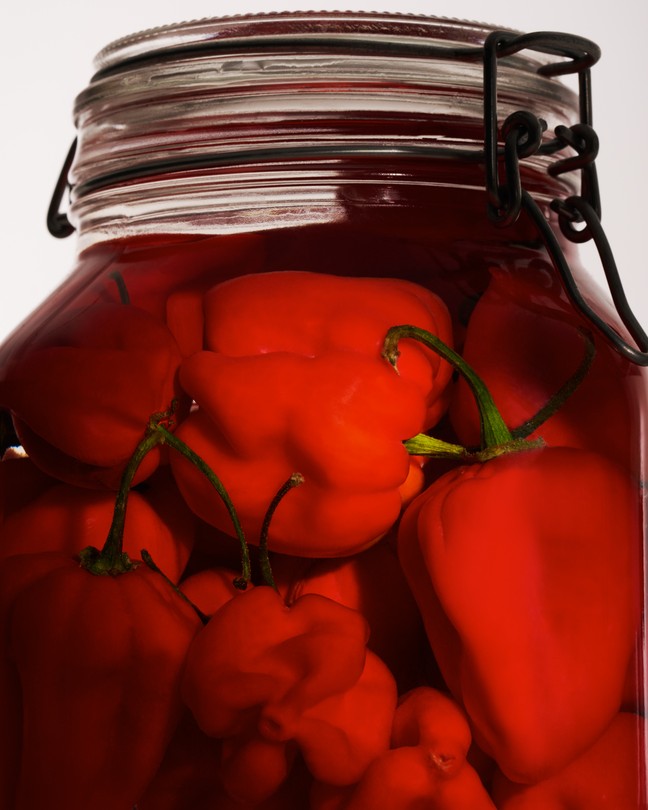
I
DID you ever think about the drama behind a jar of pickled peppers?Nothing, of course, is further from my purpose than to suggest that you are an addict. On second thought, I realize now that there is no special reason why you should have reflected upon pickled peppers at all. With your permission, however, I believe it can be demonstrated that mine was no flippant query. Mind you, I am not intimating that one can put Greek tragedy and divine comedy into jars of pickled peppers, or anything like that. My contention is merely this: that there are certain dramatic materials behind the routine business of picking, pickling, and purveying them to the pepper consumers, which may be unsuspected.
Let us try a simple test in the association of ideas. If we should ask at random one hundred persons what they connected with pickled peppers, we can scarcely doubt that ninety-nine answers would be in unison: ‘Peter Piper picked a peck of pickled peppers.’ Just study the import of that fact. Imagine the talents of the man, not to mention the drive of his organization, that could accomplish this feat. Despite all competition, Mr. Piper has made his brand, literally, a household word. Moreover, he has succeeded in driving it home, not merely to the devotees of pickled peppers, but to millions who have little or no interest in his product. This exploit, therefore, has led me to believe that here we may have the essence of business drama.
There is no good reason why I should not confess, at the very outset, to more than a cold, industrial interest in Piper and his peppers. The fact is that ‘the old man,’ as everybody calls him, is a friend of many years. True, I was not a personal observer throughout his rise from humble origins to commercial fame. The gap between our ages makes us of different business generations. But I have been privileged to hear the early story from his own lips and from his associates, not omitting the highly capable Mrs. Piper. Visits to the Piper plant, luncheons prolonged in casual chat, and many a hospitable week-end at their home have enabled me to learn, with tolerable clearness, the ups and downs of the pickled-pepper trade.
As is the case with many public and semi-public men, one does not derive much aid or interest from the bare bones of biographical data. Piper is both a modest and a reticent man. About pickled peppers he will talk by the hour. Of himself as an individual he rarely speaks. There are not more than half a dozen episodes in his career which the old man deems sufficiently vital to record for posterity. You can confirm all this for yourself by a mere glance at his official sketch — the one in Who’s Who in Pickledom.
The items in that record are, as I have said, only bare bones. Out of my friendship and with his reluctant consent, I shall try to put flesh and blood upon them. Mr. Piper has agreed, subject to two stipulations: first, that he will not review the writing in any way, leaving me solely responsible; second, that the primary object shall be to portray an interesting phase of business, without embarrassing him by hero worship. The former is easily arranged. The latter I shall do my best to observe, steering my craft as cautiously as possible between the Scylla of Mr. Piper’s reserve and the Charybdis of my reader’s natural desire to know fully what manner of man he is.
II
Peter was the eldest in a rather lengthy line of small Pipers. The year that he first beheld the smoke of Pittsburgh is a little indefinite. I have said that he is reticent; on personal dates, such as birth, marriage, and the like, he is positively secretive. However, his age can be fairly placed in the latter sixties. Patrick Piper, the father, made a modest living in the plumbing business. In fact, Pat is still remembered locally as the plumber who never — well, hardly ever — forgot his tools. Peter’s mother was Polly Plunkett of the Pennsylvania Plunketts, whose force and drive have been apparent in the life of her oldest son.
Limitations of plumbing profits, without corresponding limits to the Piper family, barred Peter from having a college education. This has not prevented him from becoming a tolerably educated man. Early he learned to think for himself, and later to read with plan and profit. So much cannot always be said of all who achieve Phi Beta Kappa keys, or even for some who have greatness thrust upon them as all-American tackles.
Much to his father’s regret, Peter did not choose to run after plumbing trade. In this he was no more wayward than many other sons in the homes of bankers, lawyers, or preachers. He did stick to business. But he early discovered that he liked to sell, and being the ‘ vital type, ’ so called, to sell what he liked to eat. At twenty-two or thereabouts he was canvassing the provinces for a wholesale grocery house. Just as soon as the modest salary and commissions allowed, Peter married the thrifty and industrious Priscilla Paddock. When I add that she sprang from the thrifty and industrious Paddocks in Portsmouth, you can visualize his comrade for the coming years.
Now the Piper rise to fame and fortune, like so many American examples of business success, was based partly on an accident. What seemed like hard luck and chance became stepping-stones to a new life. Peter was moving slowly upward in wholesale groceries when two blows fell together. A trade slump caught his concern perched on a three-legged stool with long and unsteady supports: excessive inventories, overextended receivables, and too many bank loans. When the liquidation was over, Peter’s job was gone. At that moment, typhoid fever — lurking in some obscure hostelry on his sales route — laid him low.
It was his first, and only, serious illness. The stoutness of body and will that Patrick Piper and Polly Plunkett had combined to give him pulled him through. But he was so weak that the doctor positively forbade any thought of work or travel for six months. So the young Pipers found their small domestic ship aground; and it is more than metaphor to say ‘aground.’ At this time they were living in a suburban cottage on several acres of land. There, in a soft, early spring, they faced the problem of carrying on.
‘Things never looked any blacker, before or since,’ said Peter one day with a reflective grin. ‘There was Pris with two kids, a couple of hundred dollars, me as limp as a dishrag, and no job!’
Thereupon, Priscilla took charge and showed the stuff which had made Paddocks. Partly to guard the small savings, partly for his health, she set Peter to work in the garden patch. She laid out a programme to include both summer provender and later preserving. From remarks she has dropped, I suspect some of it was pure camouflage for Peter’s benefit.
‘I just had to get him out of the house and out of the way,’ Mrs. Piper admitted once when they were recalling the old days. ‘ It’s awful to have a man around the place all day. You can’t imagine it unless you’re a woman. Especially anyone like Peter! He just has to be busy. That’s why I always say pickled peppers saved my life!’
Fooling Peter with respect to gardening, one infers, was not so hard. He knew scarcely more about it than he did about plumbing. But Priscilla Paddock Piper knew gardens and knew what she wanted. In particular, she insisted upon plenty of peppers. Then and there, though neither knew it at the time, a business was born.
There is no need to make a short story long. Helped in the early days of his weakness by the sturdy spading of his wife, Peter brought forth a garden. The garden, in turn, brought forth peppers, and brought them forth abundantly. And in the preserving season Priscilla brought forth jars upon jars of pickled peppers. In truth, abundance became surplus. Now the restored and invigorated Peter once more asserted himself as senior partner. The sales instinct was again uppermost.
One March night the three of us were seated before an open fire. I had been trying to establish the exact story surrounding the first sale of Piper’s pickled peppers.
‘I would n’t say it was a matter of life and death,’ the old man remarked, chewing on his after-dinner cigar. ‘But it was sell or eat. The house was full of pickled peppers from cellar to garret. Now that, you might say, was too big a stock for a small concern. Furthermore, I figured Pris’s stuff would sell, too. Consequently,’ he summarized, ‘I sold the surplus.’
‘And that,’ placidly added Mrs. P. by way of footnote, ‘was just my idea in the first place!’
The jars, neatly labeled ‘Pickled Peppers,’ were taken in several batches to the local tradesfolk. They were left on display, to be marketed with a commission to the storekeeper. In a fortnight they were all gone.
That autumn Peter found a new job with another food concern. But all that winter the spell of pickled peppers was upon him. He enlisted Priscilla to try the experiment on a larger scale the next season. They hired a man for the garden, and a helper in the kitchen during the pickling weeks. Priscilla threw herself into production with truly Paddock vigor. From far and near she gathered recipes and worked out the most delectable formula. In fact, she took first prize for pickled peppers at the county fair, winning twenty-five dollars and a blue ribbon. The latter, a bit faded now, is still treasured among the Piper heirlooms to be.
In this sales campaign, Peter added some new touches. The labels, instead of being inked by hand, came from the printer in bold capitals: ‘Piper’s Pickled Peppers.’ For each display he painted a bold placard: —
PIPER’S PICKLED PEPPERS
Pickled by Mrs. Piper Personally
A Piper Product from Plant to Patron
When we reached this bit of the story, Peter went upstairs and retrieved from some hideaway a soiled and bent souvenir.
‘That got ’em,’ he declared proudly. ‘It was our first advertising campaign! ’
Again the pepper output went forth to a willing market. Not only did the peppers please locally, but the Pipers began to receive letters from the relatives and friends of satisfied customers. That was enough for Peter. ‘Nothing venture, nothing have.’ The next spring he gave up his job and began looking for a small pickling plant.
Another industry, leaving the home by way of the kitchen door, had passed through the factory gates. Thus the business world saw the birth of Piper’s Pickled Peppers, Incorporated.
III
The next fifteen years form a familiar story in industry. The enterprise grew steadily, and Peter grew with it. He learned organization, accounting, sound merchandising. Accumulated reserves found him always putting money back into the plant, extending its capacity and keeping equipment up to date. He studied the mysteries of turnover, although Priscilla admits she never did grasp the real difference between pepper turnover and the apple turnover that Peter liked so much. He believed ardently in his advertising and kept full steam behind it. Year by year the pickled peppers were reaching a larger clientele, and by their unrelaxed quality keeping their hold on former friends.
Eventually the great day arrived that saw Piperville dedicated with a blare of bands and speeches. The big new plant, with its sheer glass and fresh lawns, its trim office building and the employees’ athletic field, was a nine days’ wonder thereabouts. Not a few scoffed at all the ‘paternalism,’but Peter Piper was proud indeed.
‘Slow but steady was our slogan,’is his comment on that era. ‘We did n’t have so many charts or statistics then. But I kept some figures in my little black notebook. I noticed we had our ups and downs, of course, like anybody does. One year might fall under the last one; still, when I added them up, three years at a time, I saw the totals were always getting bigger. One time we slipped a good bit. So I called in the boys from the road and gave them hel — ’
‘Peter!’ warned Mrs. P.
‘ — and gave them some helpful hints,’continued the old man with a solemn wink. ‘So we went right on, growing and growing with the best of them. You can’t go backward in a country like this.’
IV
Gradually the record unfolds about the time of our post-war boom. From this point I am able to speak with better knowledge, for in the course of business Piper and I had now begun our friendship.
During these latter years he had been reaching out further and further. To enlarge his sales, he had worked out successive steps to add other pickled edibles. Now he was buying supplies far afield in California and the South. Costs were going up in all directions, but so were prices and profit margins. Then the depression of 1921 struck the business with all its force of sudden deflation. Some of Peter’s old caution about inventories had been relaxed, and he learned a costly lesson.
In my old files is a letter written just as he was coming out of the slump. At once so typical and so illuminating, it is worth quoting in part: —
‘Since you were here, we have mopped up that inventory mess. We have charged off all our losses and taken our medicine. I can’t say it was pleasant, but at least Piper can show a clean face, especially to the banks.
‘However, what is bothering me now is how to handle this side of the business from here on. I have been thinking about our talks on this inventory problem. It seems to me we have been running it less like a business than a gambling joint. Furthermore, I have it figured out that there is more money to be saved than just by smarter buying. Of course, I admit we loaded up with supplies at the peak of the market. That is just good hindsight now, and if prices had gone higher I should have tooted my horn for a smart trade.
‘The point is that by getting into the supply end for a while I see how I can do more than reduce the cost of inventory, no matter how prices go. I can go further and reduce some other costs of production by cutting down the seasonal swing. You know yourself it is pretty bad in our line, but it is worse than it needs to be. We have n’t paid enough attention to it when business was good.
‘Also please note what it will do on the human side. I think you will admit I have always tried to be fair to our hands in spite of some pretty foul competition. But it seems to me I was thinking more about wage rates and the factory being clean than I was about the total money they earned. If I can make the business run on a more even keel, by ironing out this supply kink, don’t you think I can kill two birds?’
So Piper had learned another lesson. And whenever Peter learned he immediately put his knowledge to work. Within two years a new system of inventory control had shown extraordinary results. The purchasing department had been completely reorganized. New policies and new methods had changed it from a mere service of supply to a sort of gyrostabilizer. Although sales had finally reached a new high, supplies on hand had averaged proportionately new lows. Best of all, improved scheduling of production had allowed the plants to reach the highest percentage of operating time in their history.
Peter was jubilant. When I next saw him the annual reports were spread all over his desk.
‘Yes-siree-bob!’ he exclaimed. ‘We have got this thing licked. From now on, we buy from hand to mouth in the pickled-pepper trade.’
As the months passed, it began to appear that Piper had been bitten by a new bug — volume. When we met, he spoke as if the country were merely a huge platter to be heaped with pickled products. He began to lower his prices and to do more and more business on narrower margins. There was a good deal of talk about Henry Ford and mass production. Peter was becoming fascinated with the potential pepper markets of the world.
On a steaming August day I stopped off at Piperville. We discussed the temperature, of course.
‘It is n’t the heat — it’s the humidity,’ I contributed wanly.
Peter had taken off his limp collar. Rolling his shirt sleeves still higher, he held up a vast tabulation of figures. ‘I’m going to show you the profits in volume. It isn’t the price — it’s the quantity!’
Back in his element again, he was soon urging sales, more sales, and still more sales. Promotion work absorbed much of his time now, and the advertising budget was larger than ever. ‘I’m going to plaster the United States with posters about Piper’s Pickled Peppers,’ he boasted to me, and it may here be set down that he very nearly made good on that claim.
Publicity was increased by every medium, newspaper and magazine, subway placards and rural billboards. Increased advertising, increased volume of output, more publicity, more salesmen — the high-pressure era in pickled peppers was on. Peter chose his campaign slogan from a new assortment of ballyhoo: ‘Piper’s Pickled Peppers Please Particular People.’ The last word had been ‘palates’ in the original version, but the old man would have none of it. He insisted doggedly that the word was a misprint for ‘plates.’ Even when the advertising men finally convinced him of the reality of palates, it made no difference.
‘Palates don’t buy peppers,’ he scoffed. ‘We’re selling to people.’
And so ‘ people ’ it was.
We had lunch together in New York when this vital debate was in process. Over the coffee cups, I seized the chance to bring up a query from my old curiosity shop. ‘Speaking of slogans, Peter,’ I began, ‘there’s one thing about your old one that has always puzzled me. When you managed to get everybody saying, “Peter Piper picked a peck of pickled peppers,” why did you say “picked”?’ Going on to explain that the artful aid of apt alliteration seemed quite as valuable from ‘packed,’ I made bold to suggest that it was also more valid.
The old man grinned delightedly.
‘I don’t know as I quite get all that stuff about the illiterate artist, and so on, but I do know what’s bothering you about “picked.” It has upset a lot of folks besides you. They used to stop me on the street and tell me nobody could pick peppers already pickled.’ He broke off to chuckle again. ‘The fact is, I started with “packed.” But the printers made a mistake, and it got by everybody. I figured people would pay a lot more attention to “picked,” so we let it go; and they have!’
He rather guessed the old slogan would outlast the new, highfalutin one. And it did.
V
So advertising rolled the sales snowball along. Some time afterward, however, I observed that the old man was less exuberant. The new sales were secured by expensive methods. If volume was going up, so were costs. Margins and net profits were not keeping pace, it seemed, with the increased business. Piper was to be found more often surrounded by cost sheets. Out of his perplexities, however, a new zest was born. That natural resiliency with which he ever rises to fight more battles and win more triumphs led him on.
‘I guess I have been paying too much attention to selling,’ he wrote in another of his confessional letters. ‘I have got to dig deeper into these factory costs. They arc too high all round. I don’t mean the boys are inefficient at the plant — or if they are I can’t seem to find it. But costs are too high in relation to the selling price.
‘Now some folks think we ought to go after the sales expense. I know you have had that idea, but I think you are all wet. (Please excuse slang; the insult is intentional.) It is the sales organization and our advertising that bring in the money. I am not going to do any cutting there, and next year I may even increase it. You know it takes a lot of volume to keep all these plants and employees busy.
‘Neither do I want to touch wages. I believe in good wages because it is good business and makes good business. But I simply have got to cut down the cost of production. We have had some engineers in here, and I think I have the answer. I am going to rip out every last machine where there is a better one on the market. If it takes my last nickel, I am going to rebuild the whole works. These cost studies indicate we can get from 15 to 18 per cent decrease in operating expenses.
‘The only thing that bothers me is, not the investment, but the fact that it will cost our people a good many jobs. Still, I don’t see how it can be helped. Business is business, and progress is progress. No one can stand in the way of it. If I don’t do it, the other fellow may beat me to it. Anyway, costs have to come down. Please write me on this when you get time.’
Thus the Piper machine reformation was launched. It not merely came up to expectations; it surpassed them. The new equipment developed efficiency in every direction. Automatic machines, conveyors, standardized processes — all increased output per hour, reduced cost per unit, substituted electric horsepower for man power. Costs came down in pickled peppers. So, alas, did the number of Piper employees and the dollars of Piper pay roll.
Peter found consolation, however, in the pay envelopes he had created in the shops of the equipment concerns.
‘It’s an ill wind that blows nobody good,’ he quoted with a philosophical air. ‘That’s the way this country goes on. Those dollars for machinery help to make a market for more pickled peppers. Then, perhaps, we will be taking our people back again.’
‘Perhaps,’ I agreed dubiously, but Piper looked so hurt that I recall adding with haste, ‘Let us hope so.’
One morning, some months later, a large envelope with extra postage was placed on my desk. It contained an unusually elated letter from the old man. Much too long to reproduce and too involved for excerpts, I shall condense it as best I can.
Peter had founded Piperville at a spot where he could obtain freight service on two railroads. His shipments by one of the carriers, it appears, were considerably greater than by the other. An official from the latter dropped in for a call and in casual conversation expressed the hope for more traffic. Quite incidentally he added that, while his department, of course, had no jurisdiction in the matter, it might possibly be brought about that the dining cars throughout the system could be induced to stock up with Piper’s Pickled Peppers.
One thing led to another, and now Peter was prospecting the pay ores to be discovered in ‘reciprocal buying.’ He was making the traffic department, he wrote, an annex to the sales divisions.
The possibilities of the idea were just in their infancy. It was a horse-sense proposition, wrote Peter, that simply meant ‘Scratch my back and I’ll scratch yours.’ The purchasing agent had been brought into the game also. He had prepared a list of all their important suppliers, those from whom they bought barrels, cans, coal, glassware, and so on. They had obtained their fuel for some years through a small but reliable coal company. By switching the contract to a larger concern, he had been able to place a sizable order for pickled products to be sold in the miners’ commissaries. So they were still combing the supply list for further outlets.
Just to show me the possibilities, he added, they were even pushing three-cornered arrangements. ‘ Cushion shots,’ Peter described them. For example, he had analyzed their contract with the glass manufacturer from whom they had long purchased all their bottles and jars. This was certainly a valuable piece of business, and the glass man was far from negligible as a coal consumer. He had suggested that his glass supplier break relations with the latter’s coal company and transfer his requirements to the one with whom Piper did business. In return, Peter’s coal man agreed to increase his purchases of the Piper products. When the glass manager balked, Peter placed his requirements with another more amenable to reason — and the back-scratching continued as a merry-go-round.
It was all not a little confusing as set forth in the inchoate paragraphs of the old man’s letter. Something of its jubilant spirit, however, may be suggested in the words, scrawled in Peter’s own handwriting, across the end: ‘Reciprocal buying!! Where have you been all my life?!!’
I made no reply to this missive, but a few weeks later, being handy to Piperville, I dropped off for a call at the plant. Ushered into Peter’s office prematurely by mistake, I found him in conference with the staff.
From the conversation it appeared that reciprocal buying was proving a difficult sweetheart to woo. The sales manager was complaining that, in some cases, the new friends were scratching his back altogether too vigorously. They were beating him down below his list prices while constantly demanding a grateful spirit for the favor of their orders. The purchasing agent had a similar story of being ‘jacked up’ when he was not able to call for competitive bids. The production man’s grouch had to do with the quality or delivery of the new supplies. And the old man’s face was noticeably flushed.
‘Clear out!’ he finally dismissed them with a blow from his fist on the big desk. ‘Where do you think your jobs would be if we didn’t sell?’
Biting on a cigar savagely, he made no reference to the meeting, but turned our talk on prosperity.
VI
An interval, unusually long for us, followed wherein neither Peter nor I had any occasion to communicate. Then came a telegram: ‘Closed deal to-day for merger with Potter’s Preserves. Wanted you to be among first to know big news. Makes us biggest in world. Will give you details next week. Hooray. Piper.’
The old man brought his story, as promised, on a hurried visit to New York. Potter had wanted to sell, and he had taken the concern over, ‘lock, stock, and barrel.’ Funny, avowed Peter, that a man would want to quit when the game was so exciting. Potter’s Preserves, added to Pickled Peppers, meant a boost in size of nearly 50 per cent. He was certainly the unchallenged bull moose in the trade now, yes-siree-bob! He was already deep in plans for a new publicity crusade to announce the marriage. How was this for a new slogan? ‘Putting Together Potter’s Prime Preserves and Piper’s Pickled Peppers — Pure, Popular, and Purchasable at Pleasing Prices.’
He had decided to go in for radio advertising. In fact, they were working out the programme already. Broadcasting cost money, of course, but the merger was worth a real splash. One had to make the country ‘pickle conscious.’
So it proved. A little later, if you were visiting the big home in Piperville, you knew what to expect on every Friday evening at 8.45. The radio set would be tuned in for the ‘ Piper-Potter Products Paraders.’ At the exact moment, you would hear the jazz band break into the strains of the theme song. ‘“Ol Man River” — that’s our “signature,” they call it,’ Peter explained with pride; and then a chorus of mixed voices would sing: —
He must know sumpin’, but don’t say nothin’,
He just keeps rollin’,
He keeps on rollin’ along.’
And Old Man Piper would sing with them, lustily, if not in tune. For his sales, also, just kept rolling along.
On one of those Friday nights, after the broadcasting had ceased, we three — Peter, Mrs P., and I — were once again sitting before the familiar fireplace. It was early in February, not long after the annual reports had been completed. Piper, more quiet than usual, had not even hummed with the chorus. His wife chatted at random about Junior’s graduation from college in June.
Peter’s voice broke rather gruffly into a momentary lull. ‘Man alive, I’m getting so I don’t understand things any more. Here we are doing more business than we ever did. Sold three times more last year than ten years ago. But we don’t seem able to make much more money, and besides we’ve got four or five times more capital tied up in the outfit.’
Mrs. P. raised her head from a game of solitaire. I saw her look at the old man’s face, where the lines were growing deeper every month. ‘ Sounds like a squirrel cage to me,’ she observed.
‘ Why, we closed two deals last year,’ went on Piper. ‘Either one would have supported us in the old days. One was mail order, and tother was chain stores. Course, prices had to be shaded pretty fine to do any business with both of them. But you have to have a backlog.’
The practical Priscilla glanced into the glowing embers. ‘Are you sure, P., it’s a backlog? Perhaps they’re only ashes.’
Peter sniffed and continued: ‘Prices are too low. Nobody can get anywhere so long as they’re giving their stuff away to each other. Everybody we buy from squeals about prices. They all say they’re below the costs of production. Yet they admit they are selling as much or more than ever.’
‘Perhaps this volume idea is n’t the answer,’ I ventured meekly to suggest.
‘But, man, you have to get volume. Look at the plants and machinery we have. And the organization. The overhead is terrible. If you don’t have big sales, the fixed charges eat you out of house and home. Besides, look at the competition! When you get a fairly decent price, somebody is at the customer’s door next time with a lower bid. You have to meet it or lose the order. Furthermore, it only takes a small surplus to bust the market to smithereens. No, it is n’t the volume; it’s the prices, I’m telling you.’
I thought of that hot August day when he was expounding, ‘It isn’t the price — it’s the quantity,’ but discretion appeared a better part of valor.
‘The government’s all wet about this price-fixing. The public is entitled to be protected, and all that. But the seller ought to be able to act in self-defense, I say. Furthermore, take these foreign pickled goods coming in here. We are going to do something about that. I’m chairman of a committee for the Pickle Packers’ Association and we’re going to get protection. Pickled peppers are just as much entitled to a tariff as anything else,’ he wound up, with something of a challenging note.
Finding neither his wife nor me picking up any gauntlets, Piper went on: ‘I was reading a piece in the papers just yesterday. The fellow said that what we’re having is profitless prosperity. That’s what it is — profitless prosperity!’
Mrs. Piper adjourned the session by firmly announcing that it was bedtime for busy men. Even after I had gone to bed, however, I tossed in the broad four-poster, thinking of the old man and his burdens. Indeed, much of my rest was broken by an endless chant from radio voices: ‘More sales, more plants, more machines, more sales! Lower costs, lower prices, lower profits, lower costs! Money makes the mills go; pop! goes the market! More goods and fewer jobs, more goods and fewer jobs!’ I awoke tired, and glad it was another day.
VII
Months passed before the next big news from Piper. This item you yourself surely knew at the time. Certainly you must have read in the financial pages that the great Paramount Pickled and Preserved Products Corporation had been formed. Early in 1929 this leviathan of a holding company swallowed Piper’s Pickled Peppers, Inc., Potter’s Prime Preserves Company, and half a dozen other concerns. These retained their identity as subsidiaries. The new president of the giant enterprise was no other than our old friend Piper himself.
It was some weeks before I knew any more of the story than what appeared in the papers. Peter was submerged in a mass of detail attending the big promotion. The headquarters were, of course, in New York; in fact, the vast office space was already leased and in the process of layout and furnishing.
Up to this time, with all his progress, both industrial and financial, Peter’s way of living had changed but little in many years. His personal offices had remained at the Piperville plant, whence he directed or sallied forth to inspect the various additions to his production army. The old home — still ‘ the big house’ of Piperville, though no longer solitary — had continued to be Piper’s residence for most of the year. There Peter and Priscilla lived with hardly more trappings than in the days of early fortune. Now, of course, with the coming of the ‘Corporation,’ I realized that there must be other changes in the making.
As a matter of fact, it took a good many efforts to establish actual contact with President Piper. On the dark winter afternoon of my appointment, — such formality seemed strange in relation to Peter, — I finally penetrated the lines of impressive barriers. From the reception man I was passed to the private suite, and again was examined by the secretary. At last, stepping into a vast room, I descried Peter in the far distance, lighted by the dim glow of his desk light.
‘Peter,’ I exclaimed after my first gaze around, ‘this is magnificent!’
‘Yes, it’s pretty good for a rush job. I’ll get it fixed up right later on.’
Then he settled down, full of the tale of Paramount. He had succumbed to the lure of the bankers’ prospectus for a huge pickle and preserve merger. Piper’s Pickled Peppers, Inc., had been one of the first approached. He had received preferred stock for his holdings, also a bonus of Class C common.
‘That’s the only one with voting power. They’re floating Class A and Class B on our combined reputations. But if anyone can put it over I guess the financial interests behind the Corporation can do it. Still, all the big fellows started with a lot of water, and now look at them! Why, we’re going to be the U. S. Steel, the General Motors, of the pickle line! We have a big bond issue out now. Our bankers say the plants can stand it — for working capital and expansion, you understand. Man, watch our dust!’
Yes, he was moving to New York; in fact, they had already taken a duplex on Park Avenue. As soon as Pris got through with the interior decorators, I must come up. They were going to have a big housewarming. Did I think Greenwich or Long Island was better for a country place? Because the girls, Pauline and Patricia, were taking up with the horsy crowd, he rather thought they ought to be in the heart of the riding country. And so on, and so on.
More weeks passed before I could get Peter for a luncheon. During the initial stages, of course, he seemed eternally in conferences. Whipping the farflung organization into shape was his main job. He was fairly bursting with the pomp and power of the presidency.
At the lunch club, he waved his cigar grandly over a demi-tasse. ’Of course, I don’t have to bother with any details. That’s for the other fellow to worry about. You see, the bankers chose me as a policy man. It’s pretty hard, though, to get acquainted with everybody at the same time. Naturally we’re all new, and besides, there are so many vice presidents.’
I encouraged the old man to describe the administrative machine in some detail.
‘Well, you see, our financial interests’ — it began to dawn on me how often that phrase was in Peter’s mouth nowadays — ‘want me to coördinate the staff and line, and that’s a lot of people to keep track of. Why, just take the vice presidents. We have first vice presidents for the line — production, sales, purchasing, finance, and like that. Then we have second vice presidents for the staff divisions, such as pickles, preserves, promotion, exports, imports, reports, and the rest. Then, under the pickling vice president, we have third vice presidents in charge of peppers, parsnips, pickles, and so on, and the same under preserves, third vice presidents for pears, peaches, prunes — you get it?'
I wanted to ask how it seemed to have the fate of the historic old pickled peppers handed over from Peter, their creator, to a third vice president. But that did not seem to be just the proper time. However, they appeared to me to have become merely one ingredient in a financial potpourri.
During the next few months I saw Piper but seldom. Of course I understood how pressed he was with the involved process of making Paramount an entity out of the helter-skelter of companies thus thrown together. On the occasions when we did come in contact our meetings were either hurried or harassed by his anxieties — the duplications, overlapping, and general waste of the early organization. Even in the welter of new problems, however, he seemed to find compensations. He had been made a director of the National Trust Company and of several other boards. One met him often in the paneled halls of banking rooms, and in swanky clubs.
The old man was winning his way, as usual, and becoming acquainted — ‘with the big fellows, mind you.’ They would draw him into a group and say: ‘You know Piper, of course — the big pepper and brine man?’ Or again: ‘I want you to meet my old friend Pete Piper. He’s the real push behind Paramount Products.’ Then someone would call for the glasses to be filled again, and Peter would be asked his opinion on the market for Paramount Class A. It was all very exhilarating.
On those occasions when I did penetrate to the large executive chamber, I found myself more absorbed in what Piper did than in what he said. Several telephones were on his desk now, and even our brief chats were often interrupted by calls both to and from his stockbrokers. A ticker had been installed in the anteroom, and from its slow stream of purple printed news he drew much of his comment. He expected his Class C shares to pass two hundred in the near future. And I noticed the large cigars followed each other more rapidly than before.
VIII
So the swift passing of spring and summer brought us to the doomsdays of October and November. There is neit her pleasure nor profit in rehearsing the dreary details of the crash. It was well into the new year before I saw Peter, for I had troubles of my own. The old man seemed rather dazed, but reiterated his belief that conditions were, on the whole, ‘fundamentally sound.’ He made little or no reference to affairs in the Paramount Corporation, but grumbled a good deal about Congress, and ‘fool legislation.’
More than a year passed, largely devoid of any items worthy of record, and occupied, by both Peter and myself, in the drudgery of clearing away corporate débris. Rumors drifted around ‘the street’ that things were not going well in the Paramount. The chaff was no different in amount or in kind from that which whirled about other places, high and low. Then I ran into Peter, quite by chance one day, at the corner of Broad and Wall Streets. The old familiar grin was on his face. His walk was that of a man a little weary, perhaps, but suddenly relieved from a burden on his back.
‘Well, I’m through with all this!’
He swept an arm indiscriminately past the temples of finance around us, the Stock Exchange, Morgan’s, the looming skyscrapers. Taken aback, I pulled him aside out of the path of hurrying men. More like the Peter of old, he burst out with a swift story of his decision.
He had put across an incredible scheme. The Paramount directors were accepting his resignation as president and he was taking back control of Piper’s Pickled Peppers, Inc. They had been investigating the excess plants and the perilous gap between capacity to make and ability to market. Egged on by Peter, the third vice president in charge of peppers had made a report to the second vice president of the pickling division, which had finally been supported by the first vice presidents of production, sales, and finance. Piperville was simply impedimenta and should be closed down. There was ample capacity, both of peppers and of pickling, elsewhere. Peter seized the report and closeted himself with the chairman of the board. When he came out, it was agreed that, in exchange chiefly for his Paramount preferred, beloved old Piperville was to be released to his control. He was also to give the Corporation an optional contract to purchase such quantities of pickled peppers as they might require. Priscilla and he were going home.
His first letter from Piperville completed the record and incidentally offered me some good advice free of charge. Afterward I wished more than once that I had followed it. The Park Avenue duplex had been subleased — at a loss. The country place had been pressed to a sale — at a loss. All the brokerage accounts had been closed out — at a loss. The personal bank loans had been liquidated by their collateral — at a loss. Peter’s Class C common had been sold ‘at the market’ and the sadly modest proceeds at once invested in government bonds. The latter was the only transaction on the profit side, for the ‘bonus’ had cost him nothing.
‘If you know what is good for you,’ the letter concluded, ‘you will follow suit. This looks to me more like a tornado than a thunderstorm. I intend to be under cover. Made one profit out of our profitless prosperity, and that is a valuable lesson. In my opinion, even a good general ought to know when he is licked. When you come out this way again, drop in as usual. Pris has your old room all ready.’
IX
Pure curiosity, not to say my affection for the old man, would have brought me to Piperville, but the invitation made it certain. Another month found me at the scene of reunion. In the midst of hard times we nevertheless managed to revive the old times. It was a memorable week-end.
Plainly, he was a reborn Piper, back among his beloved pickled peppers, and his face was to the future.
‘ As between having your nose to the grindstone and having it in a stock ticker,’ he remarked late on our final evening, ‘I’m satisfied as to where mine belongs! Even when I was supposed to be working back there,’ and he jerked a thumb in the general direction of our great metropolis, ‘all I was doing toward the end was cutting salaries and wages, and firing people as fast as I could find out who they were and what they did. Was I fed up? Well — !’
From now on, it was to be a case of ‘live and let live.’ He was going to run business as a business, ‘ on the old lines of horse sense, as we did before everything went goofy after the war.’ The old product was an honest product. Thank God, its reputation was still good. He would figure how cheaply he could put the pickled peppers on the market, consistent with quality stuff, fair dealing for suppliers, and decent treatment for ‘the hands.’ Then he would find out what the market would take of decent goods, decently made, economically sold, and that was to be enough — for these times.
‘Enough is enough,’ avowed Peter.
That was not all. The Pickle Packers’ Association had drafted him for president. He had about made up his mind to accept. I seconded Priscilla in wondering if he did not have his time amply filled in putting Piper’s Pickled Peppers, Inc., on its feet.
‘Man alive, that’s just what I’m driving at!’ Peter’s voice had the old excitement ringing in it. ‘I can’t put it back on the track alone. We’re all in such a mess we have to pull out together. More than half our troubles are where one fellow can’t reach ’em alone. I tell you we have got to be willing to live and let live. No one’s getting anywhere in this riot of “every man for himself and the devil take the hindmost.”’
In my heart I agreed with the old man, but, feeling just contrary enough to goad him on, I drummed on one of his ancient tom-toms. ‘Individual initiative made this country. Are you going to toss all the rugged stuff overboard?’
‘ Rot! ’ snorted Peter without recourse to diplomacy. ‘So is suicide individual initiative. But tan my hide if I can see anything rugged about it! How about all this price-cutting and wage-slashing? How about taxes that break your back and tariffs that break your heart? How about laying lilies on the graves of pay envelopes and a club over the salesman’s back when we killed off his customers? How about making stuff so cheap it’s dear at any price? Now I admit criticism begins at home. We’ll start in Piperville, sure as God made little apples! But take it from me, those fellows in the Pickle Packers’ Association are coming in with me — up to their necks! Yes-siree-bob, right up to their ears! When I take that job, I’m going to give them hel — ’
‘Peter!’ sternly warned Mrs. P.
‘Listen, Mrs. Priscilla Piper! They need hell, and what’s more, they know it. More than that, when they picked me they expected it. And I won’t disappoint ’em. I shall give ’em the works!’
According to all my later advices, that is exactly what Peter Piper has proceeded to do — in public, in private, and in person. For old Peter is in the way of becoming, in truth, a big pepper and brine man.