ONCE upon a time, a penny was money. I know, because my mother, scandalized, said, ‘Oh, but you mustn’t accept money from little boys.’
This was soon after my entrance into the world, as the world is represented by the first grade. The little boys were blond and angelic, with wide frilled collars over their woolen jackets, or they were shaggy-headed and bare of foot. They slipped their pennies into the hands of pigtailed little girls in white pinafores, or laid them, more or less anonymously, on their desks. How this custom was discovered at home I have forgotten, — certainly the penny’s worth was always devoured at the first recess, — but I can imagine that perhaps an attack of indigestion was inquired into. ‘What have you been eating?’ ‘Well, I had some stick candy.’ ‘And where did you get it?’ . . . There could have been no question of a penny bestowed at home and not mentioned : any such largesse was received with whoops of joy, and the coin rubbed up, on the carpet, until it shone like gold. . . .
I remember, though, how I hated to refuse the next offering, and how little sense there seemed to be in the dictum of authority. If you took the penny, said ‘Oh, thanks,’ and with it slipped away to the corner grocery, you could buy what you liked. If you said, ‘I can’t take money from boys — Mother said so,’ with all the implication you could put into the emphasis, then your persistent benefactor spent it, and brought you a crumpled paper bag, and your ‘Oh, thanks, Willie,’ was all too likely wasted. The bag, untwisted, was almost sure to reveal cinnamon drops, — a penny bought so many of them, — and cinnamon drops were nasty things, and by rational children used only externally, as mock rouge, or lip stick.
For our first teaching we went to the same building where our parents had learned to read and write. In their day the West End had not been exclusively Irish and Catholic; in ours, the children who lived in the neighborhood attended the parochial school, and the boys and girls of the public school walked there from streets some blocks to the east. For this reason its environs were strange to us, and the funny little shops, the cottages, the Catholic church, had no real existence in our minds: they were merely a painted back drop to our stage.
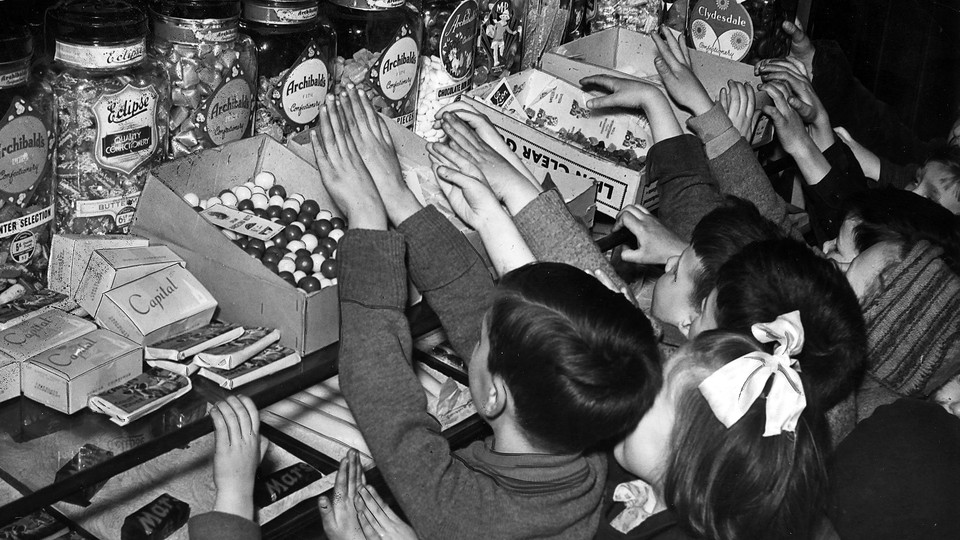
The one notable exception was Mrs. Feeney’s store, just beyond the old-rag-iron-and-bottle yard next to the school. Built on a corner where two slanting streets came together at an acute angle, the store was shaped rather like a triangle with the apex cut off, with the door where the point should have been. Inside this door, the walls sloped away on either hand into a shadowed obscurity where a confusion of burlap sacks and large barrels loomed through the dusk. The crowded room was called a ‘grocery,’ and no doubt there were purchasers for the staples of life that were kept back there in the musty-smelling dark, but we never saw an adult in the place. For us it was an Aladdin’s cave of delights. The candy counters were close to the door, where there was hardly room on one side of the glass cases for two or three small eager children, and on the other for buxom, black-haired Mrs. Feeney.
Mrs. Feeney was one of the fixed stars of our firmament. Whatever her private opinion of heretics, she was always friendly, always kind, always laughing, never impatient when her customer’s choice was debated and delayed. We valued her approval above that of the teacher, and were honored when she called us by name. She sold all the penny candies that everyone now grown remembers as a part of his childhood. Hard flat peppermint hearts, or wintergreen,— white or pink, — with amorous mottoes printed on them in red letters. ‘Liekrish’ shoestrings, as long almost as we were, tough and flexible, strong-flavored, delicious, but not to be eaten without leaving their mark — externally on chin, cheek, and pinafore; internally . . . ! Licorice ‘nigger babies,’ not so violent and not so tasty, but amusing to play with, on one’s desk, behind a First Reader. Red-and-white-striped peppermint balls, so hot that one sucked them open-mouthed for the exquisite coolness of air on the tongue, on the principle of Keats’s cayenne-pepper-and-claret experiment. Candy corn, orange at the base and yellow-pointed, so cheap that a penny bought enough for the whole playground, but too insipid to be very popular. Round white balls of confectioner’s sugar with hazelnuts (last year’s) in the centre. All-day-suckers of every imaginable color and one universal flavor, or lack of it.
Over this wide choice we swayed back and forth — ‘ What ’re you gonna get?’ ‘Well, what’re you gonna get?’ — while pennies clutched in damp palms left there a coppery smell that lingered after the candy was gone. Generally, in the end, I bought some of Mrs. Feeney’s chewing gum. She kept two kinds: real gum, which grew so stale on her shelves that it crumbled into dust in the mouth, and had to be collected and recollected by an active tongue until it could be chewed into one lump, and the windpipe was safe; and a gum made of paraffin, which was as tasteless as a wax candle after a moment’s mastication had drawn the sugar out of it. It was this I bought — not because I liked it, which would have been impossible, but because with it, if lucky, one got a prize. On this gamble I often risked my money.
I must have drawn many of these prizes, but one only do I remember — a marble of glass, unflawed, untinted, that held in its centre the tiny silver figure of a boy. The silver must have been lead foil; the figure was shaped so crudely that the boy was without grace and featureless; yet I received the marble from Mrs. Feeney with speechless delight, and even in school that afternoon I kept my hand on it in my pocket, until its cool smoothness grew warm in my fingers and its crystalline clarity was frosted over with moisture. And my affection for it never wavered. In time its bright surface was dulled with nicks and scars, but it was not broken. Nor was it ever lost; to this day I know where it is in the attic. As a marble it was useless, — far too large, — but I would not have risked it in the hazards of a game had it been a ‘champeen’ taw.
It served me principally as an object of contemplation. Squatting cross-legged beside it on the floor, I corrected its tendency to roll and turn the little silver boy upside down or slanted tipsily sideways, while I made up stories about an enchanted fairy prince. If, in my moment of nethermost despair, I were to smash that marble and release him from the spell, he would grow by magic to life size, and be the perfect hero and deliverer. But I must be certain that this present unhappy hour was the most unhappy hour possible, for of course he could not twice deliver me. The marble was never smashed, but always reserved for some worse time. ... If I did not really persuade myself that I believed this, at least the toy was a comfort in affliction, a solace, which had cost me a penny. Not that I considered that I had bought it: it was a prize, and prizes are not to be purchased, but are distributed by a kind Fate.
That was a long while ago, when to be six-years-old-with-a-penny-to-spend was very heaven. Who would of his own choice be six to-day? Not long ago I stood at a grocery counter next to a little girl who had a penny. For her money she could buy two caramels, wrapped hygienically in tin foil. Nothing else sold for less than five cents. She hesitated, disappointment and chagrin unconcealed in her face, and finally shook her head and went out. I did not blame her. A whole penny for two small pieces of candy? Hardly!
Since that morning I have looked here and there in the market place for licorice shoestrings, for peppermint hearts with amorous mottoes on them, for ‘nigger babies’ and cinnamon drops, and have not seen them. Even in these parlous times the penny has no value. We cannot correct our habit of thinking of money in terms of large amounts; the depression has profited the children nothing.