Austria, the Powder Barrel of Europe
I
SIXTY-EIGHT years ago Napoleon III was called upon to make a momentous decision. Bismarck was then visibly preparing to launch that attack upon Austria which he had long been planning. Only if France intervened promptly and emphatically was there any chance of arresting a conflict the outcome of which seemed doubtful and the consequences obscure. But in that decisive moment of his life Napoleon characteristically hesitated and vacillated. As a result, Sadowa was won while France remained passive. Less than five years later, Napoleon III was a Prussian prisoner, his empire had fallen, Paris had surrendered, and Alsace-Lorraine was lost.
Strangely enough, the problem of Napoleon III in 1866 — the question of the fate of Austria — has to-day become the riddle of Gaston Doumergue, formerly President of the French Republic and recently summoned to head a cabinet of ‘national salvation’ as a consequence of the February riots in Paris. Like his imperial predecessor, Doumergue has to decide briefly whether France will again suffer a Prussia, now expanded into the German Reich, to crush Austria.
Again, as two generations ago, the question for the French Government is whether it is prepared to precipitate a war of prevention to save Austria, this time not from military defeat but from political extinction, or whether Doumergue will yield to Hitler as Napoleon III did to Bismarck. But, while the problem is primarily for France to resolve, British and Italian statesmanship has also to reflect upon the lessons of history which is still recent. For, as France stood aside in 1866 only to be overwhelmed in 1870, Great Britain and Italy, similarly, remained neutral in 1870 only to be obliged, forty years later, to wage a life-and-death struggle against the new German Empire.
Actually the problem which now confronts not alone France, but also all of the larger and many of the smaller of the states of the Continent, was posed by the accession of Hitler to power. Briefly stated, it amounts to a choice between a war of prevention now and resignation to the creation of a colossal German Empire, against which they will almost inescapably have to fight for self-preservation a few years hence. And that, in turn, amounts to a statement that to-day Europe faces the alternative of a Franco-German war this year or a coalition conflict a few years hence.
If, moreover, the physical circumstances of the present crisis in Europe recall those of 1866, the recent progress of events has been ominously reminiscent of the years preceding 1914. For, while the actual triumph of Hitler a year ago produced an acute tension which has lasted ever since, Europe has for several years been marching from crisis to crisis, precisely as it did in the period between the Affair of Tangier and the Assassination of Serajevo.
Thus in 1930 the Brüning Cabinet, in reopening the question of the Polish Corridor, shattered the Truce of Locarno by a gesture as brusque as the landing of the Kaiser in Tangier in 1905, Again, in 1931, the proposal of an Austro-German Tariff Union precipitated a crisis as acute as that of Bosnia in 1908. In 1932, Franco-German differences wrecked the Disarmament Conference at its inception and produced a state of mind recalling that provoked by the Agadir Affair in 1911. In 1933, the actual arrival of Hitler and the subsequent withdrawal of Germany from the League of Nations brought about a situation as tense as that arising from the two Balkan Wars of 1912-1913. Finally, the current year has seen the development of the Austrian crisis out of which, it is evident, there may at any moment arise an incident as fatal to peace as the crime of Serajevo in 1914.
On this side of the Atlantic, however, the sure and steady march of Europe toward a new catastrophe has been viewed with the same incredulity and unconcern as were the events between 1905 and 1914. It was because of this state of mind, too, that pistol shots and bombs exploding in Serajevo, while they set the American editor to searching his files and the man in the street to snatching for his extra, carried no immediate alarm. For at that moment the crime in the remote Bosnian capital seemed to the people of the United States as devoid of sinister international implications as the murder of William McKinley in Buffalo a few years before.
As a consequence, when, a few weeks later, Vienna seized upon the assassination of the Archduke Francis Ferdinand as a pretext for an ultimatum to Belgrade, and that ultimatum in its turn set all Europe on fire, the American public was at once surprised and utterly bewildered. For the reality of the danger, which had long been taking form, had been completely ignored, and the frequent warnings, which the several preliminary crises had provided, had been thrust aside with irritable impatience. Nevertheless, within three years the United States was a belligerent in a European war, of the approach of which it was totally unaware.
In 1914 it was incomprehensible to the great majority of the American people how a question immediately concerning a state as small and weak as Serbia could precipitate a war which, from the start, was Continent-wide in its extent and presently embroiled the whole world. To-day it is evident that the storm centre has shifted from Belgrade to Vienna, and that Austria has replaced Serbia as the cockpit of Europe, as Serbia took the place of Belgium in the closing quarter of the last century. But again, as twenty years ago, American eyes remain blind to the larger issues hidden behind what seems only a minor quarrel.
Thus in recent weeks, as the Austrian crisis has become steadily more and more acute, the American public has continued to ask two questions. First, how can the existence of peace in Europe turn upon the control of a state as insignificant as that constituted by the Austrian fragment of the once mighty Hapsburg Monarchy? And, second, how can European peoples, unless they have collectively taken leave of their senses, even consider the possibility of engaging in a new war when they are still faced with the memories and ruins of the last?
Patently these questions must be answered if there is to be brought home to the American mind even the smallest realization of the extent of the present danger in Europe. Nor is it less evident that such explanation is made doubly difficult, first because of the existence in the United States of a conviction that those who forecast war are accessories before the fact, — a conviction evidently based upon the assumption that diagnosis is itself an unmistakable means of spreading disease, — and again because popular interest and attention are so completely concentrated upon the New Deal that it is almost impossible to arouse concern for the old danger, the danger which involved this country in its greatest war less than two decades ago.
If the American public is to grasp the contemporary fact that the peace of Europe to-day turns upon the fate of Austria, it is essential to recognize three vital aspects of the European problem itself — the historical, the contemporary, and the individual. Of these, the first concerns the general wars of the past; the second, the situation to-day as it fits into the traditional pattern; the third, the vital interests of the various European states, which make them prospective belligerents either immediately or eventually.
II
When one turns to the consideration of the general wars of the past in Europe, it is to encounter at once the doctrine of the balance of power. Anciently that doctrine enjoyed universal good standing. In fact it was recognized as constituting in some measure a Declaration of Independence for the Continent. In later years, however, and particularly since 1914, it has acquired evil implication. Thus in America and Britain, at least, it has come to be identified as the pretext of old-fashioned diplomacy and unrepresentative statesmanship for launching unnecessary wars. Accordingly, when President Wilson undertook to create his League of Nations, it was with the very deliberate purpose to substitute a new and nobler device for ensuring peace for the older, which he regarded as discredited.
Nevertheless, it is necessary to see the doctrine of the balance of power as it actually was. In fact it was no more than a principle, in accordance with which the weaker powers of Europe combined to oppose any state which both possessed disproportionate strength and was controlled by a ruler whose ambitions threatened his neighbors. In reality it was the only discoverable method of providing police power to preserve or restore European order during the three centuries between the Thirty Years’ War and the World War.
In that period, too, it was many times invoked. Thus on frequent occasions Britain, Austria, Holland, and various other Continental states united in coalitions to check the several attempts of Louis XIV to seize the provinces and cities of his neighbors and thus to establish a French state relatively so strong as to enable him to dominate the whole Continent. And the result of nearly half a century of struggle was to reestablish the freedom of the Continent momentarily compromised by the ambitions of the Grand Monarch.
Something less than a century later, Britain, Russia, Austria, and Prussia, again supported by minor states, rallied to new coalitions in the face of an obvious peril for all — the purposes of Napoleon Bonaparte. And, as the threat was at once more deadly and more direct than before, European resistance was more general, and, in 1814, became a struggle of Europe as a whole against the French Empire.
In 1914, the World War promptly took on the same character. In the first years of the present century Germany had become stronger than any of her neighbors. In that time, too, these neighbors saw in the purposes of the rulers of the German Empire a threat to their own security and to the independence of Europe as well. As a consequence, even before the war, France, Russia, and Britain had framed the Triple Entente.
The war which broke out in August 1914 was, moreover, essentially a struggle to restore the balance of power. For, by its early military victories, Germany had created an empire which, if it were permitted to endure, would possess both the military forces and the economic resources requisite to acquire Continental hegemony. In addition, Germany was visibly in the hands of leaders who sought that end. Thus the immediate objective of the Allies was to restore that balance of power which had been fatally compromised when the German armies occupied, first Belgium and Northern France, then Russian Poland and the Baltic Provinces, and finally, in association with the Austrians and Bulgarians, established a Mitteleuropa of vast proportions.
Once victory had been achieved, too, the major purpose of the Allies at Paris was to erect barriers to arrest German armies along all the routes of invasion they had followed during the World War. Thus the three vital undertakings of the victors of 1918 were the creation of a strong Poland, a powerful Czechoslovakia, and an independent Austria. In this respect the Conference of Paris only followed the example of the Congress of Vienna, which had transferred Belgium to Holland, established Prussia on the Rhine, and seated Austria in the valley of the Po to bar the traditional ways of invasion to France.
In the light of European history it is thus plain that general wars have invariably been the consequence of two things: first, disproportionate power in the hands of one state; second, imperialistic ambitions in the minds of the rulers of such a state. Primarily, too, such wars have been struggles for national existence on the part of the nations which have united to resist the single state. Coalitions thus formed were only possible, however, as long as common danger extinguished all rivalries, and they disintegrated rapidly once the danger was past.
Once, therefore, the Allies of the World War had defeated Germany in battle and had in the peace treaties erected barriers to new German attack, they separated. For they were no longer equally menaced by future German policy. But the complete retirement of the United States from Europe, the partial withdrawal of Britain from the Continent, and the early break between France and Italy left only the French and their allies, Poland and the Little Entente, vitally concerned with the preservation of the barriers against German expansion created by the peace treaties. By contrast, despite all the territorial sacrifices exacted of Germany, she still remained potentially first among the Continental states, and her primacy was further assured by the disappearance of Russia as a factor in European affairs.
The European situation following the World War was thus similar to that of two centuries earlier. Then the defeat and death of Louis XIV had been followed by the break-up of the Grand Coalition which had defeated him. Nevertheless, disproportionate strength still remained to France. As a consequence, when Napoleon presently arrived, he was able to renew the old struggle on a still grander scale and with even greater initial success, and Europe had presently to fight for its life again.
After 1918, too, the condition of Germany was identical with that of France after 1715. For a period of years it was condemned to quiescence. Eventually, however, it was sure to recover its freedom of action and regain the full use of its superior resources. After 1919, therefore, peace in Europe, in the longer view, was bound to turn upon the later course of Germany, on the one hand, and upon the post-war development of the Succession States on the other. Thus Germany might herself voluntarily renounce future expansion, or the Succession States might presently develop the strength necessary to defend themselves.
But if Germany should later fall into the hands of a master who cherished ambitions which could only be fulfilled by an attack upon her neighbors, and if the Succession States, on their part, failed to develop the strength necessary to defend themselves, then it was plain from the start that, sooner or later, the old problem of the balance of power would again be posed in its traditional form.
To-day it requires no detailed analysis to establish the fact that, with the triumph of Hitler last year, Germany passed to the control of a leader whose programme of national expansion constitutes as grave a peril for Europe as did the similar programmes of Napoleon or Louis XIV. Sufficient proof of that fact is discoverable by the smallest examination of Hitler’s own book. Again, evidence of the failure of Austria to develop sufficient strength to defend her own independence is disclosed in her recent and despairing appeal to the League of Nations to protect it against German aggression.
III
We come, then, directly to the second question. How would the Anschluss — that is, the union of Austria with Germany — produce conditions which would fall in with the familiar pattern out of which general wars in Europe have arisen? In a word, how would such union directly affect the balance of power in Europe? That question has a threefold aspect, for it not only concerns Austria directly, but Czechoslovakia and Hungary as well, although so far only the Austrian detail has attracted general attention on this side of the Atlantic.
Actually the union of Austria with the Reich would add 7,000,000 people and 30,000 square miles to the present state. Germany, thus expanded, would contain more than 72,000,000 inhabitants, and in size and population alike the Reich of Adolf Hitler would surpass the Empire of William Hohenzollern. This new Germany would possess a decisive numerical superiority over both France and Italy, since the population of each of these states barely exceeds 40,000,000.
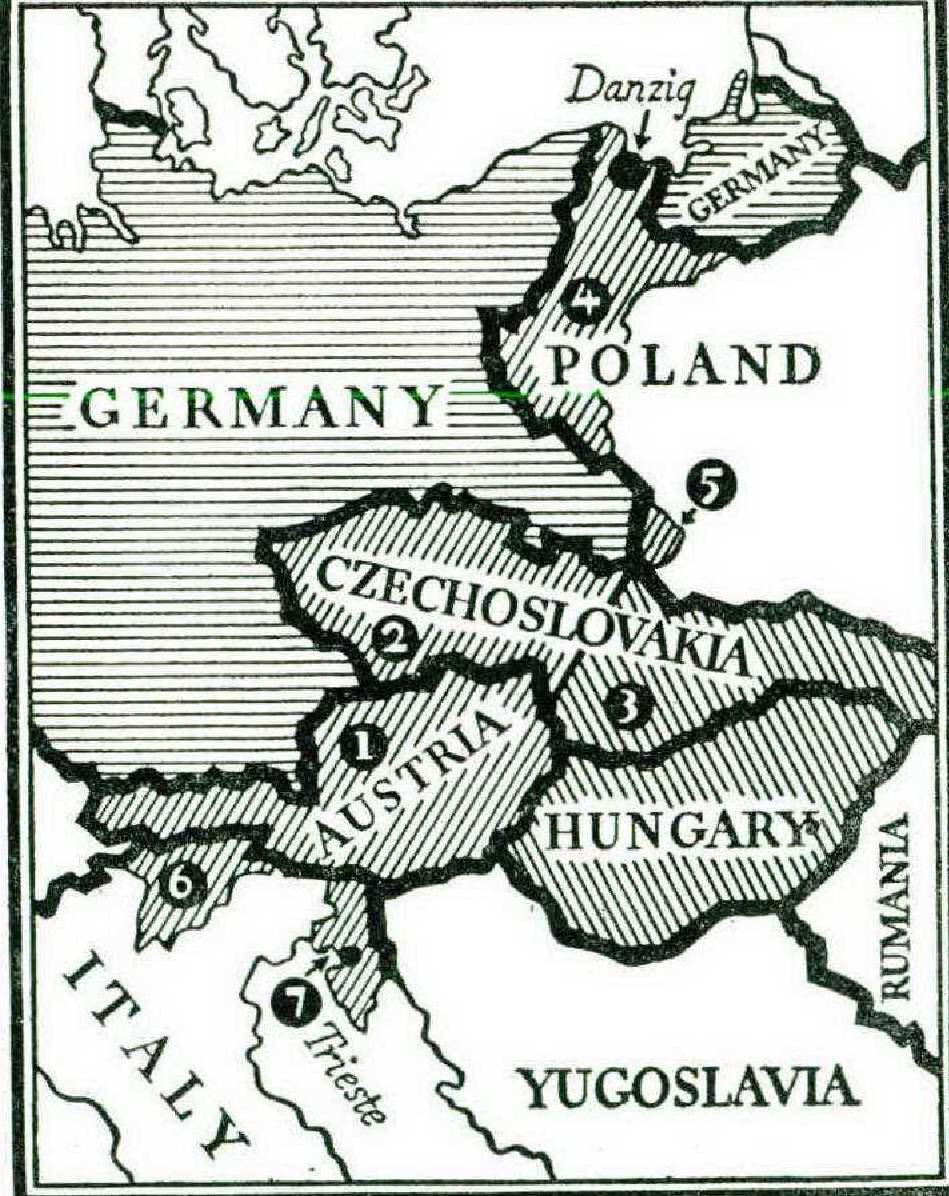
(1) Austria; (2) Western Czechoslovakia, to Germany; (3) Eastern Czechoslovakia, to Hungary; (4) Polish Corridor, as well as Danzig; (5) Upper Silesia; (6) Upper Adige; (7) Trieste
As to Czechoslovakia, once the Anschluss had taken place, its western provinces — that is, Moravia, Bohemia, and Silesia — would be almost completely encircled by German territory. On the political map Czechoslovakia would thus have the appearance of another Cape Cod, projecting, not into the Atlantic, but into a German political sea. Since, moreover, of the 10,000,000 people inhabiting these provinces more than a third are German by race and therefore eager to substitute a Teutonic for a Slavic ruler, Hitler would find ready at hand instruments to repeat in Czechoslovakia those agitations which had destroyed Austria.
Practically, therefore, the union of Austria with Germany would ensure the eventual if not the immediate absorption of the western half of Czechoslovakia by Hitler’s Third Reich. Once Germany had come to Vienna, Czechoslovakia would be strategically and economically at the mercy of its great neighbor, and either voluntarily or under coercion would be compelled to make terms with Berlin — terms which would inevitably destroy its independence. Thus there would be added another 30,000 square miles of territory and more than 10,000,000 people to the German bloc.
Again, as to Hungary: in taking for Germany the western half of Czechoslovakia, Hitler would also be in a position to restore the eastern half to Hungary. And that would mean giving back the Slovakian province which was not merely associated with the Crown of Saint Stephen for a thousand years, but also contains more than three quarters of a million of Magyars. Hungary would thus recover a province both considerable in area and containing 4,000,000 people, which was taken from it by the Treaty of Trianon, against whose provisions the Magyars have never ceased to protest.
Such a territorial restoration would bind a Hungarian state of 13,000,000 inhabitants by ties of common interest to the new Reich. These several changes in the map would create for Germany a solid bloc of 95,000,000 people occupying the very heart of Europe. And beyond Hungary lies a Bulgaria with a population of 6,000,000, as determined as Hungary to abolish the frontiers of 1919 and as certain as its former ally of the World War to accept Germany as an ally, who could ensure the recovery of the lost province of Macedonia.
Nor is the union of Germany, Austria, and Czechoslovakia a mere fantastic dream. On the contrary, it would only restore a territorial association which existed in the form of the Holy Roman Empire for the thousand years between Charlemagne and Napoleon. In addition, it would but give reality to a Teutonic aspiration for unity which remounts in legend to the age of Barbarossa. Hitler has, in fact, made himself the symbol of this desire for unity which at bottom is common to more than 75,000,000 Germans dwelling in the very heart of Europe, for a unity already possessed by all other European peoples great and small and so far denied to the Germans only by two historic accidents, the Reformation and the Rise of Prussia, the first responsible for religious, the second for dynastic, separation between the North and South.
Nor is a German-Hungarian alliance an unfounded conception. On the contrary, such a partnership would only renew the association originally arranged by Bismarck and Andrassy in the last century and continued by joint participation in the World War. No one could pretend that such an alliance would awaken enthusiasm in Budapest, for during their millennial history the Magyars have as frequently fought Germans as Slavs; but, as an alternative to their present mutilated and helpless situation, they would inevitably turn to Berlin and Hitler. And the arrival of Germany at Vienna would undoubtedly decide the debate.
Hitler’s victory in Austria would, then, ensure an Austro-German union and foreshadow the partition of Czechoslovakia, the formation of Hungarian-German and Bulgarian-German alliances. Nor would it less certainly forecast the inescapable association of Rumania and Yugoslavia with this new combination. Thus there would be established a new Mitteleuropa, extending from the Baltic to the Black Sea and from the Warthe to the Sarre, containing more than 130,000,000 inhabitants and dominated by a compact mass of 75,000,000 Germans closely allied to 10,000,000 Magyars and 6,000,000 Bulgarians. And that, in reality, would be the old Mitteleuropa created by German arms in the last war and dissolved only after four years of struggle and by the combined forces of a world in arms.
Such an empire would not only reproduce the magnificence of Napoleon’s empire at the summit of his powder, but even surpass it not only actually but relatively. And undeniably this new empire would be in the hands of a man whose ambitions are as unlimited and whose determination is as unmistakable as were those of the Great Emperor. Thus it must be apparent that the creation of that Third Reich, which is Hitler’s design and in which the first stage is Austro-German union, would accord with the pattern of the past out of which general wars have arisen.
IV
There remains the third question: Even assuming that Austria should pass to German control, either formally or by the arrival to power of a Nazi régime nominally independent but actually manipulated from Berlin, how would this development concern the other great powers? What peril, beyond the diminution of their prestige and influence, would follow the application of the other portions of the Hitler programme? Why need they individually fear attack from the new Germany, even though it would patently bo able not only to crush them separately, if it chose to do so, but even to defy them collectively?
That question is clearly the most difficult to answer satisfactorily to an American audience, which can see no reason why war should follow the creation of a Mitteleuropa such as Hitler, himself, has forecast. Why should France, Italy, Poland, Soviet Russia, be concerned with preventing the creation of such a state, which would not deprive them of any of their own territories? The answer, of course, must be found in the individual circumstances of these four states.
To take the case of Poland first. Nothing is more certain than that Germany will never permanently accept an eastern frontier which deprives her of the possession of the Corridor, Upper Silesia, and Danzig. At the moment, to be sure, the American and British public has been mystified by the recent non-aggression pact signed between Poland and Germany. But such confusion only arises from turning a blind eye to the historical precedents. What Hitler is now attempting with Pilsudski, Bismarck successfully accomplished with Napoleon III. Thus he beguiled the French Emperor with promises as dazzling as those Hitler has now held before the eyes of the Polish dictator, only to snatch them away once French quiescence had ensured Prussian triumph over Austria in 1866.
To-day Hitler has no desire to fight Poland, and he is well aware that the Corridor can only be recovered by arms. On the other hand, he has every incentive to try to keep Poland still during the decisive period of his Austrian campaign. Once Austria has been absorbed, and Germany rearmed, Poland will face the menace of a fresh partition, and, although this may not extend beyond the surrender of the Corridor and Upper Silesia, Poland will, nevertheless, be thenceforth bound economically and politically to Germany, for who holds the mouth of the Vistula must be master of the entire basin of that great river.
As for Soviet Russia, already Hitler’s followers have put Moscow on notice that the new Germany that is to come will press its claim to the rich lands of the Ukraine as fields for future colonization. Moscow, too, has not concealed its suspicion that, on the one hand, Hitler has sought to purchase Polish support by the promise of a share in the Ukrainian booty, and, on the other, to engage Japanese interest by proposals of an eventual joint attack upon the Soviet Union.
For Italy, in turn, the arrival of Hitler in Vienna possesses a threefold menace. In the first place, it would automatically end all the cherished aspirations of Mussolini to create an economic and political sphere of interest in the Danubian basin. In the second place, by bringing the German frontier to the Brenner, it would instantly intensify the demands of the quarter of a million of German-speaking people in the Upper Adige for union with the Reich. Finally, it would similarly ensure an eventual German endeavor to possess Trieste, long the port of the Hapsburg Monarchy on the Adriatic and naturally the outlet of Central Europe to the Mediterranean.
Italian anxiety for the retention of Trieste and the Upper Adige would be paralleled by French apprehension over Alsace and Lorraine — the first because of its large Germanspeaking population, the second because of its vast iron deposits, possession of which played such a part in the industrial development of Germany after 1870. It is true that on the Rhine, as along the Alps, Hitler continues to pledge eternal acceptance of the status quo. But the French and Italians who hear the speeches of the Führer have also read his book, in which all territory that was ever German, or to-day contains a German population, is claimed for the Germany of to-morrow.
All four of the great powers of the Continent are therefore faced with the fact that they hold territory which was once German and has been marked down in advance by the new master of the Reich as terra irredenta eventually to be recovered. They are similarly confronted by the inescapable truth that, once Hitler has realized his Central European programme, power to accomplish the remaining details will in full measure be within his hands. Nor is it less clear that at each step along his indicated pathway, which starts with Austria, the disproportion between German strength and that of the other Continental states, even if they arc allied, will become more marked.
And what of Britain? On the surface, at least, it would seem that the extension of German rule to Vienna and Prague, the framing of alliances with Budapest and Sofia, even the acquisition of the Corridor, Trieste and the Upper Adige, Metz and Strasbourg, would leave Britain still secure behind her water barrier. In fact, all English history furnishes eloquent testimony to the fact that acquisition of political and military hegemony on the Continent by any single state has invariably been the prelude to a challenge to British naval supremacy and security.
It must, therefore, be evident that for individual reasons all five of the European great powers have a common interest in preventing the creation of Hitler’s new Mitteleuropa. And the interest is discoverable in the facts of their own frontiers and border provinces, which they will plainly be called upon to defend if, after having carried out his Central European projects, Hitler proceeds, as his prospectus foreshadows, to the rounding out of his new empire. And what is true of the great powers is even more unmistakable in the case of the smaller states of the Little Entente, Czechoslovakia, Rumania, and Yugoslavia, the first of which faces certain partition and extinction, the other two the loss of precious provinces and political independence as well.
V
The deeper significance of the Austrian crisis must then become unmistakable. In it are reproduced the essential circumstances out of which have arisen all the general wars of the past in Europe. To-day the masters of Germany have the will to conquer, and the programme which they have laid down would give them the power to dominate. By contrast, many European nations are faced with the fact that for each individually the German programme has a direct threat, while for all of them German hegemony must be similarly dangerous.
The campaign against Austria carried on by Hitler therefore marks his first considerable assault upon European independence. How then can this assault be met, and what are the consequences, both immediate and eventual, likely to be? So far as one can now see, there are but three possible outcomes of the present crisis, and of these only one — and that the most unlikely — can even conceivably be peaceful. These three possibilities are, first, a concerted action of all the great and interested lesser powers to guarantee Austrian independence; second, a war of prevention now; third, a war of balance of powder eventually.
As to the first of these possibilities, the Austrian appeal to the League has provided the occasion. In response to it France, Italy, the Little Entente, and Poland, backed by Britain, can affirm their purpose to defend Austrian liberty and call upon Germany to desist from her present campaign for the overthrow of the Dollfuss regime. Such a decision, however, to be effective would have to be fortified by a clear purpose to use armies, fleets, and economic resources to coerce a recalcitrant Germany.
For it is plain that, at the point to which the European situation has now come, mere words could have no influence. Save in the face of irresistible force and the plain resolution to employ that force if necessary, Hitler, now on the very eve of victory in Austria, is certain not to yield. Another ultimatum like that issued by the League in the case of Manchuria could only ensure another response from Berlin like that of Tokyo. On the other hand, even such a show of force might not prove adequate, and thus the effort to use the Geneva machinery peacefully might lead to a war of prevention.
When, however, one comes to consider the likelihood of any joint démarche by a new Concert of Europe, it must be evident that the prospects of such action are slight in the extreme. In Britain the government is weak and divided, the general public almost fanatically opposed to assuming any risks on the Continent, and in official circles the absorption of Austria by Germany is already viewed with fatalistic resignation.
Again, while Italy would follow if Britain moved, Rome is certainly in no mood to go along with Paris if Britain is absent. In addition, Mussolini is contemptuous of the League, disappointed by the collapse of his own fourpower plan, and almost as jealous of France as he is apprehensive of Germany. Moreover, even if Britain and Italy were prepared to join France and the Little Entente in coercive action, such action might postpone but could not permanently arrest German progress unless all these powers were prepared to cooperate in a common programme for the economic rehabilitation of the Danubian area, and such cooperation is to-day even more unthinkable than common action on the political side.
If, however, Europe will not move and France does not march, then in no distant time Austria must pass to German control, for the Dollfuss regime is visibly in extremis. And thereafter the way to the realization of his other projects will be clear for Hitler. For the Führer, too, the Battle of Austria must be what the Battle of Austerhtz was for Napoleon, alike at home and abroad. Once he is victorious in that battle, too, power and prestige will come to him in almost unimaginable measure, while confidence in his destiny must be reenforced by the spectacle of divided and supine Europe.
Nevertheless, if European history in the past three centuries has any relevance to the present age, somewhere along his already clearly charted pathway of imperialistic adventure Hitler, like those who have preceded him on the same road, must encounter a Europe at last aroused to concerted action by complete if tardy perception of the common danger. That encounter may come when the issue of Czechoslovakia is raised, or later over the question of the Corridor. It may be postponed until the Italians see the shadow of the German eagle over Trieste or France is forced to a new defense of Metz and Strasbourg at the Sarre. It may even wait upon the moment when a fresh challenge to British naval supremacy brings England back to the Continent to renew her traditional support of the balance of power.
In proportion to the delay, however, the eventual conflict must be terrible. For if Hitler is permitted time to arm, to organize his Mitteleuropa with Prussian thoroughness, and to bind the Danubian states to his chariot, his situation will be relatively stronger than that of Napoleon, and his overthrow necessarily more difficult and costly. For all practical purposes, Europe has already reached the point where the single alternative is a war of prevention precipitated by France in the present year or a war of self-preservation waged against Germany by all of the great powers a few years hence. Finally, while actual conflict may be postponed, European peace must henceforth be as troubled as in the years between 1905 and 1914, when the World War was in the making.
As to a war of prevention, designed to overthrow the Hitler regime and once for all end its menace to France and her allies, that was always out of the question while France was governed by a Left Ministry, itself the captive of the Socialist bloc. But the revolution which took place in Paris in February and resulted in the creation of a Doumergue Cabinet has totally changed the aspect of things. With Tardieu, Barthou, and Herriot acting as a directorate of foreign affairs and backed by the Prime Minister of this new ‘Government of National Salvation,’ a war of prevention can no longer be excluded from present possibilities, unless Hitler, in the face of a direct and unmistakable threat of invasion, voluntarily yields.
To-day, for a war of prevention, France has the military means, the necessary statesmen, and the willing allies. What alone is problematical is the state of mind of the masses of the French people. Thus, until the new government is certain of the domestic effect of mobilization, nothing will be done. And, in turn, the popular state of mind depends perhaps on the future manifestations of German policy.
To be successful, however, a French war of prevention must come soon — in fact, it must come within the present year. For the superiority of French military resources, which is to-day overwhelming, is daily declining and will briefly disappear. Again, while French allies are to-day ready to march, to-morrow they may turn to Rome, if action is postponed, or, failing there, follow Poland to Berlin and make such terms as they can. And that would be to condemn France henceforth to mount guard alone upon her own frontiers against an attack that would then seem to most Frenchmen inevitable.
As I close this paper the newspapers are filled with dispatches describing struggle between the Dollfuss Government and the Socialist population of Vienna. These riots must inevitably introduce a new complication, but they cannot modify the basic conditions. Thus, in accordance with plans long prepared, Italian troops may occupy Innsbruck, Yugoslav forces seize Klagenfurt, and a Czech army march upon Vienna itself. But military occupation cannot be permanent, and while it lasts it is sure to arouse Austrian resentment. Actually German progress can be permanently arrested only if the Nazi régime in Germany is overthrown by war, or Hitler himself is compelled to yield to the force majeure of a united Europe. And mere occupation of Austrian territory by Italian and Little Entente troops will not bring about either of these results.