A Post Office in Fairyland
I
IT was a double life we three children lived in those days: one existence made up of real people and tangible things; the other, equally real to us, full of imaginary characters living in a land of dreams. In this modern day of child psychologists, it is probable that this second delightful world of fairies and elves, invisible playmates and fancied adventures, would be frowned upon. Reality would face us, and we should be asked to choose between fact and fancy, and to know them apart. Then, we hardly knew the difference between them. In a state of serene confusion we went through our days, setting places at the table for fairies and brownies, conversing familiarly with them when we were alone, and the next moment passing with no effort into the other world, no more real to us and often less interesting.
I can remember the feeling of desolation which swept over me when one day in a moment of confidence I consulted my mother as to the relative reality of my two worlds. ‘Do you mean that there are no people at all except those you can see and touch ? ’ I asked incredulously, hoping against hope that at least a selected few of my fairy friends and neighbors might win through to an actual existence. My mother gave an honest answer to my honest question, and my heart sank. Suddenly the world seemed depopulated, not worth living in, as though plunged in some mysterious catastrophe. With a dark sense of irretrievable loss, I gulped and went quietly out of the room.
But long before this devastating episode the facts of our fairy-tale lives were well established. Sue and I were capable young Fairies, accepted in all elfin circles. John we considered one of the Brownies, a race somewhat apart, but equally at home in the land of fancy, and with certain responsibilities of their own. The three elves, Fairy Apple Blossom, her small sister Forgetmenot, and the Brownie, Lightning, lived in a whirl of imaginary activities, often interrupted, but never completely overshadowed by the realities of everyday existence.
No one in his senses could step on gravel in our yard without wetting his feet, or even risking danger of drowning. Gravel was water, and we never ventured on it without waiting for a ferryboat to come along. Docks ware situated at convenient intervals up the roadway and around the garden, so that one could board the boat almost anywhere. The horse block by the porch was our nearest dock, and here we waited many long minutes while irritated elders, having dispatched us on some errand, tried to urge haste. But we would not stir until our boat came in sight, and, walking up its gangplank in a leisurely way, we steamed up the graveled road in a safe and proper fashion.
Our daily morning routine was unvaried, and, although planned entirely by ourselves, brought as great a feeling of responsibility as any more actual and necessary jobs. First there were our stables to be cleaned: two cubbies at the end of the porch, where our three steeds — the velocipede, the tricycle, and the express wagon — were comfortably housed. Imaginary hay was thrown down into invisible racks, and fresh straw supplied. A thorough brushing and currying followed before we hitched up to go to the dock, to meet various contingents of our fairy friends. Punctually they arrived every morning, waving their hands to us from the deck of the ferryboat on its way across the gravel from the locust-tree dock up the road. All day we had their companionship, and escorted them down to the horse-block dock late in the afternoon, just in time for the last boat back to Fairyland.
The velocipede, the tricycle, and the express wagon — what affection was lavished on those faithful animals of wood and iron, and to what hard and varied uses were they put! While I was fond of them all, the long wooden pole of the express wagon, when disconnected from its cart, was my favorite steed, vaguely associated in my mind with horseback riding. Many a canter down the porch I enjoyed astride its long wooden back. In addition to this stable of useful beasts, we also owned three entirely imaginary black ponies, useful for longer journeys, and kept out at pasture in the Vale of Tauensentha, a little clump of pines and hemlocks bordering our gravel road. The spirit of the Vale was the Fairy Rose, with whom we gossiped about affairs of the day whenever we entered the little pine wood to catch and saddle our ponies.
II
After we three had adopted our fairy names, my father at our urgent request agreed to make us each a fairy wand. That he would know just how to fashion a wand and endow it with elfin power we never doubted. One Sunday morning he brought them to us, three long smooth tapering sticks, carefully cut and sandpapered to a snowy whiteness, each with a fairy name carved near its base: ‘Blossom’; ‘Forgetmenot’; ‘Lightning.’ How pleased we were and how excited with the thought of new powers bestowed upon us! Bows of ribbon were attached near the top of the sticks for dress occasions. Very soon a regular lesson in the use of wands was instituted, myself installed by common consent as professor of magic. The others waved their wands carefully according to my directions, while we all three repeated our mystic formulas. The copy I find of these rules and regulations seems to cover every contingency of life and might be recommended to people faced with equally difficult situations at a later age: —
When you wish for anything, hold your wand right up straight and wish.
If someone is chasing you, take a few drops of water or some leaves and throw them behind you, and a forest will spring up or an ocean.
If a witch comes to you, take a little stone and turn it in your hand twise and she will be compelled to go away.
If a bad fairy has visited houses, go out and stand by your door, turn around three times, look up and breathe nine times, and an eagle will come and tell you what to do.
If you want to grant three wishes, touch their heart, their forehead, and the middle finger of their left hand, and the washes are granted.
If a giant is coming after you, turn around and look at him and say ‘Glamor, Glamor rame gluck.’ Something will come to you with wings and you can fly. Do not fly too high.
If you are puzzeled about something, go into a wood all alone and the first nutshell you see open and a letter in it will tell you what to do.
Often since my childhood I have wished for such a code of concise and definite directions to stave off dangers and difficulties. Pursued in later life by giants, witches, bad fairies, or other powers of evil, many of us look in vain for that fairy nutshell with the little letter, the friendly eagle to give us advice, or ‘something with wings,’ so that we can fly.
Appended to this code of directions is a helpful list, giving the number of times one must wave a magic wand to call certain beneficent agents for service, together with the articles one wishes immediately produced: —
| Fairies | 1 |
| Brownies | 2 |
| Elves | 3 |
| Goblins | 4 |
| Dwarfs | 5 |
| Trouls | 6 |
| Witches | 7 |
| Mermaids | 8 |
| Water | 1 |
| Wood | 2 |
| Air | 3 |
| Bread | 4 |
| Fire | 5 |
| Sute | 0 |
| Picture | 7 |
| Music | 8 |
| Book | 9 |
That is, if one is hungry and wishes a goblin to appear with a slice of bread, it is necessary only to wave the wand eight times, with a slight pause after the first four. It is interesting to see that all human needs, material and artistic, are neatly summed up in this list, if the cryptic word ‘Sute’ is taken to mean clothing. Beyond such a category, what else could one need or desire?
Speaking of clothes brings to mind our fairy wardrobes, planned with great care, and listed for each of us with the name of the garment and the material of which it was woven. (Needless to say, our everyday clothing was made of less diaphanous material, and received no such anxious consideration from us. The responsibility for these more mundane garments and their condition we left trustingly and entirely to our mother.)
Lying on the cool matting under the spare-room bed, our favorite hotweather retreat, we planned our wardrobes. On my sister’s list I find included a bewildering collection of fairy frocks — enough, I should say, to turn an elfin head with vanity. Dresses of bouncing Bet, of locust blossom, of wistaria, and of trumpet vine hung in her magic closet, all made of the daintiest materials — ‘gauze, shimmer, gossamer, sparkle.’ John, as suitable for a boy, had a list of more sombre garments — ‘ browns, reds, black, oak, pine,’ but made of the same shimmering textiles. An account of my own dresses I fail to find in these fairy archives. I can only conjecture, remembering various events related to more material clothing, that very soon after the garments came into my possession I must have torn the dresses and lost the list.
Lucky stones of various sizes were a part of our magic equipment. These stones, always exceptionally round and smooth, we carefully collected, a little one to carry in every pocket, and a big one to repose behind one post of every bed. Before we could expect the stones to be efficacious in warding off evil, however, they must be converted from their ordinary function by means of a suitable ceremony. This ceremony I arranged and conducted about once a week, retiring into some dark closet with the stones and my wand, and coming out with the conviction that through my magic agency the power of good fortune had come into the stones.
Often I slipped away from the others, and stole down into the garden just before dusk. October was coming, and it was time to put in the fairies’ winter coal. There under the day-lily leaves it would be getting very cold when frost was on the ground. (Was it my father’s long connection with the business of heating houses that made me feel concern that the elfin population should enjoy a comfortable warmth ?) Looking around to be sure I was not observed, I picked up a handful of gravel, and threw it against the broad leaves of the day lilies. There was a satisfying rattle as the fairy coal went down into the lily cellar. Handful after handful of gravel I threw until all the elfin bins were full.
III
In bed at night in the nursery, Sue and I installed a complete system of telegraphic communication with our friends in Fairyland. The little brass knobs in a row at the head and foot of our twin iron beds were designed especially, we believed, for a Morse code, such as we had often heard clicking away in the station master’s office at the railroad station. Every brass button connected by a direct wire with one of our magic territories, and we acted as our own telegraphers. Each night in the week was reserved for a visit to one special country. As we drifted off to sleep we imagined ourselves starting on one of these airy journeys. Each morning we reported our adventures. These nightly journeys were supposedly accomplished by means of quick transportation on a big moth, setting forth from the nursery window. The number of luminous winged creatures always fluttering against the screen, ready to be saddled and bridled for midnight journeys, suggested this transportation system, which worked entirely to our satisfaction.
Sitting on the floor of my father’s workshop, with purloined sheets of brown paper spread around me, I began to write a descriptive geography of this fairy country. My effort soon flagged, and only the first pages and a few rudimentary maps are preserved. The first section opens with the following: —
FAIRYLAND AS A WHOLE
In Fairyland there are eighteen lands. There is Fairiland in that, just as New York City is in New York State. The Queen Tatania and King Oberon rule over all the lands but Ohio and Clothesland over which Queen Mab and King March rule. Formaly Mab ruled over Fairyland but marrying a mortal man she was disinherited and the place given to her younger sister Tatania and she rules over Ohio and Clothesland which are not fairy lands. Oberon has three children and March and Mab one.
FAIRYLAND, THE STATE
There are two parts to Fairyland, the outside ring where the people live and the inside ring where only the fairies live. Queen Tatania lives in the middle of the inner circle in a rose palace. Her children’s names are Blackeyes, the oldest boy, Browneyes the next girl and Blueyes the baby. The animals Reilief is also there.
BABILAND
The State of Babiland is across the blue River from Fairiland on the east. There are five towns in it, named Cradle, Rockabye, Creeping, Toddling, and Singing. Our chief interests are in Toddling which is across the Mab River from Creeping. There is a large Ophanasilum there the head of which is Sister Katharine. There are 66 children and 20 nurses and 7 Doctors. Sister Kathirine’s cousin, Loy Gordon is the one in this Ophanasilum that shows people around. Sister Margerate Hathe tends to the servants and dairy. Both me and my sister are nurses.
NOLAND
This land is directly south of Fairiland and the family there we are most acquainted is Mr. & Mrs. Deets. Their family consists of four children, namely, Gretchen Deets, a girl of twelve, Tom one year younger, Tye a girl of eight and Robbie of six. There Aunt Tyetinia lives with them for whom the 3rd child was named. This family lives in the principle town of Nowhere. There are several other towns.
THE LAND OF NOD
The Land of Nod, — otherwise St. Nod’s Land, is southeast of the center of all things, fairyland. The family there we are most familiar with is the Whites. Mr. White is a Doctor by prophession. His children are Nellie — who is very much afraid of animals and 11 years old, Willy of 9 and Merry otherwise Marion who is 7. Oliver White born the New Year 1899 is three months old. Towns are Nod-a-bye Town, Sun, Shadow, Chair. Our friends live in the first of these names.
SLEEP LAND
Sleepland is not much of a place. We have not many friends there either. Maud Wiggins was our only one.
CLOTHES LAND
This Land is the only land except Ohio that Queen Mab rules over. There are dwarfs there for gardeners and the clothes grow on trees & bushes and shrubs. There is ribbon grass and all the clothes grow.
So much for the geography, which was never finished. It seems to be an admirable combination of history, geography, and those side lights on personalities which would add interest to any textbook.
Perhaps a few words of explanation would clarify the geographical material. Fairyland, variously spelled, naturally included all pleasant things and pleasant people, and was associated in our minds with a country landscape, scattered with villages in which it would be a delight to live. All urban activities were excluded, and such disagreeable necessities were relegated to a mythical country, Ohio, whose metropolis, Granite, — or, as I usually spelled it, Granet, — was the synonym for everything unpleasant. Clothesland naturally came under the dominion of unpleasantness, for clothes and all that concerned them were my abomination. A map of ‘Granet’ is uncompromisingly four-square, its streets marked out in rectangles and severely numbered, while the little map of Fairyland I find is delightfully irregular and inconsistent.
IV
The complexity of this world of fantasy has since amazed me. Certain families, carefully named down to the last dog and cat, were familiar to us. Certain responsibilities were part and parcel of our daily lives — for instance, the management of a large orphanage, mentioned in the geography.
Constant discussion of administrative details was, of course, necessary in connection with these enterprises, and a good deal of correspondence. We established a post office in a maple bureau near the nursery, and in its little top drawer deposited our letters and drew out our incoming mail. (The answers, I need not say, were composed in various suitable handwritings by myself.) A little pile of these letters, still in existence, show the constant activity of this imaginary life. Each one is carefully addressed, stamped, and postmarked. The stamp is usually a little sun, a tree, or a tiny window, and on the back of each letter is a round postmark.
A lecture bureau seems to have been established at about this same time, and, when textbook making began to pall, I sent out notices to the family, and took the stump. One announcement in a little blue envelope addressed to my father I find among his papers:
The first leture on Fairyland. The subject for this evening being the management of the Babiland Ofanisilum.
Blue Room
Dec. 18
Given by Fairy Blossom.
Whether my busy father attended this ‘leture’ on institutional management, or whether, indeed, the discourse was ever given, I do not remember.
In a letter from one of the many doctors at the orphanage I am invited to ‘come up on Monday, sure. A glad serprise if you do.’ And that, as I remember, sets the keynote for all my recollections of that place. It was full of ‘glad surprises,’ and therefore in our eyes a model institution. But there was nothing unsystematic about the ‘Ofanisilum.’ Every child’s name was recorded; a plan of every building was drawn; attention was given to the last detail of organization and management. Although I had never heard the word ‘records,’ some inkling of their value must have reached me at an early age, making me write down everything I considered of importance. These documents, now before me, would be illuminating to any modern group of child-welfare workers.
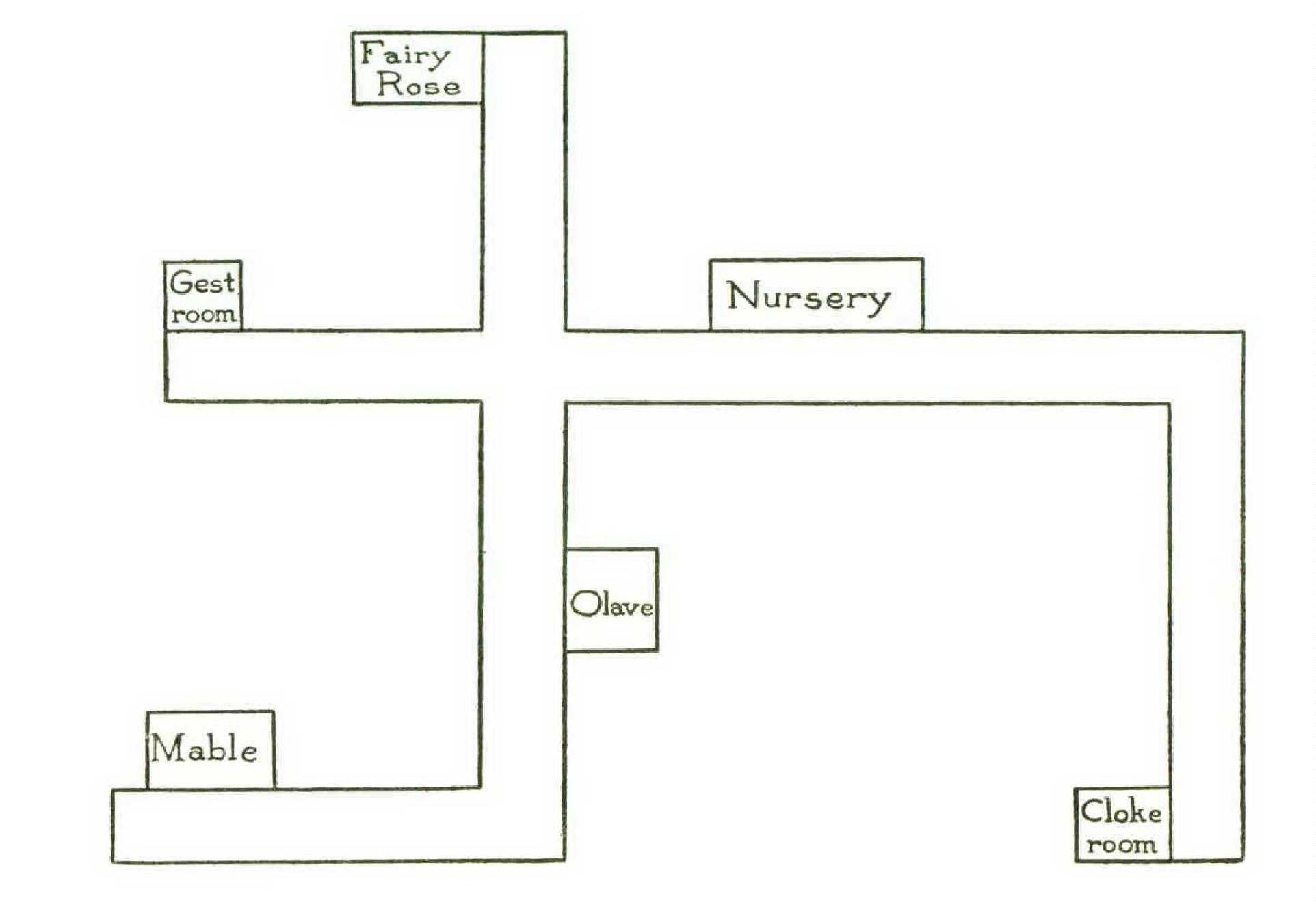
There were sixty-six children in the institution, twenty nurses, and seven doctors — not to mention our two faithful drug-store men, Mr. Ackerhane and Mr. Foolsbeed. The group of children was neatly divided into Boys, Girls, Babies, and Sick. I did not attempt to decide when a baby became a little girl or a boy, or just why the children listed in the Sick Ward should be permanent occupants of that imaginary infirmary. There they were and there they stayed, for years, each group with its own assigned doctors and nurses, and for recreation its own list of ponies and horses, under the care of the most competent coachmen.
They were a nice lot of children. I select at random from the files: Earnest, Olave, Margerate, Beartrice, Mable, and Ameila were all familiar to us. In an age of institutionalism, we were pioneers in individual care, for we planned in detail for our small charges, decided what dresses or suits each should wear, and what each one should have for breakfast. We were still oldfashioned in clinging to the dormitory idea in housing, but the rooms, as I remember them, were airy and sunlit, full of toys and books. Every detail was planned on paper. An architect might have pointed out all the waste space on one of these plans, but we were satisfied with our household arrangements. A typical floor plan is reproduced above.
Any child might be happy, we thought, in these spacious rooms, racing up and down the long corridors, or playing with the nurses. All our staff were fond of children, and enjoyed a good game of ball or hide-and-seek as much as their young charges. No grumpy, elderly nurses in our employ! And nothing but young, delightful housemaids, ready to hand out a bite in the pantry to any hungry child. The employees were considered part of the family, and are carefully listed in these records as ‘maidens’ rather than ‘maids.’ The former term I felt gave them a certain dignity and importance. In the latter I thought they might have a sense of discomfort and degradation.
V
For a well-regulated orphanage, the number of house parties planned and successfully carried through was remarkable. Royalty itself was invited — even came without invitation on occasion, as one of my letters shows: —
Queen Mab
385 North 72 St.
Granet
Ohio
O. D. (Ohio Dominion.)
Dear Queen Mab:
Of course you can come to Babiland on Christmas night. If you go to Fairyland I will take you. Bring January and March. Do not have them left out.
Your ever
Fairy
Blossom.
That Christmas house party must have been a tremendous affair, for letters flew back and forth among the various families, the orphans were in ‘drills’ of all sorts, and it is difficult to understand how any regular work was done in that institution for weeks before or after the party. Annie, a young lady who could not attend because of a previous engagement, was commiserated with by mail, and her situation discussed thoroughly. She writes to explain: —
Dear Cousin Blossom:
I am so sorry I can’t come to Babiland on Xmas night but I had made an engagement before to visit this cousin of mine in Ohio. I want to go to both places very much. Tell Cousin Nottie (Forgetmenot) that Davy got her letter the other day but has not felt well enough to answer it yet. We have not seen Brownie Lightning for some time and we expect to see him very soon too. Goodbye
your Loving Cousin
Annie S. Thorn
There was much routine business:—
To Miss Kathirene Hall
Ofanisilum
Toddling
Babiland
My dear Kathirene:
I hope you are having a very good time. Mrs. White is there I here. You had better give her the south spareroom because the north and east both have windows that don’t close very tight. Do you want me up on Sunday? I want to know because if you don’t I want to make another engagement. Tell Sarah that I got her letter yesterday and tell Dr. Bush that he had better not put Dulcimer into the drill because you know he does not learn very quick, Tatania said. Goodbye
Your loving Blossom
Two of the guests of honor were Redcap and his cousin Squirmie, Brownies or Goblins, who lived, according to the heading on their letters, in the ‘4th Tree, Beach, Woodland.’ Their home in this great imaginary beech tree was also a centre of activity, and much correspondence went on between ‘Master Redcap’ and ourselves.
Dear Fairy Blossom
I recieved your letter the day before next week Sunday. Squirme is not in the drill and can not be at all thank you just the same for asking him. I am in a great hurry as you see.
Goodbye from your friend
Master Redcap.
To add to the holiday excitement in Fairyland, a new baby arrived at the Whites’. We received word of this event over the telephone at the head of our iron beds. The next day a letter arrived from Mrs. White.
Lake Veuw
St. Nod Land
Dear Cousin Blossom:
The baby’s hair is brown and fussy, his eyes are coal black. They all liked the name you suggested but Nellie who stuck to Stenton. Now are you satisfied!? He is just the dearest little fellow alive. This is a busyness note so I won’t say anything else.
Goodbye and loving wishes,
from your Friend
Mrs. C. H. White
After much discussion in bed the night before, Sue and I had decided on Oliver as the most suitable name for the new arrival. We had telephoned immediately to Mrs. White, so we were gratified to hear that her family almost unanimously accepted our suggestion.
While every week-day night was reserved for a visit to some special land, we left ourselves free on Sundays to roam Fairyland at will. One of these Sunday-night adventures took us to a new district, Cupidland, where we met Saint Valentine and made some new friends. I had taken the precaution to write to him in advance of our visit, and also to hint that we might consider permanent residence in his domain ‘when we got a chance.’ This, in our minds, was a circumlocution for death. Realizing vaguely that a change must come in our fairy lives, we looked ahead to some new sphere of activity, and naturally wished to select the locality ourselves. The correspondence follows:
St. Valantine
Valantine Court
Cupidland
F. D. (Fairyland Dominion.)
Dear St. Valantine
Perhaps you remember a little fairy that came to your court some time ago. That was my little sister Forgetmenot. My name is Fairy Blossom, and I am a sister in the Babiland Ofanosilum, and so is Forgetmenot. Our own land is Cloudland; but we are interested in all the other lands too. We want to know if you would like to have us up on Sunday night to look around, for we don’t know anyone there.
Goodbye, from
Fairy Blossom.
P. S. We are looking around for a land to live in when we get a chansh. My sister and brother both like Cupidland (I too.)
F. Blossom.
The Saint’s answer came promptly, in the handwriting of age.
My dear Fairy Blossom:
I do remember the fairy that came to me. She said she was from Cloudland, and was a great help to my eleves. They begged me to invite her here again, she was so helpful. Of course you can come up on Sunday and I will be pleased to show you around. I hope you will be able to live here always when you get a chansh.
Goodbye, from
St. Valantine.
The result of this visit is not recorded. For my part, a vision of that future life when I ‘got a chansh’ always included a little cottage residence in some swaying meadow flower, perhaps a wild rose or a stalk of chicory, in some green dell of the inner ring of Fairyland itself.
VI
A small handmade notebook, fastened in the middle with a big pin, bears the following title: —
For Beginners.
By H. W. S.
Blue Room Pub. Co.
Gibil — the g is soft — was a rudimentary language of our own, used to keep secret our activities from the grown-up family. The little textbook is only half filled, the task of languagemaking evidently having proved too arduous for me or too dull. Vocabularies, numbers, exercises from Gibil into English and English into Gibil, are all there. I cannot remember that any very intensive study went into this language, or that, with the exception of a few sentences, it was ever very much used. ‘Kenston res semivoyle’ (‘Harness the express-wagon’) I remember as a sentence in daily use. The other sentences in the Gibil lessons recall nothing to me. But once, I do not doubt, we were all able to translate these exercises into the best Gibil, and gained much satisfaction from our linguistic ability: ‘See this bird, it is a skylark — Come and take a walk in the woods.’
Families of thirty-three children were not unheard of in our imaginings. Their names and ages were all written down on paper, the list always thickly interspersed with twins and triplets. After the brief period when we played with dolls, these lists of names took the place of more material toys, and satisfied us just as well. I had my own collection of families, each one ranging usually from boys and girls of seventeen — I could hardly imagine anyone older — down the years to a rapid succession of infants, listed in age as ‘2, one and a half, one, six months, three months, two months, and one month.’ They all had well-considered names, high-sounding or prosaic, but fitting in every case the distinct personality of the child I imagined. With these families I played for hours, sometimes with Sue, often by myself. Lying on my back on the grass, or crouched in the haymow, I planned every detail of life for the thirty or more members of my household, arranging their schooling, their clothes, their visits. When I had other things to do, I folded my family away in my favorite ‘blue wallet,’ a shabby little leather case which was one of my chief treasures. I was always careful to write on the outside, ‘Preshus paper — do not touch. By order of the B o F’ (Band of Fairies).
As we grew a little older, our nightly trips to visit our friends in each country became more infrequent. The correspondence dwindled, and often the little top drawer in the bureau held no letters at all. In building our new house in the country, the convenient stables for the velocipede, the tricycle, and the express wagon were abandoned, to make room for a wider porch. In the Vale of Tauensentha one did not often hear the soft whinnies of our black ponies, kicking up their heels among the pine trees. And more and more often the ferryboats which navigated the garden paths were so late that, impatient, we decided to discontinue the ferry service.
Skirts crept down, pigtails were turned up and tied with a bow, book straps swung larger loads of books. Every morning I choked myself into a stiff Peter Pan collar, and pricked my fingers with safety pins at the back of my shirt waist. School at fourteen was a serious matter, for already there were whispers of college four years ahead.
Intellectually breathless from the plunge, I began algebra, French, Latin, and Greek, and delved deeper into English history and literature. To acquit myself well in class meant hard, almost constant study every afternoon and evening. Sometimes during my brief playtime out of doors I thought fleetingly of the orphanage and wondered what the children were doing; or in the last luminous streaks of sunset over the river I thought I could trace a host of elfin travelers, winging their way to the green dells of Fairyland. Gradually, however, the appalling difficulties of Greek verbs or the mysteries of my dreaded algebra lesson banished my fairy friends to the remote inner places of my mind.