In Order of Their Eminence: An Appraisal of American Universities
LAST winter in answering a politician’s fantastic claims for the state university of his bailiwick, I hazarded a list of the dozen greatest universities in America. A storm at once broke about my temerarious head. Not only did the politician shriek curses and threats, but complaints and questions rained in from university presidents and professors all over the country. Even institutions which I had rated high protested that they should be higher, and universities omitted from the list wailed, and a few of them looked eagerly toward the libel courts. Only Harvard, which I placed first, was satisfied. Later followed a swarm of pupils and their mothers, asking my advice as to the college they should choose. Even instructors, ambitious for places in the sun, began to solicit my advice as to the transfer of their academic allegiances and my help in getting them positions on the faculties of my favored institutions.
Fortunately the rating of scholarly eminence among universities is not so much a matter of mere personal opinion as people generally assume. Authoritative appraisals are available of the attainments of individual professors and the relative standing of the several departments of science and learning at the various universities and research institutes. It is easily possible, although somewhat unusual, to add together the various elements of distinction and thus to assess the scholarly status of American universities.
Before appraising the greatest centres of learning, let us be perfectly clear about what we are discussing. We are considering university scholarship, not college life. A university, according to Webster, is ‘an institution organized for teaching and study in the higher branches of learning.’ In Europe, where the concept originated, the university grew up as an aggregation of scholars who came together for the purpose of pursuing advanced studies under great masters and of collaborating with those masters in enlarging the borders of knowledge in their chosen fields. Colleges in these European universities were merely subgroups associated for convenience either of residence or of discipline. The term ‘university’ in most countries has been restricted to the highest forms of academic activity. In America it has been used to designate almost anything from an institution of higher learning to an association of quack doctors or a glorified high school. But by increasing agreement, even in America, ‘college’ is now used to designate undergraduate residence or the offerings of some special department; ‘university’ is reserved for institutions of higher learning.
Whatever the vagaries of current usage, in the present discussion I employ ‘university’ to designate institutions which emphasize the higher reaches of scholarship. Great universities I regard as those which have on their faculties the great masters of the several branches of learning, masters who are not only imparting known truth to advanced students, but also working with their student colleagues in enlarging the borders of knowledge. Such high scholarship is a very different thing from either schoolmastering or the general pleasures of college life.
Creative scholarship is not necessarily better than teaching or better even than successful football teams. It is simply different. Judgments about it, therefore, must be made on different grounds from those applicable to other aspects of school and college. If I were rating the athletic standing of institutions, I should not confuse the discussion by mentioning the intellectual prowess of physically feeble professors. Similarly, when we are considering the scholarly eminence of universities, questions of football triumph or the country-club aspects of undergraduate life are not relevant.
While the search for wisdom is not the only goal of life, it is the essential feature of a university. Capitalistic business succeeds by profits, hospitals exist for curing the sick, the police are supported to maintain law and order. If these institutions fall short in these essential functions, their failure is recognized, whatever other qualities of an agreeable sort they may be able to show. Just as definitely, a university exists for the education of students in the highest reaches of scholarship and for advancing knowledge. In so far as a university falls short in this, it is a failure, no matter how handsome its campus or expensive its buildings, no matter how successful its football team or how fashionable its student body. To the degree that universities cultivate the best and most advanced intellects and to the extent that they constantly add to the store of human wisdom, to that extent they are great.
I
How does one go about appraising the scholarly eminence of universities? In the first place, one may take the lists of the most distinguished scientists as published in American Men of Science and in somewhat similar records for the other branches of learning and tabulate the centres of concentration of these most eminent scholars. Second, since creative scholarship finds expression ultimately in publication, it is possible through the scientific journals to appraise the scholarly output of the several university faculties. The third and probably the soundest method is to rely on appraisals of the relative eminence of the several departments of universities made by competent scholars in each field. The scholars themselves are best able to judge distinction in their own subject and they are thoroughly acquainted with all the important workers in their own relatively small domains. Such appraisals have been made by juries of scholars in each of the various scientific and learned subjects. An initial rating of the eminence of given departments in American universities, intended for the guidance of prospective graduate students, was made a decade ago by committees assembled by Dr. R. M. Hughes, then president of Miami University. A new and more comprehensive study has recently been made by a Committee of the American Council on Education and the results published in the Educational Record of March 1934, and reprinted as a pamphlet of the American Council. In the earlier tabulation, the juries were asked to rate the several American universities in the relative order of their eminence in each subject. The second appraisal did not attempt a numerical rating of the universities, but simply listed those which were judged to have adequate provisions in faculty and equipment for advanced graduate work in the given subject, and starred that smaller and highly select number which were judged to be especially distinguished in each field.
I have used this 1934 report of the American Council on Education as the basis of my rating of universities. That study records the judgments of fifty to one hundred competent scholars in each subject as to the standing of universities in thirty-five departments. If any university were judged distinguished in all thirty-five of the designated fields, it might be regarded as completely and universally distinguished. As a matter of fact, the university adjudged eminent in the greatest number of departments has only twenty-three stars to its credit out of a possible thirty-five.
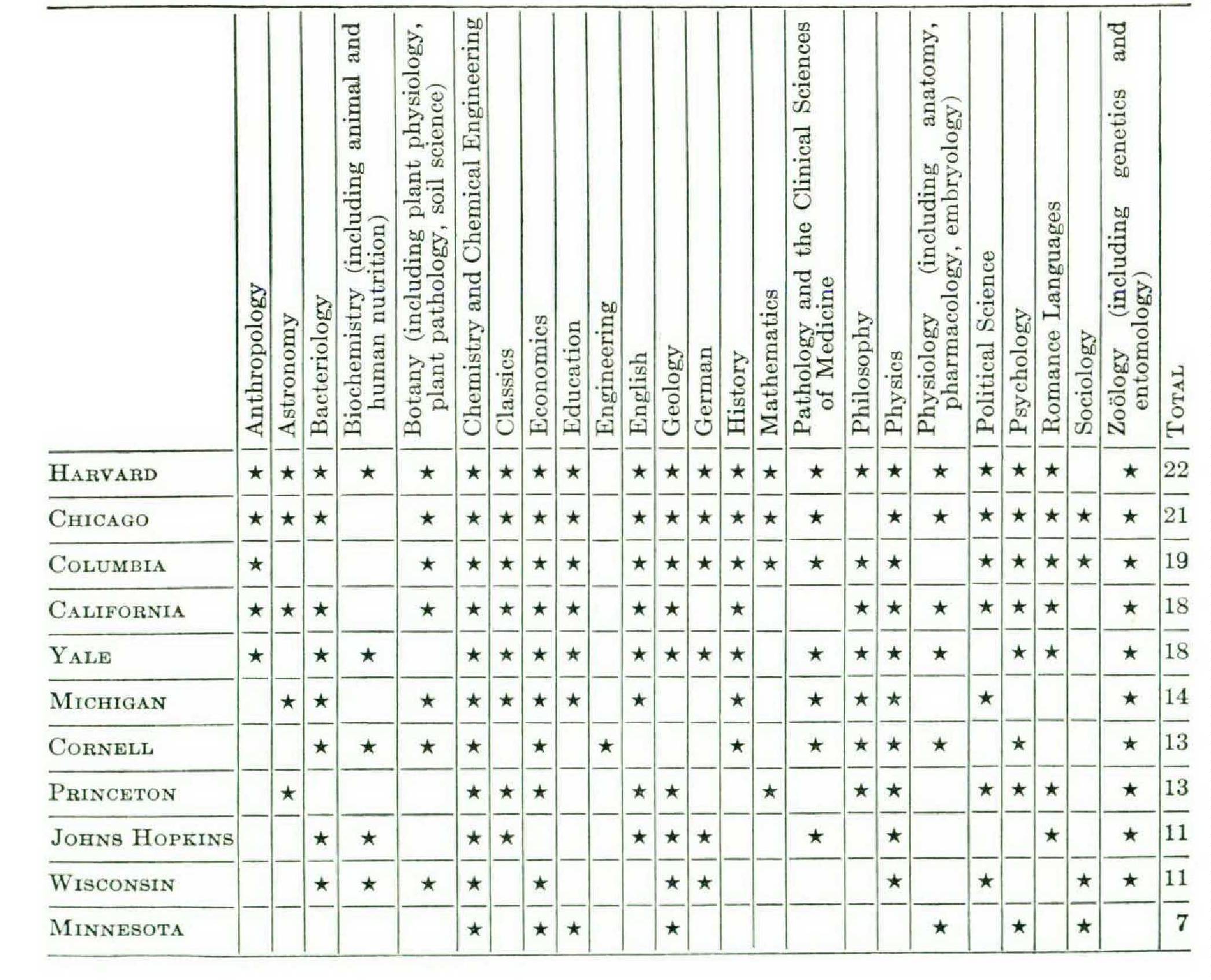
In my own tabulations I have carried the study somewhat beyond the tables of the American Council report. I have, for example, combined a number of the subdivisions of the sciences into the general basic subjects, so that there would be fairly equal units for comparison. I have also asked individuals to rate for me the basic medical sciences, which are omitted from the American Council study. In all, I have compiled twentyfour major departments of learning, including the medical sciences, as contrasted with the thirty-five subdivisions of the American Council report. A list of these departments and of the universities starred for distinction in each appears in the table on page 655. I have supplemented this study by a tabulation of the centres of concentration of the most eminent scientists as compiled in the starred lists of American Men of Science. In addition, I have consulted individual scholars and national committees which were in a position to judge the scholarly attainment of American universities.
It is surprising how consistently the several universities hold their relative places when any of these tests are applied, and it is amazing how uniform are the judgments of competent groups and individuals as to the standing of universities in given departments. For example, the American Council committee lists the universities most distinguished in anthropology as Harvard, Chicago, Columbia, California, Yale. I have asked anthropologists in various parts of the country to name the leading centres of this science; without hesitation every one has named these five universities, and no one has even mentioned any other. In certain other subjects the judgments are more difficult, but there is on the whole astonishing agreement among the scholars of any given discipline as to the university centres which are preëminent in that field. Remarkable also is the concentration of distinguished departments at a few universities. In the twenty-four basic subjects, 206 departments throughout the country are rated as of high excellence. The leading eleven universities account for 167 of these distinguished departments; only 39 are found scattered among all the other hundreds of universities and technical institutes of the United States.
There is nothing unusual or even very difficult in the rating of individual departments. That is currently done in all university thinking and planning. The thing that is out of the ordinary is to bring together these gradings of departments in an attempt to appraise the total scholarly eminence of the universities as a whole. While I have based my ratings on authoritative findings, most of which are matters of published record, I must in the end assume personal responsibility for the judgments.
With all these considerations and reservations in mind, here is my rating of American universities in the order of their scholarly eminence: —
1. Harvard
2. Chicago
3. Columbia
4. California
5. Yale
6. Michigan
7. Cornell
8. Princeton
9. Johns Hopkins
10. Wisconsin
11. Minnesota
II
Harvard is in a class by itself. This oldest of our institutions has maintained its priority for nearly three hundred years, almost the entire span of our colonial and national history. In 1636 the general court of Massachusetts Colony voted £400 toward a ‘schoale or colledge,’ whose site outside Boston was two years later named Cambridge in memory of the English university where some seventy of the leading men of the Colony had been educated. An immigrant Puritan minister, dying in Charlestown, Massachusetts, in 1638 bequeathed to the little wilderness seminary half of his estate, £780 and 260 books. In astonished gratitude the institution was at once named for him; thus John Harvard purchased enduring fame at one of the greatest bargains known to history.
Ever since Charles W. Eliot in 1869 began the transformation of a traditional New England college into America’s first university, Harvard has persistently held primacy among the nation’s institutions of higher learning. It is the richest as well as the oldest, holding probably the largest endowment for education ($128,000,000) of any organization in world history; it has on its faculty by far the greatest concentration of distinguished men of science — nearly 40 per cent more than any other university; it has the greatest number of stars in the American Council list of distinguished departments and also in my reclassification by basic departments. Of the twenty-four major branches of learning, Harvard is starred for distinction in all except sociology and the engineering sciences, which latter, in a very proper division of labor, it leaves to the Massachusetts Institute of Technology.
TABLE OF DISTINGUISHED DEPARTMENTS
Including All Universities Judged to Have More Than Five Departments of High Excellence
Furthermore, Harvard’s preëminence is widely — one might almost say universally — recognized among the laity as well as among scholars throughout this country and Europe. To hold a degree from Harvard carries social as well as scholastic distinction; to be a member of its faculty is an honor universally coveted; its president is ex officio the leader of American science and letters.
Even more striking in any study of American scholarship is the eminence of the University of Chicago. Here we have not an old foundation maintaining its standing, but a very new institution planted on the intellectually barren plains of a frontier, forging forward in pure scholarship ahead of institutions which had generations of distinguished history and tradition behind them. Chicago stands at least second by all the tests of eminence that have been applied. By certain of them she equals and even exceeds Harvard.
For example, in the earlier Hughes rating of relative standing of departments, Chicago had 8 departments rated first among all American universities, 4 rated second in eminence, and 5 third; Harvard had 7 firsts, 6 seconds, and 3 thirds. Of the twenty-four basic fields, Chicago is rated distinguished in all except the engineering sciences, philosophy, and biochemistry.
The University of Chicago is a shining example of what can be attained by the combination of ideals, consistent policy, and financial resources. Mr. Rockefeller generously poured in the millions that made it possible to build in the capital of America’s middle empire one of the world’s greatest universities — the most brilliant of all the accomplishments of the Rockefeller fortune. A total of $70,000,000 was given from Rockefeller sources, including the personal gifts and the later grants from the Rockefeller boards. The announcement, in the nineties, that salaries for top professors were to be $7000 rocked the academic world as much as Ford’s later offer to pay laborers five dollars a day shocked industry. The university’s generous and courageous attitude toward professors’ salaries ushered in a new era in academic life.
But it was not money alone that made the University of Chicago great. Even to-day her endowment is less than half that of Harvard and well below that of other Eastern universities which she outranks in scholarly eminence. Chicago’s distinction is in the fact that from the first she set out with single purpose, not to create a fashionable college or an enormous conglomerate institution, but to build a university in the real meaning of the term: a collection of the finest scientists and scholars, working with a selected group of mature students for the advancement of knowledge. The undergraduate college, although an exceedingly good one, has never been the major interest; nor has the University of Chicago maintained large schools for purely professional training.
William Rainey Harper was perhaps the most picturesque figure in the whole history of American universities. Born in an unheard-of little town in Ohio, educated at the then littleknown Muskingum College, he migrated for graduate study and teaching in Semitic languages to Yale and to a Baptist theological seminary in Chicago. No one would look in that beginning for the dynamic figure of American scholarship. But his Baptist and Midwest connections commended him to John D. Rockefeller and his advisers. And once chosen for the leadership of the new university, which was founded only forty-three years ago, Harper proved a wise and courageous builder, a persistent leech in sucking out Rockefeller millions, a ‘flashing comet in the western sky of the universe of learning.’
Columbia University, which has grown from the early foundations of King’s College in 1754 and the College of Physicians and Surgeons in 1767, is a strange conglomerate of contradictions. It sprawls on the northern hill of America’s largest metropolis. Its size is in the most blatant American tradition: an enrollment of over 30,000 students annually, of whom 10,000 are in the huge summer sessions and over 5000 in extension classes. It is on the one hand a university offering a series of well-knit courses of enriching study, and on the other a giant day school purveying knowledge in well-docketed packages to a huge population of eager and ambitious young people — aged sixteen to sixty. Its Teachers College, a semi-autonomous unit, grinds out courses and degrees to thousands of persons who return to every city and countryside of America with none too well digested ‘credits in education,’ on the basis of which they in turn pour instruction upon the defenseless heads of hundreds of thousands of pupils and pupil-teachers. Last year Teachers College gave the M. A. degree — that morsel delectable to all American teachers — to 1867 persons, all too many of them after merely a series of courses in educational busywork.
With all its size and in spite of its amorphous structure and uneven standards, Columbia has great intellectual wealth for those who care to search it out. It has excellent professional schools, especially in medicine and law. Even Teachers College, for all its degree-mongering, has some exceptionally fine scholars and some yeasty thinkers. The splendid graduate faculty is often embarrassed by the purple reputation of other departments, but its truly great scientists and scholars are not deflected from their high standards or their creative work. By any tests of scholarly eminence Columbia easily stands third among American universities. It has nineteen departments starred for distinction and numbers on its faculties fifty-four of America’s most distinguished scientists.1
III
The University of California is the leader of four state schools which find places in the list of preëminent centres of American learning. Only a few decades ago it was generally assumed that private endowments were the only guarantee of high scholarship and pure science. It was supposed that taxpayers and their legislators, while possibly willing to support extensively the passing on of knowledge to the younger generations, would never respect high standards or support research. Happily that has proved to be far from true. State universities are now in the very front rank of scholarship in America, as they have been for generations in Germany and France and most other countries except England.
In some ways state institutions are less secure than private foundations. Legislative appropriations which must be made afresh at each biennial session are less dependable than income on fixed endowment — at least they were supposed to be until the depression revealed the insecurity of any fiscal expectations. In the early days, politics tended to infect the administration of public universities. Even today an occasional outburst of political meddling occurs, as for example the scandal of a few years ago in Mississippi and the opéra bouffe antics last autumn in Louisiana. But the older state universities have won a real integrity, and the swift punishment by public opinion that recently struck the astonished heads of interfering politicians has pretty well taught selfseeking officials that they had better leave the educational institutions alone and concentrate upon easier and more accustomed spoils. While there has been some legislative interference with teaching, as in the notorious monkey laws of Tennessee, and while there are constant threats by individual legionnaires and legislators against advanced opinions in economics and the social sciences, there is in actual fact probably no more interference with the intellectual freedom of state universities than comes from reactionary donors and boards of trustees of private endowments.
The University of California — opened in 1869, only twenty years after the gold rush — has outstripped even Columbia in the doubtful distinction of bigness. Some 24,000 students are annually in residence there and about 30,000 more attend extension classes throughout the state. Huge professional schools spread over from the University’s seat in Berkeley into the city of San Francisco. And the jealousy of the southern section of the state has forced the development of a large subdivision in Los Angeles which already numbers nearly 7000 students, the overwhelming majority of whom are women studying to become teachers. In spite of its size and the factory aspects of certain of its divisions, the University of California in its higher departments has a galaxy of the most distinguished scholars and scientists in America, who have already set fine traditions in creative scholarship. Eighteen of the graduate departments of this university at the far shores of the Pacific are rated as among the scientific élite of America.
Yale for years has had the best undergraduate college in the United States. This is the purely personal opinion of a Yale graduate, since too many factors enter into college life to make objective appraisals possible. At any rate the college has always been Yale’s pride and joy. Recently even greater renown has come from the eminent graduate and professional schools, and from the distinctive contributions to scholarly publication of the Yale University Press. In material wealth Yale is exceeded only by Harvard. While a shocking proportion of her recent money — over $50,000,000 during the past decade — has gone into the most extravagant building programme ever known in academic history, this is not entirely the University’s fault. Those particular funds were available only for buildings, and during the same decade Yale has added even more — some $52,000,000 — to her endowment, which now amounts to the impressive total of $92,000,000.
Yale more than once has just missed the chance for primacy in American education. The most conspicuous instance was in the middle of the last century, when all the older colleges were in a rut and when an educational renaissance was simply waiting for a leader. The only signs of liberal education on the American horizon at that time were the newer universities of the West. The New England colleges of the fifties and sixties were still small seminaries where two to three hundred young gentlemen were presided over by clergymen and taught routine subjects by a dozen schoolmasters. There was a stalemate between the old classical teaching and the new sciences. It was not merely a question of alternative subjects. The old curriculum was almost entirely rote drill in grammatical construction and mechanical translation plus some equally routine crossword-puzzle work in mathematics, while the sciences were an intellectual adventure, an opportunity for the student to join actively with his professors in exploring new fields.
At both Yale and Harvard strong forces of revolt were in evidence. Able exponents of the new sciences were at each place and active discussions of educational policy were disturbing the centuries of complacency of faculty and trustees. Momentous decisions were being forced upon these historic colonial colleges. Harvard, amid anguish and debate, turned from its clerical and formalistic traditions and elected as president in 1869 a young professor of chemistry, Charles W. Eliot, who immediately began the building of America’s greatest university. At this same time Yale had carried even further than Harvard the new ideas in learning and had an even more brilliant group of scientists: Gibbs, Brewer, Brush, Marsh, Sumner, Dana, Gilman. Yale might have taken an educational step ahead of Harvard; she might have selected as the leader of a new programme the young geologist, Daniel C. Gilman, who in almost every way had the same relation to Yale and educational reform that Eliot had to Harvard. But Yale could not bring herself to accept her own greatness and potentialities. Instead, in 1863, the Sheffield Scientific School was founded as a separate corporation to foster the sciences which Yale College continued to snub, and in 1871 Reverend Noah Porter was made president to continue the clerical and schoolmasterish traditions.
Yale is sometimes referred to as the Mother of Colleges. Many of her graduates and professors have gone elsewhere to lead notable educational movements: Gilman to inaugurate the new University of California and to direct the brilliant course of Johns Hopkins, Andrew D. White to introduce fresh methods at Cornell, Harper to launch the University of Chicago, William H. Welch to start a new kind of medical education at Johns Hopkins, Charles H. Judd to create a great School of Education at Chicago, Guy Stanton Ford to build up one of the most vigorous of modern graduate schools at Minnesota, Robert M. Hutchins to introduce further educational liberalism at Chicago. Of course interchange of professors and leaders goes on continually among universities and is one of the means of educational progress. If Yale has suffered conspicuously, her loss is the nation’s gain.
IV
The next six universities fall clearly into the second bracket, but the relative rating among them is difficult. One can arrange this second set in any order among themselves and have good reasons for it, except that Minnesota, in spite of recent rapid gains, is still probably not above eleventh in scholarly eminence. I have set them down in a certain rank, which seems to me justified, but even the criteria that I have followed indicate first one order and then another.
Michigan is the oldest of the great group of Western state universities, dating in its direct ancestry to the ‘Catholepistemiad of Michigania’ of 1817 and in its present organization to one of the first acts of the legislature of the newly created State of Michigan in 1837. It has an honored history and an illustrious present. Cornell, which I place next, is especially strong in the sciences which underlie medicine and agriculture, and is one of the few general universities which have developed the engineering sciences to a high point. Michigan and Cornell were among the first to develop the new sciences. Even in the sixties both of them were moving toward the modern concept of a university.
Princeton has the most brilliant recent history of all the universities of this second group. Up to the year 1902, when Woodrow Wilson became its president, no one would have thought of naming Princeton in any list of institutions selected for scientific research or the advancement of knowledge. At that time it was familiarly referred to as ‘America’s most delightful country club.’ A fashionable assembly of young men between the ages of eighteen and twenty-two, many of them from the leading families of the Old South, were wont to spend four agreeable years in this New Jersey village, attending classes under benign and not too vigorous teachers, playing football with enthusiasm and success, and singing on balmy spring and autumn evenings on the steps of Old Nassau. Meanwhile the Princeton Theological Seminary, Presbyterian and fundamentalist, kept up the traditions of gentility untroubled by anything so bourgeois as intellectual struggle.
President Wilson declared, ‘The side shows have grown more important than the main tent,’ and set out ruthlessly to change it all. He attacked the student clubs, citadels of complacent snobbishness. He urged a tutorial system to stir the intellectual fire of individual students. He opposed the project of Dean West to remove the Graduate School to a separate and secluded plot, arguing that even undergraduates should be scholars, and that research and high intellectual endeavor should not be confined to cloisters but should inspire and infect the whole life of an institution. It is hard, thirty years later, to recapture the spirit of that struggle; the driving enthusiasm of the crusading president; the bitter anger of the guardians of Princeton’s pleasant traditions. Finally Dean West won his particular fight by getting a donation wdiich sealed the fate of the new Graduate School. Wilson resigned, and it looked as though any hope for keen scholarship at Princeton were lost. But the spirit of the crusade survived its leader. Fortunately the technical victory of Dean West secured not only a home but an endowment for graduate studies, and as a result scholarship was enthroned at Princeton as it had never been before.
Other events have added to the scientific eminence of the Princeton community. For twenty years the department of animal pathology of the Rockefeller Institute for Medical Research has been near by. More recently Abraham Flexner has also placed his Institute for Advanced Study in Princeton. This new graduate school will share in and add to the scientific wealth of the university. Dr. Flexner, a lifelong protagonist of the university ideal, is building his new organization exclusively on pure science in its higher reaches. Among his first appointments was Albert Einstein and he has added four others of the world’s greatest mathematicians to his small research group. Thus the mathematics personnel in this New Jersey community is already the most distinguished in the world. With Flexner’s recondite faculty and the new devotion to scholarship of Princeton itself, ably financed by wealthy alumni and friends, this university in a single generation has changed from America’s leading country club to one of the nation’s centres of highest scholarship.
Johns Hopkins is another exciting member of our galaxy of institutions of higher learning. It opened its doors in 1876 as the first real university in America — that is, the first institution to put its emphasis on the higher branches of knowledge. Established by what at that time was a fabulous bequest (seven million dollars) from a Baltimore merchant, — quizzically reputed to have been so ignorant that he did n’t even know how to spell his own first name, — the new university at once began to set fresh standards in American scholarship. The direction of the new school was put into the hands of a great scholar, Daniel C. Gilman, whose one purpose was to assemble a faculty of brilliant scientists and a student body of serious-minded scholars. The medical school, opened a decade and a half later under such leaders as William H. Welch and William Osier, transformed what had hitherto been regarded as routine professional training into an organization devoted largely to advancing the science of medicine.
The intellectual ferment stirred up by this new kind of university spread widely. The influence of the Baltimore institution was for many years paramount in American scholarship. It was a potent factor in the development of research and graduate instruction at Harvard, and it started a movement which twenty years later another new school, the University of Chicago, was able to carry much further. By all reasonable expectations Johns Hopkins should have developed into America’s leading institution of learning. But after the first dazzling bequest, and in spite of gifts totaling some twenty million dollars from the Rockefeller boards for the medical departments, the university has had great difficulty in financing itself. Furthermore, the urge to develop conventional departments became irresistible. College life on the handsome new campus at Homewood, the training of teachers, and extension courses have diverted a part of the attention which at first went solely to high scholarship. Johns Hopkins has failed to maintain the leadership that was expected of it fifty years ago. However, even to-day there are those who insist that it is still the finest of American universities, that within its resources — its annual budgets of approximately two and a half million dollars are less than one quarter those of Harvard, Columbia, and California — it devotes itself with more nearly single purpose to scholarship than any other institution on this continent.
The list closes with two of the most interesting of the Midwestern state universities — institutions which have combined the advancement of learning in its very highest branches with general educational service to the whole population of their states. Wisconsin has the older history of scholarship and of state-wide service, but during recent years Minnesota has been climbing rapidly while Wisconsin has lost some of the distinction she held during the great days of Van Hise. Under intelligent leadership of president and deans, infused equally with imagination and common sense, with political sagacity and downright courage, Minnesota offers to-day the finest example of what a university may mean in influence upon a whole great state.
I have not named the twelfth institution. This is not only to allow myself an alley of escape from the fierce claims of a multitude of universities to a place in America’s first dozen, but because no other institution, by any objective tests that I have applied, approaches the eminence of the eleven I have listed. If one were to attempt to fill this place he would have to weigh the claims of a number of universities which have distinction in certain branches but which lack the widespread eminence of the leaders. The most active contestants for twelfth place are Stanford University in California, the Universities of Pennsylvania, Illinois, and Iowa, and Ohio State University. Washington University, in Saint Louis, and the University of Rochester are strong in the medical sciences but not equally so in other subjects. The two great technical schools — Massachusetts Institute of Technology and California Institute of Technology — are preëminent in engineering and mathematics and the physical sciences which underlie this profession, but they lack the universality of scholarship implied in the term ‘university.’
V
It would be agreeable to turn for a moment from this consideration of pure scholarship to contemplate schools
which are most interesting for other reasons. So far as undergraduates are concerned, the advancement of the borders of truth is not of such immediate concern as a stimulating environment in which to acquire a general grasp of existing knowledge and to begin a wholesome growth toward the ideal of a scholar and a gentleman.
If I were picking a small college, I should place Swarthmore at the head of the list. Standing just outside the culturally rich city of Philadelphia, with a tolerant and intelligent Quaker background, this college is one of the few smaller institutions which have been able to appoint professors of a distinction approaching those of the great universities, yet has never forgotten the fact that stimulating teaching is the first duty of a college. Under the able direction of President Aydelotte it has eschewed the temptations of bigness or any kind of professional training and has concentrated its very considerable resources on first-rate general education.
America has plenty of good small colleges. Among them Amherst and Williams in Massachusetts, Carleton in Minnesota, and the Claremont group of colleges in Southern California happen to be my favorites. Dartmouth, in the New Hampshire hills, is a most excellent place. Founded about 1750 by a Yale graduate first as a charity school for Indians, Dartmouth has educated many of America’s famous men and has held an honorable place for nearly two centuries among the group of New England colleges which were the beginnings of American education. In spite of its recent growth in numbers and wealth, it takes pride in keeping itself a college rather than a university, cherishing the historic plea of Daniel Webster before the United States Supreme Court which established the inviolable rights of the college. There has grown up recently an active group of ‘progressive colleges,’ among the most notable of which are Antioch in Ohio and Bennington (for women only) in Vermont.
The most exciting American institution for the general undergraduate student is the University of Hawaii. Situated on the slopes of the picturesque volcanic hills of Honolulu, at the crossroads of the Pacific, this youngest of our state universities offers sound instruction in the conventional subjects and a stirring education in world citizenship obtainable nowhere else. Among its educational influences is the presence of considerable numbers of able and attractive Japanese and Chinese students who guarantee an intellectual competition stimulating and often distressing even to the best of Nordic brains. A smaller number of Polynesians and a few students from Australia, New Zealand, the Philippines, and other Pacific countries combine to make this the most cosmopolitan of American colleges. The presence on the regular faculty of a Japanese and a Chinese professor and visiting lecturers from many countries of Europe and Asia, together with scholarly attention to Eastern arts and civilizations as well as to those of the West, offer a broadening of view highly desirable to the average American youth. The atmosphere is stimulating also because of the important scientific research of the biological experiment stations of the large sugar and pineapple interests of the Islands, the investigations in ethnology and natural history of the Bishop Museum, and the special studies of Pacific problems, both social and physical, supported by special grants from foundations.
A similarly stimulating environment is the University of New Mexico, where the student may rub shoulders with Indian, Spanish, and Anglo-Saxon cultures in a setting refreshing both as to human and as to natural scene.
For their undergraduate course I strongly advise every boy and girl who can possibly do it to go to a college outside the home region. This is done by large numbers from the West and South, who, as a matter of course, go East to college. But one reason why New England and the North Atlantic seaboard are so much more provincial than other sections of the country is that Eastern students have not even considered going elsewhere for their education. To-day excellent colleges may be found all the way from Boston to Hawaii, and any student who does not roam a thousand miles or more during his undergraduate years misses the very considerable educational stimulus of fresh environment.
VI
In contemplating American scholarship, the sectional distribution of the great centres is significant. A surprise is the wealth of the Midwest in institutions of the first rank. Of course the Eastern seaboard still holds priority. Of the eleven universities named in my list, five are on the Atlantic coast and one other, Cornell, while still regarded by New Englanders as hopelessly Western, is really a part of the Atlantic coastal group. The preponderance of America’s scholars is still in the East, where the nation began. Nevertheless, one who has not thought much about it is amazed to find that four of America’s eleven greatest centres of learning, and in addition three of the five most active claimants to twelfth place, are in that section which is so very new and which is supposed to have little regard for anything above the material progress represented by harvesting machines, canned meat, the wheat pit, and mailorder catalogues.
The scholastic eminence of the Midwest is due largely to a single influence: the fact that the University of Chicago was enabled to build itself into an institution of such high distinction that it set standards and established traditions which the surrounding universities were almost forced to follow. The Rockefeller millions and the Harper leadership not only created a great university; they transformed the intellectual standards of a whole region.
An even more striking item is that no university in the whole South is of a scholarly eminence justifying a place on this list or even on much longer catalogues of America’s leading universities. The Atlantic seaboard, the Midwest, and the Pacific slope are all contributing toward the highest reaches of the intellectual life. The South alone is outside the main currents of science and scholarship.
The Association of American Universities has admitted to its membership only three Southern institutions: the Universities of North Carolina, Virginia, and Texas. In the twenty-four fundamental branches of learning which I have used as the basis of my tabulation, there are a total of 206 university departments throughout the country rated as distinguished. Of these, only one is found in a Southern university — the Institute for Research in Social Science under the brilliant direction of Dr. Howard Odum at the University of North Carolina.2 One place of eminence out of two hundred for a region which represents nearly a third of the area and more than a quarter of the population of the entire nation!
I comment on this shortage in the South, not in captious criticism, but in the earnest hope that something will be done about it. The South is still producing about as many of the nation’s leaders as any other region. But the lack of business opportunity has driven most of the industrially ambitious to careers in the North, and the lack of intellectual opportunity has driven the best brains to universities in the East and West for their advanced study and for their academic careers. Even one university of first rank would rally the intellectual forces of the region, would provide a centre at which Southern scholars could make their careers and to which a fair share of the best minds of other sections could be drawn. And it might be expected to have immediate influence on neighboring institutions, just as Chicago has raised the scholarly tone of the whole group of Midwestern universities.
Happily there are centres which might readily be built into great universities. In addition to the three which are now members of the Association of American Universities, promising Southern institutions are Vanderbilt in Nashville, Tulane in New Orleans, Duke in central North Carolina, and Emory in Atlanta.
It is probable that money from outside the South will be required to build a great university. Rockefeller, Carnegie, Vanderbilt, and others have already helped to create the present centres. It is natural and proper that wealth from any part of America should interest itself in a Southern university, for progress by the nation as a whole is dependent upon well-rounded growth of each of the sections. Contributions to a notable centre of scholarship for the South may easily be repaid in a single generation by scientific discoveries made at that institution and by the raising of the intellectual level of a whole section of the American commonwealth. A great university in the South is the insistent need in American scholarship to-day.
- A tabulation of the scientists starred for distinction in the 1932 edition of American Men of Science, excluding those who are retired or emeritus, shows that they are concentrated at the following universities, including in the list only institutions having twenty-five or more: Harvard 78, Chicago 57, Columbia 54, Yale 50, California 40, Johns Hopkins 39, Cornell 35, Princeton 31, Wisconsin 30, Michigan 29, Minnesota 26, Pennsylvania 26, Stanford 25.↩
- Another measure of scientific standing is a study of the universities at which the leading scientists received preparation for their careers. The scientists starred for distinction in the 1927 and 1932 editions of American Men of Science took their advanced study, culminating in the Ph. D. or Sc. D., at the following universities, listing only those with twenty-five or more: Harvard 101, Chicago 90, Columbia 05, Johns Hopkins 50, Yale 37, Cornell 32, Princeton 29, California 25. — AUTHOR↩
- In the American Council list of thirty-five departments and subdepartments, the University of Texas is also starred for eminence in the specialty of genetics. Scholarly assets begin to appear in at least two Negro universities: Fisk and Atlanta. The division of social science under Charles S. Johnson at Fisk is among the most productive of Southern institutes. — AUTHOR↩