The Contributors' Column
Wayne Coy (p. 399) has packed into the last ten years the equivalent of several full-blown careers. Proprietor of the Delphi (Indiana) Citizen at age twenty-seven, he left newspaper work to become Indiana State Relief Administrator in 1934. A year later he was appointed administrator of the WPA in Indiana, and in 1936 he organized the state Department of Public Welfare for Paul V. McNutt, then governor, who later took him as his assistant to the Philippines and to Washington. Two years as assistant administrator of the Federal Security Agency brought Mr. Coy, in 1941, to the fore as one of the most effective trouble-shooters in the Federal service, and President Roosevelt made him his liaison officer for the OEM. His friends describe him as that rare being, ‘the uncommonly skilled administrator with plenty of nerve.’ Mr.
Coy was born in Shelby County, Indiana, in 1903 and was graduated from Franklin College in 1926. This is his first appearance in the Atlantic.
Idle slurs on our allies receive their just deserts from the pen of David L.
Cohn (p. 404), whose brilliant analysis of Chapel Hill enlivened the March Atlantic a year ago.
Irony is one of the scarcest literary commodities. Our encounter with Oscar Lewis’s (p. 408) Professor Casement recalls some of the early Beerbohm portraits, possibly a Thurber or two. Knopf will publish shortly his novel, I Remember Christine, of which this is the first chapter. The Atlantic serialized five years ago his fine history of the great California fortunes, The Big Four.
Recently two interesting commentaries on modern verse have come to our attention. The first declaration reaches us from England. Its author, George Allen (p. 416), says that it was written during intensive work for the Ministry of Health and ‘is really a record of mobilization.’ The second is by
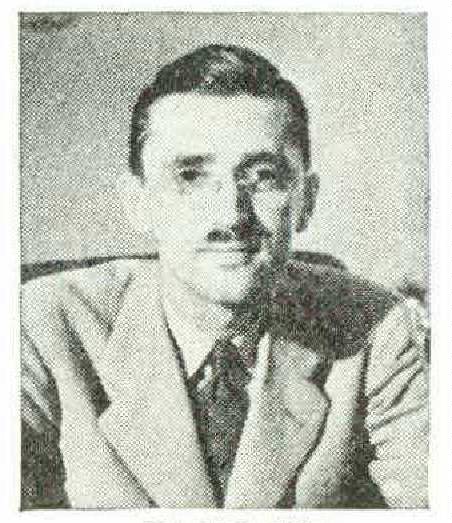
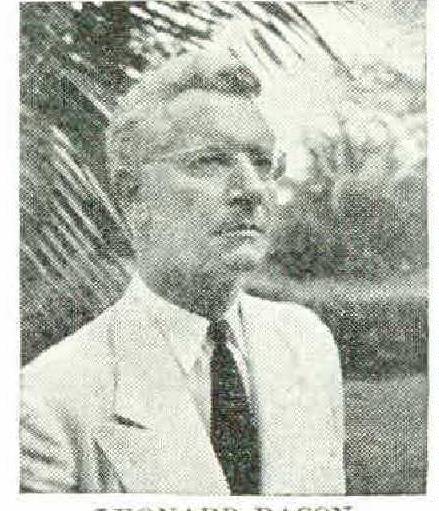
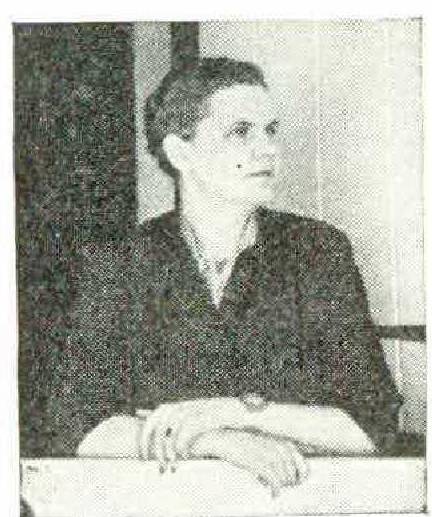
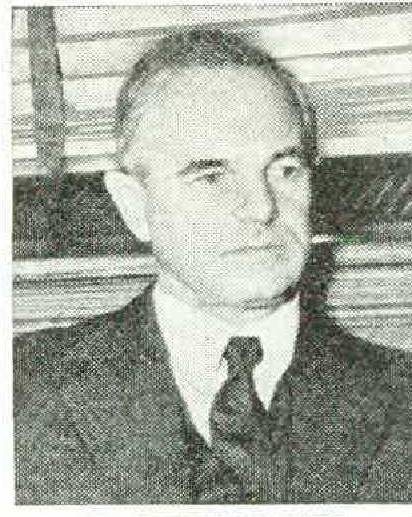
Leonard Bacon (p. 417), who has been publishing poetry since 1909, the year of his graduation from Yale, and who has more than sixteen volumes to his credit. In 1941 he received the Pulitzer Prize for his most recent collection.
H. Duncan Hall (p. 418) told the editor of the Atlantic, a few weeks ago, that one of his earliest recollections was the game all Australian children played — defending their own neighborhood against a mythical invasion by the Japanese. His later career was well suited to keeping him thoroughly informed on Pacific affairs. He was leader of the Australian Delegation at the first meeting of the Institute of Pacific Relations and for twelve years served as an official of the League of Nations Secretariat in Geneva. As liaison officer for the British Dominions he has traveled on official missions throughout the Pacific war area. Mr. Hall has been visiting professor at several American universities and is at present associated with the Harvard University Bureau of International Research, where he is engaged in the study of post-war reconstruction. A native Australian and author of The British Commonwealth of Nations, perhaps the standard work on the structure of empire, he is a distinguished newcomer to our pages.
Having followed Howard Spring (p. 426) through his leaner years, we find him in our final selection from his autobiography the writing man in his heyday. One could think of no more pleasant recognition of ‘arrival’ by a British author than his presence, through invitation, on the battleship Prince of Wales last August when the President and Mr. Churchill agreed on their historic Atlantic Charter.
Long acquainted with the importance of Sir Richard Stafford Cripps in the struggle by the left wing for recognition in British parliamentary circles, Oswald Garrison Villard (p. 433) is especially qualified to interpret the recent changes which have installed Cripps as the ‘strong man’ in Winslon Churchill’s new cabinet. Celebrated for his editorship of the Nation, Mr. Villard is the author of many books and articles and has long been a stalwart among Atlantic contributors.
Concluding in this issue our excerpts from Marjorie Kinnan Rawlings’s (p. 439) new book, which Scribners will soon publish, we are bound to wonder when we shall find again such reassuring, friendly writing. It will cheer us to have the small human relationships of Cross Creek in mind when we contemplate the Axis-ridden areas where kindness is all but a crime against the state.
Count Michael de la Bedoyere (p.
451) is the editor of the Catholic Herald, one of England’s three Catholic weekly newspapers. This paper has gained increasing influence during the war through the uncompromising stand it makes against the wartime philosophy of ‘the end justifying the means.’ The Count’s wartime book, Christian Crisis, was published in England last winter and is due for publication in America shortly.
Atlantic readers have long enjoyed the poetry and essays of Conrad Aiken (pp. 458, 476). A native Georgian, he has turned his hand to novels and stories as well as to poetry and criticism.
His latest book is scheduled for fall publication.
For the distinction of its editorial page the Richmond Times-Dispatch, of which Virginius Dabney (p. 459) is editor, has long been outstanding among American newspapers.
His writing has won many awards, and his first appearance in the Atlantic is in terms of a subject on which he commands broad respect. A University of Virginia graduate, he has been a newspaper man for twenty years.
His book, Liberalism in the South, was published in 1932, and Appleton-Century will issue his new work, Below the Potomac: A Book about the New South, in March.
From his Vermont farm Wilson Follett (p. 469) continues to flavor our pages with rural New England. His case for hand crafts may hold unsuspected values for the machine age.
Since the Atlantic published ‘Hook,’ the story of an American hawk, by Walter Van Tilburg Clark (p. 482), his first novel, The Ox-bow Incident, has gained a solid place for itself, and we are glad to have him in our pages again with another unusual story of the wilds. He has been carrying on, we learn, from a ranch in Las Vegas, Nevada, with occasional returns to his home at Cazenovia, New York.
The Atlantic is always proud to discover new talent. This spring brought us a young poet from Evansville, Indiana. Marion Edith Smith (p. 492), co-proprietor of a small and struggling book-and-gift shop in Evansville, is New Englander by birth and was graduated from the University of New Hampshire in 1930.
A teacher of English at the University of Texas, Randall Jarrell (p. 493) was first introduced to Atlantic readers in the New American Poets group last October. He was one of live young poets represented in the 1940 anthology of the New Directions Press.
William Henry Chamberlin (p. 494), the well-known foreign correspondent, gives us the first results of a thoroughgoing inquiry into Canada’s war efforts and attitudes. A familiar contributor to the Atlantic, he has just completed a lecture tour in the Middle West.
For top-to-bottom knowledge of radio we commend to you Robert J. Landry (p. 503), radio editor of that unique and imperishable Bible of the theatre and entertainment field, Variety. He is an authority on the whole complex structure of the broadcasting corporations and their affiliates, and on their constantly shifting relationships with the Federal Communications Commission as well. His judgments as a critic of radio programs are accepted as virtually final, and he was one of the first to perceive our need for a sharper qualitative review of what goes out over the air waves. This is his first appearance in the Atlantic.
We continue with the third of four installments of The Children, by Nina Fedorova (p. 513), who brought from embattled China in 1938 the wealth of material she fashions into novels. Born in Southern Russia, she escaped with her family from the disorders of 1919, moving into Manchuria and I hence to Tientsin. Her novel, The Family, won the Atlantic $10,000 Prize two years ago.