Common Sense and the Universe
I
SPEAKING last December at the annual convention of the American Association for the Advancement of Science, and speaking, as it were, in the name of the great 100-inch telescope under his control, Professor Edwin Hubble, of the Mount Wilson Observatory, California, made the glad announcement that the universe is not expanding. This was good news indeed, if not to the general public who had no reason to suspect that it was expanding, at least to those of us who humbly attempt to ‘follow science.’ For some twenty-five years past, indeed ever since the promulgation of this terrific idea in a paper published by Professor W. de Sitter in 1917, we had lived as best we could in an expanding universe, one in which everything, at terrific speed, kept getting further away from everything else. It suggested to us the disappointed lover in the romance who leaped on his horse and rode madly off in all directions. The idea was majestic in its sheer size, but it somehow gave an uncomfortable sensation.
Yet we had to believe it. Thus, for example, we had it on the authority of Dr. Spencer Jones, the British Astronomer Royal, as recently as in his new and fascinating book of 1940, Life on Other Worlds, that ‘a distant universe in the constellation of Boötes has been found to be receding with a velocity of 24,300 miles a second. We can infer that this nebula is at a distance of 230,000,000 light-years.’ I may perhaps remind my fellow followers of science that a lightyear means the distance traveled in one year by light, moving at 186,000 miles a second. In other words, this ‘distant universe’ is now 1,049,970,980,000,000,000,000 miles away.
Some distance! as Mr. Churchill would say.
But now it appears that that distant universe has not been receding at all; in fact, it isn’t away out there. Heaven knows where it is. Bring it back. Yet not only did the astronomers assert the expansion but they proved it, from the behavior of the red band in the spectrum, which blushed a deeper red at the revelation of it, like the conscious water that ‘saw its God and blushed’ at Cana in Galilee long ago. One of the most distinguished and intelligible of our astronomers, Sir Arthur Eddington, had written a book about it, The Expanding Universe, to bring it down to our level. Astronomers at large accepted this universal explosion in all directions as calmly as they once accepted the universal fall of gravitation, or the universal death in the cold under Carnot’s Second Law of Thermodynamics.
But the relief brought by Professor Hubble is tempered on reflection by certain doubts and afterthoughts. It is not that I venture any disbelief or disrespect toward science, for that is as atrocious in our day as disbelief in the Trinity in the days of Isaac Newton. But we begin to doubt whether science can quite keep on believing in and respecting itself. If we expand today and contract tomorrow; if we undergo all the doubled-up agonies of the curvature of space only to have the kink called off, as it has been; if we get reconciled to dying a martyr’s death at one general, distributed temperature of 459 degrees below zero, the same for all, only to find that the world is perhaps unexpectedly warming up again — then we ask, where are we? To which, of course, Einstein answers ‘Nowhere,’ since there is no place to be. So we must pick up our little book again, follow science, and wait for the next astronomical convention.
Let us take this case of the famous Second Law of Thermodynamics, that inexorable scroll of fate which condemned the universe — or at least all life in it — to die of cold. I look back now with regret to the needless tears I have wasted over that, the generous sympathy for the last little band of survivors, dying at 459 degrees below our zero ( — 273° centigrade), the absolute zero of cold when the molecules cease to move and heat ends. No stove will light at that, for the wood is as cold as the stove, and the match is as cold as both, and the dead fingers motionless.
I remember meeting this inexorable law for the first time in reading, as a little boy, a piece of ‘popular science’ entitled Our Great Timepiece Running Down. It was by Richard Proctor, whose science-bogeys were as terrifying as Mrs. Crow’s Night Thoughts, only slower in action. The sun, it appeared, was cooling; soon it would be all over. Lord Kelvin presently ratified this. Being Scotch, he didn’t mind damnation and he gave the sun and whole solar system only ninety million years more to live.
This famous law was first clearly enunciated in 1824 by the great French physicist, Nicolas Carnot. It showed that all bodies in the universe kept exchanging their temperature — hot things heated cold, and cold things chilled hot. Thus they pooled their temperature. Like the division of a rich estate among a flock of poor relations, it meant poverty for all. We must all share ultimately the cold of absolute space.
It is true that a gleam of hope came when Ernest Rutherford and others, working on radioactivity, discovered that there might be a contrary process of ‘stoking up.’ Atoms exploding into radioactivity would keep the home fires burning in the sun for a long time. This glad news meant that the sun was both much older and much younger than Lord Kelvin had ever thought it was. But even at that it was only a respite. The best they could offer was 1,500,000,000 years. After that we freeze.
And now what do you think! Here comes the new physics of the Quantum Theory and shatters the Second Law of Thermodynamics into gas — a word that is Dutch for chaos. The world may go on forever. All of this because of the final promulgation of the Law of the Quantum, — or, shall we say, the Law of the Just So Much, — of which we shall presently speak. These physical people do not handle their Latin with the neat touch of those of us who knew our declensions as they know their dimensions. Of course they mean Tantum — but let it go at that. Quantum is drugstore Latin, quantum sufficit. Tantum is the real thing — Virgilium vidi tantum (‘I saw something of Virgil’).
At this point I may perhaps pause to explain that the purpose of this article is not to make fun of science, nor to express disbelief in it, but only to suggest its limits. What I want to say is that when the scientist steps out from recording phenomena and offers a general statement of the nature of what is called ‘reality,’ the ultimate nature of space, of time, of the beginning of things, of life, of a universe, then he stands exactly where you and I do, and the three of us stand where Plato did — and long before him, Rodin’s primitive thinker.
Consider this. Professor Hubble, like Joshua, has called upon the universe to be still. All is quiet. The universe rests, motionless, in the night sky. The mad rush is over. Every star in every galaxy, every island universe, is at least right where it is. But the old difficulty remains: Does it go forever, this world in the sky, or does it stop? Such an alternative has posed itself as a problem for every one of us, somewhere about the age of twelve. We cannot imagine that the stars go on forever. It’s unthinkable. But we equally cannot imagine that they come to a stop and that beyond them is nothing, and then more nothing. Unending nothing is as incomprehensible as unending something. This alternative I cannot fathom, nor can Professor Hubble, nor can anyone ever hope to.
Let me turn back in order to make my point of view a little clearer. I propose to traverse again the path along which modern science has dragged those who have tried to follow it for about a century past. It was at first a path singularly easy to tread, provided that one could throw aside the inherited burden of superstition, false belief, and prejudice. For the direction seemed verified and assured all along by the corroboration of science by actual physical results. Who could doubt electricity after the telegraph? Or doubt the theory of light after photography ? Or the theory of electricity when read under electric light? At every turn, each new advance of science unveiled new power, new mechanism of life — and of death. To ‘ doubt science’ was to be like the farmer at the circus who doubted the giraffe. Science, of course, had somehow to tuck into the same bed as Theology, but it was the theologian who protested. Science just said, ‘Lie over.’
Let us follow then this path.
II
When mediæval superstition was replaced by the new learning, mathematics, astronomy, and physics were the first sciences to get organized and definite. By the opening of the nineteenth century they were well set; the solar system was humming away so drowsily that Laplace was able to assure Napoleon that he didn’t need God to watch over it. Gravitation worked like clockwork and clockwork worked like gravitation. Chemistry, which, like electricity, was nothing but a set of experiments in Benjamin Franklin’s time, turned into a science after Lavoisier had discovered that fire was not a thing but a process, something happening to things — an idea so far above the common thought that they guillotined him for it in 1794. Dalton followed and showed that all things could be broken up into a set of very, very small atoms, grouped into molecules all acting according to plan. With Faraday and Maxwell, electricity, which turned out to be the same as magnetism, or interchangeable with it, fell into its place in the new order of science.
By about 1880 it seemed as if the world of science was fairly well explained. Metaphysics still talked in its sleep. Theology still preached sermons. It took issue with much of the new science, especially with geology and the new evolutionary science of life that went with the new physical world. But science paid little attention.
For the whole thing was so amazingly simple. There you had your space and time, two things too obvious to explain. Here you had your matter, made up of solid little atoms, infinitely small but really just like birdseed. All this was set going by and with the Law of Gravitation. Once started, the nebulous world condensed into suns, the suns threw off planets, the planets cooled, life resulted and presently became conscious, conscious life got higher up and higher up till you had apes, then Bishop Wilberforce, and then Professor Huxley.
A few little mysteries remained, such as the question of what space and matter and time and life and consciousness really were. But all this was conveniently called by Herbert Spencer the Unknowable, and then locked in a cupboard and left there.
Everything was thus reduced to a sort of Dead Certainty. Just one awkward skeleton remained in the cupboard. And that was the peculiar, mysterious aspect of electricity, which was not exactly a thing and yet more than an idea. There was also, and electricity only helped to make it worse, the old puzzle about ‘action at a distance.’ How does gravitation pull all the way from here to the sun? And if there is nothing in space, how does light get across from the sun in eight minutes, and even all the way from Sirius in eight years?
Even the invention of ‘ether’ as a sort of universal jelly that could have ripples shaken across it proved a little unconvincing.
Then, just at the turn of the century the whole structure began to crumble.
The first note of warning that something was going wrong came with the discovery of X-rays. Sir William Crookes, accidently leaving round tubes of rarefied gas, stumbled on ‘radiant matter,’ or ‘matter in the fourth state,’ as accidentally as Columbus discovered America. The British Government knighted him at once (1897) but it was too late. The thing had started. Then came Guglielmo Marconi with the revelation of more waves, and universal at that. Light, the world had learned to accept, because we can see it, but this was fun in the dark.
There followed the researches of the radioactivity school and, above all, those of Ernest Rutherford which revolutionized the theory of matter. I knew Rutherford well as we were colleagues at McGill for seven years. I am quite sure that he had no original intention of upsetting the foundations of the universe. Yet that is what he did and he was in due course very properly raised to the peerage for it.
When Rutherford was done with the atom all the solidity was pretty well knocked out of it.
Till these researches began, people commonly thought of atoms as something like birdseed, little round solid particles, ever so little, billions to an inch. They were small. But they were there. You could weigh them. You could apply to them all the laws of Isaac Newton about weight and velocity and mass and gravitation — in other words, the whole of first-year physics.
Let us try to show what Rutherford did to the atom. Imagine to yourself an Irishman whirling a shillelagh round his head with the rapidity and dexterity known only in Tipperary or Donegal. If you come anywhere near you’ll get hit with the shillelagh. Now make it go faster; faster still; get it going so fast that you can’t tell which is Irishman and which is shillelagh. The whole combination has turned into a green blur. If you shoot a bullet at it, it will probably go through, as there is mostly nothing there. Yet if you go up against it, it won’t hit you now, because the shillelagh is going so fast that you will seem to come against a solid surface. Now make the Irishman smaller and the shillelagh longer. In fact you don’t need the Irishman at all; just his force, his Irish determination, so to speak. Just keep that, the disturbance. And you don’t need the shillelagh either, just the field of force that it sweeps. There! Now put in two Irishmen and two shillelaghs and reduce them in the same way to one solid body — at least it seems solid but you can shoot bullets through it anywhere now. What you have now is a hydrogen atom — one proton and one electron flying round as a disturbance in space. Put in more Irishmen and more shillelaghs — or, rather, more protons and electrons — and you get other kinds of atoms. Put in a whole lot — eleven protons, eleven electrons; that is a sodium atom. Bunch the atoms together into combinations called molecules, themselves flying round — and there you are! That’s solid matter, and nothing in it at all except disturbance. You’re standing on it right now: the molecules are beating against your feet. But there is nothing there, and nothing in your feet. This may help you to understand how ‘waves,’ ripples of disturbance, — for instance, the disturbance you call radio, — go right through all matter, indeed right through you, as if you weren’t there. You see, you aren’t.
The peculiar thing about this atomic theory was that whatever the atoms were, birdseed or disturbance, it made no difference to the way they acted. They followed all the laws of mechanics and motion, or they seemed to. There was no need to change any idea of space or time because of them. Matter was their ‘fort,’ like wax figures with Artemus Ward.
One must not confuse Rutherford’s work on atoms with Einstein’s theories of space and time. Rutherford worked all his life without reference to Einstein. Even in his later days at the Cavendish Laboratory at Cambridge when he began, ungratefully, to smash up the atom that had made him, he needed nothing from Einstein. I once asked Rutherford — it was at the height of the popular interest in Einstein, in 1923 — what he thought of Einstein’s relativity. ‘Oh, that stuff!’ he said. ‘We never bother with that in our work!’ His admirable biographer, Professor A. S. Eve, tells us that when the German physicist Wien told Rutherford that no Anglo-Saxon could understand relativity Rutherford answered, ‘No, they have too much sense.’
But it was Einstein who made the real trouble. He announced in 1905 that there was no such thing as absolute rest. After that there never was. But it was not till just after the Great War that the reading public caught on to Einstein and little books on ‘Relativity’ covered the bookstalls.
Einstein knocked out space and time as Rutherford knocked out matter. The general viewpoint of relativity towards space is very simple. Einstein explains that there is no such place as here. ‘ But,’ you answer, ‘I’m here; here is where I am right now.’ But you’re moving, you’re spinning round as the earth spins; and you and the earth are both spinning round the sun, and the sun is rushing through space towards a distant galaxy, and the galaxy itself is beating it away at 26,000 miles a second. Now where is that spot that is here! How did you mark it? You remember the story of the two idiots who were out fishing, and one said, ‘We should have marked that place where we got all the fish,’ and the other said, ‘I did, I marked it on the boat.’ Well, that’s it. That’s here.
You can see it better still if you imagine the universe swept absolutely empty: nothing in it, not even you. Now put a point in it, just one point. Where is it? Why, obviously it’s nowhere. If you say it’s right there, where do you mean by there? In which direction is there? In that direction? Oh! hold on, you’re sticking yourself in to make a direction. It’s in no direction; there aren’t any directions. Now put in another point. Which is which? You can’t tell. They both are. One is on the right, you say, and one on the left. You keep out of that space! There’s no right and no left.
The discovery by Einstein of the curvature of space was greeted by the physicists with the burst of applause that greets a winning home-run at baseball. That brilliant writer just mentioned, Sir Arthur Eddington, who can handle space and time with the imagery of a poet, and even infiltrate humor into gravitation, as when he says that a man in an elevator falling twenty stories has an ideal opportunity to study gravitation — Sir Arthur Eddington is loud in his acclaim. Without this curve, it appears, things won’t fit into their place. The fly on the globe, as long as he thinks it flat (like Mercator’s map), finds things shifted as by some unaccountable demon to all sorts of wrong distances. Once he gets the idea of a sphere everything comes straight. So with our space. The mystery of gravitation puzzles us, except those who have the luck to fall in an elevator, and even for them knowledge comes too late. They weren’t falling at all: just curving. ‘Admit a curvature of the world,’ wrote Eddington in his Gifford Lectures of 1927, ‘and the mysterious agency disappears. Einstein has exorcised this demon.’
But it appears now, fourteen years later, that Einstein doesn’t care if space is curved or not. He can take it either way. A prominent physicist of today, head of the department in one of the greatest universities of the world, wrote me on this point: ‘Einstein had stronger hopes that a general theory which involved the assumption of a property of space, akin to what is ordinarily called curvature, would be more useful than he now believes to be the case.’ Plain talk for a professor. Most people just say Einstein has given up curved space. It’s as if Sir Isaac Newton years after had said, with a yawn, ‘Oh, about that apple — perhaps it wasn’t falling.’
III
But unhappily we can’t get away from the new physics quite as simply as that. Even if we beat them out on space and time, there is far worse to come. That’s only the start of it, for now, as the fat boy in Pickwick said, ‘I’m going to make your flesh creep.’ The next thing to go is cause and effect. You may think that one thing causes another. It appears that it doesn’t. And of course, when cause and effect go, the bottom is out of the universe, since you can’t tell, literally can’t, what’s going to happen next. This is the consequence of the famous Quantum Theory, first hinted at by Professor Max Planck about forty years ago and since then scrambled for by the physicists like dogs after a bone. It changes so fast that when Sir Arthur Eddington gave the Gifford Lectures referred to, he said to his students that it might not be the same when they met next autumn.
But we cannot understand the full impact of the Quantum Theory, in shattering the world we lived in, without turning back again to discuss time in a new relation, namely, the forward-andbackwardness of it, and to connect it up again with the Second Law of Thermodynamics — the law, it will be recalled, that condemns us to die of cold. Only we will now call it by its true name, which we had avoided before, as the Law of Entropy. All physicists sooner or later say, ‘ Let us call it Entropy,’ just as a man says, when you get to know him, ‘Call me Charlie.’
So we make a new start.
I recall, as some other people still may, a thrilling melodrama called The Silver King. In this the hero, who thinks he has committed a murder (of course, he hasn’t really), falls on his knees and cries, ‘Oh, God, turn back the universe and give me yesterday.’ The supposed reaction of the audience was ‘Alas, you can’t turn back the universe! ‘
But nowadays it would be very different. At the call the Spirit of Time would appear — not Father Time, who is all wrong, being made old, but a young, radiant spirit in a silver frock made the same back and front. ‘Look,’ says the Spirit, ‘I’m going to turn back the universe. You see this wheel turning round. Presto! It’s going the other way! You see this elastic ball failing to the floor. Presto! It’s bouncing back. You see out of the window that star moving west. Presto! It’s going east. Hence accordingly,’ continues the Spirit, now speaking like a professor, so that the Silver King looks up in apprehension, ‘ time as evidenced by any primary motion is entirely reversible so that we cannot distinguish between future time and past time: indeed if they move in a circle both are one.’
The Silver King leaps up, shouts ‘Innocent! Innocent!’ and dashes off, thus anticipating Act V and spoiling the whole play. The musing Spirit, musing of course backwards, says, ‘ Poor fellow, I hadn’t the heart to tell him that this only applies to primary motion and not to Entropy. And murder of course is a plain case of Entropy.’
And now let us try to explain. Entropy means the introduction into things that happen of a random element, as opposed to things that happen and ‘unhappen,’ like a turning wheel, good either way, or a ball falling and bouncing as high as it falls, or the earth going around the sun. These primary motions are ‘reversible.’ As far as they are concerned, time could just as well go back as forward. But now consider a pack of cards fresh from the maker, all in suits, all in order. Shuffle them. Will they ever come all in order again? They might, but they won’t. Entropy.
Here then is Entropy, the smashing down of our world by random forces that don’t reverse. The heat and cold of Carnot’s Second Law are just one case of it. This is the only way by which we can distinguish which of two events came first. It’s our only clue as to which way time is going. If procrastination is the thief of time, Entropy is the detective.
The Quantum Theory begins with the idea that the quantities of disturbance in the atom, of which we spoke, are done up, at least they act that way, in little fixed quantities (each a Quantum — no more, no less), as if sugar only existed by the pound. The smallness of the Quantum is beyond comprehension. A Quantum is also peculiar. A Quantum in an atom flies round in an orbit. This orbit may be a smaller ring or a bigger ring. But when the Quantum shifts from orbit to orbit it does not pass or drift or move from one to the other. No, sir. First, it’s here and then it’s there. Believe it or not, it has just shifted. Its change of place is random, and not because of anything. Now the things that we think of as matter and movements and events (things happening) are all based, infinitely far down, on this random dance of Quantums. Hence, since you can’t ever tell what a Quantum will do, you can’t ever say what will happen next. Cause and effect are all gone.
But as usual in this bright, new world of the new physics, the statement is no sooner made than it is taken back again. There are such a lot of Quantums that we can feel sure that one at least will turn up in the right place — by chance, not by cause.
The only difficulty about the Quantum Theory has been that to make the atomic ‘orbits’ operate properly, and to put the Quantum into two places at once, it is necessary to have ‘more dimensions’ in space. If they are not in one they are in another. You ask next door. What this means I have no idea.
Nor does it tell us any ultimate truth about the real nature of things to keep on making equations about them. Suppose I wish to take a holiday trip and am selecting a place to go. I ask, How far is it? how long does it take? what does it cost? These things all come into it. If I like I can call them ‘dimensions.’ It does no harm. If I like I can add other dimensions — how hot it is, how much gold it has, and what sort of women. I can say, if I wish, that the women are therefore found out to be the seventh dimension of locality. But I doubt if I can find anything sillier to say than the physicists’ talk of ten and twelve dimensions added to space.
Let it be realized, I say, that making equations and functions about a thing does not tell us anything about its real nature. Suppose that I sometimes wonder just what sort of man Chipman, my fellow club member, is. While I am wondering another fellow member, a mathematician, comes in. ‘Wondering about Chipman, were you?’ he says. ‘Well, I can tell you all about him, as I have completed his dimensions. I have here the statistics of the number of times he comes (t), the number of steps he takes before he sits down (s), his orbit in moving round (o), aberrations as affected by other bodies (ab), velocity (v), specific gravity (sp), and his saturation (S). He is therefore a function of these things, or shall we say quite simply: —
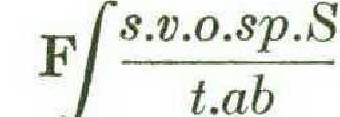
Now this would be mathematically useful. With it I can calculate the likelihood of my friend being at the club at any particular time, and whether available for billiards. In other words, I’ve got him in what is called a ‘frame’ in space-time. But just as all this tells me nothing of ultimate reality, neither do the super-dimensions of the new physics.
People who know nothing about the subject, or just less than I do, will tell you that science and philosophy and theology have nowadays all come together. So they have, in a sense. But the statement, like those above, is just a ‘statistical’ one. They have come together as three people may come together in a picture theatre, or three people happen to take apartments in the same building, or, to apply the metaphor that really fits, as three people come together at a funeral. The funeral is that of Dead Certainty. The interment is ever and the three turn away together.
‘Incomprehensible,’ murmurs Theology reverently.
‘What was that word?’ asks Science.
‘Incomprehensible; I often use it in my litanies.’
‘Ah yes,’ murmurs Science, with almost equal reverence, ‘incomprehensible!’
‘The comprehensibility of comprehension,’ begins Philosophy, staring straight in front of him.
‘Poor fellow,’ says Theology, ‘he’s wandering again; better lead him home.’
‘I haven’t the least idea where he lives,’ says Science.
‘Just below me,’ says Theology. ‘We’re both above you.’