The Contributors Column
‘Too many Americans,’ says William Henry Chamberlin (p. 667), ‘refuse to take this war as a test on which their life depends.’ Buttressed as we are by vast ramparts of water, it is all too easy to lull ourselves with the comfortable thought that by 1945 we shall have built the strength we need. Actually, says Mr. Chamberlin, the crisis is here and now — the war can be won or lost this summer, by England, Russia, and ourselves! An authority on Soviet Russia who has lived and written in Nazi Germany and in Japan, Mr. Chamberlin is able to size up the implications of Geopolitik.
We know now that Japan has access to the oil and the other vital resources which she needed so desperately before Pearl Harbor. The question is: Can Hitler get his? Without oil the German initiative will be lost in six months. For a report on this black blood of the war, we call on Frederick Phillip Hellin (p. 675), who, from 1923 to 1933, was connected with the oil industry in Germany, He was adviser to the Polish Oil Industry and for seven years an executive of the Russian Oil Products, Ltd., the exclusive German distributors of Russian oils. He has also acted as adviser for the following companies: Aquila in Trieste, Manchester Oil Refinery in Manchester, and Raven Oil Company in London; and in this capacity he made frequent trips through Central Europe, the Balkans, the Near East, and North Africa.
Louise Dickinson Rich (p. 633) lives deep in the Maine woods and is proud of it. Her husband is a Jack-ofall-tradcs, she is a Yankee philosopher; and together they have a good time hauling freight for the loggers, acting as guides for hunters and fisher folk who come their way, feeding those strange rovers, surveyors, camp counselors, brown bears and skunks, who are still at large in our Northern wilderness. This is the first in a series of papers.
Born in Nebraska and educated at the State University and at Oxford, where he was the recipient of a Rhodes Scholarship, Robert Lasch (p. 691), an editorial writer for the Omaha World-Herald, has just completed, on a year’s leave of absence, a Nieman Fellowship at Harvard.
Robert C. Weaver (p. 696), Chief of the Negro Employment and Training Branch of the War Production Board, is better qualified than any other of his race to tell us of how little we have drawn upon the skill and loyalty of our American Negroes in this national crisis. With figures secured from factories, communities, and unions the country over, he reminds us that the war can be lost without the Negro, but that we cannot win it without him.
When Llewellyn Howland (p. 707) writes about New Bedford, his native port, and about the skippers, ships, and food which made it famous, Atlantic mouths begin to water. Remember those succulent earlier papers, ‘Clambake’ and ‘Journey Cakes,’ which we printed in July and October 1941.
The most eloquent of English essayists, H. M. Tomlinson (p. 713) insists that Englishmen and Americans must cease their recrimination and get back to a candid and fundamental understanding of why we are fighting together. In the letter which announced this manuscript, he wrote: ' Most of what we earn over here — when lucky enough to earn any, and writers have to be wonders to be lucky enough for that —goes to build warships and what not. Talk about being total war is damned accurate. I got up from work at the essay you will be getting shortly to watch a Jerry bomber alight in the sky, and fall; though that is a minor interruption.’ Mr. Tomlinson’s sturdy prose appears at its best in his new book, The Wind Is Rising, the American edition of which was published this spring.
W. H. Cowley (p. 719), President of Hamilton College, defends the four-year course against the speed-up which President Hutchins has recently put into effect at the University of Chicago, where the bachelor’s degree henceforth will be conferred at the end of two years. A graduate of Dartmouth, President Cowley took his Ph.D. at the University of Chicago and became President of Hamilton in 1938.
For the other and more favorable sideof Chicago’s Fight for Education we turn to Joseph j. Schwab (p. 727), Assistant Professor of the Biological Sciences in the College of the University of Chicago. Here is an intimate description of the College within the University as it appears to one of the faculty members who grew up with it. ‘ The Chicago plan,’ he writes, ‘ is no fiat from above; it is a realization of more than one man’s hopes, the product of its teachers’ labors.’
Josephine Young Case (p. 732), wife of the new President of Colgate College, is a Bryn Mawr graduate, class of 1928, and a poet who achieved no little recognition with the publication of her first long poem, At Midnight on the 31st of March.
An Atlantic contributor who must now write under a pseudonym. Flying Officer X (p. 734) tells us of one of the most difficult moments a wing commander has to face in the line of duty.
Morals are said to shake with the wind when the guns go off, but if American women have the wit of Anonymous (p. 737) the Puritan in us will be able to resist the most beguiling of foreigners.
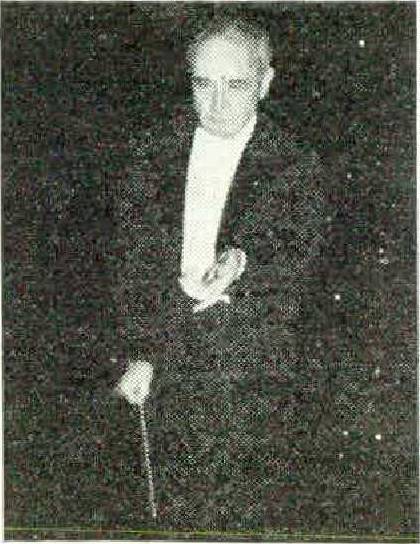
Conductor of the Boston Symphony Orchestra since September 1924, and initiator and director of the Berkshire Festival, Serge Koussevitzky (p. 741) is one of the best-beloved and talented musicians of our time. The Atlantic counts itself fortunate to publish his pithy and eloquent interpretation of his favorite composers.
The Allantic will always be proud of its discov - ery of Louise McNeill (p. 744), who was singled out fora student’s award in poetry some years ago and whose writing since then has lived up to its early promise. We expect to receive the manuscript of her first novel this summer.
Wallace Stegner (p. 745) sings and writes of the American Northwest with a gusto Carl Sandburg would relish. He spent most of his childhood, so he tells us, wandering around with his family in search of the millennium, living in a tent house, in the woods of the State of Washington, on a desolate farm on the Saskatchewan-Montana boundary, and still later on the shores of the Missouri River. Harvard does well to have him as a teacher in English composition.
Is there any common sense about ghosts? Robert Graves (p. 752), the English novelist, thinks there is. In fact, he has found people in England who have put their linger on the slimy objects. Or are ghosts slimy?
Ruth Benedict (p. 756) is one of the shining lights in the Department of Anthropology in Columbia University. In these days when there is so much loose talk about ‘Freedom’ she reminds us of how hard our North American Indians had to work if there was to be any freedom in their lives.
A critic and interpreter of modern poetry, Elizabeth Drew (p. 764) has revived for us one of the most amazing relationships in English literature. Had Lady Mary Montagu produced a daughter as sensitive as her prose, we should possess today a Diary which ought never to have been burned.
Charles Nordhoff and James Norman Hall (p. 773) have been contributors to the Atlantic since the very first days of their collaboration. The books which they have produced in partnership stand as a monument to one of the most unshakable friendships in our time. In the early summer of 1940, when France had fallen, Nordhoff and Hall were working together in Boston completing their first draft of Botany Bay, but in the back room of their minds, in the place where a man keeps his private thoughts, they were living over the anguish of the French surrender, picturing what it must have meant to the Frenchmen with whom they fought in the days of the Escadrille Lafayette. Out of this deep affection for their other country they have written a short novel which will bear comparison with that earlier Atlantic classic, The Man Without a Country.