Dressing for Beans
ByRICHARDSON WRIGHT
As TIME passes, the culinary orthodoxy of our household becomes more fixed; as the discipline of rationing increases, it grows more fascinating.
At first, to my outlander notions, the almost Puritan habit of assigning particular dishes to days of the week seemed tarred with too much New England rigid theology. Gradual and kindly pressure, however, made my succumbing to it. almost painless. Yes, I finally agreed, the coincidence of Saturday night and baked beans was of divine provenance, and with the ardor of the freshly converted, I insisted that we practice it. I actually looked forward to Saturday night.
And yet, in the days of peace and plenty, we compromised — or maybe the cook was plain lazy. Those beans were bought — bought in a can, slyly doctored, insinuated into a bean pot, and thence brought to table with the bland innocence of the uncorrupted. Then Pearl Harbor. As its encircling consequences tightened around the household our dietary backsliding fell into deeper relief. First the cook deserted her pots for a lathe; at least, she said it was a lathe — with time and a half for overtime. Next the grocer who supplies our little valley had no more canned baked beans. His shelves were as naked as a shorn lamb. It was evident that if this household was going to keep the faith, we’d jolly well have to provide those beans ourselves.
Now a well-made pot of home-baked beans is no slapdash affair. You approach its climax by a slowpaced succession. Friday night, when bedtime nears, you descend for a final glance at the kitchen fire and, as casually, measure out two pounds of marrowfat beans to soak. Saturday morning and breakfast cleared away, the ritual grows more complicated, more exacting. First come the lustrutions demanded of all who approach acts of grace. Those beans, having waxed fat like Jeshurun, are carefully washed in fresh water, brought to a boil, drained, washed again, and once more covered with fresh water, this time companioned by a chunk of salt pork, and set to simmer. This last cleansing and tenderizing by water and fire may take anywhere from an hour and a half to three hours. What an unconscionably long time these “cheap and filling” foods — baked beans, brown bread, stews and such — require! The morning is well gone before these farinaceous catechumens are ready for complete acceptance into the company of the elect.
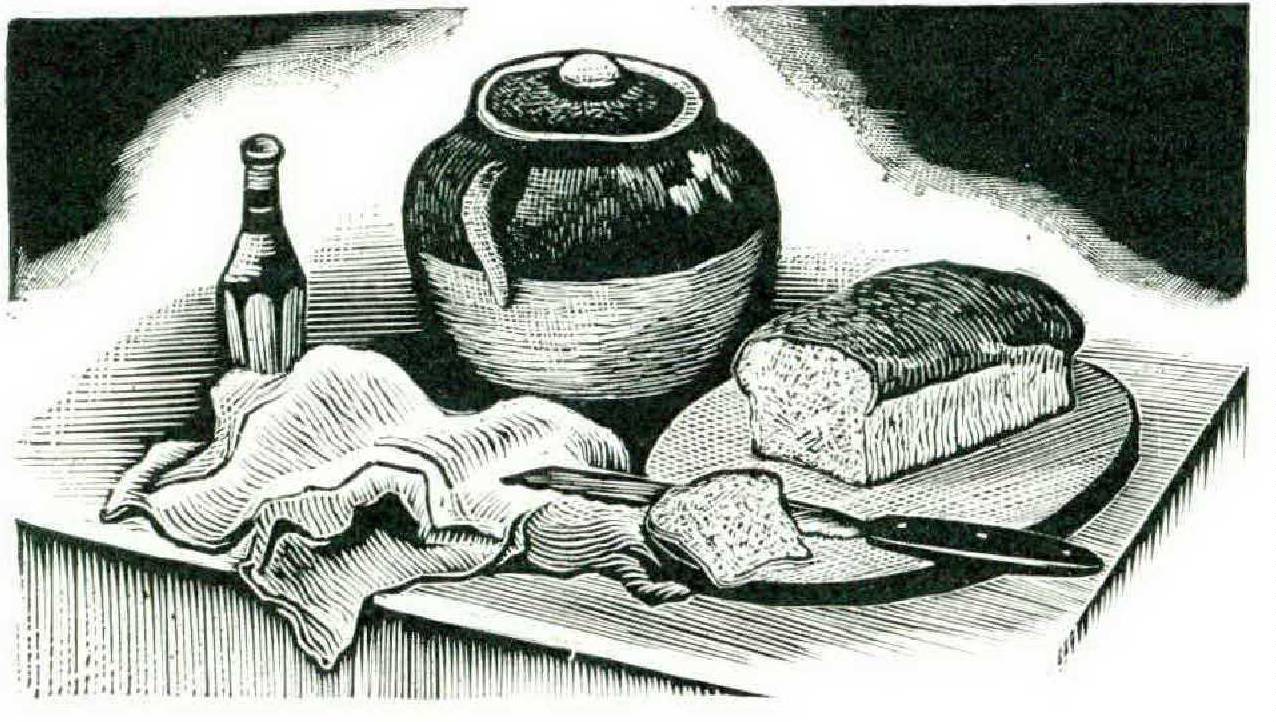
Luncheon over, the bean pot is brought from the pantry shelf and the final ceremony commences. Into its cavernous depths go the neophyte beans, with the blessing of a lump of precious butter, a sprinkling of salt, pepper, and dried mustard, and the benediction of four tablespoons of salty New Orleans sorghum to trickle down the interstices. Then into the oven for the last ordeal.
“O ye fire and heat, bless ye the Lord!” The three children in the fiery furnace could not have sung it more lustily than we that first Saturday afternoon when, the oven door aslant, we peeked at the bubbling and saw the time had come to remove the lid for an hour of browning off.
And during that final hour, without hint or suggestion, the entire family dressed. An informal household ours, sufficiently far from towns, we have never been coerced by sartorial dictates. Dressing for dinner is rather undressing. The stiffer clothes of office hours are laid aside for the easier shoes, the soft shirt, the old coat. But on this first Saturday home-baked bean night, the two small boys, of their own accord, washed fore and slightly aft, and put on their Sunday white shirts and tweed jackets. She, who prefers country suits, rose to the height of a decollete gown — black chintz spattered with realistic strawberries — and I to coat and trousers that actually matched. We bore the bean pot to the table with all the ceremony its long initiation deserved.
2
That first pot of home-baked beans opened up a whole train of alimentary experiments. First came bread.
It had always been my dream that the day might dawn when we could declare our freedom from the baker. Memories of my mother’s having baked the family supply grew more vivid with the passing years. The loaves that entered our house were too mechanically uniform and slick. They filled us, but we wondered if they also fed. The loudly proclaimed enrichment of flour was a frank confession that, somewhere in the process, it has been deprived of its richness. So far as bread went, the nation had been enduring a hidden hunger.
Between resolve and accomplishment lay many a pitfall. We accumulated a vast body of literature — free and bought — on breads and how to make them. It all seemed so simple — yeast cake, milk, salt, sugar, shortening, sifted flour, greased pans, hot oven. Who could fail? But we did fail — failed dismally, until we realized that some things in life require following the rules without the slightest turning to the left or to the right, and one of them is making bread. No job this for the improviser. No work for those who think a little of this or a little of that will do. You lay yourself under strict discipline when you make bread.
But there are compensations. Step by step you follow the directions through the mixing and the first rising and the second. How satisfactory to find that the dough has actually doubled its size! Then into an oven exactly heated. Meantime all utensils and pots arc cleaned and put away, for it is the first rule of the kitchen that no good cook stacks her pots. We retire upstairs to go about our “various occasions.” Gradually there filters through the house that sweet doughy incense of bread a-baking. It cuts in on our reading. The radio pales before it. Bread! Bread!
At the appointed hour we descend again. The loaves tumble from their pans. We set them on their sides to cool overnight. Tomorrow and the day after tomorrow and the day after that, until the ultimate toasting, we draw our dividends of enjoyment.
3
That is one of the properties of many dishes one makes at home—they last, they continue paying dividends. Something is left over, some ember with which to kindle the fire of a new meal. Boughten foods out of cans are neatly calculated to give just so much and no more. In the home pot a bit of stew remains for next day’s luncheon, a little soup that can be warmed up, a dab of beans for those robust enough to take them for Sunday breakfast.
These residuary estates of home cooking are never more apparent than on the pantry shelf and in the cellar where the savings from last summer’s garden compound their interest. A host of Americans, now that almost everyone is working in a Victory Garden, enjoy the security of these investments. From the first fruit of spring to the last vegetable of autumn, the culinary pennies are put away.
Even before the war we had added preserving to our mutual domesticahties. All one winter, on our week-end retreats from the city, we had made marmalade — five jars at a clip. By April, when rhubarb began coming in, the year’s supply of marmalade was on our shelves. After the rhubarb come strawberries from the garden, then the first peas, the infant carrots, and so on through the succession of crops until we battle our way through the engulfing combers of snapbeans and tomatoes.
Compared with the tedious hours required to prepare vegetables and fruits for their ultimate landing on cellar shelves, the days of growing them seem very short. We forget the backache from forking over the soil, the insistence on straight drills, the slow-sowing of seeds, the fights to ward off pests and diseases, the long hours of gathering
the young tender crops — usually when we would much rather be doing something else. How little those bites into our free time compared with the dreary hours of snapping and slicing beans, of scalding tomatoes, of scrubbing infant carrots and snipping minute beets! Longer hours follow over the hot stove as the jars are given their precautionary processing. How sanitary we both are, how bound by directions, how grimly aware that once the job is started we must stay with it to the bitter end. Often it is well into the small morning hours before the last jar is lifted from the boiler and the last pot washed.
As in baking beans, so in putting up garden truck and making bread — we work together. I cannot subscribe to the Philistine doctrine that the kitchen is the wife’s realm alone. “For richer for poorer” applies to preparing food as well as to the rest of married life, and when we do it together we find it is rich indeed. It also opens up a chance for competition, and with the mention of competition I approach the venerable subject of hash. And across the sublimity of hash falls the shadow of a stove.
4
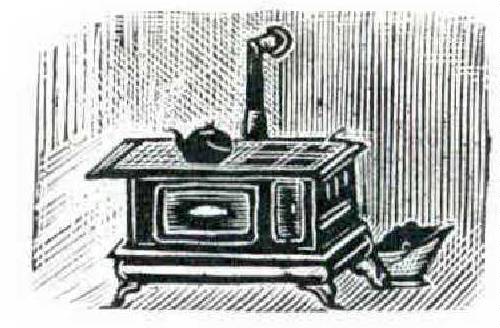
All that winter the country urge was on us. We lived from one Friday night to the next. The New York days between were endurable only because we could flee them to these Connecticut seven acres “more or loss” and this white house set under the shoulder of a hill. Here, though the house was well heated, we felt a chill every time we ventured into the kitchen. It was equipped for summer cooking. Electricity motivates it from wringer to range. Immaculately white, it was as cold as the snow outside. As cold, as once a farmer-gardener put it, as cold as jealousy s kiss. You don’t lean over an electric stove to warm your hands. You don’t rest your icy feet, against its open oven. The kettle cannot purr unwatched. What that newfangled kitchen needed was an old-fashioned stove.
As we found, you don’t just go out and buy an old-fashioned coal range; you search for it; you call up junkmen and those who sell secondhand wares, you bother the doddering contemplations of antique dealers. Week-ends of telephoning and routing around the three nearest towns finally revealed only one — an ancient of days heating a warehouse loft. This we brought home and installed where it could shed its warmth. On its broad top we “process" those countless jars of garden truck put up against the winter and brew the ketchup that, goes on those Saturday night baked beans. In its oven are baked the beans and the bread, and its heat has blended the ingredients of our hash.
That venture into hash was an experiment deliberately entered on, to see what changes could be rung with basic foods, granted that corned beef and other leftover meats are basic.
Before the last rationing you could buy hash in cans, already prepared for the heating, but even the best of it seemed to suffer from the cunning of those cooks who will give you a recipe and invariably leave out an essential ingredient. It was the absence of this ingredient that sent us on our quest. We took weekly turns at hash. We entered the mysterious region of herbs and learned the bland savor of mushrooms. The subtleties of thyme and sage revealed themselves, the pungent insistence of mustard and the robust tincture of raw red wine, We discovered the function of chives and parsley, and how far a little garlic casts its beam.
By no means is our quest ended. Many more permutations and combinations still remain to be tried. The way is long, the rationing frustrative, and the stove often cranky. But some day, when we do concoct that gastronomic apotheosis, we shall dress for hash.