Music Al Fresco

By ARTHUR FIEDLER
ONE summer day after the Esplanade Concerts had started, I was driving in Boston in an open car with Mrs. Fiedler. We had to stop at an intersection while a large and smelly garbage truck rolled by. A workman perched on top of the truck stared down at us. Then his stained face broke into a smile and he waved. “Hi, Arthur! How are you?”
Like uncounted thousands, he had been to our free concerts on the Charles River Embankment, and he was my friend, Mrs. Fiedler was a little startled, but now she has grown accustomed to having me recognized by all manner of men in all sorts of places. And I am glad to have it so, for the Esplanade Concerts are completely democratic — perhaps the most democratic symphony concerts anywhere. The concerts have always been free. We have permitted no ropes, walls, or gates. The listener can sit on the grass or he can rent a folding chair for a dime, but he has to place it himself.
On concert evenings the little sailboats draw in quietly toward the shore as the sunset tints the river and the sky. The people fall silent, the traffic noises seem to recede, and the music soars free on the evening air. As the light dims, the ducks and gulls circle lower, the evening star comes out, and the moon rises beyond the buildings. There is music in a beautiful setting.
In 1929, when I started these concerts, my friends were politely skeptical about the audience. “Free symphony concerts? People won’t come to anything but band concerts out of doors.”
The officials of the Metropolitan District Commission were more outspoken. A vivid memory is the day I went out with the chairman of the Commission and his captain of police to look over the site I had chosen. It was several acres of treebordered lawn between Embankment Road and the Charles River, in the heart of old Boston.
The captain who went with us — the late Albert Chapman—said gruffly, “I think your idea is half-crazy. This’ll be nothing but a battlefield between the bums from the North and South Ends.
We’ll have to use the wood. I haven’t enough men to handle it.”
But in time he even came to boast that his crowds were different — the best-behaved and the most honest. “There’s never been a pocket picked here,” he would say. “When ladies get dreamy over the music and leave their purses, the finders turn ‘em in to my men. Umbrellas get turned in, too. Imagine that!” And the crowds are different — because good music brings out the best in people.
“When are you going to play ‘Turkey in the Straw’?” Captain Chapman was always asking. And I made sure his favorite piece turned up often.
In making up programs, I often feel like a chef planning a meal. There should be hors d’oeuvres, a light course, a substantial entree, and so on through the musical menu. Variety is the spice we want: after a bombastic piece, we play some little thing. I am always looking for contrasts. In the beginning I started with light and semi-classical programs. Then I began slipping in an occasional movement from a symphony—and I found that people liked it, even though they had never heard symphonies before. One year I played an entire Beethoven series, another year Brahms.
We can tell when a piece takes hold of the audience by the quiet and the attention they give just as much as by their applause. The applause escapes in the open, but the hush is like that in a cathedral. Even dogs and babies in perambulators stay quiet during the music — though the dogs will bark excitedly when the clapping starts.
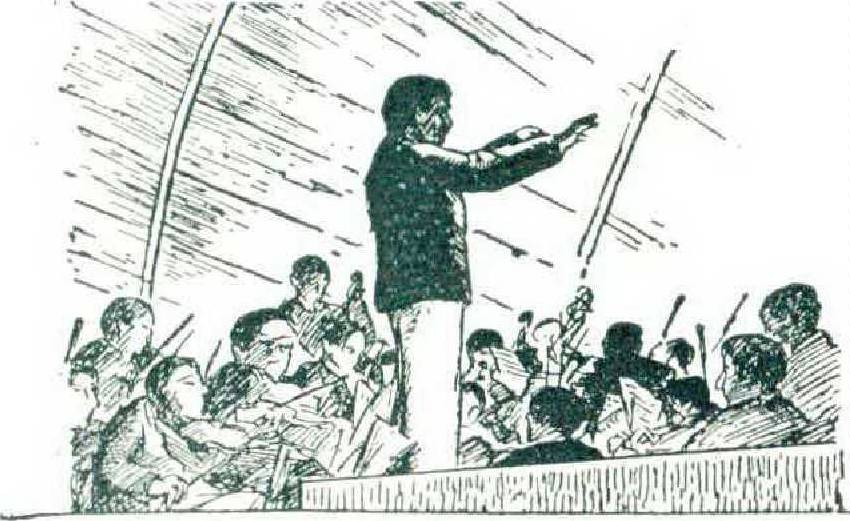
For the very first Esplanade Concert of all — July 4, 1929 — the wind was decidedly against us. It literally pitched our music into the river. The piece, I recall, was the “Merry Wives of Windsor,” and its merry pages flew about like sea gulls. Though the audience scattered to retrieve the music, and some musicians had to rely on their memories, we continued to play without interruption.
One rainy night when the wind drove rain into the concert shell so that the violins were endangered, the wind players promptly moved down and formed a barrier in front of the strings. They played with their backs to the rain — and the audience. And even though the grouping was unconventional and they took a wetting, the concert went on.
On another occasion at concert time the rain was coming down hard, yet about five hundred listeners stood hopefully in the forepart of the grassy “ platter.” I sent someone out to thank the audience for its interest — and to say that I thought it best to cancel the concert. After the announcement someone in the dripping ranks called out, “We’ll stay if you’ll play.” The rest took it up as a chant. Who could resist? We went on with the concert and before long the rain stopped.
I vividly remember the “invasion” nights, when we have visits from flying ants, midges, and mosquitoes. Possibly the music attracts them — or the bright lights. In my gasping moments I have swallowed many an insect. Players of wind instruments have found themselves munching mosquitoes as they press their lips to their mouthpieces. And when we turn the pages of our music, we find assorted pressed specimens as mementos of previous concerts on the riverbank.
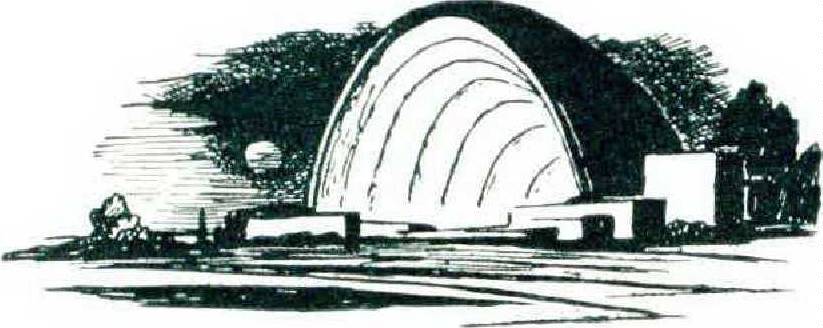
Our first shell was a wooden structure that cost. $2500. We stored our instruments in a skating house. Our second shell was acoustically sound and beautiful under night lighting, but was ugly by day and inconvenient for the orchestra. It used to store up heat through the day and shed it at night: with the lights on, the stage was an inferno. But the audience enjoyed nature’s air conditioning — cool breezes from the river. Today we have the $300,000 Hatch Memorial Shell of permanent construction: granite fined with teakwood. It still seems a little unreal to me.
The acoustical properties of the first shells were good, but occasionally freakish. Wind and humidity cause some peculiar effects. Sometimes we played a resounding chord, only to have it reflected back loudly to us in the next measure. Then there was the time when one of my flute players was announcing an encore — the introduction to the third act of Lohengrin. The text was in German. He started reading it, got stuck, and said in what he intended to be a sotto voce aside, “Oh hell! I don’t know what it is.”It came out magno voce. The audience laughed.
All our shells have pulled sounds in as well as sent them out. At certain points on the stage we can catch conversations from distant places in the audience. One night we heard a clear voice commenting, “I can’t see why those musicians play for him. I understand he doesn’t even pay them.”
Certain people manage to sit in the same spots night after night. I recall the eccentric elderly lady who, when we played the “ Beautiful Blue Danube,”got up and waltzed before the front row. The next night, in gratitude, she put a chocolate bar on every musician’s chair. It was a hot night, and the chocolate melted. The cleaners had a good many pairs of flannel trousers the following day.
In the early years, so many youngsters used to steal up close to the shell and listen so attentively that in 1938 I planned a morning series especially for them. Each season since then we have run a weekly concert for children — the largest anywhere. We have had as many as ten thousand on those Wednesday mornings.
Because many of the children are too young to read a program, we have an announcer say a few words about each composition. But we want to avoid having the children consider this a school. After all, it is their vacation and we want them to enjoy it. I select lively, pictorial pieces, a Mozart minuet, a “Nutcracker Suite.”Children prefer things like variations on “Pop Goes the Weasel,”waltzes, and marches.
I used to do my own announcing for the children’s concerts, but evidently I spoke too fast or not distinctly enough. One day when the children were crowded right up to the low foot of the second shell, I announced: “Now we’ll play ‘Up the Street’.”Perhaps they thought it was a new game, or perhaps they thought I said “Up the Stairs.”Anyhow they took it as an invitation. They promptly stood up and marched up the stairs and simply swarmed all over the stage around my legs, in and out among the players. There were hundreds of them, and they got very much in our hair.
It is a delightful sight to see the children arrive. Over here come little slant-eyed dolls from Chinatown, over there a little black cloud of pickaninnies. Some groups of very young children come down the paths with hands linked or even tied together, so that they won’t get lost.
In the first few years lost children were more frequent than they are now. We used to have the trumpeter play a fanfare and we would announce that so-and-so was lost. Then he always turned up.
Over the years I have come to know many of these children and have watched them grow up. I like to think that the Esplanade Concerts have been a valuable and entirely pleasant part of their education. Where else can children go to hear good symphony music outdoors and free? I wish there had been such concerts when I was young.