Spirit of the Fire
I CANNOT fix the date or place of my first meeting with Uncle, for I can remember no pattern in the fabric of my earliest life through which he does not shuttle. When I cast back to pin down his first crossing of my track, I find him everywhere —a dear and welcome presence which I recognize, not by face and figure, which are very hazy, but by the dexterous strength of hands that lifted and caressed me, and a subtle odor of wood-smoke and tobacco.
As the years have passed I have come to realize that as Rembrandt, was born to be a painter, so I ncle was born to be an uncle — a role, I opine, as distinguished in the eyes of the Lord as that of any man of mark. So inherent were his talents for this part that, in his boyhood, his schoolmates unerringly nicknamed him “Uncle”; and by the time I came to see him in the clear, apart from others, I dimly perceived — with a pang of jealousy — that I must be content to share his precious relationship to me with all the many, both young and old, who knew him.
I suspect it was the early demand for his particular gifts in the households of others which caused him, when the right time for mating had come round, to neglect founding a family of his own — a heavy price to pay for his art, and one that might well have induced a sour note in his make-up. Yet, whatever the reason for his single state, in all the years of our intimacy I never heard him out of tune or saw a sign of repining. But while he shone on the many domestic stages where he was always in demand, it was in a setting of his own — “The Shop” — that he performed most brilliantly.
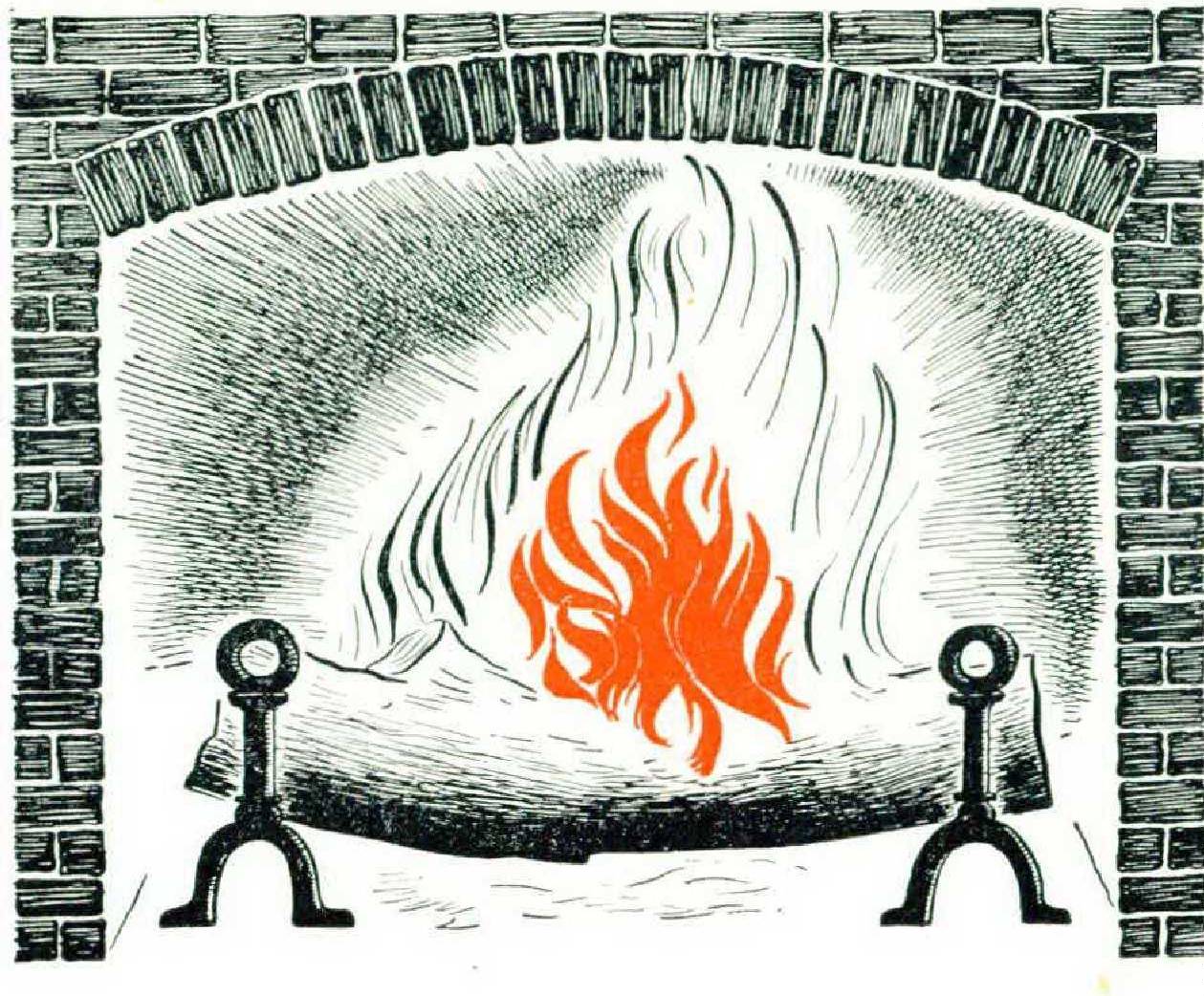
And here, in the little old story-and-a-half gambrel-roofed building, I am convinced it was the pure spirit of the fire — full-bellied and roaring in winter, a mere glow of embers in summer, but ever alive in the fireplace — that gave the inexplicably rich colors and shadings to the many facets Uncle exposed to it while he carried on his daily work of wood carving. If he were within, there on the hearth would be a fire appropriate to the weather outside, although on blazing days of July and August, as during his absences, it would be found banked with ashes, a thread of smoke spiraling up the black throat signifying its ever-readiness to spring to life again. So carefully did Uncle tend and nourish this flame in “The Shop” that one came to feel that perhaps he was a votary of Vesta, or some older goddess of the hearth from the Far North.
New Bedford born, LLEWELLYN HOWLAND knows full well what the open hearth means to a New England home.
While Uncle’s workroom — (he entire ground floor—like the building itself, had its center in, and was anchored by, the chimney stack with its fireplace and brick oven, there were other properties helping to give it atmosphere all its own. This quality of otherness made itself felt the moment the door-like gate in a high plank fence closed behind you to shut away the hard macadam street it faced, and, by the click of its latch, free you from the oppression of the town. From the gate a grassy cart-track flanked by two rows of heavy-branched black oaks enticed you down its seemingly long and mysterious arcade only to drop you with surprising suddenness on a doorstep of blue flagging at the weather-beaten door of “The Shop.”
To your right, as you fronted the door, stretched a great garden where narrow beds of heliotrope, roses, gillyflowers, lilies, and sweet peas, in their seasons, surrounding an ample kitchen garden, gave color and sweetness in summer, while the green of clipped box, bordering graveled paths, cheered the eye in winter. At the northwest corner of the little gray building a huge American elm towered, a sentinel, with strong protecting arms spread above the roof. The silence and tranquillity of these things gave promise of more delights within. You pushed open the door, eagerly confident of a welcome and of finding treasure to your taste.
But though 1 never found anyone familiar with “The Shop” who failed to respond happily to its influence, there was a strange lack of unanimity as to its functions and furnishings other than Uncle and the fireplace.
For the children — generations ol ’em — who came there, I’m sure it was the “best nursery ewer,” with unmatchable toys: dolls of all vintages and origins, a three-storied doll’s house, tops, kites, bags of priceless glassies, and model-boats of home and foreign build. As they grew older they found it a free and easy meeting place where they could (‘hatter, and where the great square drafting table with high stools made a perfect arena for games of “Hearts,” “Hands up — Hands down,”or a bout with “A Devil Among the Tailors.”
To one gentle old lady it was, I know, a shrine of ordered beauty where, after selecting a book from the shelves lining one corner, she could stretch out on ihe faded brown length of the Sheraton sofa facing the hearth and bury herself in “Idylls of the King,”while on summer days an Aeolian harp — a masterpiece of dark, polished wood carving from the Iberian Peninsula — breathed out its soft notes at an open south window to set her head a-nodding.
To a painter it was a studio with desirable light streaming through the long battery of north windows under which stood the heavy bench with its shallow drawers full of keen carving tools; and where, too, innumerable and unusual bits of still life were at hand : a dark-green, pot bellied ten-gallon .Madeira wine bottle, for example, with sprays of golden beech leaves fanning out from its neck, and happening to stand where it caught the cold window light on one cheek and the warm firelight on another. How could the beginner, or the veteran either, but be inspired in such surroundings, with Uncle, master of design and draftsmanship, able and willing to criticize?
Then, too, there were a few old and middle-aged men who came there as to a club to spend an easeful hour after the toil of the day, who would tell you, if asked, that there were a few shabby chairs and an old sofa, very comfortable and fitted to their shapes, and that the tobacco, coffee, and beer there were “uncommon good.”
And I came to know that there were occasions when the sore at heart sought it as sanctuary where, say on a bitter winter night, with the red curtains drawn and a single lamp dimly revealing the smoke-browned duskiness of the old pine planks sheathing the walls and ceiling and the lovely proportions and joiner work of a mahogany desk with gleaming brasses, the stricken one could sit silent before the fire until the nimble-fingered flames had melted the ice of trouble and he could acknowledge his fault or tell his grief to the kindest of confessors, who had waited patientK a long hour, perhaps, for this moment of unburdening.
In fact, “The Shop" might well be said to approach an earthly Elysium a place where all men in all moods and seasons were contented, finding and appraising only those things there that had appeal for them at the moment; hut all of them always quickened by the simple magic of the harmonious whole.
And I am humbly grateful that it should be my lot to have shared with Uncle the secret of this magic pervading those four walls and roof; for on a cold, stormy night in early spring, after an absence of years, I came to “The Shop,” sick from the stress of months among scenes of sudden death, destruction, and maiming, and with a great craving for the sane and healing influences I could count on finding there.
When he greeted me that night, Uncle, after one appraising look, tiled “The Shop” by drawing a black curtain across the two glass bull’s-eyes forming the upper panels of the front door—his customary notice that he was not to be disturbed and then without delay, and as if there had been no gap between this and my last visit, gave me food and drink. While I ate, he stoked the (ire with a big chunk of oak ship’s timber and presently I found myself on the old sofa with Uncle in his chair at my elbow, and the yellow flames, now shot with peacock blue and green tongues from the blazing driftwood, beginning their work of untangling the kinks of my tautened nerves. Except for a gentle whimper now and then from the fire, and the low ticking of the tall clock with its ever pitching ship in a lunette above the XII mark, there was utter silence in the room, and time stood still while the smoke of our pipes, blue in the yellow glow of the shaded lamp, shrouded the ceiling overhead.
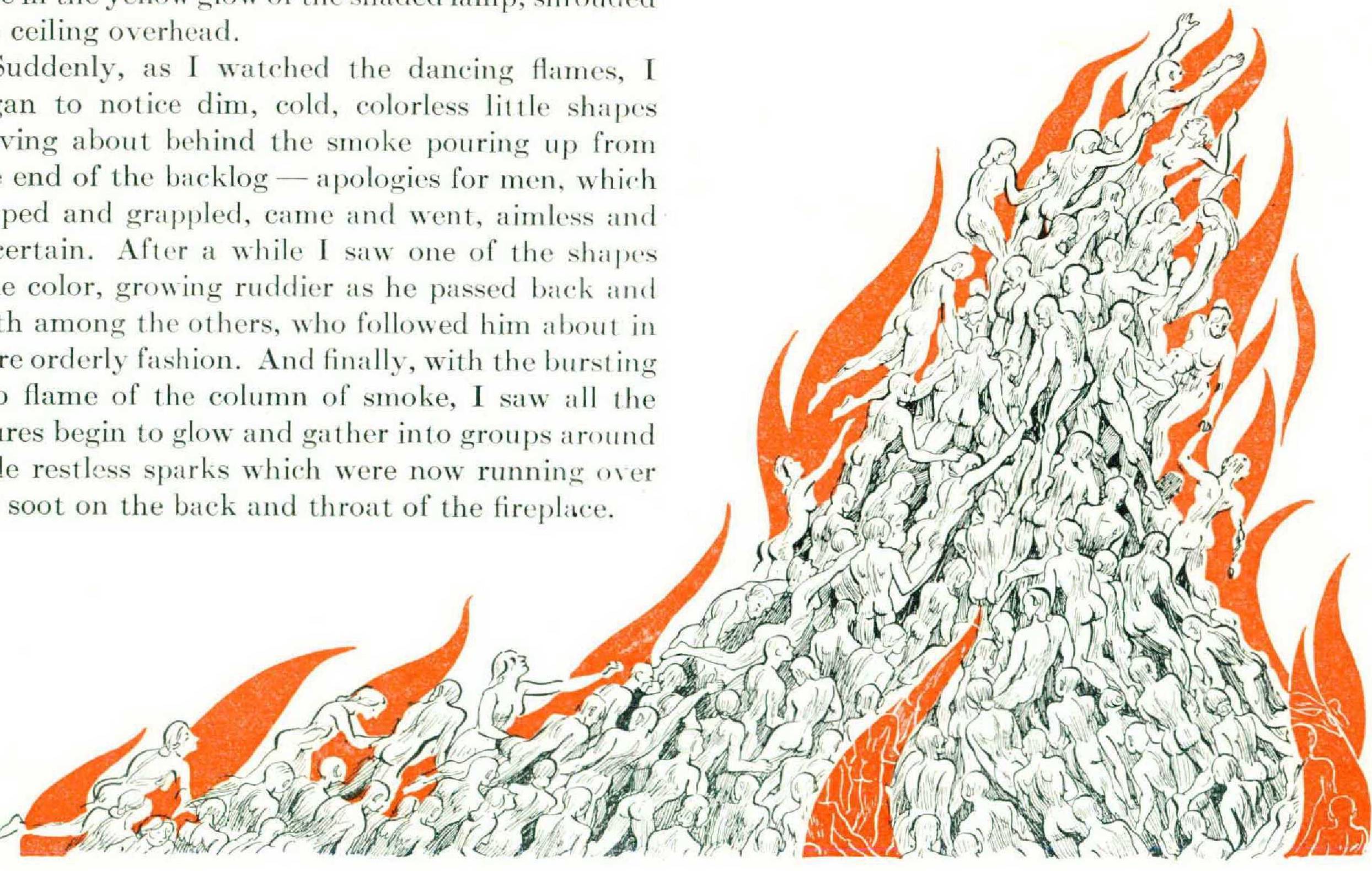
Suddenly, as I watched the dancing flames, I began to notice dim, cold, colorless little shapes moving about behind the smoke pouring up from one end of the backlog—apologies for men, which groped and grappled, came and went, aimless and uncertain. After a while I saw one of the shapes take color, growing ruddier as he passed hack and forth among the others, who followed him about in more orderly fashion. And finally, with the bursting into flame of the column of smoke, I saw all the figures begin to glow and gather into groups around little restless sparks which were now running over the soot on the back and throat of the flreph
As the sparks multiplied, so did the bands of shapes increase, and commence to separate into tribes — men, women, and children —jostling and fighting, but desperately clinging together, each group around a pinpoint of lire and all of them on the climb, until the cut ire throat was crowded with a multitude the upper ranks of which were constantly depleted by departures up the chimney, while recruits from below took their places. If a spark went out or was stolen, down tumbled the unfortunate losers, condemned to begin another cycle of disorganized groping for light and warmth.
How long I sat bemused by this spectacle before I closed my eyes to rest them from the fire glare I do not know. The gusty wind sucked at “The Shop" chimney. The clock struck twelve, dispelling the last dregs of my enchantment. I started guiltily at the touch of Uncle’s hand.
“Son,”said he, “you’ve seen It little parts of It — the grandest pageant ever staged! Man, with fire hi his possession and inspired by its pure spirit, on the march upward -out of an unimaginable past, on his way to an unimaginable future. Guard that fiery spirit well on the hearth of your own fireplace, if you’ve earned one — where it can be most free, and where you can commune with it most often. There in time, you will come to prove it, as I have, an ever willing servant, a wise counselor, the destroyer of base thoughts, the inspirer of humility and achievement, the gift, from Nature, of all the most precious.”