I Become a Mohammedan
ByMAX STEELE
REGARDLESS of all my other experiences before the end of the war, I’ve an idea that when I gather my grandchildren about me, I shall tell them only about my unnerving experiences in Tennessee. They’ll understand then the slight hesitation in my speech, my habit of glancing quickly over my shoulder, and the dizzy spells I have when looking at Oriental rugs.
Our group had been in Tennessee three days, and our arms were just becoming sore from shots and vaccines when we were given a two-page questionnaire labeled “Personal Evaluation.” Mainly because I was tired of answering questions, I asked the sergeant what the blanks were for.
“Sidesaddles,” he answered.
He did not laugh, and I did not.
With a grim feeling I began writing again “Name, age, date of birth, city, county, state. . .”When I came to the religious preference blank, in a thorough state of rebellion I printed very plainly “Mohammedan.”
One day two months later, when I came in from the drill field, I found a notice on the bulletin board: “Pvt. Max Steele, call the Persian Rug Cleaning Company immediately.” The notice was signed by the captain.
I phoned and asked if anyone there wanted to speak to me. “Ah, yes! Ah, yes!” a heavily accented voice said. “This is Hatim Bahram. We are so glad you called, for we are, my wife and I, glad to learn that there is another Mohammedan in town.”
“Yes, sir,” I said.
There was a silence which he broke by saying, “We want you to come to dinner Saturday night.”
“ But — ” I said.
“Your Commanding Officer assures me that you will be here.”
“Yes,” I said. “Yes, sir. Thank you.”
“Thank you,” he said.
“Yes, sir,” I said, vaguely. “Thank you.”
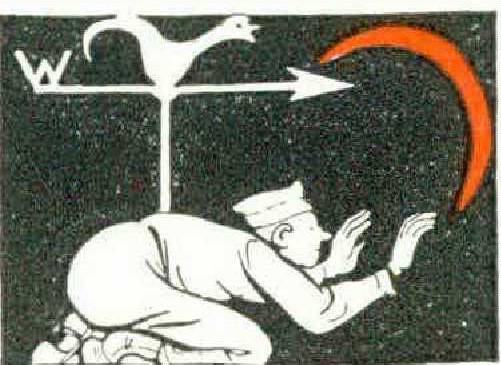
Back in the barracks, I lay on my bunk and thought of everything I knew about Mohammedans: “They eat black bread and ride camels. Drink goat’s milk. Use chopsticks. Cows are sacred. Wear fezzes. Except for the women — they wear veils. Unclean: pigs.” I watched the moon rise in the east and wondered which direction Mecca was from Tennessee.
Saturday morning I went over to the library to find out more about the religion and to read the Koran. The girl at the desk had never heard of it. Finally I got an old National Geographic on Arabia. One of the first sentences said: “Mohammedans are fanatical in their religious zeal; they consider Christians as infidels, and some of the bloodiest battles of the early thirties took place between these two creeds in Palestine.”
We are assured by MAX STEELE, a private in the Army, that this story is fiction.
I thought about those battles that night when I knocked on the door of Hatim’s house. The door opened a crack.
“What is it ?” a woman’s voice asked in that same thick accent that I had heard over the phone.
“I’m Steele,” I told her.
“Ah, yes!” she said, opening the door wider but hiding behind it. “Come in. We will be down in a minute.”
When I walked into the vestibule, the woman was gone; a curtain to the left was still fluttering. The living room was to the right and on a lower level. Except for the Oriental rug, the room looked very much like a furniture store window advertising an “eight-piece living room suite.” I was still walking around when Hatim came to the top step of the vestibule.
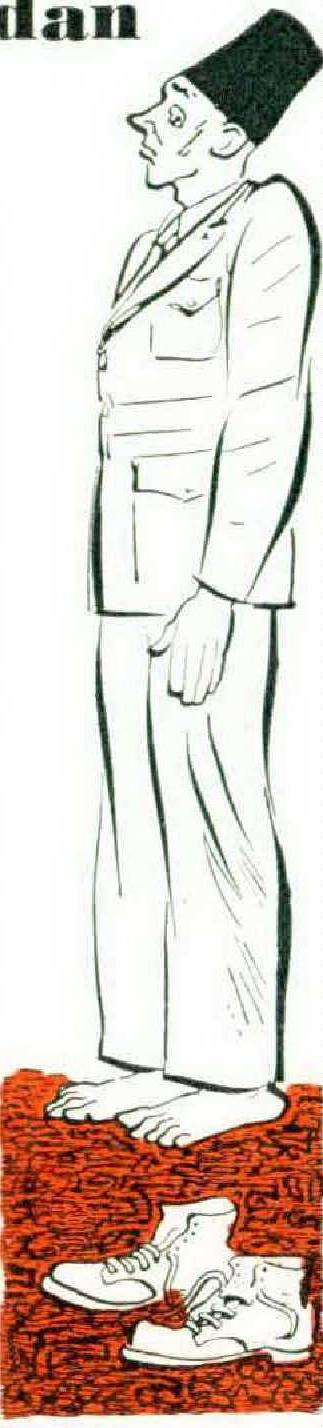
He was a rather short man and dark. He was bald on top, but the hair on his temples was very black. He spoke even more precisely than he had over the telephone: “Forgive us for not being ready. We will be dressed in a minute.” He had on pin-stripe trousers and was buttoning a white shirt. I noticed that he was barefooted.
“I’m probably early,” I said.
“ Have off your theengs,” he said. “ Make yourself at home.”
As I already had my cap off, I was puzzled. “ Have off your theengs.” Probably, I thought, just an idiom that means “You’re welcome.” I had come prepared for expressions and customs that I would not understand; but then, suddenly, I remembered Hatim’s bare feet. I looked at my GI shoes, which seemed enormous now. Already I had made the unpardonable blunder of entering a Mohammedan’s house without first removing my shoes.
Even so, I was not worried, for Hatim’s reminder had certainly been mild-mannered and polite. I sat down and began unlacing my shoes, wondering if I should try later to make an excuse for my breach of etiquette. I pulled my shoes off and placed them neatly under the sofa. I had just tucked my socks in my shoes when Hatim and his wife entered. They both wore shoes.
During our first exchange of words I was conscious only of being barefooted. When I looked down at my feet, I discovered that I was standing on my right foot and was trying to hide my left foot behind my right trousers leg. As a matter of fact, I was rubbing the top of my left fool up and down my leg from the knee to the ankle.
“Charming! Simply charming!” Hatim’s wife was saying. “ I don’t blame you a bit. Those Army shoes must be heavy.”
Hatim was not so comforting, but he did say, “I liked to go barefooted, sometimes — when I was a child.”
Finally I said, “I hope you don’t mind.”
“Mind?” the woman said, laughing a beautiful laugh. “ We love for people to feel free! No pretense here, ever.”
She asked me to have off my blouse, but I explained that I should be out of uniform. She took my cap and hung it up. “Your shoes,” she said, “can I take them for you?” I showed her where they were, and both she and Hatim agreed that that was an excellent place for them.
Mrs. Bahram was dark like her husband, but she had a full head of hair, very black and braided about her head in two cords. She wore a dark-red velvet dress and heavy costume jewelry. She was easy to talk to, and I was glad that she was there, for Hatim just sat and looked at me. Occasionally I would catch him staring at my feet. (I had not realized until then that I talk with my feet, just as some people do with their hands: during the time that I was telling Mrs. Bahram about Army life in Tennessee, I repeatedly found that I was wiggling my toes in excitement, and that while listening as she talked about her Red Cross first-aid classes, I bent my toes under and rolled my feet backward and forward on them. Hatim sat fascinated.)
Mrs. Bahram was so charming that after I had got my shoes back on, by explaining that my feet felt much better, I was as comfortable as though she and Hatim were not Mohammedans. Actually, I forgot that they were until Mrs. Bahrain went in to finish cooking dinner.
Hatim and I were left staring at each other. He looked at the floor, then looked quickly up at me and said, “This Eastern matter is still sickening, isn’t it ? ”
Immediately I remembered the article in the National Geographic. ‘Yes,” I said. “It seems like those Christians will have Palestine for some time yet.”
Hesitantly he said, “It’s the Japanese I’m talking about.”
In the silence that followed, Hatim watched me out of the corner of his eye. I started to say, “It’s a nice place you’ve got here,” but when he saw that I was going to speak, he turned and looked at me so suddenly that I just sat there with my mouth open, giving somewhat the appearance of a goldfish coming up for air. We both sat for a while gazing at the elaborate rug.
“It’s a beautiful rug,” I finally said. “Did you make it yourself?”
“Good God!” he said — which was, I thought, no way for a Mohammedan to talk.
Before I could say anything else, Mrs. Bahram came in with three goblets that looked like water goblets, even though it was not water in them. I was faced with a problem because I had always planned to take my first drink on my twenty-first birthday. I knew that I could not explain that to the Bahrams, because actually I did not understand it myself. Waiting was just something that I was doing without knowing why.
I took the glass and watched the Bahrams. Neither of them sipped from the glasses; they drank freely, tilting the bottoms up. At first I twisted the stem of my glass and watched the reddish-brown reflections. I ate one of the little sandwiches on the tray. For a minute I had to hold my mouth open, for the whole inside of it was burning; then, seeing that Hatim’s glass was almost empty, I took a deep breath and drank. It was not bad. “Date brandy,” I said to myself, then drank the rest.
When Mrs. Bahram had gone back to the kitchen, Hatim said, “About the rug. It is from the same province that I am from.” He then began telling me all about the rug, about the families that made it, about the wool and how it was gathered, and why the colors were not consistent.
He sat down on the floor with his legs crossed neatly and motioned for me to join him. I crossed my legs the way he crossed his, although it was not comfortable or natural.
While we talked, Mrs. Bahram brought in the glasses again, explaining that the meat just wasn’t cooking. Hatim pointed out to me some of the more subtle motifs of the intricate and delicate design as we drank the second glass. I did not have to pretend interest, for the pattern was a complex and intriguing one. I couldn’t remember ever having enjoyed a rug so much. I even took Hatim’s bet that I could not count the different geometrical patterns in one square yard of the design. I followed the curving lines in and out among the flowers and stars, counting and recounting for about ten minutes. When I looked up, the doors of the room seemed round like flowers, and the picture molding was the curving stem from one flower to the other.
Mrs. Bahram was standing in one of the doors offering to fill the glasses again. “No, thank you,” I mumbled.
“Really?” she asked.
“No, really, I don’t think that I should,” I said thickly. To end the evening by not being able to pick myself up from the floor would certainly be worse than wearing shoes, or not wearing them. I tried to move my legs, but they seemed to have disappeared. When I finally stretched them out in front of me, they tingled, and I knew that the circulation had stopped. I remembered that one of my friends at a dance had passed out completely without ever complaining about his legs being numb. I shut my eyes so that I should not have to see the many-figured rug with its thousands of stars and flowers.

“Aren’t you feeling well?” Mrs. Bahram asked when I lay back on the floor and groaned.
“No’m. Not very,” I said, opening one eye.
Mrs. Bahram told me to loosen my belt, explaining that she had learned that in her Red Gross class. Then she put a pillow under my feet. “Don’t you want your shoes off?” she asked.
Hatim coughed violently. Mrs. Bahram went over to where he was watching from the other side of the room. There they whispered together.
Gradually my pride came back, and I realized how disgraceful it would be to pass out in someone’s house or to be asked to leave. “I’m afraid that I shouldn’t stay for dinner,”I said. “ Would you mind calling a cab?”
“I’ll take you,” Hatim said.
When I stood up I felt much better, and outside in the night air I felt so healthy I could have run the obstacle course. “It was probably that scuppernong tea,” Mrs. Bahram said. “I didn’t think to ask you whether you liked it or not.”
“Scuppernong tea?" I asked.
“Yes,” Hatim said. “We always put the juice of the scuppernong in our tea when the season comes and seuppernongs are ripe.”
“You will let us know how you are, won’t you?” Mrs. Bahram asked as Hatim held open the car door for me.
I told her that I would phone, but somehow I never did. I did send them a Christmas card though. I was in California in December.