Television and the Artist
ByEMLEN ETTING
PICTURES, like music, can best be savored when one is comfortable and when one can be silent — preferably at home. Music has been well served by radio, and in England sculpture and painting have been televised for years; but in this country little has been done in this respect.
Separate color reproductions have found their way into the home, and in the days to come the work of the painter will appear more and more comprehensively in book form. With increased facilities for printing, particularly in color (from silk screen to every photographic or mechanical means), reproductions will be more and more faithful and will assume increasing significance. The starving artist who has something to say may be able to make a decent living through selling the rights to reproductions. Publishers will be encouraged to bring out the complete works of painters, and the artist will share space in home libraries with writers and composers. With television a fact, people may even come to look at pictures without expecting to have them explained, discussed, and commented on till they vanish.
New mediums are coming too. We are now approaching the time when painters may use light itself as a medium, and this will vastly increase the possibilities of their color scale, just as music has been enriched by the free use of discord. Early phonograph records had a very narrow range of sound reproduction. Electrical transcription widened both the fidelity and the range of audibility; and after the war, FM radio will bring into the home a miraculously true account to listeners. In the same way our present color plates may be contrasted with what is to follow. The image of tomorrow may be conceived out of light itself and be equally visible by day or by night.
Through working on stained glass, Rouault was stirred by the brilliance of transmitted light. He was the first painter to suggest luminous pigments. Van Gogh was obsessed with the desire to inscribe the sun’s radiance. In 1888 he wrote: —
I am always hoping to make a discovery in the study of color, to express the love of two lovers by a marriage of two complementary colors, their mingling and their opposition, the mysterious vibrations of kindred tones. To express the thought of a brow by the radiance of a light tone against a sombre background.
This is the kind of symbolism implied in a work of art. Every tone has a meaning.
In this country men like Tchelitchev and Rattner are making innovations. Tchelitchev has already used light directly in ballet décor, and in this connection one recalls his fascinating “Errante.” His large canvas, “Hide and Seek,” as well as his more recent explorations of nerve anatomy with what resembles neon spaghetti, suggests other scales of color contrasts than those found in our classic heritage. Rattner in his recent canvases seems to evoke light from behind his canvas in the manner of a translucent screen.
Degas was the first to try new compositions suggested by the camera, when the snapshot gave him the idea of presenting figures partially out of the canvas. Animated cartoons in the movies give contemporary painters new prospects.
Thomas Wilfred has for years been doing pioneering work with his color organ in his little theater in the Madison Square Garden building. His color evocations doubtless are the forerunners of an elaboration of the painter’s art. Not only did Mr. Wilfred invent an instrument which projected developing images on a screen with the whole range of a prism, but he also created a machine, the size of a home radio, on which the owner could play simpler compositions of his own. They could be made on transparent disks by brushing on color, lines, and spots. Revolving the disks over a shaft of light throws patterns on a curved screen.
Actual use in film projection has so far been limited almost exclusively to Walt Disney; in his fantasia, for instance, many vistas of development were forecast. Several artists have experimented with 16 mm. Kodachrome film to create cinematic poems or abstract animations. Dali, Cocteau, Leger, as well as many Americans, have essayed this medium. Few results in color have been shown, because satisfactory copies cannot be made of Kodachrome; the originals are perishable and unique.
The Pinto brothers in Philadelphia have made a complete record of the Barnes collection on transparencies. It is a fascinating experience to examine these Kodachrome slides over a special glass display case. Beauties of color unimagined by artists appear. The change in Renoir nudes or still-lifes by Cézanne, when looked at in this way, is like the change in Johann Sebastian Bach’s compositions as played by him and as rendered by Stokowsky with the full resources of the modern orchestra.
Having considered the visual image projected from a motion picture machine, one cannot overlook another obsession that artists have had: the dimension of time. In the Florentine school, events that took place at different times and places were usually placed in separate panels hinged or hung together. But later artists placed varied events in different planes of their composition, foreground or background.
El Greco depicted in one canvas the burial of Count Orgaz and his reception in Heaven. Marcel Duchamp described the progress of a nude descending the stairs. Years later, photographers borrowed this trick from painting, and today its most adept exponent is Gijon Mili with his stop-camera shots of athletes and dancers in action.
Picasso frequently has painted the aspect of a female figure, placing on the same surface the result of his observation from several angles — after he had taken the time to stand about examining his model from different corners of the studio. Thus a full face combined with a profile, or buttocks combined with breasts, have upset a lot of people who are perfectly able to enjoy counterpoint . The time element will surely become an added dimension to the artist’s work.
Many of us have examined in magazines photographs tracing the different stages in a Matisse figure piece. It might be satisfying to watch these different stages as shown by some film exposed by a stop camera. Special screens built in as part of a room’s decoration will reflect bright images without requiring darkness.
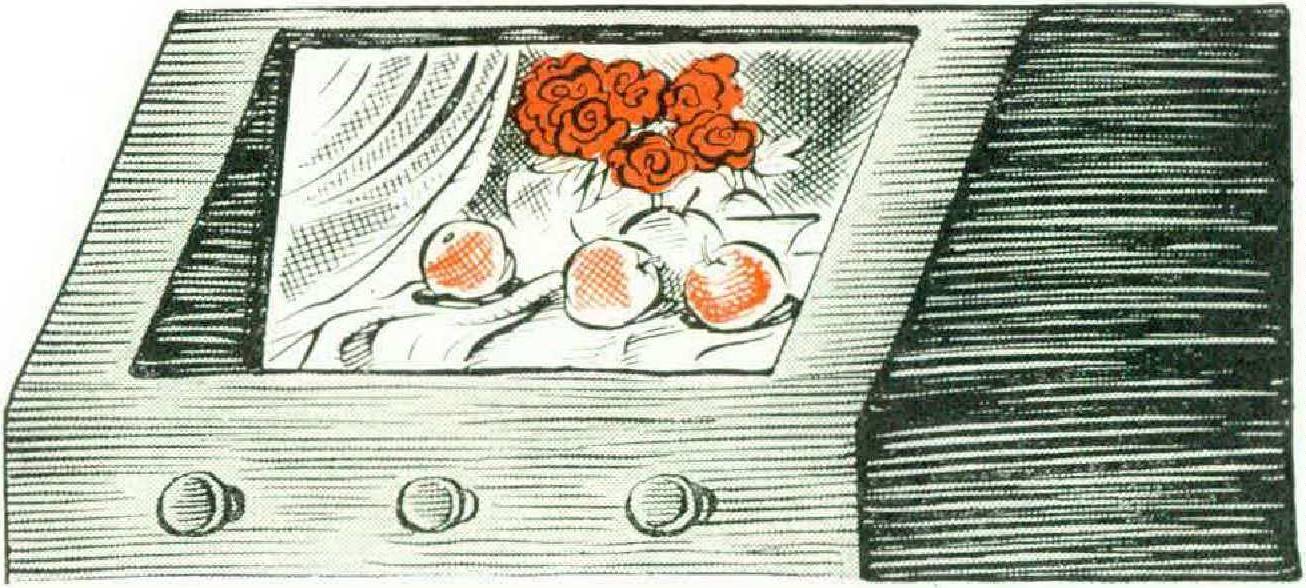
Certain artists may create directly for film. In this way a picture will be a movie strip projected in a frame on the wall. In the home of tomorrow, by pressing a button a painting will be flashed in daylight over the sofa or on the television screen. Still pictures may thus be shown as desired, like slides, and exhibitions or museum collections will be broadcast for home consumption, to be enjoyed at leisure and in comfort.
Television will bring together the attributes of light and time to the work of the creative artist. The spectator will be able at one sitting to examine the various stages or trials in the evolution of a picture, or he will be able to witness the complete convolutions of a graphic work especially conceived for the luminous screen.
Before the war, television functioned with antiquated equipment, and its stages and projected images recall the early days of the motion picture. But in the laboratories many snags have been worked out and new inventions have been developed, with the result that soon the public can expect magnified images of adjustable sizes, pictures in perfect focus, and then the transmission of color over the air waves.