Old Glass
By SGT. PAUL PERELLA
I LEARNED about old glass from my landlady, Miss Pidboddie. Her interest in antique glassware dates back to 1910, when somebody gave her a Sandwich glass statuette for her hope chest. About 1925 Miss Pidboddie realized it was hopeless and became an antique collector and dealer. Several years later a friend found me an upstairs room in Pidboddie’s Antique Shoppe and of necessity I developed an interest in old glass.
My landlady can tell you what pattern almost any piece of antique glass is, what it sells for, and how old it is — and her antique wisdom does not stop there. If she were in the cellar scrubbing on a washboard, and one of her smaller crystal finger bowls were brushed off a low table in the garret, she would hear it. She would not only hear it: she would immediately know it was a finger bowl, crystal, small, $1.25 retail. And that information would appear in neat handwriting on your weekly rent notice.
My first, lesson came as a surprise, probably because it resulted from the most innocent and natural of everyday gestures. I merely leaned on a table. In Miss Pidboddie’s glass-infested living room it is hard enough to find a place to stand, let alone lean. But I had found a place by carefully moving an 1890 floor lamp, and was listening to a Pidboddie soliloquy on Sandwich glass when I casually placed my hand on a near-by table and leaned. Some ingenious balance among the antiques on that table must have been disturbed, for I watched, and Miss Pidboddie watched, as a Wedgwood china fruit bowl (hand painted, $13.50) sidled over to the edge, wobbled, and was gone. My rent that week was $23.50.
My landlady manages to get around in her own home without becoming an impromptu customer. It seems she has trained her elbows to turn inward. Maybe that is why she was never in complete sympathy with me during my weeks of trial with that fern stand at the turn of the staircase.
She had placed it there herself in 1928 for the sole purpose of supporting a strange, multi-handled piece of crockery which I soon nicknamed “the whirling dervish.” On the average of four times a week for two months my left, or untrained, elbow would snag one of those handles and set the crock into its jittery, precarious whirl. The week it finally happened my rent came to $27.32, but in a way I was happy.
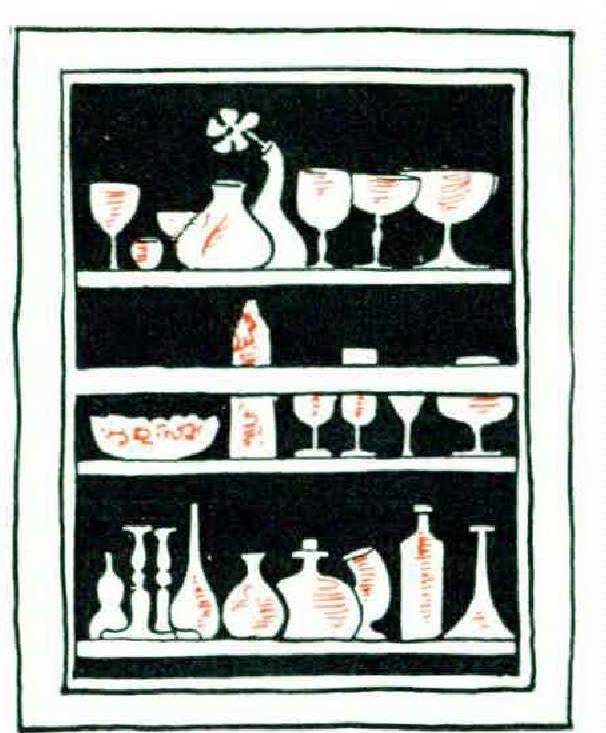
Second only to Miss Pidboddie’s passion for old glass is her passion for shelves to put it on. Across my double windows facing east were three glass shelves holding various-colored clear glass items that were beautiful in the morning sun but just in the way when I wanted to lower a window. Every rainy day meant a sure increase in my rent. I found that in hurriedly closing those windows I brought my entire destructive anatomy, and even my clothes, into play. My left coat sleeve, for example, was usually good for at least a green herringbone goblet, easily the most unstable product of the glassblower’s art.
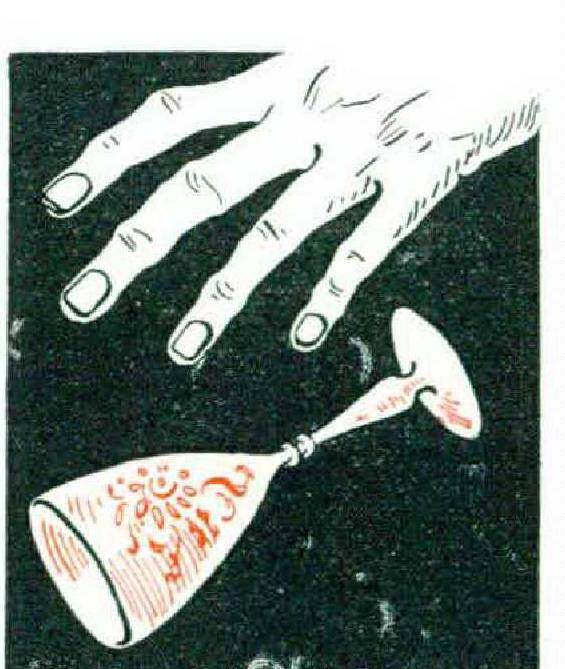
Then as I would stand with bowed head surveying the remains, up the steps would come small, firm footsteps. My door would open just wide enough to admit Miss Pidboddie’s sober, bespectacled face. “My green herringbone,”she would announce.
“Four ninety-eight,” I would say, and she would nod and repair to her Hepplewhite writing desk below. I never knew her to miss but once.
That once I shall always remember with smug complacency. A sudden cloudburst routed me from my decrepit armchair, and amid the thunder and lightning I nervously wreaked complete havoc with the east window complex. Thunder, lightning, rainstorm notwithstanding, the small face of my scorekeeper appeared presently at a point three inches above the doorknob. I was on one knee in the midst of the glittering mess, a bit saddened at the demise of so many old acquaintances. I had begun to look up to them as miraculous survivors of a sort.
Miss Pidboddie had a sweeping pan, a tiny broom, and her account books. “ My fleur-de-lys celery vase,” she said. “And my Florentine china tea service.”
“And your pressed glass compote, and another green herringbone goblet,” I added. My left coat sleeve again.
“All old — old,” said my landlady, whose spectacles represented practically the only unbroken antique glassware in the room. She silently handed me the pan and broom and descended the stairs with tragic slowness.
I waited until I could hear her above the drumming of the rain, opening her Hepplewhite desk. Then with an evil chuckle I scrabbled behind the footstool and came up with the two halves of a rare old porcelain canary bath, circa 1785, $11.30 wholesale. Miss Pidboddie was getting deaf.
My Bachelor of Broken Glass degree I attribute to the help of a certain Swiss clock that stood in the downstairs studio. I was playing chess with a friend in the studio one evening, while my landlady read a catalogue of antiques in a far corner. I had taken what seemed to me extreme care in moving everything fragile from the coffee table where we placed the board. It was just past 7.30, I remember, because the little mechanical dwarf had just come out of his door in the Swiss clock to beat the half hour on a brass gong with his hammer. That was his only purpose in existing, that dwarf, and he always performed with resounding diligence.
There came a lull in the game, and my eye wandered across the coffee table. There, in a position of impending disaster near my friend’s elbow, stood a little glass statuette. I still cannot explain why I didn’t notice it sooner, but I lost no time in removing it to a safer place. I then continued our chess, filled with the sense of relief that comes after a narrow escape. Miss Pidboddie sat immobile across the room, reading by the light of an ancient chimney lamp. She had seen not hing.
A few moves, a bishop taken, and the fateful hour was at hand. Some vague presentiment caused me to look in the direction of the Swiss clock, where a muffled grinding heralded the appearance of the punctual dwarf. Then I saw, and Miss Pidboddie saw. I had placed the glass statuette on the front porch of the Swiss clock.
Miss Pidboddie did not move as the door opened and the dwarf emerged, intent on beating that gong eight solid times. There was a kind of dejected pout on her features — nothing more. I started to get up, but I only knocked over my queen.
The first stroke of eight, was half metallic clang and half tinkling glass as the dwarf swung his hammer with gusto. I could have sworn he enjoyed it fiercely.
“My Sandwich glass statuette,” said Miss Pidboddie tonelessly after eight o’clock had been firmly established.
A friend told me recently that Miss Pidboddie had secured a new statuette. They will become antiques together without interference from me. I don’t live there any more.