Beans

By CROSBY
THOSE who stem from early Pilgrim or Puritan stock have gastronomic traditions to live down that would have destroyed less hardy people. The more or less pious voyagers on the Mayflower and subsequent barques did not believe that anything in life was good if it looked good, or tasted good, or smelled good, or felt good. After all, they must have been a pretty dreary lot, and we still suffer from some of their mental and spiritual constipations.
After three hundred years Cape Cod has only one method of dealing with clam chowder. That’s just one of the minor misfortunes of Cape Cod. Boston knows only one way (a good one, it is true) of baking beans, when there are at least fifty ways of doing it that are better.
It is certainly time that something was done about it, and I propose to start with a short account of the cult of the Cassoulet, or bean pot, as they practice it in France.
I once attended a small dinner party at the house of Sacha Guitry in Paris. The purpose of the occasion was to introduce me to Mr. Guitry’s favorite Cassoulet from Languedoc. Each one of the guests had his own notions about a Cassoulet, and it appeared that there were as many variants as there were cooks. I was told of fabulous concoctions from Aude, Burgundy, Bagnères, Alsace, Brittany. I tried to edge in a few words about Cassoulets tie Boston and Cassoulets de New York, but was politely hushed up before I had even put my beans to soak.
Sacha Guitry is a dramatist of note and an actor of distinction, but it is as a baker of beans that I shall best remember him. Here is the story of his Cassoulet. It begins with a trip to Les Halles for the purchase of the various ingredients, including a pound of the whitest and fattest haricots blancs that can be found. The French cook does not have much use for the small white navy bean that seems to be an American obsession. I find that the larger varieties are much more succulent and that some of the colored beans have their real uses in the pot.
To get back to Paris and Sacha Guitry, you wash your beans and then leave them in a bath of cold water overnight. Then they are drained and go into a kettle with enough fresh water to cover them; to the water has been added a cup of white wine, a couple of ounces of chopped bacon, a clove of garlic, an onion stuck with two cloves (why two, I’ll never know), a touch of thyme, and pepper and salt to suit yourself. The pot is covered tightly and goes on the back of the stove to simmer slowly for three or four hours until the beans have split their white jackets.
Meanwhile, you have taken out of your market basket six neatly trimmed pork chops with most of the fat left on. These you sauté in a saucepan until they are ever so slightly tanned and the sweet fat is bubbling around them.
Into the casserole go the beans, the pork chops and their gravy, and, as a final Languedocian touch, the pickled leg of a goose and a tablespoon of goose fat, if you happen to have such gadgets in the house. (I, personally, could do without the goose, but no Frenchman would ever allow it.) The top is sprinkled with bread crumbs and dotted with butter, and then you put the mixture into a languid oven for six or seven hours.
I had three helpings, along with a stout Burgundy and plenty of lively talk, and felt a better and nobler man for the experience.
A proper Cassoulet is a happy marriage of beans and meat, and it is in the imaginative selection of various meats for the bean pot that the French regional cooks show their superiority.
The Alsatians will use a dismembered goose, a calf’s foot, half a pound of veal knuckle, and a touch of smoked ham and sausage, all lightly browned in fat before addition to the pot. The good people of Toulouse add inch-square pieces of mutton to the other meats. At Carcassonne, they add a halfbraised partridge and a partially-braised leg of mutton to their mixture. The cooks of Aude, in addition to pork, call for sausage of Toulouse and some diced ham. They take their pots to the bakers and let them simmer slowly for twelve hours or more in the community oven. This long and patient subjection to heat makes the bean a less rebellious and gusty tenant in the human stomach.
I have a farm up on a range of hills in Westchester County in New York State, and live in a rambling farmhouse, parts of which date from 1760. I call it Watch Hill Farm, because I can catch glimpses of the boats going up and down Mr. Hudson’s river, can look deep into the purple hills beyond its silver cincture, and at night catch the flash of the beacon light that tops High Tor.
We have a way of baking a bean there that seems to please most of our guests, whether they be local friends or gastronomic emissaries from foreign lands. Out of courtesy to our friends in France, let us christen it
WATCH HILL FARM CASSOULET
1 lb. large white beans
½ lb. salt pork
3 frankfurters
1 onion
2 cloves of garlic
¼ tsp. black pepper
Salt to taste
¼ tsp. dry sage
1 tsp. dry mustard
⅛ tsp. allspice Sort and wash the beans and soak in cold water overnight. Drain and cover with fresh water. Add the onion, pork, salt (perhaps 1 or 2 teaspoons, remembering that the pork contains salt), pepper, sage, and the garlic cloves (spiked on a wooden toothpick for easier identification and later removal). The pork should be blanched in boiling water and then properly scraped. Heat slowly and simmer below the boiling point until the skins of the beans are ready to burst; then take out the pork and slice it. Remove garlic. In the meantime, you have skinned the frankfurters and cut them into quarter-inch round slices. Dissolve the mustard powder with a little bean water and add this along with the frankfurter slices to the beans, and blend thoroughly. You must have a covered earl hen ware bean pot or casserole. Put a few slices of pork on the bottom, fill up the pot with the beans, and place the remaining pork on top and sprinkle on the allspice, Cover and bake in a slow oven for three or four hours, removing the cover for the Iasi hall hour, and adding a touch of hot water or broth if the contents are gelling too dry.
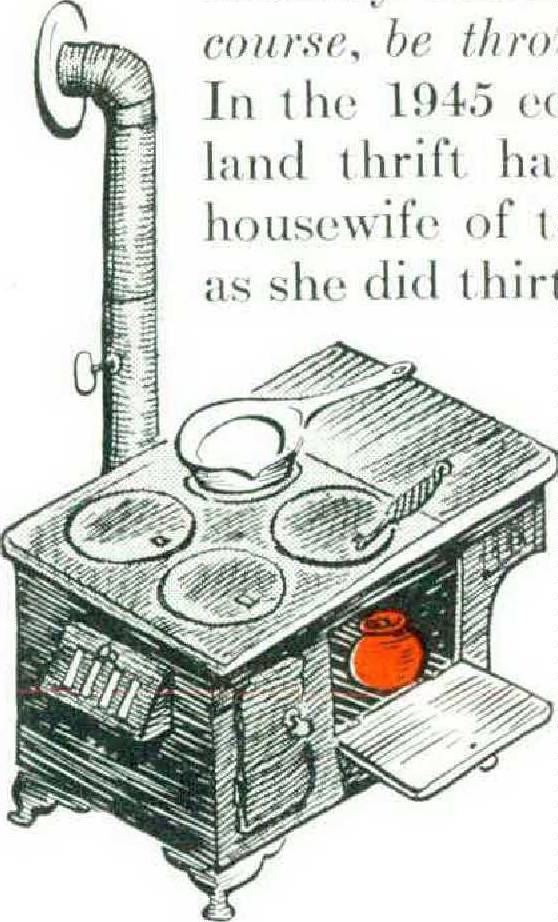
In Languedoc, the bean pot is an heirloom. It acquires grace and flavor with use and with age. The accumulated essences of garlic and onion and other savory things gradually permeate its earthen pores and guarantee an aura of goodness and of sanctity. She is only half a bride who does not bring a wellseasoned casserole to her new home. The much lamented Fannie Merritt Farmer, who, as late as 1911, knew nothing about baked beans except the Boston variety, takes a really shameful crack at the pot
when she says: —
“The fine reputation which Boston Baked Beans have gained has been attributed to 1 fie earthen I leanpot with small top and bulging sides in which they are supposed to be cooked. Equally good beans have often been made where a five-pound lard pail was substituted for the broken bean-pol.”
I wouldn’t know, never having dealt with a fivepound lard pail, but it sounds like sheer heresy to me.
In 1911, Fannie, speaking of the testing of the bursting point of the bean skins, said it “is best determined by taking a few beans on the tip of a spoon and blowing on them, when the skins will burst if sufficiently cooked. Beans thus tested, must, of course, be thrown away.” (Italics are mine.) In the 1945 edition of her book, New England thrill has asserted itself. The Boston housewife of today blows on her beans just as she did thirty-four years ago, but it is left to her conscience and her discretion as to the disposal of those blessed by breath. She can surreptitiously slip them back into the pot when no one is looking, or she can save them for Christmas presents for those remote Apley cousins from Springfield.
In the interval between 1911 and 1945, Miss Farmer, or her heirs and assigns, became aware of a monstrosity known as Baked Beans, New York Style. This formula is properly dismissed with three terse lines of text (I, personally, would not give it even one): “Omit molasses. Bake in shallow pan. Arrange slices of salt pork over top. Do not add water during last hour of cooking,” Apparently, the slices of pork may be added after baking. It would not make much difference.