Lie Down, Rover
BySTANLEY E. GWYNN
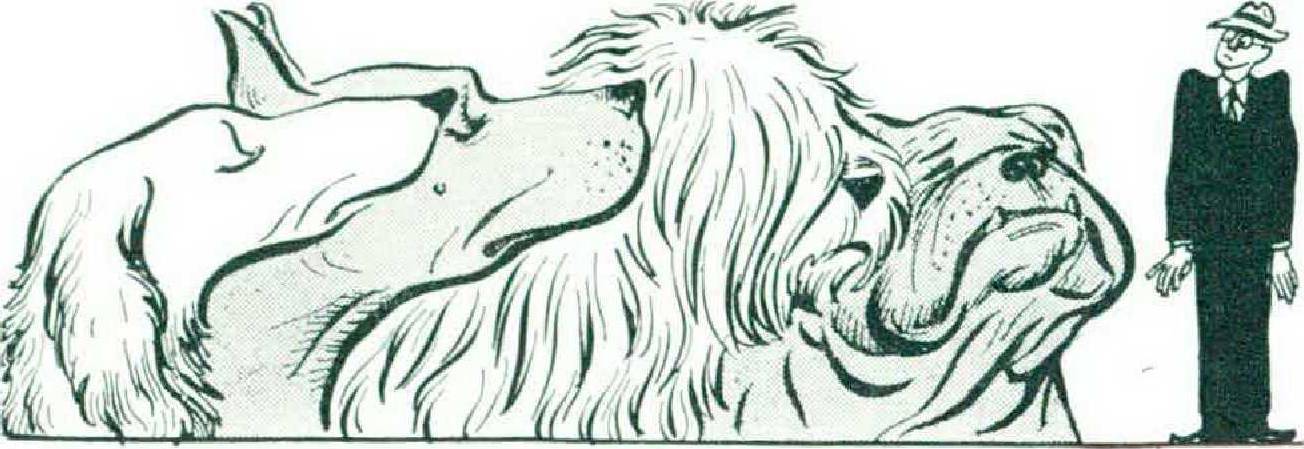
I HAVE just received a letter from the Board of Managers of our local kennel club inviting me, in adroit and flattering prose, to act as one of the judges at their forthcoming bench show. This event, they assure me, is rapidly becoming one of the classics of the dog world, and the impending meeting is to be distinguished by the presence of “such celebrated canines as Champion Auburn’s Michael of Ballycreen and Champion Prince Sunset Buddy Pourquoi.” End quote.
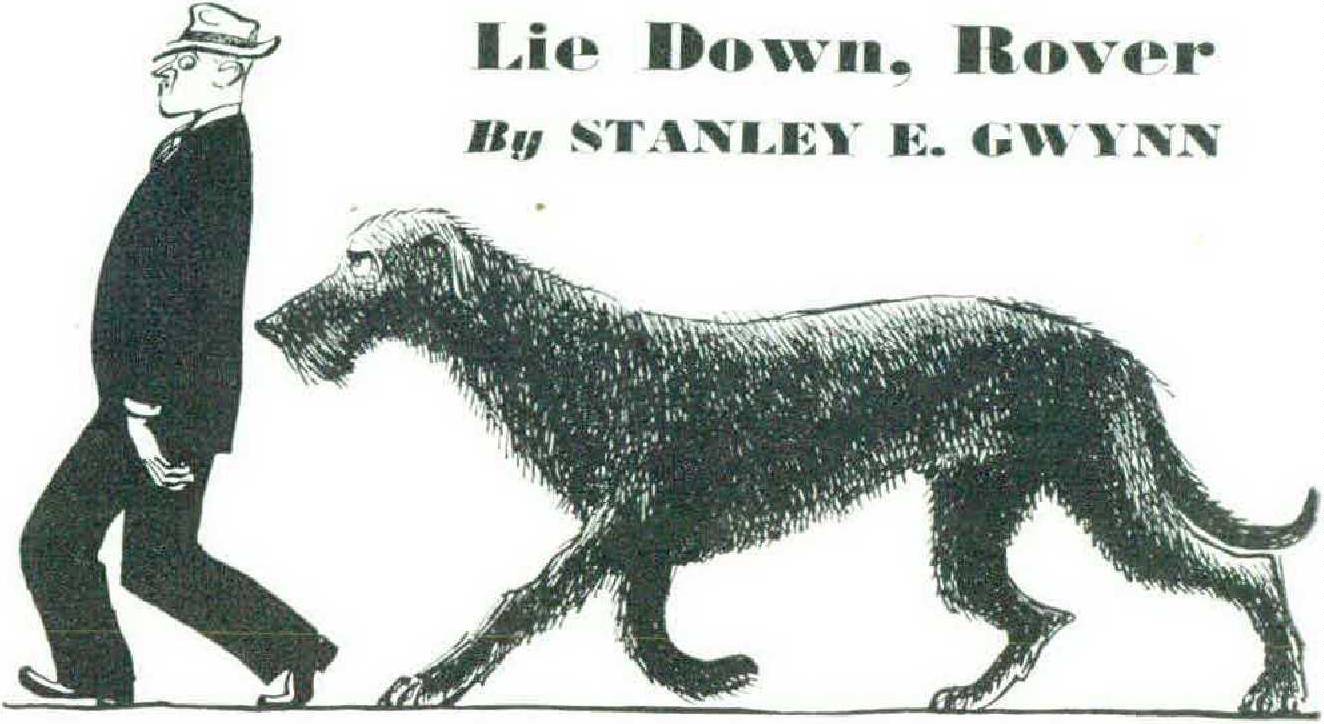
I do not know what awful mischance has placed my name in the hands of the Board of Managers; perhaps I have a namesake somewhere in tins broad land who is a dog fancier, or it may be that one of my new neighbors (I have recently moved into the community) saw me walking down the street the other day with an expensive-looking Irish wolfhound and concluded that I own and know fine dogs.
But whatever the nature of the blunder that brought me my invitation, the good Board Members could not have chosen a more incompetent person to act as judge at a convention of man’s best friends. What I know about thoroughbred dogs could be put in the eye of Auburn’s Michael of Ballycreen without even blurring his vision; and what dogs know about me, after one glance and a couple of sniffs, is enough to make them slink out behind the garage and slay there until I have left the premises. I like them— I am even very fond of them and for years have secretly desired the companionship of a faithful hound — but we were not meant for each other. Every time I have taken up with a dog, the association has brought me nothing but disappointment and the pup nothing but woe, and I learned long ago that both of us would be better off if I just avoided the animals entirely. Mother didn’t know what to do about Bardolph, and was so
That matter of the Irish wolfhound, for example, is typical of all my encounters with dogs, except that in this case the dog came to no harm. In the Hrsl place,
I was not walking down the street with the dog. I was being herded. I had stopped in front of a neighbor’s place, about half a mile from my own, to admire the view, when suddenly I received a determined nudge in the rump. I turned around — fortunately without too much haste — anti there, staring meaningfully at me, was the wolfhound. Obviously he belonged to the estate whose view I was enjoying, and just as obviously he had been trained to permit no loitering by strangers.
I am not afraid of dogs but I am no fool either, so I just stood still and kept my arms close to my body, a practice which, I have read somewhere, is recommended by grocers’ boys and other service-men who frequently find themselves face to muzzle with belligerent watchdogs. The wolfhound waited a moment for me to be on my way and then, when I made no effort to move, stepped forward a few inches and gave me another and more forceful nudge, this time in the midriff. With that, I got his meaning. I turned slowly around and slowly walked away toward my home. The wolfhound followed close behind, ready to boost me again if I seemed to need further stimuli, and it may be that this little shepherding act gave one of my neighbors the wrong idea of my connect ion with the canine world.
The very first dog in my life was an efficient and forthright collie who ran up to me on the street one day about twenty years ago, nosed me with an air of cool objectivity, bit cleanly and deeply into my right thigh, jumped back as if startled, regarded me intently, and loped off down an alley wearing an expression indicative of mild nausea.
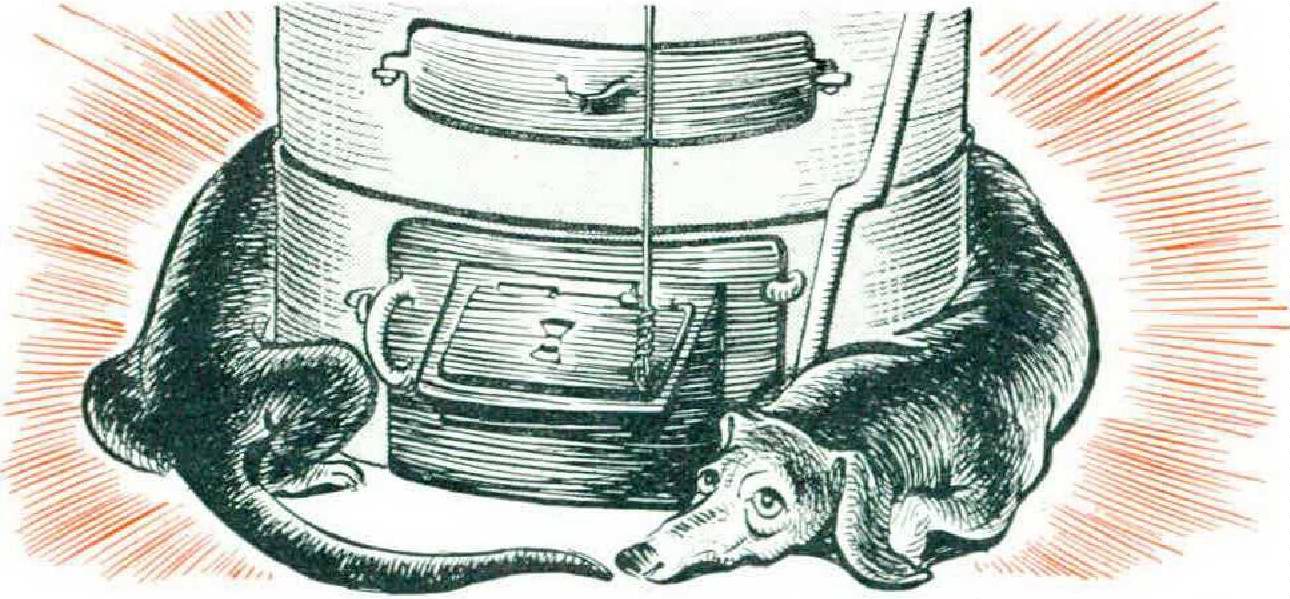
My second dog came along several years later. He was a dachshund of incredible length who accompanied my grandfather home from the vinegar factory where he (my grandfather) was a chemist. I was a boy of twelve at the time and the creature was supposed to become my pet, but almost immediately I began to notice evidences of our incompatibility. For one thing, I had a reasonable amount of boyish energy and craving for action, but Callohan, as my grandfather called the dachshund (after the owner of the vinegar works), was opposed to any kind of exercise. He also resented adult or adolescent humans, cats, and most foods, but was passively fond of warmth, sleep, and fried thuringer. He appeared to be sufiering from a perpetual chill and soon after his arrival found his way into the basement, where he spent the remaining six days of his sojourn coiled around the base of the furnace.
Once or twice a day I went down and halfheartedly prodded him with my toe, but that was the extent of our boy-dog companionship. At the end of the week, Grandfather took Callohan back to the vinegar factory. Within an hour he broiled himself rather thoroughly about the head and shoulders during a close investigation of an open ashpit door, but even that did not dissuade him in his search for warmth. For all I know, he is still there at the factory, draped among the tubes of the boiler.
My third hound also ended up at the vinegar factory, but I have forgotten how we acquired him. His name, I recall, was Bardolph. He seemed to he a pretty good dog if you overlooked a rather simple smile and a certain vagueness in his general attitude. For several days after his advent we had a lot of fun together, but after a week or so his vagueness look on more than a touch of lunacy and I began to have some misgivings. I covered up for him as well as I could, but one afternoon our telephone rang urgently and after my mother had taken the message I could tell from her expression that my pup was, so to speak, a dead duck.
“What’s the matter?” I asked,
“It’s Bardolph,” said my mother, walking rapidly toward the front door. “He’s gone crazy. Mrs. Koehler says he’s trying to climb the side of her house.”
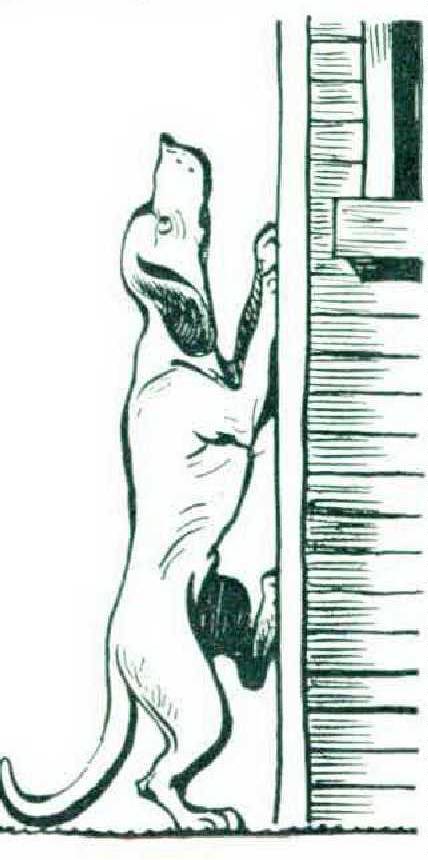
We arrived together on the front porch and peered over the railing. Sure enough there was Bardolph halfway back in the gangway, earnestly trying to walk up the clapboards of Mrs. Koehler’s bungalow.
Absolutely no frenzy was connected with the enterprise; there was no frantic harking or desperate leaping. Bardolph stood quietly on the sidewalk, looking up and thoughtfully studying the wall as if he had important business on the roof and was choosing the most comfortable of several logical routes to reach it. Then he stood on his hind legs, put his forefeet against the wall, and started to move his legs in the conventiona1 manner and at conventional speed, just as if he were walking briskly along on the level. Of course he collapsed at once, falling to the walk repeatedly and just as frequently scrambling to his feet for another try. It appeared, from his demeanor, that he considered the easy ascent of vertical surfaces a normal activity of dogs, and it was obvious that his failure was beginning to puzzle and worry him.
Entranced by his efforts that for once I had no advice to offer. So the dog kept on climbing and the audience kept on growing until the whole thing was brought to a crisis by the arrival of-a Black Maria full of policemen, summoned by one of our more officious neighbors.
It was evident that the police had been thinking of the ease as a routine affair, and had been planning merely to shoot my dog and carry his body off to the city incinerator. They were entirely unprepared for Bardolph’s poise and, confronted by it, were unnerved and thrown into a state of indecision. After a moment or two they formed themselves into a tight, brass-buttoned circle and busily discussed the proper move to make.
At the height of all this pother—the gendarmes arguing, the neighbors advising, the passers-by staring, and Bardolph striving intently for the roof Grandfather came home. Always quick of percept ion, he took in the circumstances with one swift glance. Then he waded into the tumult and the shouting and m no time quelled what was becoming a small riot.
His expansive geniality calmed the neighbors, appeased the constabulary, and even fell like a beneficent balm on poor addlepated Bardolph. He was able to convince the police that the dog should not be shot, and he promised to take him down to the vinegar works, where, and the pungent fumes of acetic arid, he soon would be made a new dog.
The next morning he put Bardolph in a box and carried him off to the factory, and that was the last any of us ever saw of him. For, as Grandfather told us that evening, Bardolph had no sooner been given his freedom at the factory than he took a deep breath of the fume-laden air. That did it.
Bardolph emitted one long, horrible, agonized shriek. He tore madly around the room three times, careened through an open door into the shipping room and out another door, soared grandly into space off the end of the loading platform, tumbled head over tail when he hit the ground, and, when last seen, was streaking like a whippet for the river, trailing behind him a string of anguished yelps whose sound floated to the ears of Grandfather’s astounded colleagues.
Well, that’s my dog record up to date, and I’m willing to admit that it’s a spotty one. The Board of Managers of the local kennel club has been fooling with dynamite, and they’d better drop me at once.
I hope that henceforth they will examine the pedigree and background of potential judges as carefully as they scrutinize the pedigree of Auburn’s Michael of Ballycreen. Or of Prince Sunset Buddy Pourquoi, for that matter.