Morning Musicale
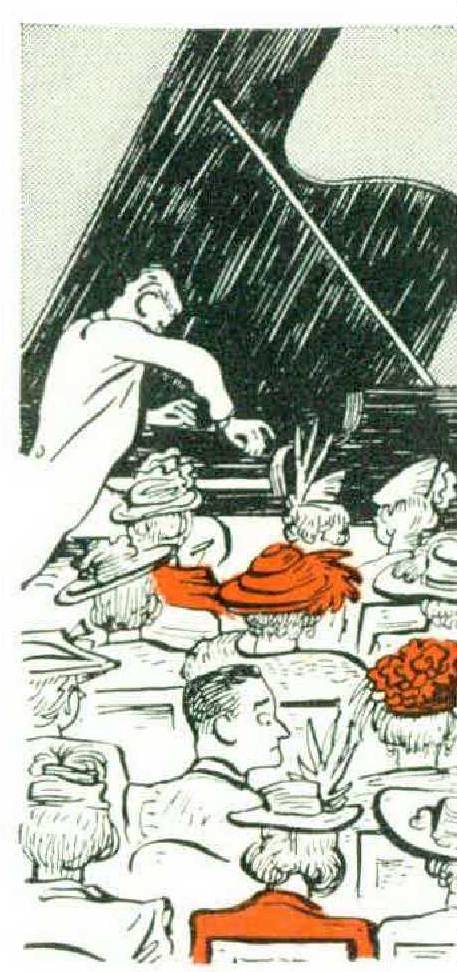
MY friends warned me that it would be a sorry venture —that with admission limited to subscribers I’d probably be turned away at the door, and that even if I was admitted I’d doubtless be the only male in the audience and I’d find myself in an atmosphere so unnatural that it would kill any pleasure I might take in the music. With a fanaticism born of over a year of listening to an Army concrete mixer, I held firm.
The concert was to be given at eleven the following morning in the ballroom of the most fashionable hotel in t he cit y where I was spending my leave. The words of my friends had sunk in overnight, and my resolution had paled considerably by the time I reached the hotel. Only my intense desire to hear the pianist carried me on, but even that wasn’t enough when, in the lobby just outside the ballroom, I came upon a great gathering of women — all wearing hats and all chattering like mad. I looked hopefully about, but no other man was in sight.
The crowd of women became more intimidat ing by the moment, and my courage ebbed to nothing. I was about to admit defeat and to slip quietly away when a large, forceful-looking woman suddenly disengaged herself from the throng and bore down on me, hat on high and furs flying. She grasped me by the right elbow and asked eagerly if I wanted to hear the concert. Trying unobtrusively to free myself, I mumbled that I had wanted to hear the pianist, but that under t he circumstances I — well, I’d probably be happier elsewhere.
A light shone in her eye, she got a firmer grip on my right arm, and before I knew it I was swept into the midst of the hats and the furs and the chatter, and was being enthusiastically introduced left and right as a “soldier boy” who wanted to hear the concert. A buzz of excited interest attended the introductions and I got the ungrateful impression that these women had been trying to get a member of the Armed Forces to attend one of their Morning Musicales ever since the war had started, and that at Iasi they had found a victim.
Still with a firm grip on my arm, my patron led me to a table where a small, thin woman with hat askew was tumbling distractedly with an assortment of admission cards. My presence was explained lo her and she sought among the cards, eventually finding one that she knew would not be claimed that morning. A Mrs. Willoughby, it seemed, had called saying that she had a sore throat and could not come to the Musicale, and that her card could be given to anyone — anyone, she had added, except a music student. ’Mrs. Willoughby is very peculiar that way,” sighed the woman at the table.
“Well, obviously, our soldier boy here is not a music student,” boomed my friend, the large woman, cheerfully, “so Mary Willoughby’s mind can be at case.” She took the card and drew me off again, this time to a long table where several women were sitting pouring coffee into tiny cups. More introductions followed, and again there were the exclamations and expressions of pleased incredulity. Four of the little cups of coffee were pressed on me and in some confusion I downed them all. They helped. I was finally steered inside the hall and there turned over to a pretty young thing with black eyes and hair down to her shoulders, whom I followed lamb-like to a seat in the front row.
I had survived the trial by fire, and though somewhat shaken and confused in mind, I knew that I could take anything else they would have to give. As it was, the worst was over, for from then on I had to cope with only a limited sphere of women. I was flanked by two middle-aged ladies who, after they had satisfied their curiosity about the absence of Mary Willoughby, talked to me at amiable length of her good works and eccentricities. I gathered that she was something of a female Dr. Johnson, and certainly she suffered no dearth of Boswells.
The pianist played superbly and the audience was reasonably quiet while he played, but between times the talk was unnerving. “All technique—no art,”a woman behind me in a business suit kept repeating imperiously. The woman at my right sighed. “It does seem so nice to have a man as the artist, she said. “Mind you, I have nothing against Gladys Swarthout and Lily Pons, but, as Mary Willoughby always says, ‘A woman’s rightful place is in the home.’ ”
At intermission I escaped a good twenty minutes of Mary Willoughby by withdrawing to the lobby to smoke. I concealed myself behind a large pillar off to one side and had just finished a cigarette when, to my considerable surprise and relief, I saw another man — an elderly individual with white hair. He had just slipped behind the next pillar, where he stood chewing savagely on a cigar. He spied me and we made for each other like chemicals in a solution.
He drew me to a corner, put a hand on my shoulder, and said in a hoarse, furtive whisper, “My boy, don’t ever retire. No matter how old you get, don’t ever retire. When you do, your life isn’t your own any longer. You’ve got to put up with every whim that comes into your wife’s head.” He shook his head hopelessly and there was a look of desperation in his eyes. “My wife’s had me coming to these damned things for over a year now, and this is the first time I’ve ever seen another man in the audience. For God’s sake, don’t ever retire!”
With further exhortation to stay in the Army should a fate like his seem remotely possible, he left me — or rather he was drawn away by a sweetly resolute old lady, who informed us that the intermission was over. I saw him over a flock of bobbing hats at the end of the performance and he looked at me somberly and raised a warning finger.
The Army is generally credited with teaching the soldier to adjust himself to any sort of situation — even Morning Musicales, presumably — and by the second half of the performance I was reasonably well adjusted. I still felt that I was but poorly taking Mary Willoughby’s place, and I’m afraid that 1 was rudely noncommittal when, in the middle of the final encore, the woman at my left whispered, “It’s the way the lights are shining on him. It’s bothered me all through. The last time I saw him he didn’t have all those lines on his face. It must be the lights.” And after it was over I was able to shake the hand of the woman who had collared me in the lobby at the start, look her in the eye unflinchingly, and say that I had enjoyed the concert very much.
Although I shouldn’t like to endure it. again, I must admit that my experience at the Musicale was valuable. When I listened to our phonograph on my return to duty, I could at least have the memory of what the music should sound like, and when I started to brood about the absence of women on the base, I could think of my morning at the Musicale and count my blessings.