Offstage
THEATER
To Paste in the Hat
Into everyone’s life comes a time when he is taken backstage, red-faced and grinning, and introduced to the great star. The occasion calls for just the right remark, the perfect combination of civility and ecstasy. Since play or performance may have wobbled here and there, this can be a problem. One woman of whom I have been told has solved it. “My dear,” she intoned, seizing the star’s hand in both of hers, “you have simply no idea what it was like!”
Foon vs. Boff
The purchaser of entertainment finds himself under an irrational but very real obligation to the vendor. A movie, for example, is not a success in the eyes of its creators unless, during the New York run, there is a block-long queue of patient people waiting outside in the weather, their money clutched in their hands. Producers always have such queues photographed and the pictures printed in the trade press. Seeing a movie is not enough; you must prove your sincerity by risking pneumonia or sunstroke.
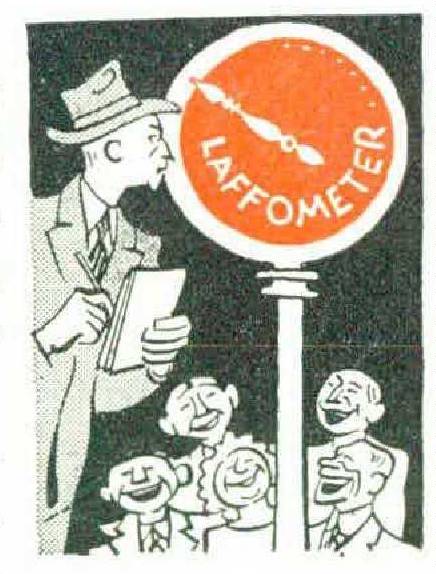
Similarly, in the theater, there is an obligation laid upon audiences at comedies, particularly during the tryout period; they must not merely enjoy the play: they must enjoy it noisily. Producers of comedies measure success in decibels. They have even
worked up a special vocabulary to differentiate between laughs of varying degrees of intensity.
For instance, one kind of laugh satisfactory to a producer is the yak (pronounced “yawk”). This is the short, barking laugh with which the average pewholder salutes a shrewd thrust, or snapperoo— for example, “The trouble with women is . .”or “A man isn’t drunk until . . .” More to be desired, though, is the boff, which is the Homeric response to an elementally comic situation, such as the comedian’s pants falling off. In the course of a boff the customer bellows or shrieks, slaps his thigh, nudges both his neighbors in the adjoining seats, loses his spectacles, drops his overcoat on the floor, and perhaps suffers a slight stroke.
The concept of silent enjoyment is a new one to show business. Countless times, a producer has tiptoed out of a theater where an audience was sitting, all crinkled up with silent and voluptuous amusement at a new play, and sent a hurry call to George Kaufman or some other reliable play doctor. Now there is at least one comedian who takes cognizance of the silent laugh — or, to be exact, the just-audible evidence of enjoyment, which sounds to a person on the stage like the murmur of a breeze in distant pines. For this sound he has found a lovely word: he calls it the foon. The renaissance of the American theater will be at hand when we have a majority of comedians and writers working for foons instead of boffs. The comedy of manners will flourish, and whole seasons will go by without a single comedian losing his pants.
Full Circle
The marriage of ballet to musical comedy, like most marriages, has finally reached a stage of weary resignation. The producers all realize that there can be no musical show without its ballet — and not just an interpolated ballet, either, with some casual cue like “Hurrah! Here come the girls!” but a heavily plotted number in which the hero’s or heroine’s mental conflicts are acted out in the stark and fretful idiom of the modern dance. The producers realize this, but they don’t like it.
Just recently I heard a producer and some henchmen discussing — or, as the West-of-Broadway idiom has it, kicking around — ideas for the obligatory “dream ballet” in a new musical play. After half an hour of fruitless talk, the producer moodily dropped his cigar butt into his coffee and snarled, “Maybe we should just have a ballet where the audience goes to sleep and dreams they’re across the street at Oklahoma!”
Hot Tip
I don’t know whether any established producer would touch the play I have in mind. Plays about the interrelations of whites and Negroes have tended lately towards an intellectual mushiness. The historical, geographical, economic, and social problems involved vanish behind a sexual smoke screen. Such plays remind us of the belligerent Southerner in the Pullman washroom, who crushes arguments by asking if anybody present wants to see his sister married to a colored man. The plays, to be sure, assume that we are liberal instead of bigoted, and would not object to such a union; they then base upon this assumption a further assumption that no real problem exists. It’s mushy thinking, though well-intentioned.
The script I have in mind faces directly up to the facts. The fundamental problem, it says, is the economic one. One of the characters, a Southerner who is an exploiter of Negro labor, sets the keynote.
“I’ve got just as much conscience as any man in business can afford to have,” he says. The psychology of the Negro under a social system which, at best, is degradingly paternalistic, is explored in a series of searching character studies, ranging from a child who accepts her racial handicap with defiance and hatred of the whites to an old and senile man who knuckles under completely and consoles himself with religious myths.
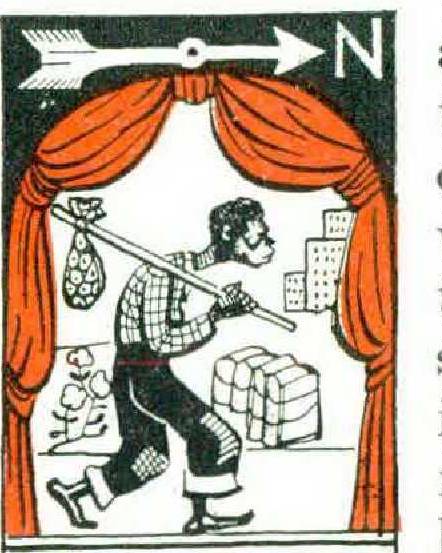
The author hints plainly enough that the Negroes’ only hope is to leave the South; those who remain are shown entangled, one way or another, in a morass of mawkish sentiment which kills self-respect and hampers economic progress. In a final scene of mordant irony, we are given a comment on the net result of the sentimental approach to a real problem: Uncle Tom does not even hope for justice oN this earth; perhaps in Heaven . . .
More Uneconomics
Bernard Baruch’s phrase, “uneconomic area,” meaning a situation in which the ordinary laws of economics do not operate, is indispensable in any discussion of show business. Show business is a permanent uneconomic area. Consider, if you will, the Strange Case of the Vanishing Postman, as I have ventured to call it.
Several years ago, there was a big historical playwith-music which you never saw because nobody ever saw it. In one scene a postman figured prominently— he wandered up to a group of people who were talking something over, disagreed with something somebody said, almost got into a fight, and wandered off. It wasn’t a particularly powerful scene, but, then, none of the play was very powerful.
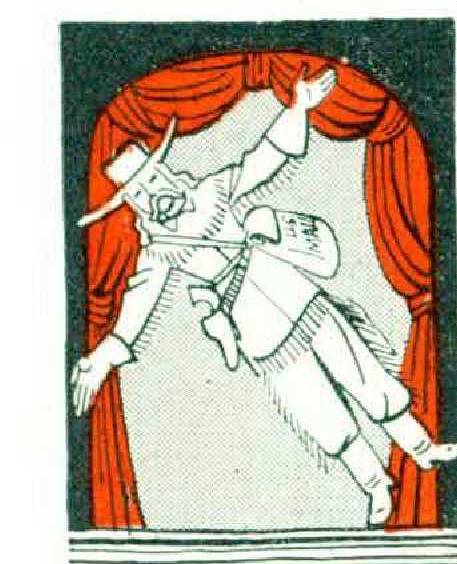
The scene was backwoods America in the nineteenth century, and the costume designer was delighted to discover, upon checking the exact dates and places involved, that the people of this region, at the time indicated in the play, were served by the Pony Express. To set off this postman from the other characters in the scene, who were all overall-clad farmers, the designer had made for him a skin-tight suit of fringed white buckskin, supplemented by a wide white Stetson and two six-shooters.
Meanwhile, inevitably, the play was being rewritten by another writer. As far as this new writer could see, the original playwright had made the postman a postman simply to get him on and off the stage with a minimum of explanation.
Already, there was some confusion, since it was plain that the original author saw his postman not as a Pony Express rider but as the ordinary kind of postman, the kind you have to tip at Christmas. It got worse, too. Over the week-end, the character left the Postmaster General’s employ, the new author having found it more expedient to bring him in with the line “Where is everybody?" and to send him off saying, “Well, guess I’ll go home for my vittles.”Nobody thought to tell the costume designer about this, however, and for the duration of the play this particular actor wandered through his scene in inexplicable splendor. No great harm done, though: the play closed during the out-of-town tryout, as such plays almost always do.