The Stew Pot
LUCIUS BEEBE, in one of his more purple moments, once designated the author of this essay as America’s No. 1 gourmet.
Nothing could be more embarrassing than such a classification. Potential hostesses at once took to cover like frightened does, imagining that nothing less than a tub of pâté de foie gras would satiate my jaded palate. The term gourmet, or epicure, is really an invidious one and should be avoided by the judicious. He who would be Epicurus in France would not so rank in Cambodia. The question sums itself up in the answer that Lorenzo the Magnificent gave when asked to define an expert. “An expert,” said Lorenzo, “is a person who, when asked whether or not he really is an expert, admits the fact.” Perhaps the best account of what an epicure or a gourmet is supposed to be is contained in The Merle Armitage Book of Food, from which I take the liberty of quoting:—
“I have always been doubtful of the prevailing picture of an epicure. It seems as false to picture him only as a decadent, sensuous taster of gastronomic sensations, as it is to consider a painter, à la motion pictures, as an unkempt, impractical, Velvetjacketed denizen of a Paris attic. The epicures whom I have encountered have been, without; exception, men of cultivated palates and exacting tastes, but who knew thoroughly the value of purity and simplicity. He should frighten no reasonably intelligent hostess who knows anything about the rudiments of food and cooking. He may know wines, spices, salads, sauces, roasts and other luscious viands of every race and nation, but he will not be condescending about a good plate of corned beef and cabbage, nor in its time and place, buckwheat cakes, maple syrup and sausage.”
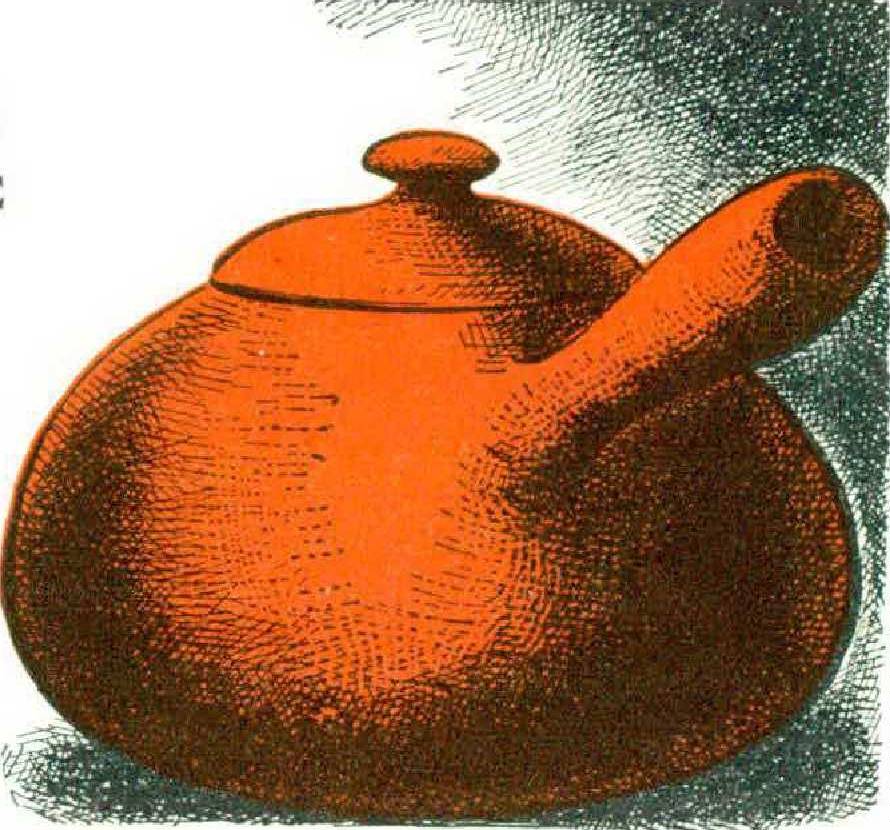
As a matter of fact, I like a good stew and I don’t mind standing right up in meeting and saying so. What more noble symbol of the good life can there be than the Stew Pot? It can be a Dutch oven; it can be made of iron; it can be fashioned of copper plated with tin or silver; it can be stamped out of gleaming stainless steel; it can be molded out of clay. I happen to be the fortunate owner of all these various implements, but my favorite is a French marmite of clay of ample pro portions. La marmite bout dans cette maison is a wise French saying.
My marmite is the shape and size of a very large pumpkin; and like the pumpkin, it is a rich orangeyellow at the top. This glowing yellow gradually tones into a soft, smoky brown as the upper curves expand into its comfortably bulging belly, from which bubble miracles of succulence and flavor. Its very shape typifies the plenitude of the round earth itself. More than any other element except the fire, it stands as the high queen of the kitchen. Into its capacious walls go from time to time all the fruits of the fair earth, there to melt together slowly, to blend and to mingle gently the flavors and concentrated nutrition that make a first-class stew — the leading one-dish meal that can be devised.
There is an infinite variety of stews. They can be fashioned of meat and vegetables, of fish, or of vegetables alone so cleverly seasoned that they convey to the palate a rich and meaty tang. The magic wand of flavor holds the secret of such concoctions. For the enjoyment and good health of the readers of the Atlantic, I am going to describe the high and sacred formulas of one or two stews that, as far as I am concerned, have stood the test of time and so are forever welcome upon my table.
The first of these will be lamb stew as fashioned at the old Waldorf-Astoria Hotel. When the old hotel went into the hands of the wreckers, Oscar, that prince of hosts, escaped from the dangers of falling bricks and mortar, bearing in his inside pocket, as a sole memento of ancient grandeur, the recipe for Irish Lamb Stew Old Waldorf. One snowy winter’s day, from his office in the new Waldorf-Astoria, he sent the secret on to me as a Christmas present. And now, with Oscar’s blessing, I share it with you.
To serve six hungry persons you take:
14 ounces of lean pork shoulder, trimmed and
cut into 1½ inch squares
28 ounces of lean and tender lamb, trimmed
and cut into 1½ inch squares
20 ounces of sliced potatoes
8 ounces sliced onions
14 small whole onions
14 very small turnips
18 tender carrots, sliced
1 cup of green peas
1 cup of sliced string beans
1 bouquet consisting of 6 stalks of celery and
a little parsley tied together
1 clove of garlic, chopped
1 bayleaf and a pinch of thyme
2 tablespoons of chopped parsley
1 quart of water
Salt and pepper to taste
Place in the stew pot the meat, the water, sliced onions, one half of the sliced potatoes, the chopped garlic, and the seasonings, except the chopped parsley. Bring to a gentle boil and let simmer for twelve minutes. Then add the rest of the potatoes, the small onions, turnips, sliced carrots, peas, and beans. Season to taste with salt and pepper and continue the slow cooking until the meat is lusciously tender and the vegetables are soft but still retain their individuality. Remove the bouquet. Serve very hot with the vegetables on top of the meat and the chopped parsley sprinkled over all. This excellent dish is garnished with flaky dumplings which have been made in the following manner.
Mix well together: —
½ pound flour
4 ounces of finely ground veal fat
1 lightly beaten egg
½ cup of milk
¼ teaspoon of salt
½ ounce of baking powder
2 tablespoons of chopped chives, parsley,
and chervil if the latter is available
Pat the dough on an even surface to a halfinch thickness and cut into rounds with a cooky cutter.
Now there are as many different ways of cooking dumplings as there are said to be of killing a cat, and in most instances the result is an unhappy sogginess. Dumplings can be boiled in salted water or they can be steamed in the covered stew pot for fifteen or twenty minutes. So let us pop them into the pot and say amen to a perfect meal.
Franz Liszt dreamed the high and haunting melodies of the Rhapsodies Hongroises. It would be pleasant to believe that he also composed Hungarian Goulash, a fragrant symphony in its own right.
The shepherds on the wide plains of Hungary employed for their cooking an iron pot hung on a tripod over an open wood fire. Like the Greeks, they had a name for it — the gulyds, which in English becomes goulash. One of the characteristic seasonings of the Hungarians is paprika, their name for a member of the pimiento family, which possibly came to Hungary with the Turks some four centuries ago. In Hungary it is used green as we use our green peppers. When it is ripe, however, it reddens just as our peppers do. It has a flavor all its own and when ground into the paprika of commerce it can be almost as hot as a chili, if the seeds have been ground with it, or it can be mild and aromatic.
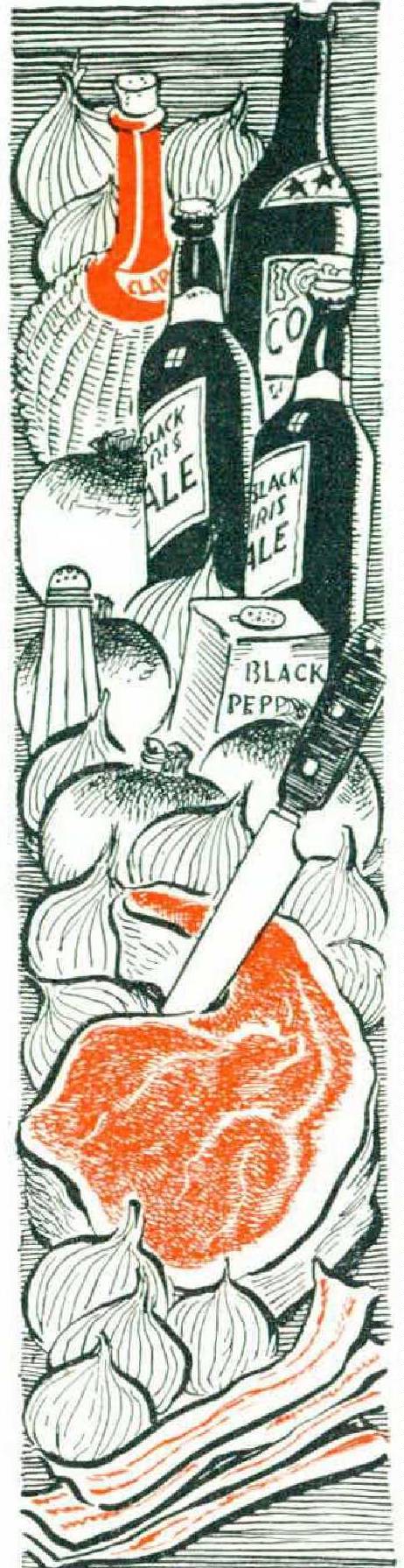
To make a proper goulash you go to your butcher and, if you are on good terms with him, — I have yet to find a good butcher who was not responsive to a person whose judgment of meat he could respect, — ask him to provide five or six pounds of choice top round. I usually cook on a week-end for at least ten or twelve voracious lions, so you must take this into account in estimating your own problems. The steak should be trimmed and cut into neat one and onehalf inch squares. Personally, I like bacon fat to grease the saucepan; so into the bright, stainless steel interior of this perfect implement I put about four good slices of bacon diced. When the fat gets good and hot, in go the cubes of steak, to sizzle, with occasional turnings, until all four sides are seared. Meanwhile, I have sliced up four pounds of sweet Bermuda onions. These join the beef, together with one onion whose rounded sides have been pierced with six cloves, and they all cook for about ten minutes. Next I add two bottles of ale, a half bottle of claret, a half cup of brandy, and a pint of tomato paste.
An hour and a half of slow cooking should suffice. Then season with salt, pepper, and a good tablespoonful of paprika. This last ingredient should be sifted in carefully so as to reach all sides of the meat as you turn it, but avoiding the sides of the pot, as scorched paprika will give a bitter taste to your stew.
In the meantime, a pound and a half of noodles have been boiled in salted water, and a cup of bread crumbs has been browned with a clove of garlic in hot butter. Pour the crumbs and butter over the noodles.
Place the noodles in the center of a large platter, and circle the rim of the platter with the cubes of meat. Serve the gravy in one of those maritime implements known as a “gravy boat”; then sit down at table and say nice things about the Hungarians.
Incidentally, as we must think of drink as well as meat, a bottle of Burgundy or Rioja is a pleasant accompaniment. Served with this meal may be a heaping bowl of mixed green salad and a well-ripened Brie to finish off our story in time for the coffee.