An Revoir, Mr. Chips
By J. J. O’MALLEY
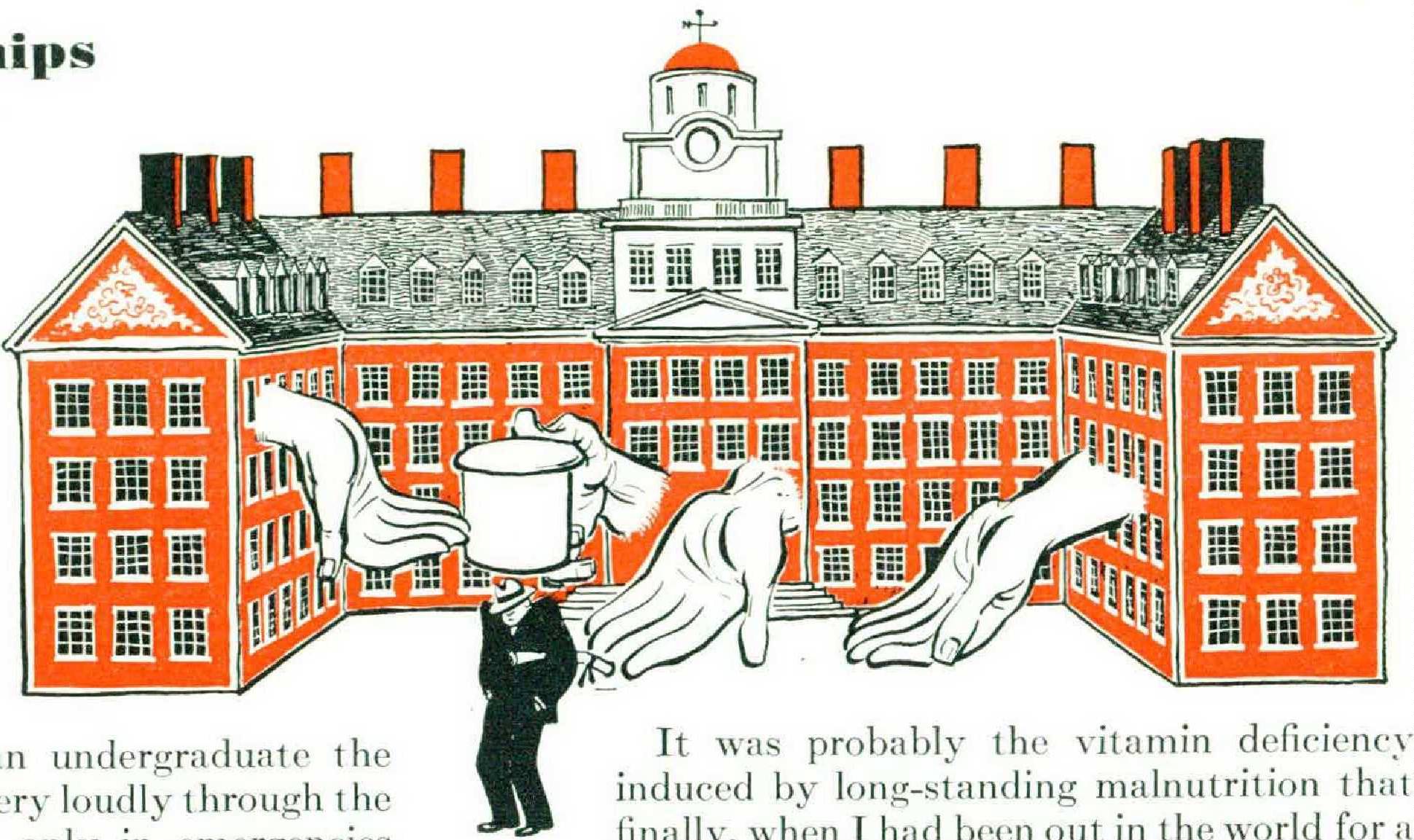
THIS is an absolutely true story, and I think a touching one, about a bond between a great Eastern university and one of its alumni, a bond so strong that it was not parted even by death. For a number of reasons, all cowardly, I am withholding the name of the great Eastern university; but I feel free to reveal that I am the alumnus in question.
During my four years as an undergraduate the name of O’Malley never rang very loudly through the fabulous ivied halls. Athletic only in emergencies and thoughtful only during sleepless nights, O’Malley was gently sneered at by even such minor collegiate celebrities as the assistant manager of the hundredand-fifty-pound erew. God loved him, no doubt, but nobody else made much of a fuss. A dismal bird of passage, you would have said, and one not likely to be remembered long after he had passed by. But how wrong you would have been!
Well over a decade has passed since my graduation, and I don’t suppose there has been a month in which I have not heard from Alma Mater, in the person of the class secretary, the class treasurer, the class president, the alumni publication, the college club, the custodians of this and that fund.
I lump them all together as letters from Alma Mater because they were all alike in tone, and, for that matter, in subject . After a few mellow and wistful paragraphs about the good old days, — intended, presumably, to soften me up, — there would be a crisp reference to financial matters. Alma Mater, it seemed, was pretty hard up. To be sure, she owned some of the juiciest slum property on the Eastern seaboard, enjoyed immunity from almost all forms of taxation, and for countless decades had been accepting conscience money from robber barons; nevertheless, it was pretty hard for her to raise any quick cash.
I soon gathered that the trouble was that most of Mater’s money was given her under hampering conditions of various kinds — stipulations that it be expended on scholarships, professorships, various monuments and memorials, and so on. I could see, of course, how galling it would be for a university to have the price of an astronomical laboratory, say, and not be able to spend any part of it for a chocolate ice-cream soda; but I couldn’t see how I could relieve this distress in any very adequate way. Later communications reassured me on this point.
“ Do send us something,” said one chatty letter, “if only a few hundred dollars.”
It was probably the vitamin deficiency induced by long-standing malnutrition that finally,when I had been out in the world for a full three years, drove Mater to the point of reminding me that I had never paid for my education; not really. “You will be the first to admit that the amount of your tuition didn’t represent the value of what you got out of your four years at college,” she wrote. As it happened, I had begun to think the same thing, and had been thinking of inquiring about a refund, if only a few hundred dollars. In the end I decided that the best I could do was accept the stalemate.
In addition to making me feel guilty every time I laid out $6.60 for a pair of theater tickets, Mater got me upset about political matters. Pathetically confident that four years under her care must have imbued me with wholesome political convictions, she addressed me, through the college club in my home town, on the subject of the 1936 elections. “It is not enough to vote yourself,” she said. “You must be sure that all your friends vote, too.”The sad thing was that she look my choice of a candidate for granted, little dreaming that I was one of that tiny group of malcontents who did not vote for Alf M. Landon.
The way my life has worked out, I have never discarded a mistress. I imagine, though, that communications from such an unhappy creature would be not unlike the communications out of my blameless collegiate past — full of a somewhat cloying sentimentality, and always nag, nag, nagging about money. At length I chose the coward’s way out — death. Across the face of the next letter that bore the college seal, I wrote, in a firm and steady hand, “Deceased.”
I dropped the letter into the nearest mailbox and bade good-bye to that phase of my life. Prematurely, as it turned out.
The letters now arrive, in unabaled spate, addressed to my estate. You’ve no idea what that can do to you on a rainy Monday morning. I am now hunting for a good unethical lawyer who might be willing to tell Mater that the estate is hopelessly tied up and unable to part with even a few hundred dollars. As, indeed, it is.