Arctic Gardens
By ELIZABETH LUKENS FLEMING
MR. GIBSON was setting out cabbages at 2.00 A.M., his head well covered with a mosquito netting. This apparently peculiar action did not show, as one might have supposed, that Mr. Gibson was in any way abnormal or mentally unbalanced. It simply meant that Mr. Gihson lived one hundred and twenty miles north of the Arctic Circle, where in summer the sun shines all the time and the mosquitoes are very bad. His working at that hour meant, also, that he had been too busy at the school to do his transplanting earlier, for Mr. Gibson is Principal of the Anglican Residential School at Aklavik and his energies for the preceding week had been concentrated in getting his hundred and ten Louchoux Indian and Eskimo pupils returned — many by boat — to their respective families for the summer holidays. Gathering in the children in the autumn by the same method would be an equally arduous undertaking.
Mr. Gibson’s garden adjoins the school property and the Principal’s house. In it are neat and thriving rows of cabbages and kale, spinach and Brussels sprouts, carrots and turnips, beets and peas, and several varieties of lettuce. The Archdeacon of Aklavik has a similar garden down by the mission house, and he too can often be seen working not only in the daytime but in the brilliant sunshine of the wee small hours. Both gardens are irrigated with water from the near-by river. In summer the heat, the lack of rain, and the nature of the soil all combine to create excessive dryness, which can only be combated by watering one half of the garden each evening. It is not unusual to have the hose and sprinkler running for six and seven hours at a time.
One of the greatest problems is that of the permanent frost line. Normally it is only ten to twelve inches below the surface of the ground. As an experiment the Bishop of the Arctic sent to the mission at Aklavik a tractor which is proving most helpful in this connection. Each year the tractor plows down a few inches deeper, until by now the permanent frost line is eighteen inches below the surface. When it reaches a depth of twenty-four inches people can, according to the authorities, grow anything suitable to the climate.
Of course neither vegetables nor flowers can be started outdoors, as the season is far too late and the sun so strong that they would never have a chance to develop roots, but would run entirely to weedy tops. It is hard to realize the great force of the Arctic summer sun; and the fact that it shines right round the clock means that it does double duty so far as growing plants are concerned. But mission and school alike have greenhouses in which, in the spring, the flats are set out. An even temperature is maintained with a wood-burning stoveno small feat in itself, as firing has to be done day and night. Then in July the seedlings are transplanted to the open ground. Most of the ordinary vegetables do very well and provide a wonderfully welcome change from tinned foods. Mr. Gibson has had great success too with tomatoes, although these have to he kept in the greenhouse. As yet potatoes seem to he too variable a crop at Aklavik to be relied on. Some years they flourish and provide an abundance, but other years they are an almost complete failure.
At Fort McPherson we had turnip tops for dinner, and no greens ever tasted better. The tops were pulled when the rows were thinned. The remaining turnips will never grow to full size, but they will be sweet and sound. At Fort McPherson the situation is quite different from that at Aklavik and more favorable to gardening. The settlement is further inland from the Arctic Ocean, more protected, and has a better soil. The missionaries in charge, Mr. and Mrs. Dewdney, have perhaps the most successful garden in the Arctic.

About the first or second week in April the Dewdneys start the season’s gardening. The first step is 1o bring earth from the greenhouse into the kitchen to be thawed out. With the ordinary winter temperature staying at 20 degrees to 30 degrees below zero, with periods of dropping to 40 degrees and 50 degrees below, this thawing is imperative. Within a week after the seeds are planted they are up, and from then on there is not a moment to spare. For almost all the vegetables and flowers, the sequence is from greenhouse to cold frame to open ground. Cabbages, cauliflower, kale, Brussels sprouts, onions, and lettuce progress in this way, but string beans and tomatoes never get beyond the cold frame. They seem to need the intensified heat. Peas, carrots, chard, parsnips, spinach, sage, and parsley are sown in the open ground and do well. So also do beets — although, like the turnips, they never grow beyond a tiny size.
From the first of June to mid-September there is, generally speaking, no frost at Fort McPherson; but even so, it has been found that beans and corn are too easily touched to be worth the labor involved. There were some healthy-looking rhubarb plants and equally healthy-looking raspberry canes. The latter have looked well for live years but have not yet borne any fruit. Last year blossoms appeared, so the hope is that they are becoming acclimatized.
Last year Mrs. Dewdney bottled from their own garden thirty quarts of carrots, fifteen quarts of turnips, ten pints of beets and ten pints of peas. Having this amount of home-grown produce to use during the monotonous, dark months makes all the difference to the winter larder. Sometimes, too, there are a profusion of wild blueberries which can be bottled and small quantities of red and black currants.
All the seeds at Fort McPherson are provided by the government as part of the work of the series of Experimental Stations that are being developed. There are now thirty of these coöperative stations in the 1600-mile stretch from McMurray to Aklavik, and all keep careful and accurate records. As part of the experiment at Fort McPherson several early varieties of wheat and oats have been planted, some of the seed having been sent in and some having been saved from the “crop” of the preceding year. This matter of acclimatization is very important in the Arctic and applies to chickens as well as to plants. Mr. and Mrs. Dewdney have been very successful with New Hampshire reds which they have raised themselves. They were setting about eighteen eggs this summer, and if any of these chicks hatch, they will be much hardier than those that are sent in.
The fertilizing of the soil is experimental also. One half of every row has been enriched with a mixture sent in by the government. The other half of each row is supplied with leaf mold that has been carried in sacks from an old lake bed a quarter of a mile distant.
By the flag post at the Fort McPherson mission house there was a beautiful, vigorous clump of delphinium, its tall spires of blue rivaling the sky in intensity. The delphinium stays out all winter despite the cold. The warm covering of deep, deep snow protects it, and each succeeding summer it shows forth again.
In the Eastern Arctic there are gardens, but of a very different sort from the Western Arctic described above. The Hudson Bay area and Baffin Land are too cold, barren, and sterile for anything to grow in the open ground. Indeed it can scarcely be said that there is open ground. The best that can be done is to cultivate lettuce, radishes, and parsley in cold frames made from the storm sashes of the houses. When this double protection is taken off in the spring, the glass is converted into cold frames. As each row of green appears, it is watched with earnest hope and great expectancy, for that tiny harvest provides the only fresh green available the whole year round. The day that the first radishes are served, or the first salad, a record is made in the diary!
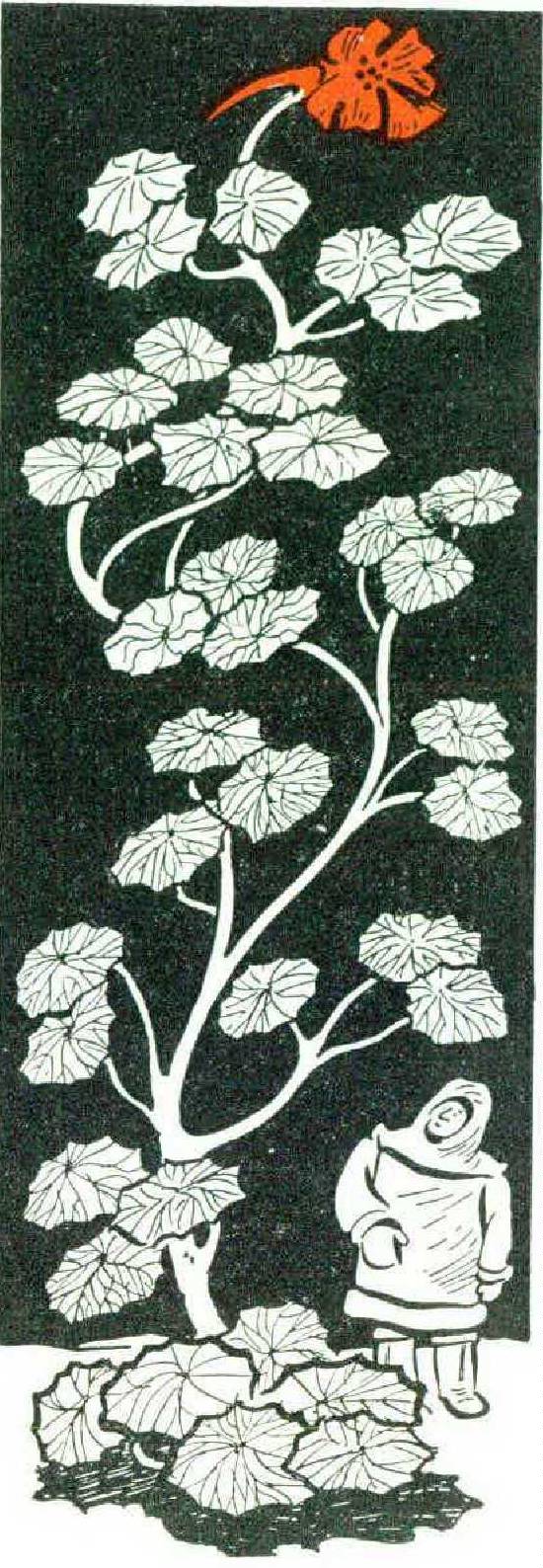
There is scarcely a house in the Eastern Arctic that does not manage to grow a few flowers to make it look like home. A bit of living color in that snow-clad land means more than a hothouse full of bloom “outside.” At Lake Harbour in Baffin Land there were a dozen bright blue cornflowers on the table; at Wolstenholme a miniature bouquet of Phlox drummoudii. Flowers there do not, however, always behave as one expects. Some dwarf nasturtium seed sent to the Anglican hospital at Pangnirtung has two years in succession reached the ceiling of the kitchen and bloomed at the top of the window instead of on the sill below! This was not from any mistake in the labeling of the package. Rather it is a vivid illustration of the strength of the midnight sun. Its compelling power pulled the little dwarfs up and up and up.