Summer Soups
FOOD
By CROSBY GAIGE
I ALWAYS like to quote from the works of Dr. Sam Johnson because it saves argument. The bald statement that Dr. Johnson said the dinner hour is, in civilized life, the most important, hour of the twenty-four is not likely to get much back talk even from those who prefer lunch or breakfast. Another authority is Casanova, who, finding in England neither soups nor desserts, reported, “An English dinner is like eternity; it has no beginning and no end.”
In most civilized homes, soup starts the meal; and as soup goes, so goes the dinner.

A book on etiquette published some hundred years ago, describing the proper course a dinner should take, lays down the law as follows: “When all are seated, the gentleman at the head of the table sends soup to everyone. If you were to decline soup, you would place both yourself and your entertainer in an awkward position. You cannot be helped to anything else. You should, therefore, always receive the plate, and toy with the soup, if you do not use it. For a similar reason you should not ask for soup or fish twice (you may be sure that they will not be offered twice); it keeps the rest of the company waiting.”
Nineteenth-century etiquette was something that my forthright grandmother would have called “nasty-nice.” Just imagine anyone stupid enough to “toy” with a plate of good soup. The question of asking for a second helping is debatable, although I have often yielded to temptation.
Nothing that comes to the table lends itself more readily to the imaginative touchstone of the creative cook than the soup pot. A household blessed with such a cook could well have a different soup every day of the year, and for many more years than one. Hors d’oeuvres, those mislabeled appetizers, may come into fashion as the preface to a meal or they may go, as I think they should go, into oblivion, but good soup is ever welcome.
Upon examination I find that most cookbooks stress the hot soups and present little variety in the cold and jellied sorts. Compounded with skill and presented with an eye to color, the cold soup can be the outstanding feature of a midsummer meal creamed, consommé or broth, jellied, or fruit. Perhaps the most publicized of the cream soups is Crème Vichyssoise Glacée, which, under the stigma of the unpopularity of the Vichy government, became temporarily Crème de Gaulleoise.
My scholarly friend William Rhode avers that Vichyssoise had its genesis in the Scotch “Cock-aLeekie.” Perhaps it did, but if so it has traveled a long way from the highland brew of pullet, leeks,and prunes that Scott extolled in The Fortunes of Nigel, where King James IV said, “And, my lords and lieges, let us all to dinner, for the cockie-leekie is a-cooling.”Prunes no more belong to a proper Vichyssoise than do the carrots that, are sometimes added by the unjudicious.
I have before me Cooking à la Ritz, presented to me by Chef Louis Dial of the Ritz-Carlton Hotel in New York. It is his recipe for Vichyssoise Glacée that I offer as the authentic and classic formula: —
4 leeks, white part
1 medium onion
2 ounces sweet butter
5 medium potatoes
1 quart of water or chicken broth
1 tablespoon salt
2 cups milk
2 cups medium cream
1 cup heavy cream
Finely slice the white part of the leeks and the onion, and brown very lightly in the sweet butter. [Actually, the onion and leeks should not be browned at all, but allowed to melt in the hot butter until soft and of a golden yellow color.] Then add the potatoes, also sliced finely. Add water or broth and salt. [Incidentally, chicken broth, either canned or brewed at home, makes a finer soup.] Boil from 35 to 40 minutes. Crush and rub through a fine strainer. Return to the fire and add 2 cups of milk and 2 cups of medium cream. Season to taste and bring to a boil. Cool and rub through a very fine strainer. When the soup is cold add the heavy cream. Chill thoroughly before serving. Finely chopped chives may be added before serving.
To me, the chopped chives are a must — emerald beads upon an ivory bodice. A pleasant variant is to blend four cups of Vichyssoise with one cup of tomato juice.
Sorrel is one of my favorite summer greens. Before I grew it in the garden, I gathered it as the common narrow-leaf dock from pasture or field, where it flourished as a stubborn and hardy weed. One may make an excellent cold cream of Sorrel by wilting three tablespoons of well-washed sorrel leaves, cut with the shears into fine green ribbons, in a saucepan with an ounce of sweet butter. Blend the sorrel with four cups of Vichyssoise, simmer for ten minutes, and serve very cold with just a touch of grated lemon peel to garnish.
From Andalusia in Spain comes what might he called a real salad soup for sultry days in summer. Its name is Gazpacho. A Gazpachero is not only the soup maker but the person who takes buckets of this healthful beverage along with loaves of bread, some cheese, and jugs of red wine to the laborers in the fields under the Mediterranean sun.
It’s good to serve for luncheon at home or to take iced in a thermos jug for a picnic. Here is a stylized version of Gazpacho as we make it at Watch Hill Farm::—
6 good-sized ripe tomatoes
1 clove garlic
1 sweet red pepper
4 small fresh cucumbers
2 tablespoons lemon juice
2 tablespoons finely grated raw carrot
2 tablespoons finely grated Bermuda onion
Salt and pepper to taste Parsley
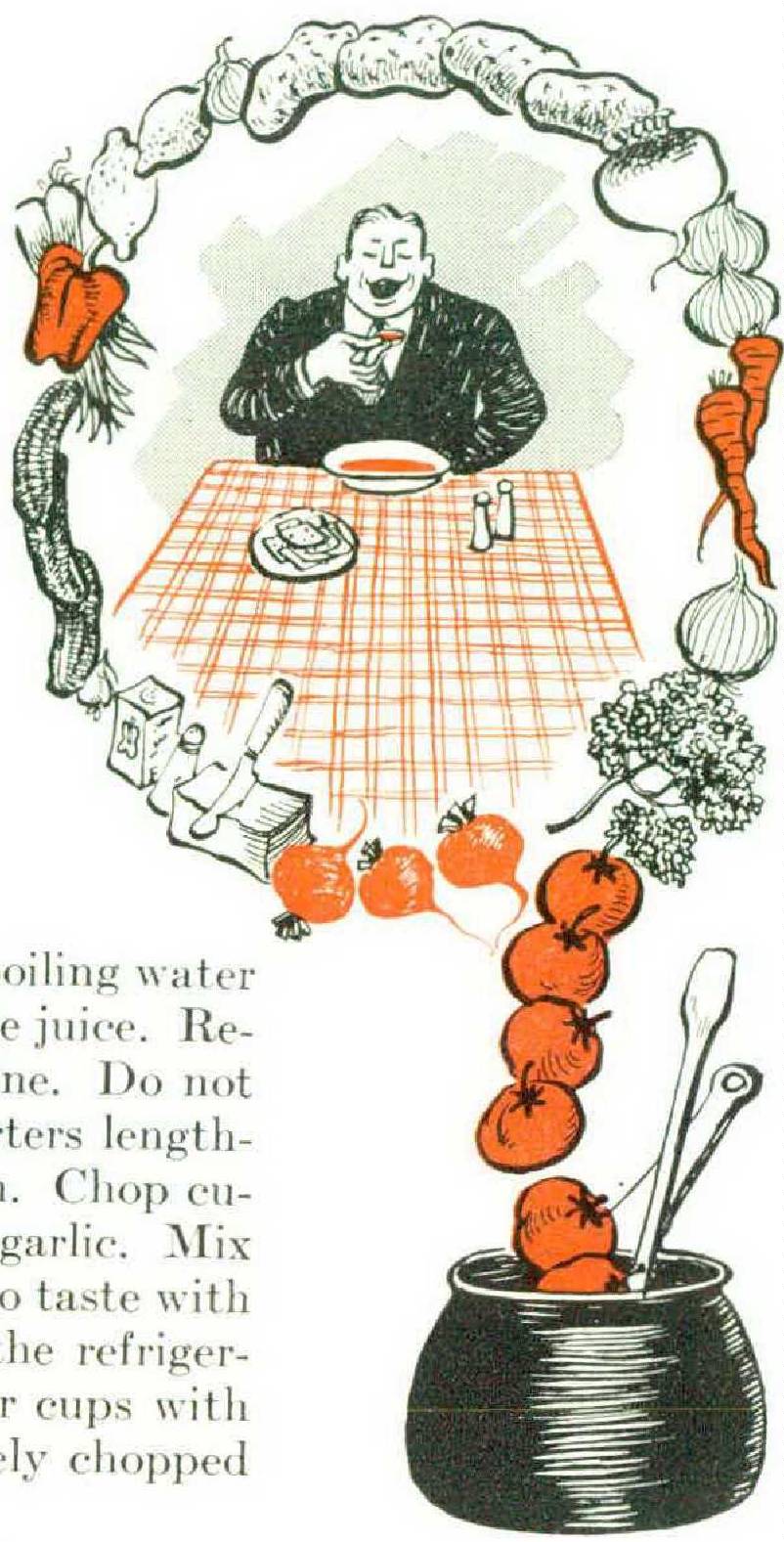
Wash the vegetables. Dip tomatoes in boiling water and remove skins. Chop fine, saving all the juice. Remove seeds from red pepper and mince fine. Do not peel the cucumbers, but cut them in quarters lengthwise and scoop out the seeds with a spoon. Chop cucumbers fine. Thoroughly mash clove of garlic. Mix all the ingredients in a glass bowl, season to taste with salt and freshly ground pepper. Put in the refrigerator and chill well. Serve in glass bowls or cups with an ice cube in each and a sprinkle of finely chopped parsley.
The variations that have been invented in the realm of fruit soups are infinite, and most of them seem to have stemmed from the fertile brain of sodajerkers driven to the verge of mania from overdoses of maraschino cherries. In my humble opinion, fruit soups should not be thickened with any starch or flour, but should be companionate blendings of fruit juices with or without a touch of gelatine.
Here is luncheon refreshment for four:
3 measuring cups of freshly squeezed orange juice
1 measuring cup of fresh lemon juice
1 pint of ripe strawberries cut into small pieces
1 tablespoon of Kirsch
3 tablespoons of gelatine Sugar
Heat enough orange juice, about 1 cup, to dissolve the gelatine. Mix all the ingredients, including the juice from the strawberries, in a glass bowl and sweeten with sugar to taste. Chill in the refrigerator until firm. Break up with a fork and serve in glass bowls or cups garnished with a large strawberry, stem and all.
Beets can be the foundation of a delicious and refreshing soup. Most Americans who have suffered from the Soviet sour-cream concoctions of amateur bortsch makers may be dubious, but I will give you an easy formula that will please: —
6 medium-sized beets
4½ measuring cups cold water
½ bay leaf
4 bouillon cubes
2 tablespoons gelatine
2 ounces lemon juice
1 dill pickle
3 bard-boiled egg yolks
Take six medium-sized beets fresh from the garden. Remove the tops and tails and wash thoroughly in cold water. Pare the beets and cut into small pieces. Put the beets with the bay leaf to simmer slowly in 4½ cups cold water. Never allow the soup to come to a hard boil or you will turn its nice ruby color to a rusty brown. When the beets are soft, drain off the beet liquor through a piece of muslin. Take a cup of the hot broth and dissolve in it 2 tablespoons of gelatine and 4 bouillon cubes. Add this to the rest of the beet broth along with the lemon juice. Taste the mixture to see if it needs a bit more salt. Put the brew in the refrigerator to chill. When ready, break up with a fork and serve in generous bouillon cups garnished with grated egg yolk mixed with finely diced dill pickle. An alternate garnish might well be fresh, crisp cauliflower buds.
Jellied consommé, either amber in color or red with tomato juice, is getting to be a pleasant summer habit in most well-run American homes. Excellent sorts can be had at the grocer’s in boxes or in cans. Many of these carry their own seasonings and all you have to do is to follow directions. However, here is a chance for the wishful cook to improvise, to invent, to create something new and exciting in an age-old art. Sometimes at Watch Hill Farm we mix a plentiful portion of chopped sweet onions with the jellying tomato bouillon just before it goes into the refrigerator. What you yourself add is no affair of mine.