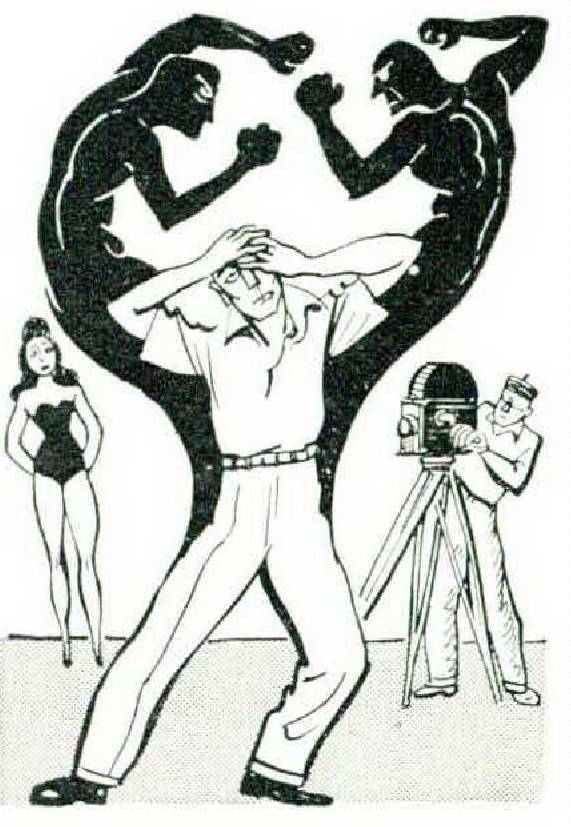
Morning After the Lost Weekend
FILMS
ByGORDON KHAN
MOTION picture fundamentalism, long in dubious battle with the younger heterodox forces, is now found out to have a glass jaw, gutta-percha feet, and a clapper from The Bells of St. Mary's for a tongue. The Lost Weekend had demolished the pious malarkey which held that a consummately adult picture is destined to expire in a thin gust of CheyneStokes breathing for lack of box office plasma.
That, Bwana, was the thunder on the left. And the drums spell out that the Weavers of Dreams are falling back to prepared positions on the Culver City escarpment, chanting “Gable’s Back and Garson’s Got Him.” An elite corps of Harvey Girls, lady psychiatrists, and National Velvet Dragoons on intelligent race horses jog behind Donald Crisp playing “Clang! Clang! Clang! Goes the Trolley” on the pibroch.
Should Weekend fetch only five of the six million dollars predicted for it, it has already touched a dab of 40-rod turpentine to the sluggish withers of the Hollywood unicorn. That old campaigner has never let a trend outrace him — by much — and this time he scents something deeper. Possibly an orientation away from the doctrine that unless a motion picture titillates it is downright subversive.
Masterworks based on the interlocking-weenie are being jettisoned. Triple-whimsies with the coy dradle go to the bottom of the heap of scripts on the production executives’ desks. Literary agents with a “drunk story” are plied with aromatic perfectos.
The papers have not yet been inked, as Variety says, but one film company has already pinned down the title Alcoholics Anonymous from the organization of that name, for the bargain price of $50,000.
Signs and portents of the movement away from the film theater as a Punch and Judy shadow box are blossoming like the crocus. Two major companies are promising that their films about atomic energy will show what it augurs for the world instead of who gets Prue Beauregard, modest instructor in the doubleentry abacus, who, as Lili von Huehnebrust, wormed her way into the position of chief code clerk at the Reichskanzlerei, working under J. Edgar Hoover all the time, natch.
At Warner Brothers, Paramount, Twentieth Century, and four juicily financed independents, they are looking around for properties with which they aspire to deal with a condition of material existence in the forthright way that Brackett and Wilder handled the human economy of Don Birnam, drunkard.
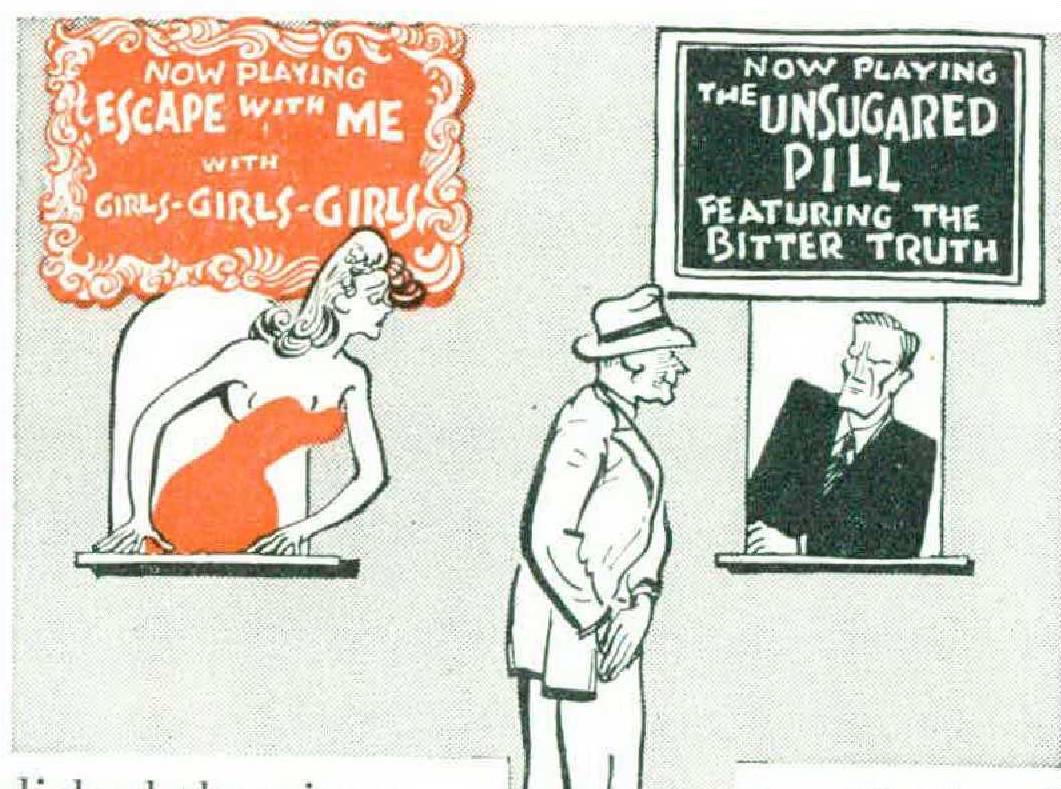
Metro-Goldwyn-Mayer’s couchant lion apparently dissents. He roars, “Art for art’s sake,” on every technicolor explosion of tulle, jolly Jack Tars, narcissus, and José Iturbi in pastel. Mr. James K. McGuinness, a policy-making executive at that studio, and the already named Mr. Crisp, who played the firm (but fair) butcher in National Velvet, loudly advocated the escapist path on a Reader’s Digest sponsored “Town Meeting of the Air” last September.
MR. McGUINNESS: Mankind is starved for laughter, for joy, for beauty, for escape from tragedy. Motion pictures can supply these great balms for the spirit. Hollywood can give hope that the simple joys of peace shall flourish again. On the screens of the world Hollywood can help humanity. Let us not preach at our fellows, but let us give them back the boon they have been so long denied. Let us do our part to restore laughter to the world.
[Motion pictures made in Hollywood] do influence public opinion. They have to if they are to be effective. . . . This has come about because Hollywood and the motion picture industry have always upheld in their pictures the basic principles of morality which form our Western Civilization. These principles are the religious and moral concepts of the Ten Commandments and the Sermon on the Mount.
MR. CRISP: Keep the theatre a house of illusion, keep the screen free of alleged messages from any group of self-constituted leaders. When we go to the movies let’s have fun and let’s remain free to think for ourselves.
It all boils down to whether the American people can decide what they like or want, or whether the few folks who happen to make pictures in Hollywood should decide for us. ... It was fitting that when we saw Lana Turner or Betty Grable we should also be fed a documentary film on the war and a government short urging us to save waste fat. That was Uncle Sam’s way of arming us, hardening us, bolstering our morale and showing what a tough fight we had on our hands. But that necessity no longer exists.
Mr. Crisp busted a final lance meant to impale not only The Lost Weekend but some of its notable predecessors like The Grapes of Wrath, The Ox-Bow Incident, The Black Legion, and Zola. He said, “The thing is, you pay your money to see the picture. You should see it without anything being forced down your throat. You should have entertainment — entertainment one hundred per cent!“
The Lost Weekend neither entertains nor amuses in that sense. It shocks, but with considerably less voltage than Charles Jackson’s novel from which it was adapted, because of the taboo about the true cause of the subject alcoholic’s behavior. Still, it has gone as far into that as the French production of The Puritan dared, even without any wowsers at its elbow. It has ignored most of the paralyzing vetoes of the Hays Code. W here “ brutality and possible gruesomeness" are prohibited under the section headed “Repellent Subjects,” Billy Wilder gave horror its head in the Doré-esque alcoholic ward scenes.
Not since a character in Carnet de Bal threw a hideous wing-ding has there been anything on the screen so grisly as Don Birnam’s epic brannigan and his scream as the stricken mouse bled on the wall.
Where Weekend hewed to the line of the novel it was superb. It carried unqualified conviction of the booze-fighter’s torment when he hasn’t that nip of elixir in the morning as a pistol shot. It is distinguished for the realism of its acting throughout and for its fidelity to the physical Don Birnam.
Brackett and Wilder ignored those in Hollywood whose minds were hermetically sealed to new forms and who said, “You can’t make a picture all about a fellow drinking.”With astonishing skill they did precisely that.
In its most flagrant divergence from the novel, the picture misstated the profound truth that neither his girl’s devotion nor his brother’s despairing threats could cure Don Birnam of his alcoholism any more than aspirin can help a brain lesion. It is clinically misleading to say that by his own resolution he could do himself any good at all.
It would have been useful to say in the picture that alcoholism is suicide by flagon and that the Don Birnams of the world need expert help the doctor, the psychiatrist, and the community.
In a major sequence of the film and not because of any apprehension of censorship one of the most moving scenes in the book is gratuitously vulgarized into a Teacher-and-Johnny joke. The passage in the book reads:
He fought for breath afraid that he would break into a wail if he didn’t hang on hard. He yanked at the door-knob (the glass shook and rattled) and gave way: “Why aren’t you open, what’s going on, why are you all closed!
The two glanced at each other, incredulous, and then one darted his head farther out of the dark stairway and snarled, “What’s the metter with you, it’s Yom Kippur!”
There the encounter ends. But in the picture it was done this way: —
FIRST MAN: What’s the matter with you?
DON: Why are they all closed? They’re all closed, every one of them.
FIRST MAN: Sure they are. It’s Yom Kippur.
DON: It’s what?
FIRST MAN : It’s Yom Kippur, a Jewish holiday.
DON: It is. (That makes sense to him, Or does it?) What are you talking about? How about Kelly’s? How about Gallagher’s?
FIRST MAN: They’re closed too. We’ve got an agreement. They keep closed on Yom Kippur and we don’t open on St. Patrick’s. (The two men stand grinning.)
DON (almost weeping): That’s a good joke. That’s funny, that’s very funny.
Despite Don’s last line, instead of the rustle of irony’s passing, there is the thwack of the bladder. Nobody rolls in the aisles, a fact which saves The Lost Weekend from becoming Mr. Crisp’s kind of entertainment — entertainment one hundred per cent! — thank heaven.
Charles Jackson’s Don Birnam ends by putting the stuff where the flies won’t get it and buckling down to the business of getting fried on both sides this time.
Brackett and Wilder’s man, on the other hand, is saved from another attack of the ork-orks by a Seventh Cavalry finish. With all its imperfections, The Lost Weekend is big enough to stand beingchipped at. Only a very great fool would destroy a milestone. For if The Lost Weekend heralds a new kind of motion picture, in which antagonist and protagonist are in the same man and the conflict is internal, the day of Hamlet on the screen is not very far off.