Musical Glasses
MUSIC
By CARL ANTHON
To THE music-minded the world is full of music. Tissue paper, combs, rubber bands; bottles, nails, saws — all have been made to disclose their musical nature. Dripping water faucets provide exquisite staccato tunes, and the boiling teakettle is the very soul of the kitchen orchestra. One can even improvise melodies to the deep hum of an electric motor in the same way the bagpipe plays its tunes to a steady drone produced by one of the pipes. And who has not been tempted to line up the wineglasses on the dinner table until all the notes of the scale were represented? Glasses have the advantage of being amenable to tuning by simply increasing or decreasing their contents until the desired pitch is reached.
While a set of glasses makes an admirable xylophone, their true musical character has not yet been exploited. Not by rude percussion will a glass yield its innermost musical secrets. But try rubbing the rim of the glass with your moistened finger tip and you will soon discover a new kind of musical tone. The sound thus produced is unusually pure and has an unearthly character, worthy of the gods. Perhaps you have never heard the celestial music of the spheres, but the harmony emanating from a few wineglasses comes as near to it as anything that man has invented.
Already in the early seventeenth century this parlor trick was familiar. In a work entitled Mathematical and Philosophical Pastimes, the German poet Harsdörfer gives the following directions for the performance of this music: —
To produce a merry wine-music, take eight glasses of equal form; put in the one a spoonful of wine, in the other two, in the third three, and so on; then let eight persons, with ringers dipped in wine, at the same moment pass them over the brim of the glasses and there will be heard a merry wine-music that the very ears will tingle.
In the middle of the eighteenth century an Irishman named Richard Pockrich conceived the idea of making a regular musical instrument out of tuned musical glasses. He undertook concert tours in England and Ireland, and within a few years musical glasses became the rage of society. Oliver Goldsmith in The Vicar of IT Wakefield describes English ladies as talking of nothing but “high life, and highlived company; with other fashionable topics, such as pictures, taste, Shakespeare, and the musical glasses.” No less a composer than Gluck appeared in England and in Denmark performing “a concert upon Twenty-six Drinking Glasses, tuned with Spring water, accompanied with the whole Band . . . upon which he performs whatever may be done on a violin or harpsichord.”
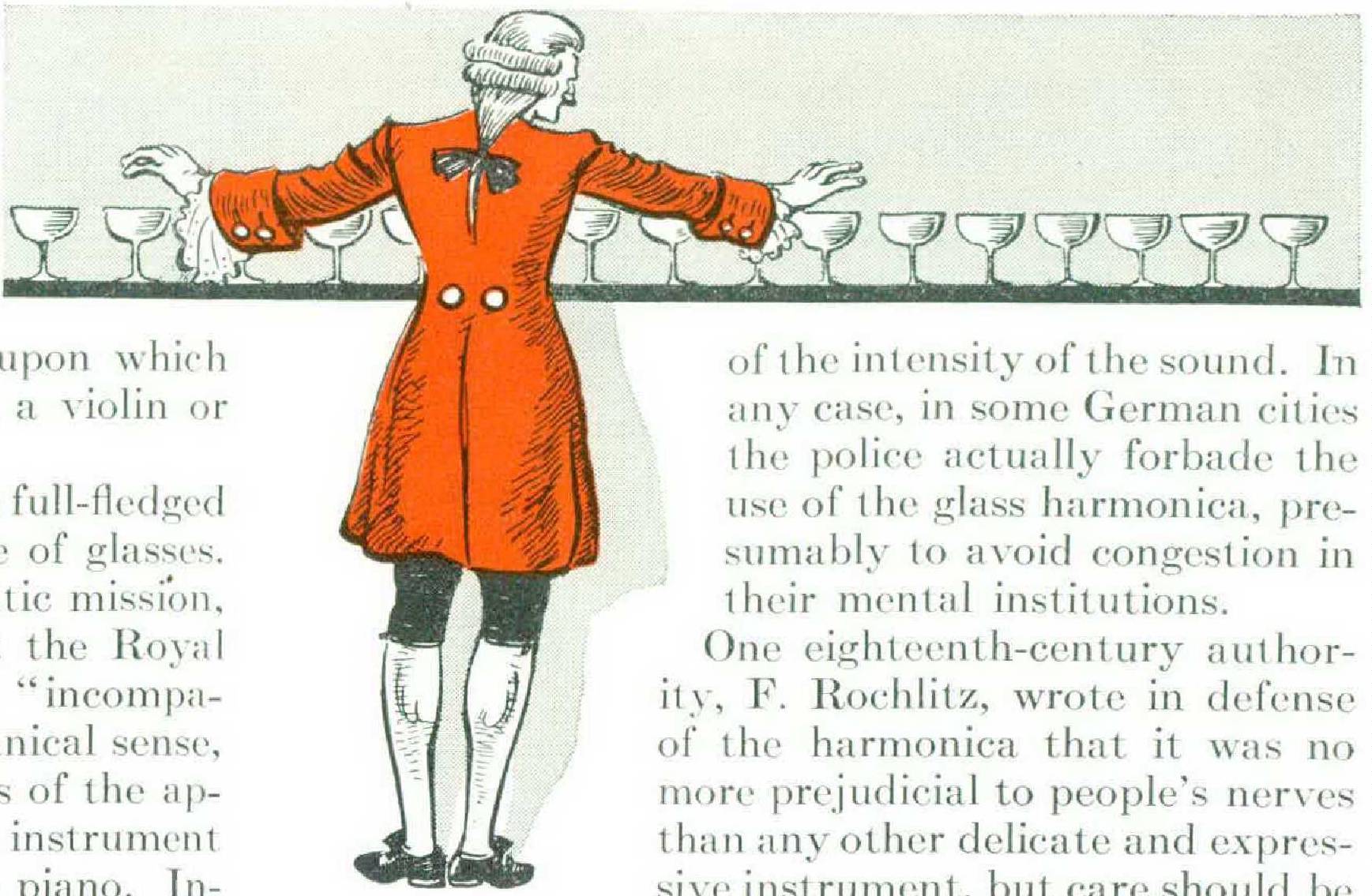
It was Benjamin Franklin who made a full-fledged instrument out of this crude assemblage of glasses. When he went to England on a diplomatic mission, he heard the musical glasses played at the Royal Society, and he was captivated by the “incomparable sweetness” of the tones. His mechanical sense, however, was outraged by the clumsiness of the apparatus, and he decided to construct an instrument that could be played more or less like a piano. Instead of beer glasses he took about three dozen specially blown glasses in the shape of hemispheres of varying size, and mounted them on a horizontal spindle which was made to revolve by means of a treadle — very much like an old-fashioned sewing machine. In turning, the glasses dipped into a shallow trough filled with water and vinegar which moistened the rims. The player merely passed his finger tips over the glass rims and could play chords and arpeggios as on any keyboard, but much more slowly, of course, and with greater stretching of the hands.
The harmonica, as musical glasses came to be known on the Continent (not to be confused with the modern harmonica), became a real fad for the next thirty years. English virtuosi like Marianne Davies toured the European courts, and in Vienna Marie Antoinette became one of her pupils. Perhaps the most famous harmonica virtuoso was the blind Marianna Kirchgessner, for whom Mozart — ever alert to new musical possibilities—composed two delightful pieces in the last year of his life. One of them is scored for glass harmonica, flute, oboe, viola, and cello a possible indication of the relative volume of the instrument.
Something about the tone of the harmonica appealed to an age that was fast becoming romantic. It had a sustained, penetrating quality, which could be swelled or softened by varying the pressure of the finger tips. The purity of the tone was unlike that of any other instrument, with the exception, perhaps, of the recorder. Goethe, who probably had heard his friend Angelica Kauffmann play the instrument in Rome, seemed to detect “the heartblood of the universe” in its ethereal harmony, and romantic fiction featured sensitive heroines swooning at its sound.
This somewhat mysterious aspect of the instrument was perhaps a cause for its disappearance in the early nineteenth century. Supposedly much playing of it made the performer a nervous wreck — some would say because of the irritating contact of sensitive finger tips with vibrating glass rims; others, because of the intensity of the sound. In any case, in some German cities the police actually forbade the use of the glass harmonica, presumably to avoid congestion in their mental institutions.
One eighteenth-century authority, F. Rochlitz, wrote in defense of the harmonica that it was no more prejudicial to people’s nerves than any other delicate and expressive instrument, but care should be taken to select pieces “that touch the heart, and softly animate the feelings.” Even this apologist felt it necessary to caution against “indulging in its soft and pleasing tones too much at night”! Mendel’s dictionary of music, a nineteenth-century pillar of authority, claims that the effect was so intense, especially on women, that one single tone “produced with the utmost feeling” might send the listener into the realm of the unconscious.
Obviously, this was exaggeration, and these facts do not seem to be borne out by the experience of modern players with the glass harmonica. But whether exaggeration or not, eighteenth-century Germans wanted an emotional workout, and regarded the harmonica as an ideal medium for their intoxication. After all, the late eighteenth century was the dawn of the modern movement known as romanticism, from the effects of which we are still suffering. It was the period of Werther and Héloise, of morbid Mesmerism, and of pietism dripping with sentimentality. Significantly enough, Mesmer, the prophet of animal magnetism (which turned out to be the stuff psychoanalysis is made of), used harmonica music as a background for his frenzied seances to increase the susceptibilities of his patients.
But glass harmonicas belong to a bygone age — an age that indulged in a great deal of experimentation with new effects and new instruments. Composers were not averse to trying out new devices. Even Beethoven wrote a piece for the glass harmonica. Perhaps we might reconstruct the dilapidated harmonicas in our museums (all of them are smashed up), and find out whether the sound might not be worth while resuscitating.
What chances would the glass harmonica have today? In the early nineteen-hundreds musical glasses of the pre-Franklin variety were featured in American vaudevilles. It was frankly a stunt and the effect on the ear was hardly edifying. The days of vaudeville are gone and so are the musical glasses. But might not an instrument based on the same acoustic principle have certain possibilities?