The Fairly Merry Widow
RADIO
ByEDWIN O’CONNOR
THOSE who have been wondering from what direction their next quota of grief and misery was coming will be happy to learn that the radio industry has no intention of revising its present program of daytime entertainment.
The war altered so many things that a lot of people had been afraid that radio’s “soap-opera” programs would fall victim to the changing times and be replaced by some good musical or variety shows or by a comedian with funny material. The heartening news is that all such novelties are out, and that postwar radio will do its best to present every snide lawyer, grief-crazed widow, and embezzler who ever succeeded in creeping into the heart of the pre-war radio public. Of all these popular favorites, the widows are easily the most important, partly because of their great numbers, but mostly because of the essential hopelessness of their position.
Asa preview of things to come, I have jotted down a few notes on some daytime favorites selected at random. I regret to say that I did not hear these programs under ideal conditions. Usually, the people who listen to them are simultaneously washing children, slicing vegetables, beating rugs, or doing light laundry — diversions which are the breath of life to the average soap-opera. No such distractions were available during my experiment, so I heard the programs in what you might call their naked state.
Ground was broken officially at ten o’clock in the morning with the program called “Valiant Lady.” The Lady in question is Christine Jeffrey, a widow who lost her husband at Salerno. As this episode began, she had made a special trip to a port of disembarkation to welcome home Cliff, a returning soldier. Cliff participates in the joyful ceremony by secreting himself in his hotel room and refusing to see her. Christine, saddened by this lack of cooperation, seeks the truth from Matthew Logan, Cliff’s soldier buddy. It is Matthew who fills her cup of happiness by telling her to move along, as Cliff has expressed the desire to avoid her at all costs, and, more than that, is by no means in the best of health. On this buoyant note, Matthew leaves her flat, and there is nothing for the Valiant Lady to do but go in and soothe her turbulent emotions by eating a hearty meal.
The “Lora Lawton ” program is also about a widow. In the words of its announcer, who is heard from immediately following a few bars of “Just a Little Love, a Little Kiss,” this program is “the story of a girl who, after years of marriage, was left alone, and of her struggle to win the happiness that every woman seeks.”When I heard it, the struggle was not going too well. Peter, Lora’s fiance, was treating her like a child. Just as Lora was doing her best to justify this treatment, the door opened and in walked Iris Hamilton, a haughty woman who despises Lora. After a few practice snarls at Lora, Iris asks Peter to arrange for the arrest of a woman who has insulted her at a party. Peter, who knows his law, refuses this commission. “Well,” twinkles Iris, “this is a peculiar kind of loyalty when my father was the only man who believed in you when you tried to steal $25,000 from the Company’s funds!” This gives the listener a new slant on Peter, and some idea of the rocky road still ahead of Widow Lora Lawton.
The principal difference between Phyllis Dineen, the widow in “Young Dr. Malone,” and the preceding widows is that Phyllis is convinced that she is going crazy. She is in bed, in bad shape, under the care of Young Dr. Malone, who comforts her by telling her that just because her mother died in an institution it does not necessarily follow that she too will wind up insane. Phyllis thinks this over and counters by telling the Young Doctor that she has decided she is in love with him, to which he replies gruffly that there’s nothing doing. Before he leaves the Dineen house, he informs old Mr. Dineen that Phyllis is “living on the razor edge of psychological balance” — a remark that gives the old gentleman the shakes. Having taken care of all this, the Young Doctor returns to his wife, a normal woman, who coyly asks him how his home looks to him after a day spent among the mink coats of the Dineen household. He retorts, in a sharp burst of social criticism, that “people like the Dineens have to wear mink coats to cover up what’s underneath!”
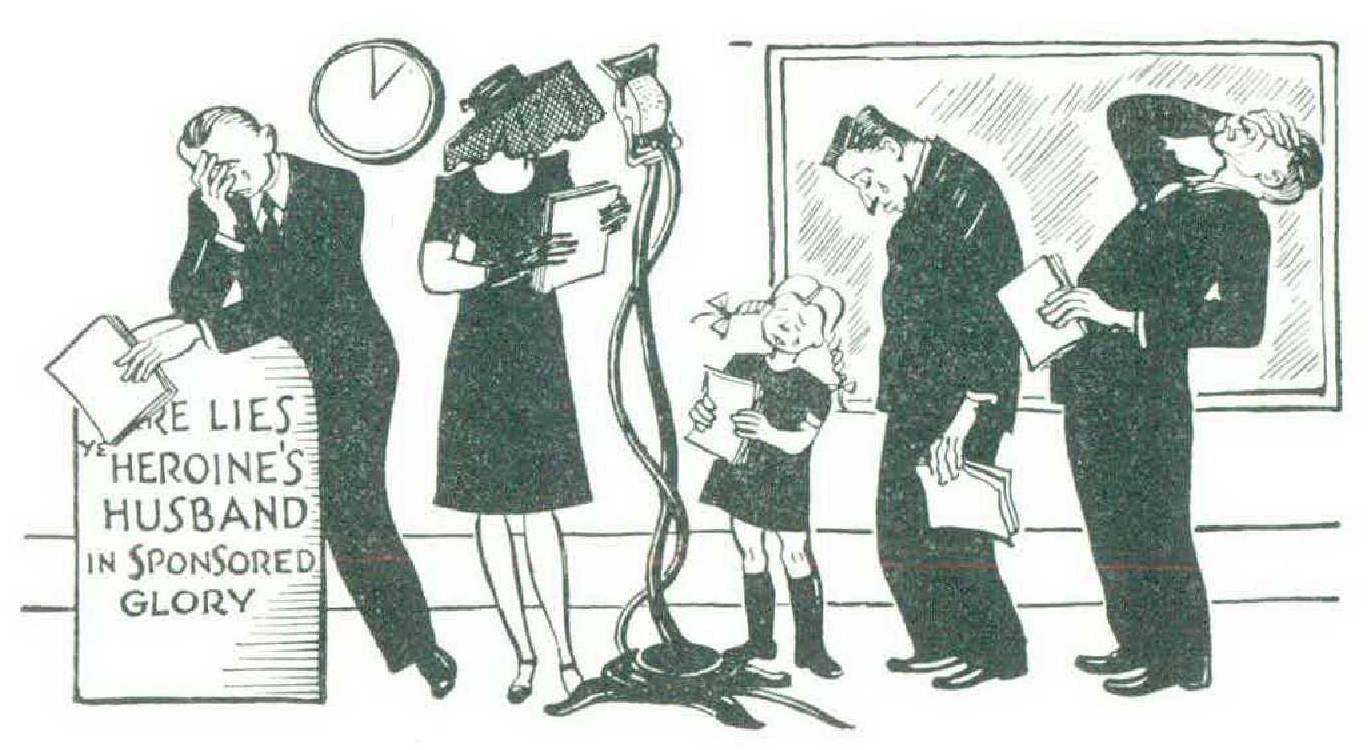
It was in the “Ma Perkins” sketch that the first note of undiluted happiness crept into the day. This happiness, shared by Ma and her friends, was grounded in a rather unusual circumstance. Ma had just received a letter from the parole board, containing the gleeful tidings that Bert would be out of jail for the holidays.
The scene of “Road of Life” was a laboratory in a neuropsychiatric institute, where a white-coated figure, seated at a desk, is mumbling to himself: “No! No! No!” The white-coated figure is Dr. Jim Brant, who is merely examining some unpleasant data on little Tommy Sinclair’s tumor. From a subsequent conversation between Dr. Jim and a woman doctor named Carson McVickers, it is learned that Dr. Jim is soon to perform an operation of extreme delicacy on little Tommy, with no positive results guaranteed. Dr. Jim, who is in an understandable state of perturbation, is further encouraged when he is reminded that not another doctor in the hospital agrees with his diagnosis.
“Just Plain Bill,” the day I listened to it, was concerned largely with a girl named Bessie, who, although not a widow, technically speaking, manages to come up to the customary catastrophic standards. The title of this program, augmented by such homely melodies as “Darling Nellie Gray” and “ Pollywolly Doodle All the Day” might lead one to expect a simple tale of kindly folks leading everyday lives. Unless Bessie’s being struck down and knocked unconscious, having valuable securities stolen from her, and going blind as the result of the assault is considered as particularly folksy, I’m afraid the expectation falls short of realization. The Bill of “Just Plain Bill” is Bill Davidson, a lovable old arbiter whose job it is to patch up the quarrels of his neighborhood, and in this installment he was having a normally busy day.
“When a Girl Marries” is announced as “the story of Joan and Harry Davis,” but on the afternoon I heard it neither Joan nor Harry put in an appearance, thus proving that the Davises are nobody’s fools. The plot revolved around Irma Cameron, who, much to my surprise, turned out to be a widow! If Irma has a fault, it is her tendency to become so absorbed in one person that she loses sight of all others. For example, her romantic interest in Steve Skidmore grew to such proportions that she forgot all about her daughter Kathy, who retaliated in the simple, direct manner of children everywhere by running away from home. Now that Kathy has returned, Irma goes in for such a bout of maternal devotion that there is some danger Mr. Skidmore will run away, and just imagine all the heartaches that would cause!
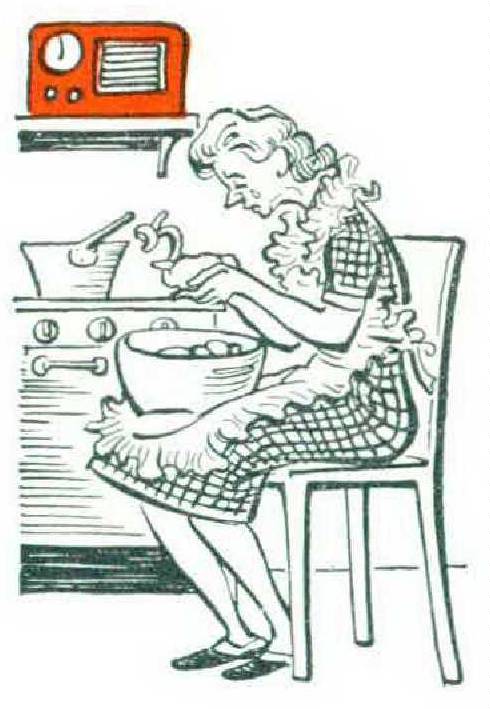
Prudence Barker, the heroine of “A Woman of America,” is a woman whose husband has died, leaving her with two children, and unless my calculations are wrong, this qualifies Prudence as a widow. Her chances for renewed bliss are no better than those of her sisters in bereavement. If anything, they are worse, because the man in her life, though straight as a die, is a man of cautious passions. He informs Prudence that he would like to say the all-important words to her, and hold her in his arms, but he concludes this confession rather glumly. “I may never do either,” he says. This is not much of a promise for the future, but it is all that Prudence Barker, A Woman of America, has.
The widow featured in “Portia Faces Life” is Portia Blake, who seeks to find happiness with a man named Walter Manning. At the moment of my listening, the trouble was that Walter was about to be court-martialed on charges of military desertion, and his chances for acquittal were dependent upon favorable testimony from one Norman Byron. Portia’s expressed belief that Norman will do everything, short of breaking his neck, to get Walter acquitted are backed up by the following facts: —
1. Norman hates Walter.
2. Norman is secretly in love with Portia himself.
3. Norman numbers among his pleasant recollections the fact that he once talked a man into killing himself.
At the present time, these therapeutic quarterhours and similar entertainments which differ from them neither in theme nor in quality are available to the public each day, Monday through Friday, Saturday and Sunday being spared for the same reasons that professional boxers are allowed rest periods between rounds. The American people are a reasonably hardy lot, capable of taking their widows and other disasters in wholesale bunches, but occasionally they do like a little time off for good behavior.