Cartoonist's World
By CARL ROSE
SOME years ago, there was buried in Flushing, Long Island, the Westinghouse Time Capsule. This was a plastic case presumably able to withstand for five thousand years the earth’s corrosive chemistry. From the objects encased within it, the scientists due to dig it up on that distant day will deduce the way of life on earth (at least our section of it) in 1939. The gesture presupposed that enough will be left of civilization in 6939 to make the whole thing worth while, and that the good will accruing to the Westinghouse Company, sponsors of the project, will stand them in good stead then.
It’s a fascinating prospect, and I say more power to it. But, I’d have liked to see enclosed within that tube about five thousand gag cartoons dealing exclusively with the domestic scene— the husbandwife-children-house-car combination. How close to truth could a perceptive archaeologist get from an examination of such material? If I shut my eyes hard, sweep my mind vacant, and if the telephone doesn’t ring, would his deductions read something like this?
Life in the mid-twentieth century, it would seem, was middle-class, for rarely does great wealth figure in these drawings, and not much oftener are members of the proletariat depicted. It was an urban or a suburban existence. The rural note is all but missing. A study of the male or husband-father character shows him to be of medium build, partly bald, possessed of a mustache and an ineffectual expression. During one or more of his family meals, he would hide himself behind a screen labeled “Times” or “News” while at table.
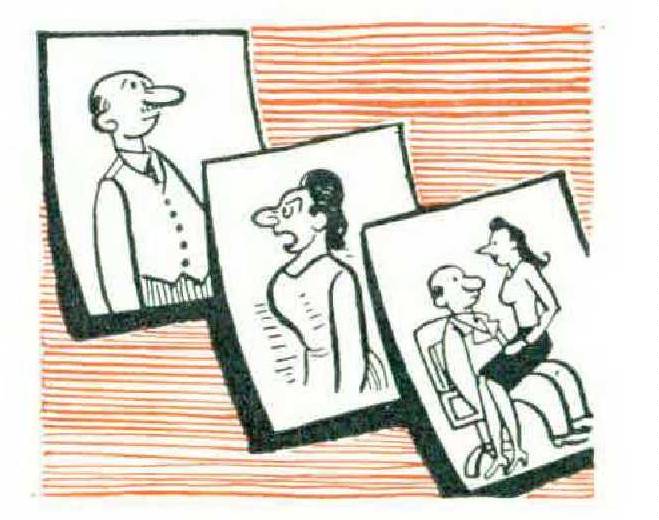
He spent his day at an “office,” in the anteroom of which numerous people waited to see him. He himself would hide in an inner room and conduct his “business” at a desk while a pretty office habitué sat upon his lap. At day’s end, he would hie to a tavern where, in the company of other men, he drank strong liquors until he became “ drunk.”At this point he would call his wife on the telephone to inform her (a) that he would be late for dinner, and (b) that he was bringing a friend home for dinner. Upon arrival he would be greeted (a) if he were young and recently married, by a tearful wife and burning pans upon the kitchen stove, or (b) if he were older and longer married, by a tearful wife who complained about the children. These latter were badly behaved, maladjusted youngsters unwilling to take lessons on one of the limited number of musical instruments available at the time.
On the whole, it was the wife-mother who dominated the domestic scene. She was of dull intelligence, constantly at odds with her husband, her children, and her environment. She spent much time in “beauty shoppes,” her head in a large mysterious metal contraption, or her body in an equally mysterious square cabinet. Withal, she remained an unattractive woman, shapeless and dowdy. There seemed to exist, however, pretty females whom the husband ogled, usually within sight or hearing of his distressed or angered wife. Relations were rarely pleasant between the two. Not one representation of connubial bliss is shown, although they slept in the same room and often in the same bed. They quarreled continuously, frequently to the point of violence and sometimes literally to the death. A curious circumstance in this connection is that while many times the wife is shown killing her husband, usually with a “pistol,” a popular lethal weapon of the time, the reverse is never shown. Since we know from collateral research that uxoricide was not unknown, we can only conclude that this onesidedness was the result of some quaint chivalric notion on the part of the artists.
There was little, if any, gayety in the couple’s lives. For sport, they played “cards” with a like couple, but these interludes ended either in acrimony or in homicide. He laughed at her hats but he allowed her to pick out his outer raiment. Their occasional picnics were beset with ants, and their “golfings” had more of pain than of pleasure in them. She had him wait long periods before a social evening while she attended to her toilet, but she was as frumpy after her labors as before.
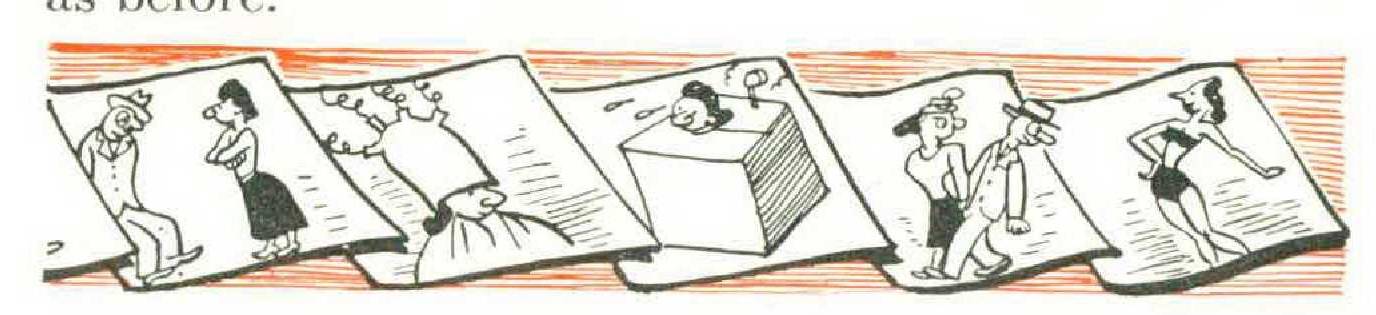
Machinery baffled them both although the machine age was pretty well along. Especially prevalent was an inefficient little instrument of surface locomotion called a “car” — a four-wheeled vehicle with an internal-combustion engine driven by a crude form of gasoline. The woman, especially, showed an almost incredible ineptitude in its operation, but she did not hesitate to pour forth a stream of admonitory words when the man was driving.
Their house was jerry-built. Slight external pressure would punch a hole in the plaster ceilings or walls. Plumbing was in dreadful disrepair, for when it broke down, there was never a gentle leak, but a deluge which inundated a room with one to five feet of water. During the cold months, heating was inadequate; it was customary to pound upon “radiators” to evoke an extra degree or two of warmth. When the house burned, it burned completely. Mishaps were epidemic, catastrophes common.
The most trivial actions were attended by inconvenience. The telephone rang only when one was in the bathtub; visitors dropped in at moments least conducive to pleasant social intercourse; there was no hint of—
Excuse me, the telephone just rang.