From the League to the UN
On the first anniversary of the Senate’s ratification of the United Nations Charter, it is time to consider whether the UN is a weaker instrument for peace than the League.
1
WHAT is the United Nations Organization, or UN? What is it not? What may we expect from it? What should we do with it? One finds a lead for answering these questions in the experience of the League of Nations between World War I and World War II.
The League of Nations was the outgrowth of a world-wide moral movement that aimed at supplanting the rule of force with the rule of reason in international relations. Its Covenant pledged the members of the League to settle their disputes by arbitration. Any threat of war was to be regarded as a matter of concern to all. Any member of the League that resorted to war in disregard of the Covenant should ipso facto be deemed to have committed an act of war against all other members. The latter were to enact sanctions to enforce the Covenant of the League. This was termed the system of “collective security.”
However, collective action for collective security was not at all secure. Diplomats, military chiefs, and politicians in all countries were persuaded that international relations not based on force were a dream to which it was impossible to give body, and that peace was merely an insecure state of affairs between two wars.
Consequently the governments that had to operate the League never took seriously the Covenant of the League that pledged them not to resort to war. They never intended to give up their right to wage war—that is, their sovereignty. For Lord Curzon, British Foreign Minister in 1923, the League of Nations was nothing but “a good joke.” For Monsieur Berthelot, for many years Permanent Secretary of the French Foreign Office, it was a “grotesque hoax.”
The Covenant of the League resulted from a compromise between two opposing forces: on the one hand, the will to peace of common men everywhere; and on the other, the prepossessions of diplomats, military chiefs, and politicians. Under this compromise the League became an association of governments that pledged themselves to respect certain principles but reserved the right not to carry out those principles. The provisions of the Covenant were like the Commandment which forbids a man to covet his neighbor’s wife.
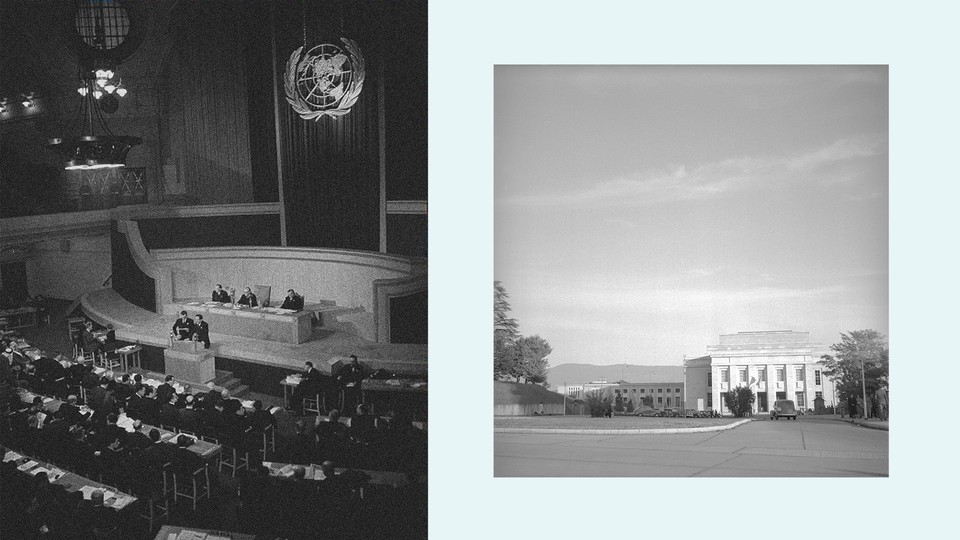
The League of Nations was only what the delegates of the countries that formed it wanted it to be. It was merely a palace in Geneva where diplomats and politicians met to solve problems well, or badly, or not at all, by means of private negotiations. When they had decided what to do or not to do, they met officially in halls called the Hall of the Council of the League, or the Hall of the Assembly of the League, and there they announced their decisions on behalf of the League. Agreements prepared outside the League were laid before the League, and people were told that all had been done by the League. The League, while nothing more than a notary public, was held responsible for everything it was requested to register.
This procedure had conspicuous advantages for diplomats and politicians. When a problem had been solved satisfactorily, they took credit for the good solution. When the problem had been badly settled, or not settled at all, the fault was ascribed to the League. In 1923, the French and British Foreign Ministers, instead of putting down Mussolini when he wantonly seized Corfu, saved his face through a deplorable compromise. Responsibility for this compromise was saddled on the League.
In 1931, it was not the British Foreign Minister who allowed Japan a free hand in China: it was the League that was unable to curb Japan.
If the plan to reduce armaments or prevent their increase miscarried, the responsibility rested not with the political leaders of Britain, France, Germany, and Italy, who sabotaged all plans, but with the League, which was said to be impotent to reach any conclusion. If Mussolini was allowed to embark upon an obviously criminal war against Ethiopia, if Hitler and Mussolini from 1936 to 1939 could intervene in the Spanish Civil War and send armed help to Franco, those acts were declared to be the fault not of the British and the French Foreign Offices, which held the bag, but of the League of Nations, which was unable to stave off those scandals. It was as though racketeers had formed a “union” and maintained that by racketeering they were obeying the orders of their “union.”
One of the devices through which the League was methodically paralyzed and kept impotent was that of showing deep concern for its health and accusing anyone who wanted it to act of endangering the existence of so precious and yet so frail an institution. The League might be destroyed if overburdened with a task it was ill-fitted to perform. And the task it was ill-fitted to perform was precisely that for which it had been set up: that is, the prevention of war among the nations. As soon as a serious problem arose which needed the League’s action, a cry went up from all quarters: “Do not rock the boat!” And the boat was shunted aside to become useful in some future and more dangerous emergency. The League touched nothing which it did not adjourn.
The history of the League of Nations between World War I and World War II was the history of the devices, ruses, deceptions, frauds, tricks, and trappings by means of which the very diplomats who were pledged to operate the Covenant of the League managed to circumvent and stultify it. They were its most effective foes, since they were undermining it from within, while nationalists, militarists, and fascists were attacking it openly from without in all lands.
2
AND now let us turn to the UN.
According to its Charter, the UN’s aims are the same as those of the League of Nations: that is, to maintain international peace and security, to take measures for the prevention and removal of threats to peace, to suppress acts of aggression, and to bring about by peaceful means, and in conformity with the principle of justice, adjustment or settlement of international disputes.
Yet the Charter tells us also that “the organization is based on the principle of the sovereign equality of all its members.” This formula means that the members of the UN, no less than those of the deceased League, keep untrammeled their national sovereignty and their right to go to war any time they deem it fit. The explicit affirmation of this principle in the Charter of the UN constitutes no novelty. It merely tells us that we must not expect any more from the UN than we got from the League of Nations.
The UN, like the League of Nations, has a General Assembly and a Council. All member countries, great and small, send delegates to the General Assembly. But the Assembly is only entitled to “discuss,” to “consider,” to “make recommendations.” Any question on which action is required falls within the jurisdiction of the Council. The matters to be discussed are prescribed to the Assembly by the Council. The Assembly has to keep its peace as soon as a problem involving war and peace arises, or as soon as the Council steps in and orders it to step aside. The Assembly is only a debating society.
The Council is made up of the permanent delegates of the great Powers and representatives of the smaller countries chosen every two years by the General Assembly. The representatives of the small Powers taken together have in the Security Council one vote more than the permanent delegates of the great Powers taken together. However, since it is difficult for politicians of small countries to remain in power unless they prove acceptable to the government of some great Power, it is obvious that some, if not all, representatives of the small Powers will act as yes-men of great Powers.
To sum up, the Big Five (or rather the three and one-half who “in due course” are expected to become four when France has overcome her present transitional state, and five when and if China overcomes her present parlous and nebulous state) control the decisions of the Council, and through the Council they control the General Assembly of the UN — as long as they do not split up; and when they split up, everything will go to the dogs.
Under the Covenant of the League of Nations, the Council was duty bound to investigate the right and wrong in a dispute. A majority of the Council could decide to publish the report of the findings and to recommend a settlement of the dispute. The partner in a dispute, before resorting to war, had to wait three months after the Council had published its report. If these rules of procedure were not respected, the lawbreaking member was ipso facto deemed to have committed an act of war against all other members of the League. Nothing of this kind is to be found in the UN Charter.
The sovereign equality of the lesser Powers with the great Powers exists only on paper. The small Powers are under the thumb of the big ones. Mr. Churchill put this matter bluntly in the House of Commons on March 15, 1945: “We may deplore, if we choose, that there is a difference between the great and small, between the strong and weak in the world. There is undoubtedly such a difference and it would be foolish to upset the good arrangements proceeding on a broad front for the sake of trying to attain immediately to what is a hopeless ideal.” The word “immediately” could have been spared. The gist of the Charter may be summed up as follows: the small Powers delegate all rights to the great Powers who control the Security Council, and the great Powers reserve for themselves the right to do what they please and to go to war when they please and against whomever they please. Each one of them intends to remain the law unto itself. They have reinstated among themselves de jure that law of the jungle which they had never discarded de facto.
This is merely a return to the “Concert of Powers” which existed in Europe during the nineteenth century and on the eve of World War I, and which never prevented any great or small Power from going to war any time it wanted to do so. Telling us that in the UN “ we are about to embark on a new experiment in international practice” is insulting human intelligence. The UN does not embark on a new experiment. It merely does away with the League of Nations experiment. This is its significance. This is the whole and naked truth. Let us not escape the responsibility of accepting that truth as it stands, if we intend to accept it.
The full bearing of the UN system is to be found in the so-called “veto.” A great Power can block any consideration of any dispute by its own negative vote or the negative vote of another friendly great Power or of two client smaller Powers. Each one can veto everything but war. Much fuss has been made about this veto power. Yet it is the inescapable consequence of the untrammeled national sovereignty and the right to go to war with which the UN Charter invests the great Powers.
Walter Lippmann was right when he wrote: “Even if a treaty were drafted under which the governments agreed to abide by majority rule in matters of this sort, the agreement would be worthless. That is why in serious matters there can be no such thing among nations as voting and being outvoted. For this reason the best voting system would have been to have no voting system, and thus to have recognized clearly at the outset that except on procedural questions and issues that do not involve force or vital interest, the idea of majority rule is an illusion.”
As a consequence, mankind confronts a new armament race, and the countries which have no compulsory military service, in time of peace, will have to have it. Bigger and bigger navies, bigger and bigger armies, bigger and bigger air forces, will bestow increasing happiness upon the brave new world. The new race in armaments stems from the same old spring: absolute national sovereignty; then international lawlessness; then armaments; then counterarmaments; then World War III, until the atomic bomb solves all problems by destroying a mankind that no longer deserves to survive.
Yet the hankering after peace and the will to believe are so deep-seated and active in the peoples’ hearts that the UN, no less than the League of Nations, has become associated with the idea and hope of peace. The abstract formula “The United Nations” has taken the place of the abstract formula “The League of Nations” in the peoples’ mystic expectations. It again hides the responsibility of the flesh-and-blood men who control the policies of the United Nations. And whoever does not show faith and hope in the UN is again charged with rocking the boat. Whoever does not swallow the UN hook, line, and sinker is branded a “deadly perfectionist.”
To be sure, we must never seek for perfection in human affairs. To be sure, we must be content with what little good or lesser evil we can get in this vale of tears. On the other hand, we should not allow ourselves to be dragooned into cheering the danger of war as peace. Even if we have to be branded as “deadly perfectionists,” we should not conceal from ourselves the fact that the ideal of peace has suffered a tremendous defeat in the UN Charter.
This does not mean that we have to give up fighting for our ideal. One is defeated only when one admits that the fight is over. The real and almost irreparable defeat is to delude oneself that a defeat has been a victory. This is what we are asked to believe when the UN is under discussion. And this is the delusion we must discard if we do not wish to act as the blind instruments of a nefarious destiny.
3
WE do not need to reject the UN Charter wholesale.
First of all, the right to discuss and to make recommendations, granted by the Charter to the General Assembly, should not be underestimated. Forcing the parties to a dispute to air their arguments publicly, and forcing the other members of the Assembly, even through mere recommendations, to pass judgment, may have its usefulness. It may restrain the possible malefactors, and at least give a clear lead to the judgment of decent men and women all over the world. Those who are entangled in the dispute may remain stubborn, but those who want to form a fair opinion will be helped to reach it.
The Security Council can step in at any moment and stifle discussion in the Assembly. But the Power which took that initiative would put itself in an undesirable position morally. Nor could the members of the Council, without discrediting themselves and their own countries, suppress uncomfortable disputes at every turn. This is what remains of the best provisos embodied in the Covenant of the defunct League of Nations. It is not much, but it is something. Let us not throw it away.
In addition, the Charter of the UN should be squarely accepted in so far as it puts the national sovereignty of the small Powers under control by the great Powers. Untrammeled national sovereignty is the curse of mankind. Its limitation by any kind of superior authority, wherever it is found, ought to be approved of. Small Powers are not Powers at all. Holland, Luxembourg, Belgium, are unable to prevent their stronger neighbors from attacking each other. A small country like Denmark is too weak to keep the door to the Baltic shut. The same holds true for the Dardanelles and Turkey.
In actual fact, the small countries have always been at the mercy of the big ones. They had to be content if only their would-be sovereignty was not too brutally trampled upon, and if face-saving devices avoided too great scandals. Equality of might does not exist and cannot exist among nations any more than among men. And since the smaller Powers cannot go to war without the connivance or permission of some great Power, let us explicitly admit that only the great Powers are in a position to enforce peace; and by this token, it is they who must enforce peace.
This, however, is not the whole story. If they cannot dream of equality in might, the small Powers are entitled to demand equality of right under the rule of law. As one of our best political writers, Albert Guérard, puts it, “I should have no chance against Mr. Joe Louis in the ring or against Mr. John D. Rockefeller, Jr., in the auction room. They are ‘great Powers,’ and I am not. But the essence of our civilization is such that they are debarred from using their power against my rights. Under the rule of law, Luxembourg, Austria, Holland, Denmark, must have exactly the same freedom, the same dignity, the same security as England or Russia.” If the UN Charter granted justice to big and small countries alike, nobody should demand more.
The fault of the system lies precisely in the fact that it affords no promise of justice for anybody, and that while doing away with the national sovereignty of the small Powers, it leaves the great Powers an absolutely free hand for good or for evil. The great Powers want to be free. They don’t intend to pledge themselves to be just. On this point we should be as “deadly perfectionist” as possible and never accept defeat.
Not even on this point, however, should we demand too much. Let us only demand that the great Powers pledge themselves to abide by the rule of arbitration in all their disputes.
To make this point clear, let us assume that active desire to prevent war existed in the United States, England, France, and Russia in the summer of 1938, when Hitler was threatening Czechoslovakia. Even if Hitler’s claims had been valid, his procedure of threats and blackmail would automatically have set the coalition for peace in motion against him. Hitler would have been powerless against the forces of the coalition, and he would not have gone to war, because he would have known that he would be defeated.
But a dispute between Germany and Czechoslovakia having arisen, it had to be dealt with. A committee of arbitration, chosen half by Hitler and half by the government of Czechoslovakia, would have been presided over by a mediator chosen either by the first arbitrators or by the International Court at The Hague. The committee of arbitrators would have taken into account Hitler’s grievances, would have passed judgment on them, and would have devised measures to remedy those, if any, which were not groundless.
If this method of settling disputes were adopted, no power would act as the judge, who decides cases, but each one would act as the policeman, who forces both parties into court and sees to it that they abide by the rule of law. It would be the committees of arbitrators, chosen case by case, which would act as the judges. They would form their decisions in line with those moral principles which are alive in the hearts of decent men and women everywhere.
In a civilized society, when a private dispute arises, the interested parties have no right to resort to arms. They must go before a judge — or arbitrator — who will rule who is right and who is wrong. The umpire may make mistakes. He may even be unfair. But the peaceful settlement of disputes by judicial procedure or arbitration presents so many and such overwhelming advantages that, even admitting the possibility of blunders and acts of partiality on the part of the judges or arbitrators, people prefer to take these chances rather than face the evils of perpetual violent strife.
No country can pledge itself never to have any differences with any other country. The world cannot be frozen once and for all. Fresh developments will demand readjustments. A perfect world for all time, ruled by never to be revised laws, will never exist. Peace, no less than justice, is a day-by-day creation. Mankind has to win them anew every day, by constant endeavor, through trial and error. Nor can one think that the governments of the great Powers can sit in permanent judgment on all disputes that may arise in the world among the lesser Powers and among themselves. Not even governments consisting of gods could assume such an immense burden of responsibility.
Nor can one afford to accept all the governments of the world as judges in any dispute which might affect the rights and interests of one’s own country. Why should a representative of Liberia pass judgment in a dispute between Britain and Russia? Why should the delegates of Australia pass judgment in a dispute between the United States of America and France?
But from these common-sense points, one is not entitled to draw the conclusion that there is no way out of untrammeled national sovereignty, international lawlessness, and war.
The great Powers, after suppressing through the Charter of the UN the national sovereignty of the smaller Powers, can spontaneously put brakes upon their own national sovereignty. All international treaties are brakes that the contracting parties place on their own sovereignty. Unrestrained national sovereignty exists only in time of war against the enemy, but not among allies. The tragedy of mankind is that peoples and their rulers are prepared to accept brakes upon their sovereignty to wage war, or to threaten war, or to protect themselves against defeat in war, but not to enforce peace.
4
ONCE the pledge to arbitrate all disputes had been given, there would be no more room left for the Council of the UN to decide whether a dispute should or should not be investigated. All disputes would be settled by the interested parties themselves either by negotiations or by arbitration. There would be no difficulty in defining who was the aggressor to be kept down and who was the party to be supported. The aggressor would be the party that refused arbitration or did not abide by the ruling of the arbitrators. As a consequence, the veto would become empty of all significance.
There would be no reason to object to the division of the world into spheres of influence among the great Powers. Under the Charter of the UN, if the countries like Greece or Italy, which fall within the British sphere of influence, feel that they are being enslaved and exploited, they have no redress except to send one representative to the Assembly of the UN to be cowed there by the British big stick. But a pledge of all-in-arbitration for all Powers, great and small, would provide promise of justice.
To be sure, a government might not keep its promise when the moment came. But that government would have to break its promise, whereas in the UN nobody gives any promise. As long as the UN Charter is not supplemented by the pledge of arbitration, not only does the gangster reserve for himself the right to act as a gangster, but we ourselves acknowledge his right to do so. A pledge is not a certainty; it is even less than hope. But when promise is lacking, every certainty and even hope is destroyed. If no pledge is given before the emergency arises, this undoubtedly means that each one is determined to jump at the other’s throat as soon as an emergency arises. People’s minds are poisoned by suspicion even before grounds for suspicion exist.
Without asking any reform of the UN Charter, let us demand that the United States of America offer to all countries, both great and small, a treaty of all-in-arbitration. If both Britain and Soviet Russia agree, the treaty à trois should be left open to all other countries. If only Great Britain or Soviet Russia agrees, let the two parties to the treaty keep it open to anyone else. If neither Great Britain nor Soviet Russia agrees, let the American offer stand just the same, for all other countries. The United States is so overwhelmingly powerful that nobody would dare to reject arbitration in a dispute with her, nor could anybody suspect that her offer was aimed at strengthening herself by a diplomatic ruse.
This method would not be a panacea for all evils. It would only be a first step to be taken by the U.S.A. to bring about a first beginning, a minimum of confidence and good will in international relations. The U.S.A. is the only country which can take that step without danger to herself or without arousing suspicion in the others.
The obstacle against the pledge of arbitration does not arise from any objective or technical difficulty. The obstacle is in people’s minds. We are confronted here with a moral, nay a religious, problem. If the rule of arbitration controls international disputes-that is, if disputes have to be settled by right and not by might-the hierarchy of great and small Powers vanishes into thin air. The only difference is between the Power which is right and the Power which is wrong.
We must pay a price if we want peace. We must forget the old principle, “My country, right or wrong.”We must follow the teaching of Carl Schurz, the great American citizen of German birth, who last century gave us another principle — a principle worthy of people consecrated to the ideals of both peace and justice: “Our country, right or wrong. When right, to be kept right; when wrong, to be put right.”
Are we prepared to admit that if any dispute arises between the United States and, let us say, the Republic of Liberia, that dispute, whatever its gravity, must be settled by arbitration? And if arbitration decides that the United States of America is wrong, are we prepared to maintain that the United States of America must abide by that decision and give the Republic of Liberia its rightful due? If we answer, “Yes,” we can strive for peace. If we answer, “No,” let us stop chatting about peace and let us frankly accept war and its consequences.
America was the hope of the world at the time of President Wilson. The ground that has been lost can easily be regained if America is not ashamed to return to her traditions. Demanding that the United States government offer a treaty of all-inarbitration to all great and small Powers is not demanding too much. Let us be content with as little as we can get now. Let us put aside all other issues and let us concentrate all our forces towards this little aim alone. But let us be stubbornly determined to reach that little aim now.