Grade-Labeling in the Theater
THEATER
By RUSSELL MALONEY
Where Do Prizes Come From?
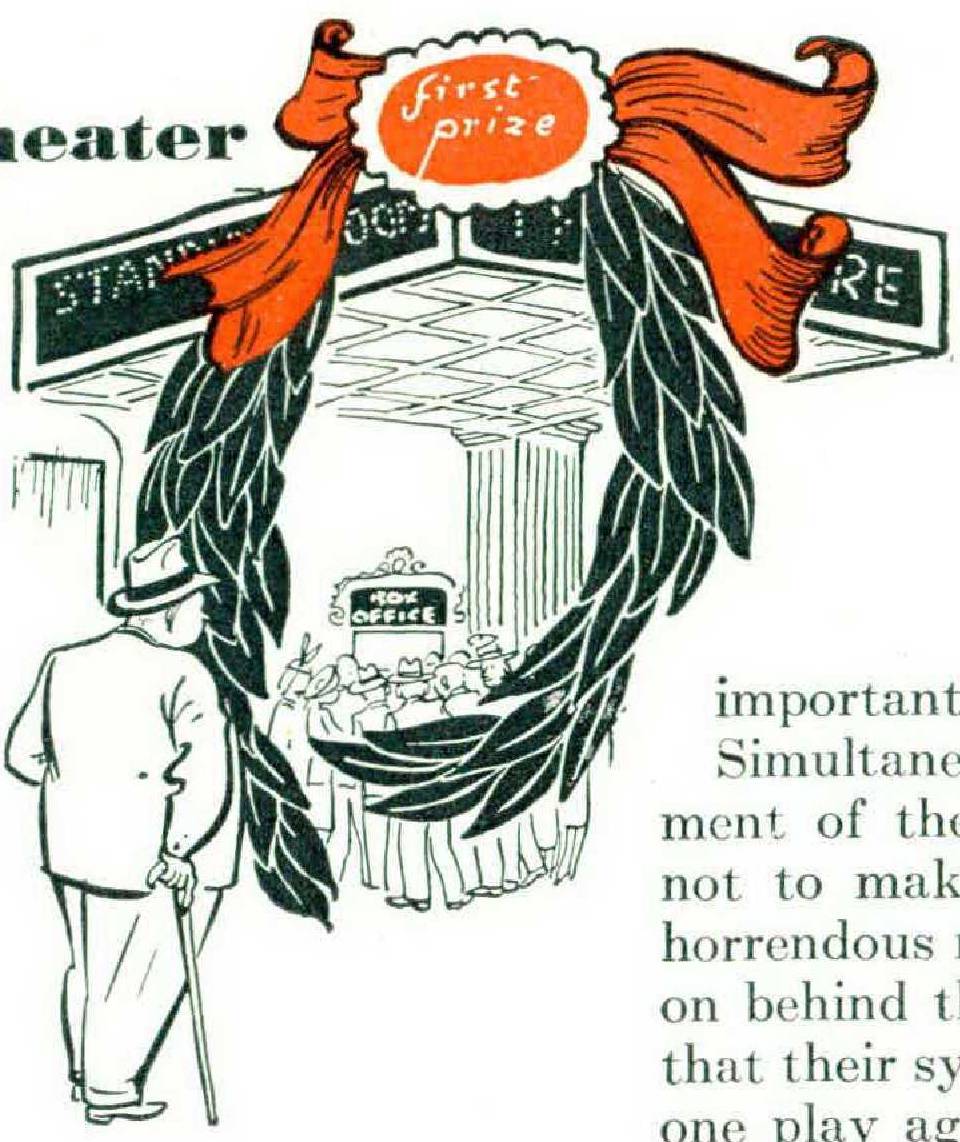
The awarding of a prize or citation by the Pulitzer Prize committee or the Critics’ Circle is, of course, a good thing for the play thus honored; or so we must suppose. To be sure, the play is always a hit of long standing (prize committees shy away from worthy failures) and the seats are selling four months in advance anyway; but presumably there is for the management a certain amount of innocent good fun in the fact that there now are twice as many people futilely queued up in the lobby.
At the risk of making an obvious remark, I’d like to point out that the people in the lobby are not only seeking out this prize-winning play: they are by the same token shunning other plays. The custom of awarding prizes may just possibly be a bad thing for the theater, in that it substitutes one certified good play for half a dozen unofficial good plays.
In imagination I buttonhole these eager playgoers and ask, “Why so anxious to see this particular play?”
“Because it won the Critics’ Prize,” they tell me. Or sometimes, “ Because it won the Pulitzer Prize.”
“But did you ever see a critic?” I ask them. “Do you know who is on the Pulitzer Prize committee? Can you, as a matter of fact, name even one person who has ever been on a Pulitzer Prize committee? ”
They just look at me with their mouths hanging open.
Here is a strange situation. There is an absolute value attached to the verdict of the prize committees. The “best" play of the season flaunts its unqualified superlative unchallenged by anybody in or out of the theater business. To be sure, there may be another “best” play doing business up the street, if the critics and the Pulitzer people happen to have disagreed, but that’s all right; competition is the life of trade. The strange thing is that the open disagreement among the people who award the prizes has done nothing to discredit the prizes. This state of affairs might, without intentional irreverence, be compared to the occasional disparity between the private lives of clergymen and their unquestioned authority on Sunday.
Having done their best to disqualify the Pulitzer Prize clique, the critics are now doing their best to destroy themselves. It is a dull season indeed in which a New York critic does not write a review of a play he hasn’t seen, get himself accused of plagiarism from the work of a brother critic, or show up staggering drunk at an important (to some people) opening. Simultaneously with the announcement of their award, or their decision not to make one, the critics release a horrendous news story about what went on behind those locked doors. It seems that their system of testing the merits of one play against those of another is to ballot themselves into insensibility, like a hung jury or the delegates to a political convention, until some play, any play, gets the necessary majority. Thus it is possible in theory for a play which was not the first choice of even one critic to receive the majority vote and become the best play of the season. For all I know it may have happened.
The Most Delicious Ham Sandwich in the World
Viewed in various theater lobbies during intermissions, the ticket-buying public does not strike the observer as an assembly of intellectual aristocrats. Just home folks, you’d say—pretty well heeled, but no different otherwise from a movie audience. Matter of fact, they are the movie audience— part of it—just as they are part of the reading public and the radio audience. They are the people who read detective stories because they damn well like detective stories; who listen to one or two corny radio programs for the solid satisfaction that is to be gained from corn; who like movies with Myrna Loy and William Powell in them. But, considered purely as playgoers, what feebs and addlepates they are, to be sure!
Theater audiences today are, as a matter fact, hardly worth the powder to blow them up. They have lost all vestiges of self-respect. As an element in the success or failure of a play, the audience is negligible; playgoers bear the same relationship to show business that beeves bear to the wholesale beef business. A Cook’s-touring schoolma’am scuttling through the Louvre is a more potent and dignified figure in the world of art than a playgoer in the New York theater. And all because these same people who choose their own books and movies and radio programs and magazines are for some reason unwilling to choose their own plays.
Whatever else you want to say about them, radio programs and movies and popular publications are produced on the basis of a predictable demand. The dreadful little members of the intellectual underworld in some manner make their wishes felt, and they are obeyed. Occasionally, the creative people working within these fields have been driven by public pressure to improve the quality of their product—the contemporary detective story is a case in point. A Broadway play, however, is simply something that somebody thought he might produce, and some other people thought they might act in, and that somebody else thought he might invest in, and that another man thought he might rent his theater for, and that the critics decided might be praised without loss of face. This much being true of a play, you can always count on an audience; the audience is the least of anybody’s worries. What we have here is a smoothly functioning conditioned reflex; say “hit" or “prize play” and the people line up outside the theater.
The superlative is peculiarly twentieth-century American — the champ, the world’s record, the prize-winner. In this milieu athletics (as several people have doubtless pointed out before now) becomes a matter of twenty-two men playing a game and seventy-five thousand people watching them. This is passive athletics, and it’s silly. Passive aesthetics is just as silly, but try to tell that to this generation of playgoers. I go around buttonholing producers and Shuberts and all suchlike, telling them, “The best play is the play with the best audience,”but all I get in return is some mighty funny looks.
The only possible answer to a committee which announces to you that it has just picked out the best play of the 1945—1946 season is: “And who, during that time, made the best ham sandwich?” In no time at all, you will have your committee spouting arguments against this idea — it’s impossible, it’s too subjective, you can’t even remember exactly how a ham sandwich tasted, two or three weeks afterwards. Then it would strike the committee, in a giant delayed take, that all this applies to plays, too. Audiences have been bullied and badgered until they lost all their self-respect, but they are still the only measurement of a good play. Objective standards don’t exist.
Get in There and Fight
Today’s theatergoers have never been to a bad play. They don’t even know what a bad play is, bless their hearts. To be sure, they have seen plenty of empty plays; they have indeed had a surfeit of inanity. But the bad plays, the technically imperfect plays, are briskly killed at birth by the critics. For some reason or other, we must have technical perfection in the theater or the reviewers are unhappy. And we can’t have the reviewers unhappy, can we?
Some years ago Philip Barry wrote a good play called Here Come the Clowns. Since even the potboilers Mr. Barry writes — Holiday, for instance, or The Philadelphia Story — are very good, his good plays are really something. This one was about the problem of good and evil. Well, the problem of good and evil is something that the human race has been puzzling over for a good many centuries, and the fact is that Mr. Barry’s dramatic discussion of it offered no solution. The critics pointed this out. Good try, they said in effect, but no cigar. The play closed-can’t have a play which poses a problem and doesn’t solve it. Hence the present-day capillary-caliber play, the play which, so gracefully and with such an air of accomplishment, solves the tiniest possible problem.
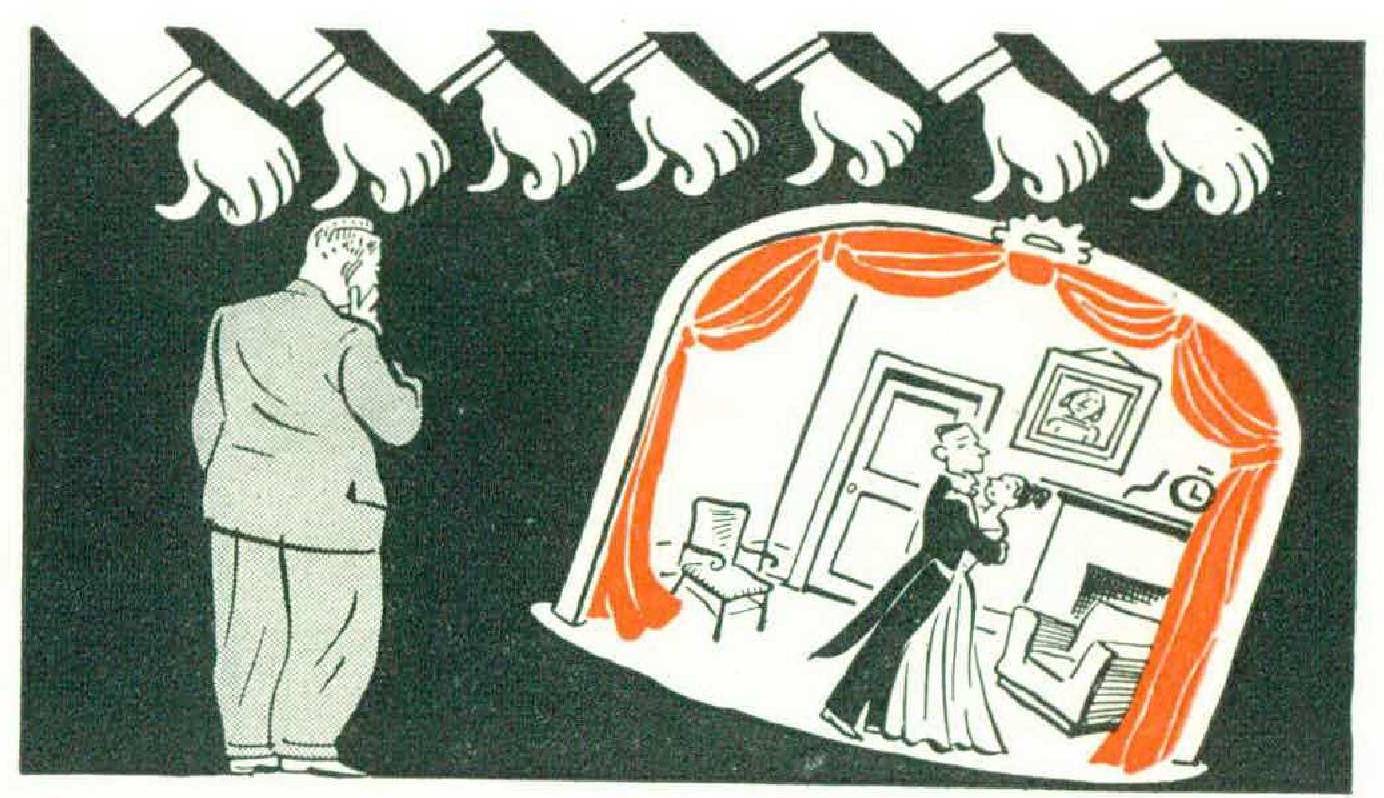
The possibility that a bad play might be in some way as rewarding as a good one has yet to be explored by the theatergoing public. Indeed, the elasticity of the words “good” and “bad” remains a secret known only to a select few. What can we make of the fact that a percentage — a minute, fractional percentage, to be sure, but a percentage — walks out onto the street after seeing Oklahoma! full of simple wonder that all that hooraw has been made over an ordinary song-anddance show? Might not some of these malcontents wander into a non-hit and like it? And if enough of them liked it, might it not become sort of a hit? What thoughts!