Pool
By FRANKLIN P. ADAMS
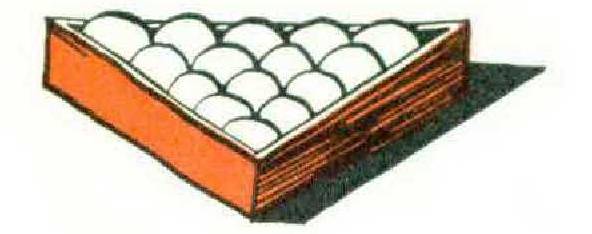
DEFINITION No. 2 in Thorndike’s Dictionary, which has a better definition of poolroom than either Webster’s or Funk & Wagnalls’s, is “A place where people bet on races”; and it should have added, “illegally.”
Definition No. 1 is “A room where pool is played.” And Thorndike’s inclusive and exclusive definition of pool is “A game played on a special table with 6 pockets. The players try to drive the balls into the pockets with long sticks called cues.” There are, as Funk & Wagnalls have it, “15 object balls and cue balls, the object being to get certain balls into the pockets, and to avoid getting the cue ball into a pocket.” The lexicographers don’t play pool, though the definitions are good. The balls are numbered from 1 to 15.
Now, owing to the fact that the vendors of pool tables — notably the Brunswick-Balke-Collender Company — found that “poolroom” got to mean a joint where possibly objectionable fellows bet on races, Section 352 of the Penal Code of New York reads:—
The word “pool” shall be discontinued as a descriptive word referring to a pocket-billiard room or place. Wherever the word “Pool” appears on any window, sign, building, or stationery, used for or in connection with a billiard or pocket-billiard place, it must be changed to read “Billiards” or “Pocket billiards.”
Well, I have seen the good players, or Cue Wizards, play. And I have seen them play long after Section 352 of the Penal Code was in effect. And they have played marvelous pool — Greenleaf, Taberski, Mosconi, Caras—most of them. I’ve seen them make marvelous shots. Shots? Runs. They play what we who play Crazy Pool, Kelly Pool, Bottle Pool, and other variations, call Straight Pool. The break is a safety break, and the object is to put 14 balls, designated by the shooter, into the pockets, and to leave one ball up. Then the 14 are spotted, and the Wizards try to leave that ball in such a position that when hit it will scatter the 14. I have seen Greenleaf, for one, take three deliberate scratches, and then run the 128 necessary to win. Championship games are played for 125 points.
Where I — and my young cronies — play pool, there is only one table, so little Straight Pool is played. Years ago Kelly Pool was played exclusively, but for ten years Crazy Pool has been played all day, and most of the night.
Crazy Pool is popular because there is a lot of luck in it, and the better players are not always the winners— the luck tends to equalize things. Anything goes. We usually play partners — two against two. The break is “open” — that is, you hit the 1-ball as hard as possible, and if any ball goes into any pocket it counts as many points as the number on the ball. The balls have to be hit in rotation, and if the cue ball scratches or the object ball fails to be hit the penalty is the number of the ball you are trying to hit. The game is 150 points, and simple addition of the numbers 1 to 15 totals 120. Nobody plays pocket billiards. We shoot pool.
The life of the club centers about the pool table, as the kibitzing gallery, including a quartet waiting to play, often is large. For there is a vast amount of raillery, repartee, hobbledehoy, and calling upon the Deity, particularly when a scratch is made on a highnumbered ball.
The club has dozens of pool players of various degrees of skill; and there being only one table, nobody is likely to play more than one game consecutively, as there are too many players waiting for the table. Yet, though I average not more than two days a week, my wife — and she is not alone in this — has the idea that I play pool ten or twelve hours a day all week.
Some of the players are gay, and some are so serious that they are nicknamed in honor of one of the non-playing members, Ernest Poole.
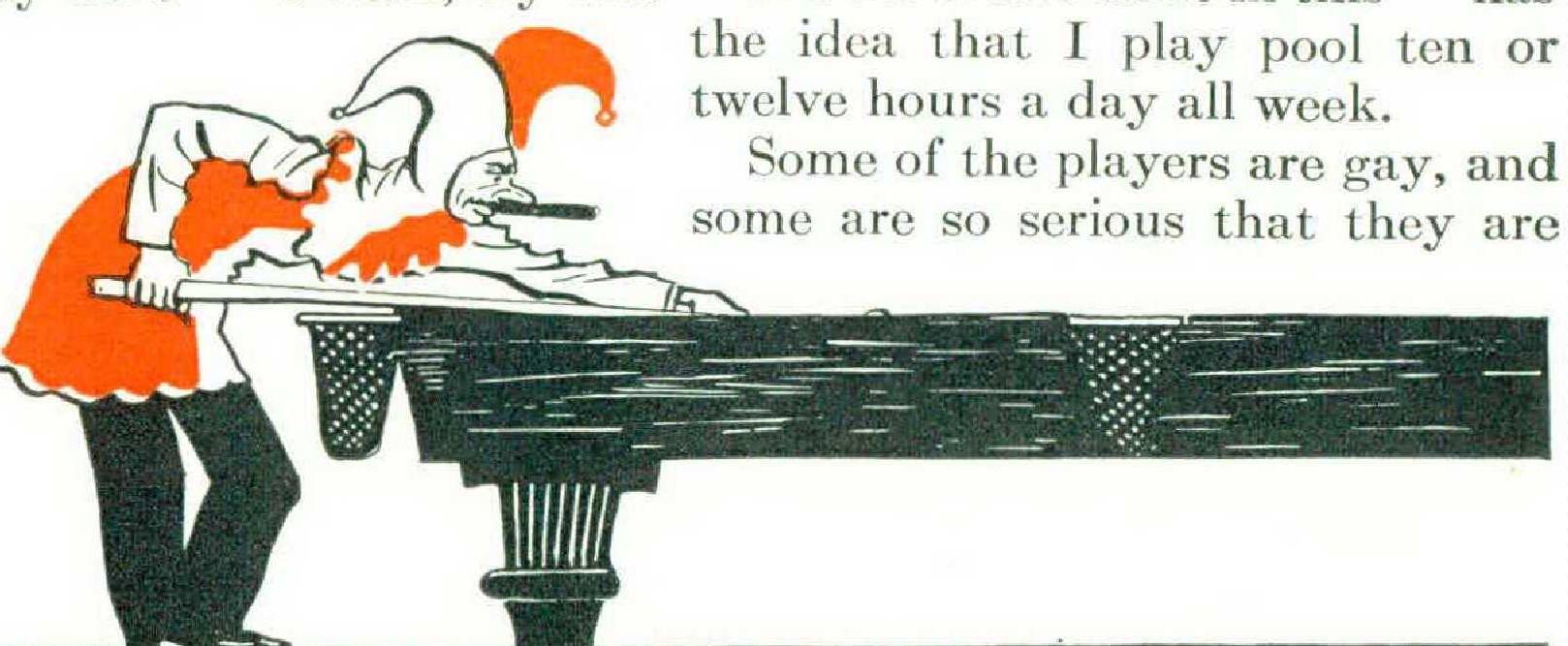
The game of Crazy Pool has given rise to many a daily wheeze. Rollin Kirby, when his opponent makes a succession of good shots, says, “ He was born with a silver cue in his mouth,”or “ He plays like one of the Poolist Fathers.” Also, once when somebody “playing position” failed even to pocket the ball he was shooting at, he said, “Position, heal thyself!”
A miscue is known as member of the Rumanian Embassy. One day, as Rea Irvin was playing phenomenally, I said, “You’re very, very good.” To which he countered, “And be it understood, I command a right good cue.”
Now and then an actor who has played Shakespeare is in the game — James Rennie, Herbert Ranson, to name two. Whereat somebody always says, “See what a shot the envious Casca made.” And sometimes, “Ones are made by you and me, but only Gordon Stevenson can make the three.”A particularly soft shot, ten years ago, was a Shirley Temple. Two excellent players, when pitted against a pair of mediocrities, are known as Frank and Jesse James.
How old the game of pool is I don’t know, but billiards was brought to this country by the Spaniards who settled St. Augustine in 1565. And speaking of billiards, your billiard player has considerable contempt for pool; there is, except for the great pool players, less skill, and less concentration in it.
Easily worst of our pool players is Thomas Chalmers, who was Polonius in Maurice Evans’s Hamlet. He is now known as Poolonius, and the other day when John Cecil Holm was so anxious to play that he forgot to remove his overcoat, it was said that he kept on his “poolo” coat.
When Straight Pool is played, as it is in the club and inter-club matches, there is less noise than there ought to be even at a championship golf match. Most of the time, however, the comment is so noisy that in summer, when the windows are open, there are complaints from the adjoining coeducational club.
There was a time when I chronicled some of the pool matches I played. Often I mentioned that I had been playing with Dr. Richard Hoffmann. His adoring mother said to him one day, “Listen, Richard. It’s all right getting your name in the paper for playing pool. How about getting it in once for winning the Nobel Prize?”
In 1938 I was in the operating room of a hospital. While under the anesthetic, I yelled, as I yell in the pool games when an unusually unlucky scratch is made by me, ”No!” A woman about to have an appendectomy rose, put on her clothes, and went home. She said that she refused to stay in a hospital where inordinate cruelty was practiced.
And one touch of sentiment: Over the portrait of Mark Twain hangs the cue that he played with. . . . And any little male reader in the vicinity of Gramercy Park that wants to watch is welcome. The Collector of Internal Revenue tells me that is chargeable to Entertainment.