This Month

We note in real-estate advertising an increasing reference to the “rumpus room.” It’s a new essential in the American household. Paneled in pine, floored with a spirited linoleum, the rumpus room is supposed to be a gathering place for all sorts of family high life: the twins playing ping-pong; older daughter flailing the piano for an admiring cluster of young men; Junior hammering out a ship model at his workbench; Dad showing off his rifles and fly-books to several genial cronies or busy at his built-in bar; Mother with a few friends in for bridge; the old folks in great big chairs by the fire, reading like mad.
We have not yet encountered this scene in real life. Some of the rumpus rooms of our experience have been painfully neat and unused, like the front parlor of a farmhouse. The others have served more as storage places, a handy spot for hibernating summer garden furniture, old magazines, and disused toys. In both cases they convey to the visitor only the impression of a dream that never paid off. The father would rather issue his drinks in the library. The children have gone to the movies.
A sound family comprehension of cue games would convert a rumpus room to a genuine utility. It would also do away with the term “rumpus room.” The place would become the billiard room or the pool room. We leave it to Franklin P. Adams, on the following page, to argue for pool. Our own preference is for billiards. But either game, we believe, holds large and perhaps unsuspected values for any household with a sizable room to spare and the price of a first-rate table and equipment.
F.P.A. is quite right in talking up the conversational merit of pool. We note his omission, however, of the classic Kelly pool line, heard from the principal whenever a money ball is sunk. It comes jubilantly from the shooter who has just sunk his own money ball, ruefully from a participant whose money ball has just been pocketed by the shooter. The line, which was likewise omitted by Jacques Barzun in “Mencken’s America Speaking” (January Atlantic), is: “That’s me.”
Our illustrator, Carl Rose, turns to writing in this issue of the Atlantic. Random House is bringing out this fall a book of his drawings for which he has written his own text. The book will be called One Dozen Roses, and our excerpt is one of the twelfths into which Mr. Rose divides himself.
Ray Josephs has been giving us a few pointers from South America which seem worth attention in some of our own cities. For those who find taxis too scarce or too expensive, he recommends the “micro-bus” of Buenos Aires (page 137). Our transit authorities can probably think up countless reasons why the micro-bus would not work in New York or Chicago, but it sounds like a good scheme here in Boston, especially if a $5000 life insurance policy were issued with each cut-rate micro-bus ticket. Next month Mr. Josephs will report on the fabulous subway system of Buenos Aires, whose trains appear to need only a rumpus room in each car to round out the pleasure of underground travel in B.A. These hints of urban development in Latin America make us wonder whether the Lexington Avenue line is really the last word in transportation or whether it isn’t just about the same last word that it was twenty years ago.
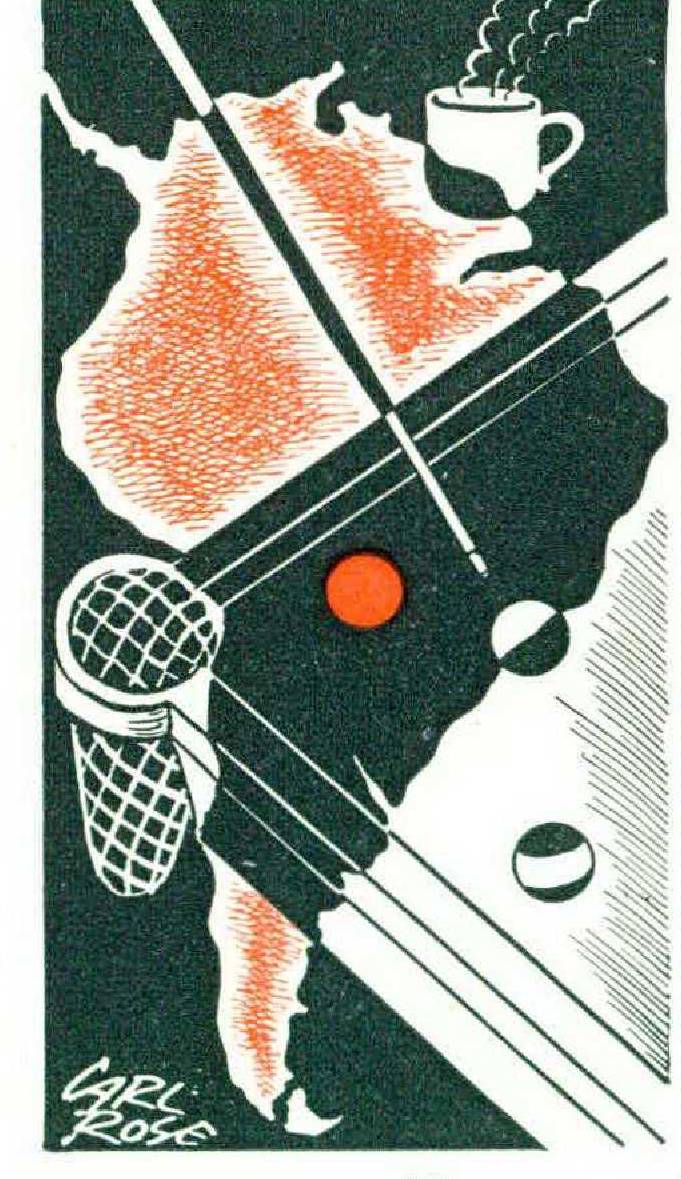
Are we quite the nimble masters of Change, and is the rest of the world still gaping at our innovations?
A Middle Western businessman dropped in at the Atlantic recently with another odd bulletin after a trip to Brazil. A little experiment is afoot down there, he said, which would turn the world coffee industry inside out and upside down. The coffee would be roasted on the plantation or at the dockside and be made immediately into an essence of coffee of maximum strength, which would then be quick-frozen. The export product would be cubes of the frozen essence. The ultimate consumer would simply add boiling water.
We realize that “prepared” coffee is to the coffee enthusiast as “processed” cheese is to Crosby Gaige, but our informant believes that the quick-freeze treatment may be the answer. A coffee bean is full of crotchets but, after all, so is a ripe raspberry.
C. W. M.