Conversation Piece
THEATER
ByRUSSELL MALONEY
Tickets
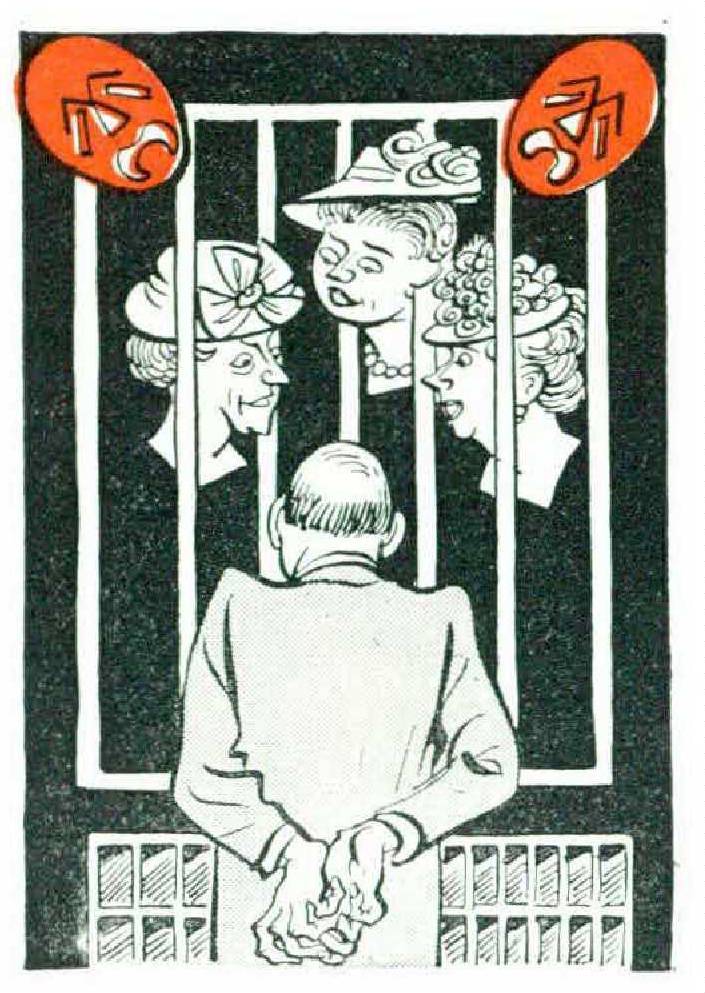
A theater box office. Three ladies approach. The box-office man, or treasurer, shudders. He turns his back and, purely to gain time, shuffles next week’s tickets and sorts them out again. He clutches his coat somewhere in the region of his ulcer, then turns and speaks: —
“Yes, ladies?”
“How much are the tickets?”
“What kind of tickets, Madam?”
“Tickets for a week from Wednesday.”
“Where do you want to sit, Madam — orchestra or balcony?”
“Well, how much are they?”
“Orchestra seats are four-eighty. Balcony seats are —”
“Ooh, Gloria, he says four-eighty!”
“Agnes, Josephine says they’re four-eighty.”
“Well, ask the man if they’ve got anything cheaper.”
“Josephine, Agnes says ask the man if he’s got anything cheaper.”
“Have you got anything cheaper?”
“First balcony— three-sixty. When do you want them, matinee or evening?”
“ Matinee.”
“Here you are. Madam — three in the tenth row of the balcony for the matinee, a week from Wednesday. That’ll be ten-eighty.”
“But we want five seats. Grace and Marion are coming, too.”
“I haven’t got five together. I can give you these three, and another pair in the twelfth row on the side.”
“Go ahead and take them, Josephine. I and Gloria will sit on the side.”
“That’s no fair, Agnes. I’ll sit with Gloria on the side.”
“Why don’t we try and get five together? — Haven’t you got five together? ”
“Not for that performance.”
“Ask him what about the orchestra, Josephine.”
“What about the orchestra?”
“I can give you four in the fourteenth row, and one directly behind, in the fifteenth row.”
“Well, how far back is that?”
“Fourteen rows, Madam.”
“How much are those seats?”
“Twenty-four dollars for the five, Madam.”
“ Goodness!”
“Ask him if he has five together some other time, Josephine.”
“Have you got five together some other time an evening?”
“When do you want them?”
“Well, when have you got them?”
“Three weeks from next Monday — four weeks from next Thursday — three weeks from this Friday — ”
“How does that sound, girls?”
“Let’s make it three weeks from Friday, shall we?”
“All righty, three weeks from Friday — but wait a minute, that comes on a Friday! And I can’t get away because the bridge club breaks up so late that I could never get Fred’s dinner and get away on time —”
“Grace said anything but Monday.”
“Marion said anything but Thursday.”
“Goodness, I forgot all about Grace and Marion! Somebody call them up right away— I’ll keep our place in line. And Agnes - oh-hoo, Agnes!”
“ Yes?”
“Ask them if they’re really sure they want to see this show. Maybe we could do better somewhere else.”
Friends
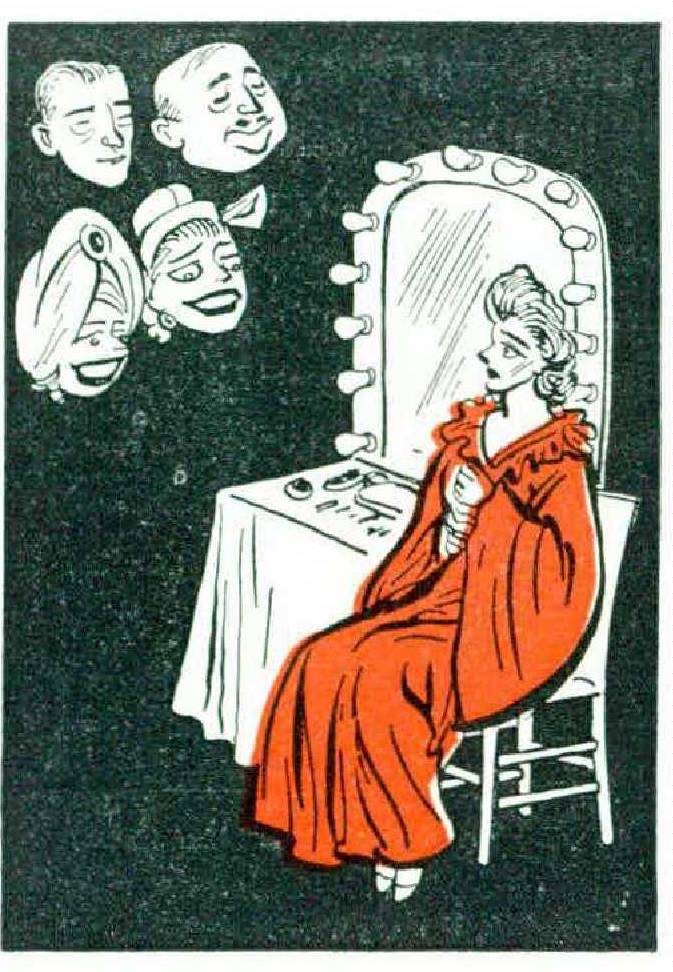
A leading lady’s dressing room. The leading lady, wearing a kimono and full stage make-up, has just seated herself before her mirror to clean her face. There is a knock at the door. The leading lady looks round, sees that her maid is absent, and speaks: —
“Who is it?”
“ Clarissa? ”
“Yes, who is it?”
“May we come in, Clarissa?”
“Who is it?”
A party of four, two men and two women, files in. During the ensuing scene neither of the men speaks, though they both occasionally clear their throats in a rather sociable way.
“Dear Clarissa, we really shouldn’t be here—”
“Oh, that’s quite all—”
“We should be over at the Astor for cocktails this minute, but —Oh, I’m sorry! Clarissa, this is Mr. and Mrs. Mumble, and this is my own John.”
“ How do you do?”
“I’m not sure I ought to trust John here, with a real, live actress, Ah-haha-ha-ha!”
“ Ah-ha-ha-ha-ha-ha! ”
“Well! . . .”
“Well! . . .”
“Go right ahead and finish your face, Clarissa.”
“Oh, no.”
“Barbara Mumble owes me a quarter, Clarissa. She bet me I didn’t know you. So you can just hand over that quarter, Barbara.”
“We never bet — not really. I just said —”
“Well, if we had bet, you’d owe me a quarter.”
“Well, we didn’t. Ah-ha-ha-ha.”
“Ah-ha-ha-ha.”
“I think I will take my face off, if you really don’t mind.”
“Oh, no.”
“Look, Barbara, this is that negligee she wears when her father-in-law comes in and finds her writing the letter.”
“It isn’t her father-in-law, it’s her uncle.”
“Not that finds her writing the letter.”
“Yes it is too, because he says—”
“Clarissa, it is your father-in-law. isn’t it?”
“What?”
“It is vour father-in-law that finds you writing the letter, isn’t it? When you’re wearing this negligee?” “ Yes.”
“See? That’s another quarter you owe me.”
“ We didn’t bet.”
“Well, if we had bet you would.”
“But we didn’t.”
“ Ah-ha-ha-ha-ha,”
“ Ah-ha-ha-ha-ha.”
“ Clarissa? ”
“ Yes? ”
“Barbara and the boys just loved the show. They really did.”
“Well, thank you very—”
“Who’s going to do your part when they make it into a movie?”
“I don’t think they’ve decided yet.”
“Then it isn’t Claudette Colbert?”
“Not that I know of.”
“There, Barbara, that’s another quarter you owe me.”
“But we didn’t bet — not really.”
“But if we had—”
Critic
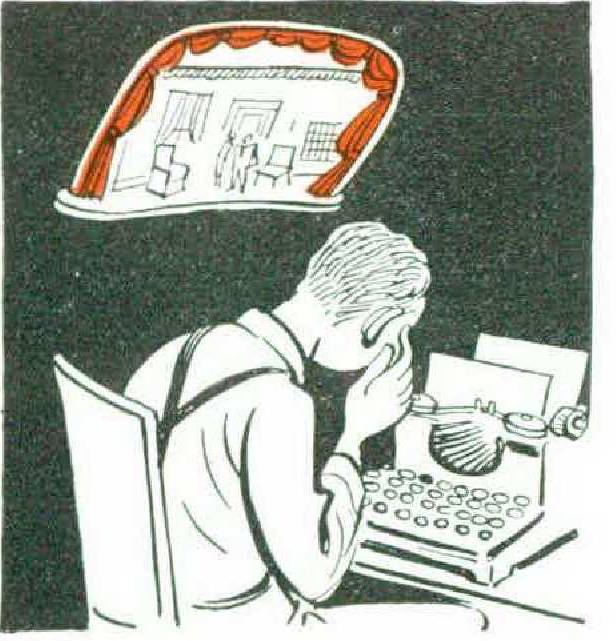
SCENE: The study of a drama critic, one of the weekly or monthly kind, who has a chance to see what the newspaper reviewers say about a play and then, in his review, rises superior to it. He is writing and communing with himself simultaneously, like an O’Neill character.
Grady’s Dilemma, in spite of anything I may say about it, will probably run forever at the Foon Theater. (Nice going, pal. You already got ’em looking over their shoulders. It’s going to run forever, but you’re too smart to like it.) Bert Fooster will no doubt be surprised to find that he has a hit on his hands (that will show Fooster what I think of him) but it was inevitable, I guess, plays about young love being practically foolproof (neat little thrust, if Fooster is smart enough to get it). However, in a season which has to date offered nothing but Rims, Fifteen Love, and the Rodgers and Hammerstein musical version of Faust, it may, perhaps, look better than it really is, which would not, after all, be saying a great deal. (It runs, it doesn’t run, or it stands on edge — I’m covered.) The author, a man apparently called William Johnson (that’ll have the son of a gun wondering whether or not he’s alive at all), has composed some remarkably silly dialogue, some of which is redeemed by the unstudied and sincere playing of Robert Fishwick. (None of the other critics noticed him — and for all I know, he is as unstudied and sincere as any other actor; anyway, it shows I keep my eyes open.) The less said about the performance of Elvira Touhy the better (and that will show her— Hm-m . . . seven hundred words to go . . .).
The story opens with the arrival in a little Southern mill town of a . . .